Dr. Gymbro
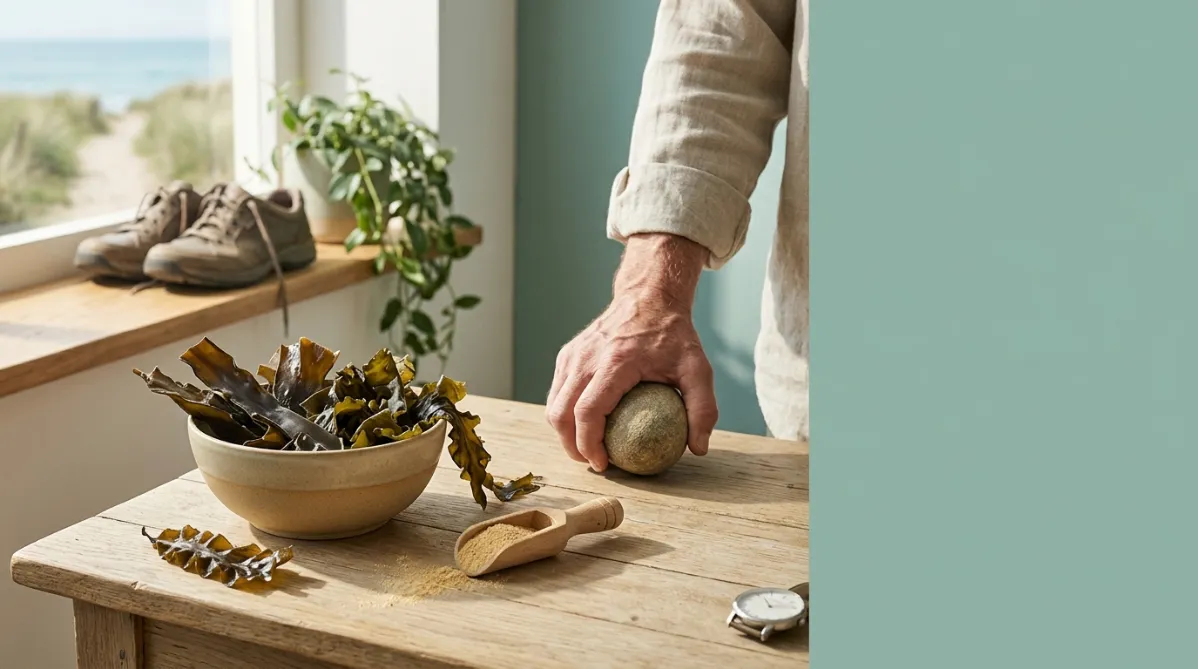
A wide, softly lit editorial photograph of a rustic light-oak table by a sunny window. On it, a handful of dried brown kelp and wakame seaweed fronds spill from a handmade matte ceramic bowl in warm sand tones, their glossy, ruffled edges catching the light. Beside the bowl sits a small wooden scoop holding fine golden-beige powder, with a little of it dusted across the table. In the middle ground, an older adult's weathered but strong hand grips a smooth, rounded river stone, with the knuckles and tendons subtly emphasized to suggest strength and vitality. Only the hand and part of a forearm in a soft oatmeal linen sleeve are visible.

In the background, slightly out of focus, a pair of worn leather walking shoes rests on a windowsill next to a trailing green plant. Beyond the window, a blurred coastal path winds through dune grass toward a pale blue sea, hinting at walking and an active daily life. A simple analog wristwatch lies on the table's edge, a quiet nod to the twelve-week timeline.

The palette is muted and natural: sage green, warm sand, soft ocean teal, and creamy off-white, with deep olive-brown accents from the seaweed. Morning light streams in from the left, casting long, gentle shadows and a faint golden glow. The depth of field is shallow, with crisp focus on the hand and seaweed and a creamy bokeh background. The composition follows the rule of thirds, with the hand and bowl on the left and generous negative space on the right for headline text. The mood is calm and hopeful, with a clean, contemporary wellness-magazine feel. The image is shot as if on a 50mm lens with subtle film grain and a natural, uncluttered, tactile look.
Science & Research

Il fucoidano estratto dalle alghe potenzia la forza di presa negli over 60 in 12 settimane

Dr. Gymbro · · 5 min read

Il problema: la forza svanisce più rapidamente di quanto ci si aspetti

La sarcopenia, cioè la perdita di massa e funzionalità muscolare legata all’età, è uno dei problemi di salute pubblica più silenziosi delle società che invecchiano. Raramente fa rumore. Aprire un barattolo diventa più difficile, le scale sembrano più ripide e una camminata un tempo facile si trasforma in una fatica. L’allenamento di resistenza resta lo standard d’oro per rallentarla, ma non tutti possono sollevare carichi pesanti o farlo frequentemente. Fragilità, dolori articolari, malattie croniche e, semplicemente, la mancanza di opportunità ostacolano molti. Questo vuoto spinge i ricercatori a cercare integratori utili a chi non può allenarsi molto.

Un nuovo studio randomizzato pubblicato su Archives of Gerontology and Geriatrics ha testato un candidato: un fucoidano di bassa massa molecolare estratto da alghe brune. I risultati sono stati incoraggianti per forza e funzionalità, meno così per la dimensione muscolare.

Che cos’è l’oligo‑fucoidano?

Il fucoidano è un polisaccaride solfato presente nelle alghe brune, noto per numerose attività biologiche, tra cui possibili effetti di supporto alla funzione muscolare. Il prodotto testato è una forma «oligo», cioè frammenti più piccoli di circa 15 kDa. L’ipotesi è che molecole più piccole siano più facilmente assorbite. Lo studio ha impiegato un prodotto di marca chiamato OliFuco; pertanto i risultati si riferiscono a quella specifica formulazione e non a tutti gli integratori a base di alghe o fucoidano.

Come è stato condotto lo studio

Lo studio, doppio cieco, controllato con placebo e della durata di 12 settimane, ha randomizzato 60 adulti che vivono in comunità, di età pari o superiore a 60 anni, in tre gruppi:

  • Oligo‑fucoidano da solo
  • Oligo‑fucoidano più amminoacidi a catena ramificata (BCAA) e vitamina D
  • Placebo

La dose di fucoidano era di 825 mg due volte al giorno (totale 1 650 mg/giorno). I ricercatori hanno misurato la forza di presa, la circonferenza del polpaccio, l’indice di massa magra appendicolare (misura DXA della massa muscolare degli arti), il test dei cinque alzarsi‑sedersi, il test di camminata di sei minuti (6MWT) e la forza di estensione del ginocchio isocinetica. Un'analisi secondaria riportata da Ergo‑Log ha indicato che 46 partecipanti sono stati inclusi nell’analisi finale. L’abstract non descrive alcun programma di esercizio; dunque i risultati devono essere interpretati come effetti dell’integratore nella vita quotidiana degli anziani, non come conseguenza di un nuovo regime di allenamento.

Il risultato principale: la forza di presa

La forza di presa è migliorata in modo significativo con l’oligo‑fucoidano (p < 0.001, d‑effetto r = 0.82). Nel gruppo fucoidano, il 64,7 % dei partecipanti ha superato la soglia di differenza clinicamente minima, ovvero un cambiamento sufficientemente grande da avere un impatto nella vita di tutti i giorni. La relazione di Ergo‑Log stima un guadagno di circa 18‑23 %, sebbene questo dato provenga da una fonte secondaria e non dall’abstract.

La forza di presa non è solo un trucco da festa: è ampiamente usata come indicatore rapido della funzionalità muscolare globale negli anziani e costituisce una componente standard nello screening della sarcopenia. Un miglioramento clinicamente significativo in sole 12 settimane è quindi degno di nota.

Anche la performance di camminata è migliorata. La distanza percorsa nel 6MWT è aumentata in modo significativo (p < 0.001) e il 47,1 % dei partecipanti ha superato la soglia di variazione minima rilevabile. Un’analisi multivariata (MANOVA) su sei esiti ha mostrato differenze di gruppo significative, guidate principalmente dal miglioramento della presa nel gruppo fucoidano rispetto al placebo.

Le sorprese: nessun aumento della massa muscolare e nessun bonus da BCAA + vitamina D

Due risultati complicano il quadro.

  1. Massa muscolare invariata. Il beneficio si è manifestato in termini di forza e performance, non di tessuto magro. Questo potrebbe indicare che il fucoidano agisce sulla qualità muscolare, sulla funzione neuromuscolare o su altri meccanismi, ma lo studio non è in grado di dirlo. L’unico segnale legato alla massa è stato nel gruppo placebo, il cui polpaccio è diminuito (p = 0.012), mentre il gruppo fucoidano non ha mostrato alcun calo.
  2. Nessun vantaggio aggiuntivo da BCAA e vitamina D. Molti “stack” di integratori presumono che più ingredienti significhino risultati migliori, ma questo trial non supporta tale ipotesi. Secondo il riepilogo disponibile, il braccio combinato non ha offerto alcun vantaggio chiaro rispetto al solo fucoidano.

Nessun evento avverso è stato segnalato durante le 12 settimane.

Avvertenze importanti

  • Lo studio è piccolo: 60 partecipanti randomizzati in tre bracci.
  • È durato solo 12 settimane, perciò non sappiamo se i guadagni persistano, si stabilizzino o svaniscano.
  • L’intervento ha riguardato un unico prodotto di marca, a bassa massa molecolare e a una sola dose; non possiamo assumere che altri integratori di fucoidano diano gli stessi risultati.
  • Gli autori stessi chiedono ulteriori ricerche sugli effetti a lungo termine e sull’ottimizzazione della formulazione. Studi piccoli con effetti grandi meritano replica prima di essere considerati definitivi.

Conclusioni pratiche

  • Chi potrebbe trarne beneficio: gli adulti più anziani, soprattutto quelli con capacità limitata di svolgere allenamenti di resistenza intensi.
  • Dose studiata: 825 mg due volte al giorno (1 650 mg/giorno) di oligo‑fucoidano a bassa massa molecolare per 12 settimane.
  • Non aspettatevi muscoli più grandi: i miglioramenti misurabili sono stati in forza e performance di camminata, non in massa muscolare.
  • Per ora evitate gli extra: BCAA più vitamina D non hanno migliorato i risultati rispetto al fucoidano da solo in questo studio.
  • L’allenamento resta il re: gli autori confermano che l’allenamento di resistenza è lo standard d’oro. Se potete sollevare, continuate a farlo. Il fucoidano, se confermato, può essere un ausilio o un’alternativa, non un sostituto.
  • Consultate un professionista: chi ha condizioni di salute o assume farmaci dovrebbe parlare con un medico prima di introdurre un nuovo integratore.

In sintesi

Questo studio suggerisce che uno specifico fucoidano derivato dalle alghe può migliorare la forza di presa e la performance di camminata negli adulti anziani in tre mesi, senza segnalare eventi avversi. È una pista promettente e non farmacologica per chi ha difficoltà a fare allenamento, ma rimane preliminare, limitata a un prodotto specifico e priva di effetti sulla massa muscolare. Trattatelo come una pista da seguire, non come un sostituto del bilanciere, della banda elastica o delle scale.

Fonte: Chang et al. "The effects of Oligo‑Fucoidan on muscle function in community‑dwelling older adults: A double‑blind, randomized, placebo‑controlled trial." Archives of Gerontology and Geriatrics (2026). DOI: 10.1016/j.archger.2025.106055. PubMed: 41124892.
Original study

Read the original research on pubmed.ncbi.nlm.nih.gov →

This article summarizes published research for general information. It is not medical advice.

DG

Written by

Dr. Gymbro

Dr. Gymbro writes for Dr. Gymbro: science-backed fitness, nutrition & performance.

Related Articles

A landscape editorial photograph of a sunlit kitchen table in soft morning light. An older adult's hands, with silver hair and a cream knit sleeve just visible, rest around a ceramic mug. Beside the mug are two small matte white ceramic dishes. One holds a mound of fine white powder, and the other holds a slightly different crystalline white powder. Two wooden spoons lie next to them. A handheld hand-grip dynamometer in muted sage green sits on a linen placemat in the foreground, slightly out of focus. A small open notebook with a pencil and a pair of round tortoiseshell reading glasses sit nearby, with no legible text.

The tabletop is pale oak with a visible grain. Behind it, a window with sheer curtains lets in warm golden light, and the blurred shapes of a trailing green pothos plant and a pale terracotta vase show in the background. The color palette is warm cream, sage green, soft terracotta, and pale wood, with a touch of muted navy from a folded napkin. The mood is calm, thoughtful, and quietly scientific without any laboratory feel.

The composition follows the rule of thirds. The hands and dishes sit in the left-center, and generous negative space on the right is suitable for a title overlay. Shallow depth of field, 50mm lens look, gentle film grain, and soft shadows. Modern lifestyle-magazine and health-journal aesthetic, natural and unstaged, high-end editorial photography.
nutrition

Il precursore della creatina supera la creatina nella forza di presa nei soggetti over 65

BY DR. GYMBRO ·

Un piccolo studio su adulti over 65 ha scoperto che l’acido guanidinoacetico (GAA), precursore diretto della creatina, ha migliorato la presa più della creatina monoidrato. Si tratta però di un trial pilota di otto settimane con soli 21 partecipanti completi, senza programma di esercizio, e con un intervallo di confidenza che a malapena supera lo zero. Il GAA ha inoltre mostrato una soppressione più marcata della miostatina e dei miglioramenti misurati con BIA negli indici legati al muscolo, sebbene possibili riflessi di idratazione. L’omocisteina è il parametro di sicurezza da tenere d’occhio, poiché il GAA consuma gruppi metilici e l’ha aumentata in altri studi. Ecco cosa è emerso dallo studio, cosa non possiamo ancora affermare e perché la creatina monoidrato resta la scelta provata di default.

A bright, airy editorial still life photographed from slightly above on a pale oat-colored linen surface, in soft natural window light with gentle long shadows. In the foreground, a rustic ceramic bowl holds halved and whole oranges, glossy red bell pepper slices, and a few kiwi halves with emerald flesh. Beside it sit loose strawberries and a small pile of bright yellow lemon wedges. Their colors pop against the muted neutral palette. A single clear glass of water with a slice of orange rests nearby, catching the light.

On the right side of the frame, a pair of well-worn but clean walking sneakers in sage green and cream sits casually on the surface, with one lace loosely trailing. Behind them, a simple wooden chair with a light ash finish is partly visible and slightly out of focus, a quiet nod to the sit-to-stand test. A small stainless-steel stopwatch lies next to the shoes, with a subtle reflective glint.

A minimalist ceramic dish holds a few small, round, pale-yellow vitamin capsules, kept understated. A sprig of green leaves and a folded cotton napkin in soft terracotta add a warm accent. A small open notebook with a pencil rests in the upper left, its page blank except for faint, abstract pencil lines suggesting a simple rising graph, with no legible text.

The composition leaves generous negative space on the left third for title overlay, with a soft cream-to-peach gradient background. The mood is fresh, healthy, and contemplative, like a modern wellness magazine or a trendy online journal. The color palette is warm citrus orange, sunny yellow, sage green, and soft cream, with gentle terracotta accents. The depth of field is shallow, with crisp focus on the fruit and shoes and a creamy blur in the background. The overall look is clean, natural, and editorial, with fine film-like grain, true-to-life color, and a calm, optimistic tone. Landscape 16:9 framing.
nutrition

La vitamina a buon mercato per gambe più forti con l’avanzare dell’età

BY DR. GYMBRO ·

Uno studio britannico su più di 5 000 adulti tra i 48 e i 92 anni ha scoperto che chi ha un livello di vitamina C nel sangue ottimale (≥ 50 µmol/L) cammina più velocemente e si alza da una sedia più rapidamente rispetto a chi ha valori più bassi. Nelle donne la stretta di mano è risultata più forte, anche dopo aver corretto per l’altezza; negli uomini non è emersa alcuna correlazione. L’assunzione di vitamina C attraverso la dieta è stata associata ai benefici solo nelle donne e senza un chiaro andamento. Lo studio è trasversale, perciò non dimostra causalità, ma i dati suggeriscono di tenere sotto controllo il proprio livello ematico.

A warm, softly lit modern home gym or sunlit studio, photographed in a clean editorial style. In the center-right of the frame, a silver-haired woman in her mid-60s with a calm, confident expression grips a matte black kettlebell at hip height. She wears a fitted sage-green athletic top and charcoal leggings. Her forearms and shoulders show lean, defined strength rather than bulk. Beside her, slightly out of focus, a man in his late 60s with short white hair and a trim beard performs a controlled bodyweight plank on a pale oak floor.

In the foreground on the left, a minimalist wooden tray holds two small ceramic bowls. One contains fine white powder and the other holds a few cream-colored capsules. Next to them sit a glass of water with a lemon slice and a folded linen towel. A subtle scatter of powder dusts the tray. The foreground is shot with shallow depth of field and a creamy bokeh falloff.

Behind them, tall windows pour in golden morning light, with long soft shadows across the floor. A potted fiddle-leaf fig and a stacked set of pastel-toned dumbbells on a low wooden shelf add texture. The wall is warm off-white plaster with a hint of terracotta in the corner.

The palette is muted and modern: sage green, warm cream, soft terracotta, natural oak, and charcoal, with gentle highlights. The mood is quietly optimistic, focused, and grounded, suggesting strength, vitality, and measured scientific curiosity. The composition leaves clean negative space in the upper-left for a headline overlay. The look is a high-end wellness magazine cover with natural film-like grain, soft contrast, and crisp detail on the hands and kettlebell. There is no text, no logos, and no futuristic elements, only authentic, aspirational realism.
nutrition

Creatina + HMB rendono più forti gli over‑60 in 6 settimane, ma non più grandi

BY DR. GYMBRO ·

Un protocollo di sei settimane con creatina e HMB ha aumentato significativamente la forza di gambe, braccia, schiena e core in adulti attivi sopra i 60 anni, mentre la massa muscolare è rimasta quasi invariata. Lo studio, randomizzato, in doppio cieco e crossover su 30 soggetti, suggerisce che i guadagni di forza siano dovuti principalmente a meccanismi neuromuscolari, non a un accrescimento della massa. Attenzione però ai limiti: durata breve, campione ristretto e valutazione della composizione corporea tramite BIA.

A softly lit editorial still life on a pale oatmeal-colored linen surface, shot from a slightly elevated three-quarter angle with a shallow depth of field. In the left foreground, a small ceramic dish holds several translucent golden-amber fish oil softgel capsules, glowing as if lit from within by warm morning window light. A few capsules are scattered casually beside it, catching crisp highlights. Just behind them, a sliced fresh salmon fillet with vivid coral-orange flesh rests on a matte slate board next to a sprig of dill, a halved lemon, and a small glass dropper bottle of golden oil.

In the soft-focus midground, a pair of weathered, capable older adult hands rests on the edge of the table, gently holding a pale sage-green resistance band, a hint of an active lifestyle. Beside them sits a modest set of brushed-steel dumbbells and a folded heather-gray towel. Subtle natural details add warmth: a glass of water, a small ceramic mug, and a sprig of eucalyptus in a bud vase.

On the right side, a tidy stack of printed research papers with a few pastel sticky tabs and a pair of thin tortoiseshell reading glasses sits on top, suggesting scholarly review. A fountain pen lies across the pages, with a few abstract handwritten notes and a simple hand-drawn bar chart visible but unreadable.

The palette is warm and calming: cream, soft sage, terracotta, honey gold, and coral accents against muted neutral tones. Window light enters from the left, producing long gentle shadows and a faint dappled leaf-shadow pattern across the linen. The background fades into a creamy blur of pale wall and a hint of a wooden shelf.

The composition leaves clean negative space across the upper right third for headline text overlay. The mood is trustworthy, health-forward, and modern, reminiscent of a contemporary wellness and science journal's photography. Fine film-like grain, natural color grading, high-resolution editorial photography, 16:9 landscape format.
nutrition

Olio di pesce per i muscoli invecchiati: cosa mostrano davvero 14 studi

BY DR. GYMBRO ·

L’olio di pesce viene presentato come una sorta di corazza per i muscoli invecchiati, ma cosa dicono davvero i dati? Una revisione “umbrella” del 2026 ha raggruppato sette studi clinici randomizzati e sette meta‑analisi su adulti di 55 anni e più. Sono emersi guadagni di forza modestamente misurabili, soprattutto per gli arti inferiori. La presa, la velocità di camminata e la forza della parte superiore risultano molto meno certi, e la notevole sovrapposizione tra gli studi rende le evidenze più fragili di quanto sembrino. Ecco cosa significa, a chi potrebbe servire e chi dovrebbe prima consultare il medico.

This page is available in