Dr. Gymbro
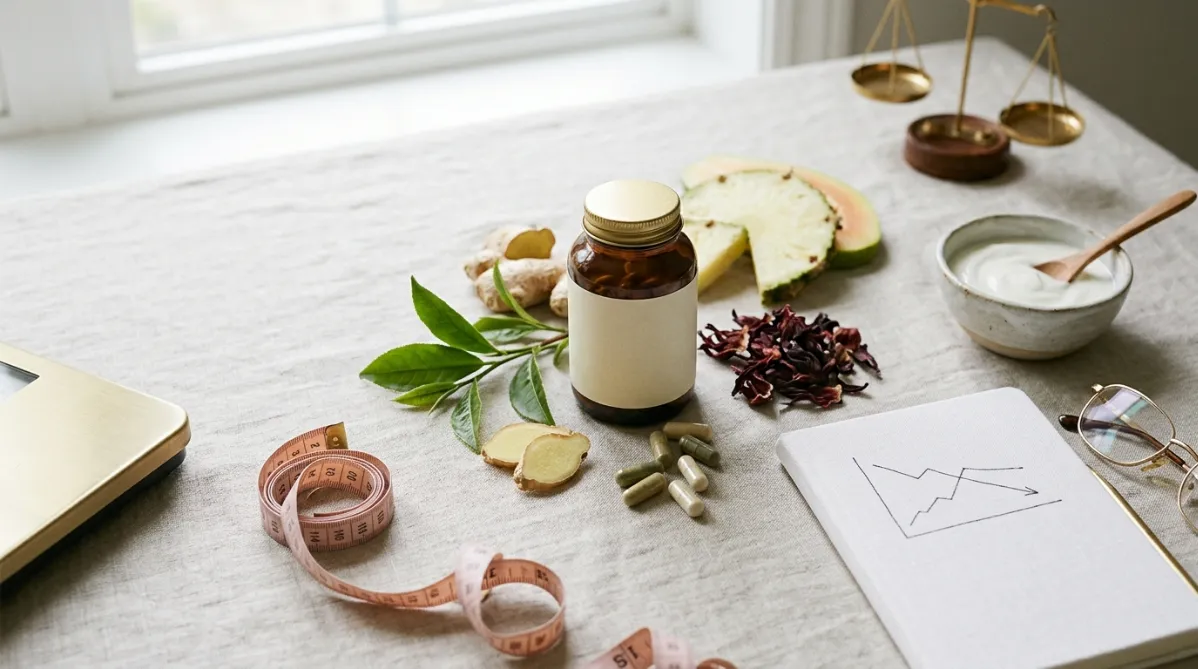
A clean, modern editorial flat-lay on a pale oat-colored linen surface, shot from slightly above in soft diffused natural window light. At the center sits an amber glass supplement bottle with a minimalist cream label, unbranded, with a few capsules spilling onto the fabric in soft greens and ivory tones. Around it are fresh botanical elements: a sprig of green tea leaves, sliced ginger root, a small bundle of dried hibiscus petals, and a few pale green pineapple and papaya slices hinting at digestive enzymes. A small ceramic bowl of creamy plain yogurt with a wooden spoon suggests probiotics. To the left, a flexible tailor's measuring tape in soft blush pink loosely curls across the linen, with a slim brushed-brass scale partly visible at the frame edge. On the right, a minimalist white notebook lies open with a hand-drawn simple line chart showing two diverging lines, one trending downward and one flat, with no readable text. A pair of reading glasses with thin gold frames rests beside it, and a tiny pair of balanced brass scales sits in the background, subtly suggesting weighing evidence and caution.

The palette is muted sage green, warm cream, soft terracotta, and touches of blush and brass. Shadows are gentle and long, the depth of field is shallow with a creamy blurred background, and the negative space on the left third of the frame leaves room for a headline overlay. The overall feel is a contemporary health and science journal, calm, trustworthy, and slightly skeptical, in the style of a premium wellness magazine photographed with a 50mm lens, with crisp texture on linen, glass, and botanicals.
Nutrition

Il blend probiotico‑enzimatico SlimSEB supera il placebo—ma c’è un inconveniente

Dr. Gymbro · · 4 min read

Un blend probiotico‑enzimatico supera il placebo su peso, circonferenza vita e parametri lipidici in uno studio randomizzato

Prima di aggiungerlo al carrello, leggi le clausole in piccolo: i dettagli contano tanto quanto i numeri in evidenza.

Cosa ha testato davvero lo studio

Il lavoro, pubblicato su Frontiers in Nutrition nel 2026 (Rathi et al., DOI 10.3389/fnut.2026.1956865), ha valutato un supplemento denominato SlimSEB. Si tratta di un blend multicomponente contenente:

  • Probiotici (1,5 miliardi CFU)
  • Enzimi digestivi, tra cui SucroSEB, che il produttore sostiene trasformi gli zuccheri alimentari in fibra prebiotica
  • Estratto di foglie di gelso
  • Tè verde
  • Polvere di cannella
  • Picolinato di cromo

Lo studio era prospettico, randomizzato, in doppio cieco, parallelo e controllato con placebo. Ottantasette adulti a rischio di diabete di tipo 2 hanno assunto quotidianamente SlimSEB o placebo per 84 giorni (12 settimane). Di questi, 43 erano in sovrappeso e 44 obesi. Lo studio è registrato con il numero CTRI/2023/11/059798.

I numeri in evidenza

Rispetto al placebo, SlimSEB ha prodotto riduzioni statisticamente significative aggiuntive (differenze medie corrette):

  • Peso corporeo: –2,60 kg nel gruppo in sovrappeso (p = 0,0045) e –4,51 kg nel gruppo obeso (p < 0,0001)
  • BMI: –0,92 e –1,80 kg/m² rispettivamente
  • Circonferenza vita: –3,86 cm in sovrappeso (p = 0,0169) e –11,03 cm in obesi (p = 0,0014)

Il dato sulla circonferenza vita nel gruppo obeso è il più sorprendente: 11 cm di differenza in sole 12 settimane è notevole per un integratore, suscitando curiosità ma anche prudenza.

Anche i marcatori metabolici si sono mossi

L’abstract riporta miglioramenti nei parametri glicemici: il glucosio plasmatico a digiuno è diminuito di 0,45 mmol/L in entrambi i gruppi, l’HbA1c è calato del 0,65 % e del 0,67 %, e l’HOMA‑IR (indice della resistenza insulinica) è stato ridotto di 0,47 e 0,69 punti. I dati mostrano decrementi dell’HOMA‑IR del 21,5 % rispetto al 9,0 % del placebo nei soggetti sovrappeso, e del 24,8 % contro il 4,3 % nei soggetti obesi.

Il colesterolo ha mostrato il contrasto più marcato:

  • Il colesterolo totale è diminuito del 14,21 % e del 16 % nei gruppi trattati con SlimSEB; nel gruppo placebo è calato del 3,85 % nei soggetti sovrappeso e è aumentato dell’8,65 % nei soggetti obesi.
  • Il colesterolo LDL è diminuito dell’11,61 % e del 14,63 % con SlimSEB; nel placebo è calato dello 0,88 % nei sovrappeso e aumentato del 13,39 % negli obesi.
  • La proteina C‑reattiva (CRP), marker infiammatorio, è scesa del 13,6 % e del 17,3 %, ma la differenza tra gruppi è risultata significativa solo negli obesi.

Da notare che i valori lipidici nel gruppo placebo sono peggiorati nel sottogruppo obeso, rendendo il confronto ancora più drammatico rispetto al semplice miglioramento osservato nel gruppo trattato.

Profilo di sicurezza

Sono stati registrati otto eventi avversi lievi, nessuno ritenuto correlato al prodotto, e nessun evento avverso grave. È rassicurante, ma uno studio su 87 persone per 12 settimane non può escludere problemi più rari o a lungo termine.

Ecco l’inconveniente

  1. Collegamento industriale. Il prodotto è stato fornito da Specialty Enzymes and Probiotics (USA), il suo produttore. Questo suggerisce una collaborazione con l’industria, che non invalida i risultati ma rende indispensabile una replica indipendente.
  2. Campione limitato e monogeo. È stato condotto in un unico centro in India con 87 partecipanti divisi in due gruppi. I risultati potrebbero non essere generalizzabili ad altre diete, etnie o contesti.
  3. Durata breve. Dodici settimane non consentono di valutare la persistenza della perdita di peso né la durata dei benefici metabolici.
  4. Blend, non singolo composto. Con probiotici, enzimi, gelso, tè verde, cannella e cromo in un unico prodotto, non è possibile attribuire l’effetto a un ingrediente specifico.
  5. Dosaggio non specificato. La dose giornaliera esatta del prodotto finito non è indicata nei materiali disponibili, perciò non è possibile fare ipotesi precise.

Quanto è davvero significativo?

Una perdita di 2,6‑4,5 kg rispetto al placebo è modesta. I farmaci GLP‑1 operano su scala diversa: nello studio pivotale STEP 1, il semaglutide ha indotto una perdita di peso media di circa il 15 % del corpo in 68 settimane. SlimSEB non rientra nella stessa categoria, e i dati non suggeriscono che possa sostituirli. Tuttavia, potrebbe rappresentare un piccolo effetto di supporto valido per ulteriori ricerche.

Conclusioni pratiche

Dose e timing: Lo studio ha impiegato una somministrazione giornaliera per 84 giorni, ma la dose specifica e il momento della giornata non sono indicati nel materiale consultato. Segui le indicazioni riportate sull’etichetta e verifica il paper completo prima di adottare un protocollo preciso. L’unico dato confermato è il contenuto probiotico di 1,5 miliardi CFU.

Chi potrebbe trarne beneficio: Le evidenze riguardano adulti in sovrappeso o obesi a rischio di diabete di tipo 2. Non includono persone con diabete già diagnosticato, bambini o individui già magri.

Chi dovrebbe evitarlo o consultare prima un medico (precauzioni generali, non emerse dallo studio):

  • Persone in terapia per il diabete, poiché il blend contiene ingredienti con effetti ipoglicemizzanti;
  • Donne incinte o in allattamento;
  • Persone immunocompromesse, a causa dei probiotici vivi;
  • Chi è sensibile alla caffeina o agli estratti di tè verde;
  • Chi si aspetta una perdita di peso drammatica in stile GLP‑1.

In sintesi: Si tratta di un risultato promettente ma preliminare, legato al produttore. Qualità della dieta, attività fisica e sonno rimangono le basi, e uno studio più ampio e indipendente è necessario per capire se questo blend meriti un posto accanto a queste strategie.
Original study

Read the original research on doi.org →

This article summarizes published research for general information. It is not medical advice.

DG

Written by

Dr. Gymbro

Dr. Gymbro writes for Dr. Gymbro: science-backed fitness, nutrition & performance.

Related Articles

A softly lit editorial flat-lay on a pale oat-colored linen surface, shot from slightly above in a wide landscape composition. On the left, a small cluster of fresh Coleus forskohlii plant sprigs with velvety, scalloped green leaves and a few delicate lavender-blue flowers lies beside a rustic ceramic bowl of fine, golden-brown powdered root extract. A wooden scoop rests in the powder. In the center, a minimalist amber glass dropper bottle and a few cream-colored capsules are spilled neatly onto the linen, with no readable labels or logos. On the right, a slim analog kitchen scale in matte white shows a small, subtle weight, and beside it a soft sage-green measuring tape is loosely coiled in a gentle curve, hinting at waist measurement. A small open notebook with blank cream pages and a thin brass pen suggests careful tracking, with a few abstract pencil tick marks and no legible text. Accents include a halved lemon, a glass of water with condensation, and a sprig of eucalyptus for a calm wellness feel. Natural morning window light enters from the upper left, casting long, soft, diffused shadows and warm highlights across the textures of linen, ceramic, glass, and leaves. The palette is muted and modern: sage green, warm cream, soft terracotta, honey amber, and touches of dusty lavender. Shallow depth of field gently blurs the far edges, with the focus on the center objects. The mood is calm, trustworthy, and quietly skeptical, like a high-end health and science magazine cover. It is clean and uncluttered, with generous negative space at the top for headline overlay. Photographic, high-resolution, with subtle film grain and true-to-life color.
nutrition

Forskolin brucia grassi: 2 kg in 12 settimane — Modesto ma reale?

BY DR. GYMBRO ·

Forskolin è stato promosso per anni come il miracoloso brucia‑grassi, ma quanto conferma davvero la scienza? Un nuovo studio del 2026, condotto su 60 adulti in sovrappeso per 12 settimane, evidenzia una perdita di peso di circa 1,93 kg e una riduzione della circonferenza vita di 1,83 cm, con miglioramenti di trigliceridi e HDL. Tuttavia lo studio è quasi‑randomizzato, di piccole dimensioni e finanziato dal produttore, e l’effetto rimane modesto rispetto ai farmaci GLP‑1. Ecco cosa dicono i dati e come valutare il forskolin con aspettative realistiche.

A sunlit outdoor running track in late afternoon, shot from a low angle with shallow depth of field. In the foreground, a matte black bottle with a minimal off-white label sits on the edge of a warm terracotta-colored track lane, beside a folded white towel and a small glass of amber liquid catching golden light. Condensation beads on the bottle. A faint heat shimmer rises from the track surface and softens the background.

In the midground, slightly out of focus, a lean athlete in a sage-green tank top and charcoal shorts runs on a treadmill-like stretch of track, a thin sheen of sweat on their shoulders, their expression focused and calm. Their motion is gently blurred, suggesting endurance and rhythm. Long soft shadows stretch across the lane lines.

The background fades into hazy peach, apricot, and pale yellow tones, with the suggestion of tall trees and a distant stadium wall. Warm sun flare enters from the upper right, creating a subtle glow and a few soft light streaks across the frame.

Subtle editorial touches: a small notebook with a pencil and a stopwatch rest beside the bottle, hinting at data and timing without any text legible. The color palette is warm and muted, with terracotta, cream, sage, and charcoal accents, and a fine film-like grain. The composition leaves open negative space on the left third for a headline overlay. The overall mood is clean, modern, and health-journal inspired, natural and aspirational, with a calm scientific curiosity rather than hype.
nutrition

Bevande chetone al caldo: più resistenza e memoria più acuta?

BY DR. GYMBRO ·

Le bevande a base di chetoni sono spesso associate a biohacker che vogliono bruciare grassi, ma uno studio sullo stress termico suggerisce che potrebbero anche migliorare la capacità di sostenere uno sforzo intenso. In 17 uomini allenati, il mono‑ester di chetone combinato con caffeina ha prolungato il tempo fino all’esaurimento di 8,9 minuti contro 7,0 con carboidrati più caffeina, dopo 90 minuti di corsa su tapis‑roulant a 34 °C. Inoltre, l’accuratezza al test 1‑back è aumentata, mentre frequenza cardiaca e temperatura corporea non hanno mostrato differenze significative. I risultati, però, sono limitati da un campione piccolo, maschile e da una singola sessione. Ecco cosa dicono i dati e cosa resta incerto.

A wide, editorial-style still life photographed from slightly above on a pale oat-colored linen surface, lit by soft morning window light from the left. In the center sits a small matte ceramic bowl holding a mound of fine white powder, with a minimalist wooden scoop resting beside it. Next to the bowl is an open amber glass supplement jar with a plain cream label, and a few white capsules spill across the linen in a loose arc.

To the right, a neatly arranged cluster of analog "study" objects suggests careful measurement: a vintage stopwatch with a clean white face, a slim notebook with a sage-green cover open to a hand-drawn bar chart (blurred, no legible text), and a mechanical pencil lying across the page. A small row of six identical ceramic dishes, each holding a pinch of powder, is lined up along the top edge of the frame to hint at the six-week trial. One dish is slightly out of alignment, a subtle visual cue for ambiguity.

A shallow glass of water and a single sprig of green eucalyptus add a calm, organic note in the foreground. Soft, long shadows fall across the textured linen, and the palette stays restrained: warm cream, soft sage, muted terracotta, pale gray, and touches of amber from the glass jar. A few translucent paper cutouts in two tones (sage and blush) overlap in the upper right corner as a modern graphic accent, evoking overlapping data points without showing any numbers.

Depth of field is shallow, with the bowl and stopwatch in crisp focus and the edges gently softened. The composition leaves generous negative space on the left third for title text overlay. The overall mood is thoughtful, balanced, and quietly skeptical, in the style of a contemporary wellness and science magazine: clean, tactile, minimal, with a subtle film-like grain and natural color grading. No people, no futuristic or sci-fi elements, no readable text or logos.
nutrition

GAA: potenziatore cerebrale? Il risultato della prova di 6 settimane è complesso

BY DR. GYMBRO ·

Il GAA, precursore della creatina commercializzato come potenziatore cerebrale, è stato testato in uno studio doppio cieco di sei settimane su 58 adulti sani. Sono emersi tempi di reazione più rapidi e lievi miglioramenti dell’umore, ma la maggior parte dei test cognitivi è rimasta invariata e molte conclusioni sono solo tendenze.

A sunlit, minimalist home gym corner photographed in soft golden morning light, with a young athletic man seated on a wooden bench, leaning forward with his elbows resting on his knees, catching his breath after a hard leg session. He wears a muted sage-green t-shirt and charcoal shorts, his face turned slightly away from the camera, calm and focused. A matte ceramic dish in the foreground holds a few small, translucent golden softgel capsules, with a glass of water beside it catching the light and casting a soft caustic shadow across a pale oak floor. Behind him, a loaded barbell rests on a squat rack, slightly out of focus, and a tall window pours warm sunlight diagonally across the scene, creating long gentle shadows and a hazy glow. A small potted green plant sits on a shelf at the edge of the frame. The color palette is warm and editorial: cream, soft gold, sage green, pale wood, and charcoal accents. Shallow depth of field, with crisp focus on the capsules and glass in the lower third and a creamy bokeh background. The composition leaves generous negative space on the right side for a headline overlay. The mood is clean, modern, and aspirational, like a high-end wellness magazine or a trendy health journal feature. Shot on a 50mm lens, natural light, fine film grain, subtle matte finish, landscape 16:9 framing.
recovery

Vitamina D favorisce il recupero della forza negli uomini con livelli sufficienti

BY DR. GYMBRO ·

Uomini con vitamina D nella norma hanno recuperato la forza più velocemente dopo un intenso allenamento delle gambe assumendo 4.000 UI al giorno. In uno studio randomizzato, controllato con placebo, su 28 soggetti attivi, la forza isometrica di picco è tornata circa l’8 % più alta a 24 h e i marcatori di danno muscolare (ALT, AST) sono aumentati meno. Tuttavia, l’indolenzimento non è migliorato. Scopri i risultati, i limiti dello studio e chi può trarne davvero beneficio.

This page is available in