Dr. Gymbro
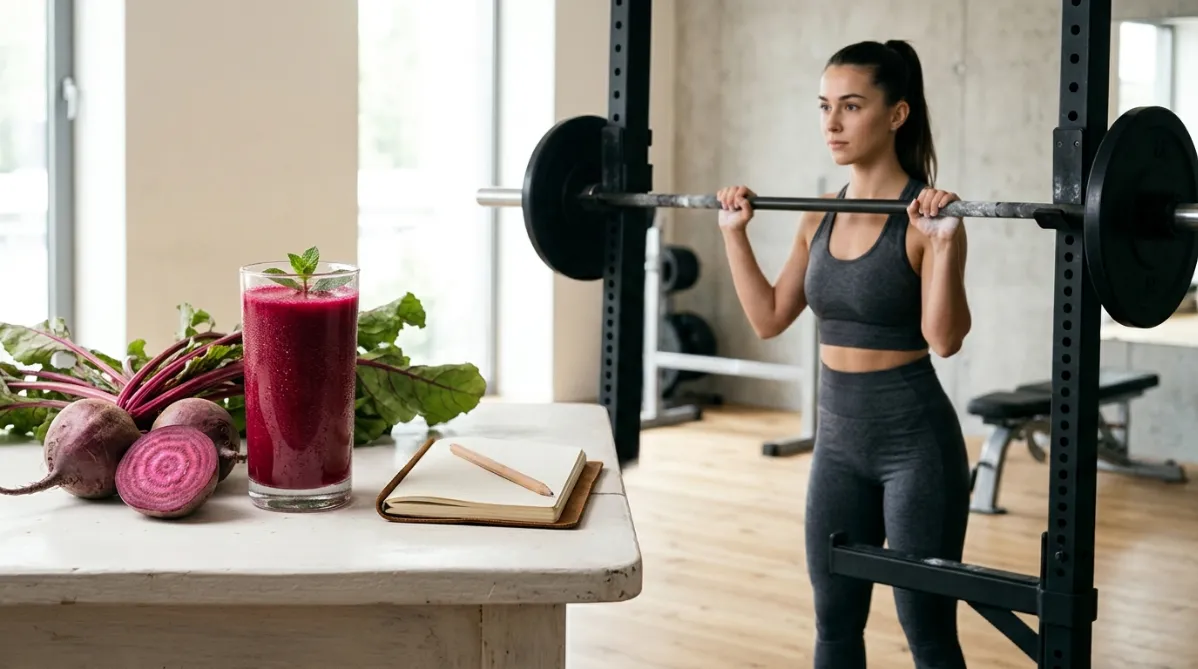
A wide, editorial-style photograph of a bright, modern gym corner softened by morning window light. In the foreground, a rustic matte-white ceramic table holds a tall clear glass of deep magenta beetroot juice, beads of condensation on the glass, a few fresh whole beetroots with leafy crimson-veined stems beside it, and one beetroot sliced in half to reveal its vivid concentric purple-pink rings. Next to the glass sits a small, neat notebook with a pencil, suggesting a research note, with no legible text. Behind the table, slightly out of focus, a young woman lifter with a tidy ponytail and a fitted charcoal training set stands at a barbell resting on a squat rack, chalk-dusted hands gripping the bar, calm and focused expression. A loaded bench with a bar is visible further back, with matte black plates and a light wooden floor. The palette is restrained and trendy: warm off-white, soft concrete gray, muted sage green accents from the beet leaves, and a bold beetroot magenta as the focal color. Shallow depth of field with a creamy bokeh background, natural side lighting casting long gentle shadows, subtle film grain. Composition follows the rule of thirds, with the juice and beets on the left third and the lifter on the right, leaving clean negative space in the upper area for a headline overlay. Mood is thoughtful, clean, and slightly skeptical, like a contemporary health and science journal cover. Realistic photography style, high-end magazine look, no text, no logos, no futuristic elements.
Nutrition

Il succo di barbabietola delude le donne sollevatrici e rallenta anche la panca

Dr. Gymbro · · 4 min read

Hai visto il clamore: il succo di barbabietola, il pre‑allenamento viola che presumibilmente trasforma i vasi sanguigni in superautostrade e la velocità della tua barra in un razzo. Un nuovo studio randomizzato su donne allenate ha messo alla prova questa promessa. Il risultato? Nessun beneficio per lo squat e un leggero calo della potenza in panca a un carico.

Cosa hanno realmente testato i ricercatori

Un team guidato da ricercatori della Pepperdine University, in collaborazione con l'University of Virginia, McMaster, Birmingham City e Loughborough, ha pubblicato lo studio su European Journal of Applied Physiology (2026). Diciotto donne allenate hanno partecipato a un disegno crossover randomizzato, doppio cieco. Ogni partecipante ha provato entrambe le condizioni, il che rende il confronto più pulito rispetto a due gruppi separati.

Le due bevande erano:

  • Placebo (PL): succo di barbabietola privo di nitrati, con tracce trascurabili.
  • Succo di barbabietola (BR): succo ricco di nitrati che forniva circa 6,7 mmol di nitrato, cioè circa 415 mg.

Entrambe sono state consumate 2,5 ore prima dell'esercizio, un intervallo di tempo comunemente usato nella ricerca sui nitrati.

L'allenamento: veloce, leggero‑moderato, esplosivo

Non si trattava di un test di massimale. Le partecipanti hanno eseguito una serie di tre ripetizioni esplosive di squat con bilanciere e panca, al 55 %, 60 % e 65 % del loro 1RM, con due minuti di riposo passivo tra le serie. Un trasduttore lineare ha misurato potenza e velocità massime e medie in ogni serie. Il protocollo mira al tipo di sforzi rapidi e potenti a cui i nitrati sono spesso associati.

Il risultato principale: nessun effetto sullo squat

Per lo squat, non ci sono state differenze tra le condizioni su nessuna variabile (tutti i P > 0,05). Il succo di barbabietola non ha migliorato né potenza né velocità a nessuno dei tre carichi. Gli autori concludono che l’ingestione acuta di nitrati non migliora la performance dello squat in questo gruppo.

La sorpresa: la panca è leggermente peggiorata al 60 %

Anche per la panca i risultati sono stati generalmente nulli, con un’eccezione. Al 60 % del 1RM, il succo di barbabietola è risultato peggiore del placebo:

  • Potenza media: 201 ± 61 W con BR vs 206 ± 61 W con placebo (P = 0,047, gz = ‑0,48)
  • Velocità media: 0,68 ± 0,08 m/s con BR vs 0,70 ± 0,08 m/s con placebo (P = 0,049, gz = ‑0,50)

La differenza è di circa 5 W e 0,02 m/s. Entrambi i valori P sono appena sotto la soglia 0,05, e l’effetto è comparso solo a un carico. I set al 55 % e al 65 % non hanno mostrato differenze. Con così tanti outcome misurati, un risultato al limite potrebbe facilmente essere un caso statistico. Gli autori non affermano che i nitrati danneggino i sollevatori; chiedono invece ulteriori ricerche per capire se esista un effetto ergolitico (riduttivo) nelle donne allenate.

Come interpretare onestamente questi dati

Si tratta di dati umani, non di studi su animali o cellule, ma hanno dei limiti. Il campione è piccolo (18 donne), la dose è un’assunzione acuta singola, e sono stati testati solo tre carichi leggeri‑moderati con serie da tre ripetizioni. Non ci dice nulla su sollevamenti massimali, serie ad alto volume fino al cedimento, o integrazione quotidiana per settimane. Gli autori hanno dichiarato di non avere conflitti di interesse.

Consigli pratici

  • Dose e tempistica dello studio: circa 6,7 mmol di nitrato (≈ 415 mg), assunti 2,5 ore prima dell'allenamento. Controlla l’etichetta del prodotto, poiché il contenuto di nitrato varia molto tra succhi e shot.
  • Chi probabilmente non dovrebbe preoccuparsi: se sei una donna che solleva per forza e potenza nello squat e nella panca, questo studio non ti dà alcuna ragione per aspettarti un boost pre‑allenamento dal succo di barbabietola. Al massimo non fa nulla, e a un carico della panca è addirittura leggermente peggiore.
  • Chi potrebbe ancora trarne beneficio: lo studio non risponde a chi pratica sport di resistenza o sprint. La ricerca sui nitrati è storicamente più focalizzata su performance aerobiche e ad alta intensità; quindi gli atleti di questi ambiti potrebbero ancora trovare utile sperimentare.
  • Modo intelligente di sperimentare: se ti piace il succo di barbabietola, non cambiare il resto della routine. Provalo qualche giorno di allenamento, registra la velocità della barra o la tua percezione di performance, e confronta con i giorni senza. Se non aiuta, stai solo pagando per una bevanda viola costosa.

La conclusione

Il succo di barbabietola non è un pre‑allenamento magico per la potenza con bilanciere delle donne. In questo trial non ha prodotto miglioramenti nello squat e ha mostrato un piccolo calo della panca a un singolo carico, risultato che necessita di replica prima di trarre conclusioni definitive. La lezione più grande è che la forte reputazione di un integratore in uno sport non si traduce automaticamente in vantaggi su piattaforme di sollevamento pesi.

Original study

Read the original research on pubmed.ncbi.nlm.nih.gov →

This article summarizes published research for general information. It is not medical advice.

DG

Written by

Dr. Gymbro

Dr. Gymbro writes for Dr. Gymbro: science-backed fitness, nutrition & performance.

Related Articles

A wide editorial still life on a clean, pale oatmeal-colored linen surface, lit by soft natural window light from the left. In the center-left, a small clear glass shot glass filled with deep magenta-crimson beetroot juice catches a glowing highlight, with a few droplets beaded on the surface beside it. Behind it sit two whole beetroots with their leafy stems, the skins a dusty burgundy and the stems a vivid pink-red, and one beetroot sliced in half to reveal concentric rings of magenta and soft pink. To the right, a vintage-style brass stopwatch rests at an angle on the linen, its white face crisp and its hands frozen, slightly out of focus in the foreground edge. A faint curve of a sprinting track lane, in muted terracotta with thin white lines, sweeps diagonally across the blurred background, hinting at a running track without showing any people. Scattered across the surface are a few small, delicate beet-colored splashes and a light dusting of coarse sea salt. The palette is restrained and modern: warm cream, terracotta, dusty rose, deep magenta, and touches of sage green from the leaves. Shallow depth of field and a gentle film-like grain give it a contemporary lifestyle-magazine feel. The composition leaves generous negative space on the upper right for title overlay. Minimalist, tactile, calm, and sophisticated, in the style of a high-end health and science journal's editorial photography, 16:9 landscape.
nutrition

Il succo di barbabietola ha aumentato il nitrito di 35 volte, ma gli sprinter non sono diventati più veloci

BY DR. GYMBRO ·

Il succo di barbabietola ha fatto schizzare il nitrito salivare di circa 35 volte negli sprinter allenati, un risultato che sembrava preannunciare un miracolo prestazionale. Tuttavia, una volta avviato il cronometro, non si è registrato alcun miglioramento. In uno studio randomizzato, in doppio cieco e con placebo, condotto su 12 sprinter maschi, una dose di 70 mL di succo non ha ridotto i tempi sui 60 m o sui 100 m, né ha aumentato l’altezza del salto o la maggior parte delle misure di funzione muscolare. Ecco cosa è stato testato, cosa lo studio non può dirci e chi dovrebbe risparmiare i soldi.

A wide, editorial-style still life photographed on a pale warm-gray concrete surface in soft, diffused morning window light. On the left side, a tall clear glass filled with deep magenta-crimson beetroot juice sits beside two halved raw beetroots, their concentric rings of vivid fuchsia and purple clearly visible, with a few small green-and-red-veined leaves draped casually nearby. On the right side, a matching clear glass of cloudy white creatine solution rests next to a small matte ceramic bowl heaped with fine white powder and a minimal wooden scoop, a light dusting of powder scattered across the surface. In the center, between the two sides, a simple matte black barbell grip and a single chalk-dusted weight plate edge rise into the frame at a low angle, hinting at lifting without showing a person. The composition is split in a balanced, symmetrical way, with a subtle vertical shadow line dividing the saturated magenta tones on the left from cool, neutral whites and creams on the right. The background is softly blurred with a muted sage-green and oatmeal-toned wall, with plenty of negative space at the top for a headline overlay. Shallow depth of field, crisp focus on the glasses' condensation droplets and the textured beetroot flesh. The color palette is limited and refined: magenta, cream, charcoal, and soft sage. The mood is clean, modern, and health-journal chic, like a contemporary wellness magazine cover, with natural shadows, a tactile matte finish, and subtle film-like grain. No text, no logos, no futuristic elements.
nutrition

Succo di barbabietola vs creatina: chi vince nel sollevamento in 72 ore?

BY DR. GYMBRO ·

Un recente studio crossover randomizzato ha confrontato succo di barbabietola e creatina per circa 72 ore di integrazione su sollevatori principianti. La creatina ha garantito un maggior numero di ripetizioni nella panca al 80 % del 1RM, mentre il succo di barbabietola ha spiccato per velocità della barra, ossigenazione muscolare, frequenza cardiaca di picco e recupero HRV. L'abstract non indica né dosi né tempistiche, perciò segnaliamo queste lacune. Di seguito trovi la scheda completa e le indicazioni su chi dovrebbe scegliere quale integratore.

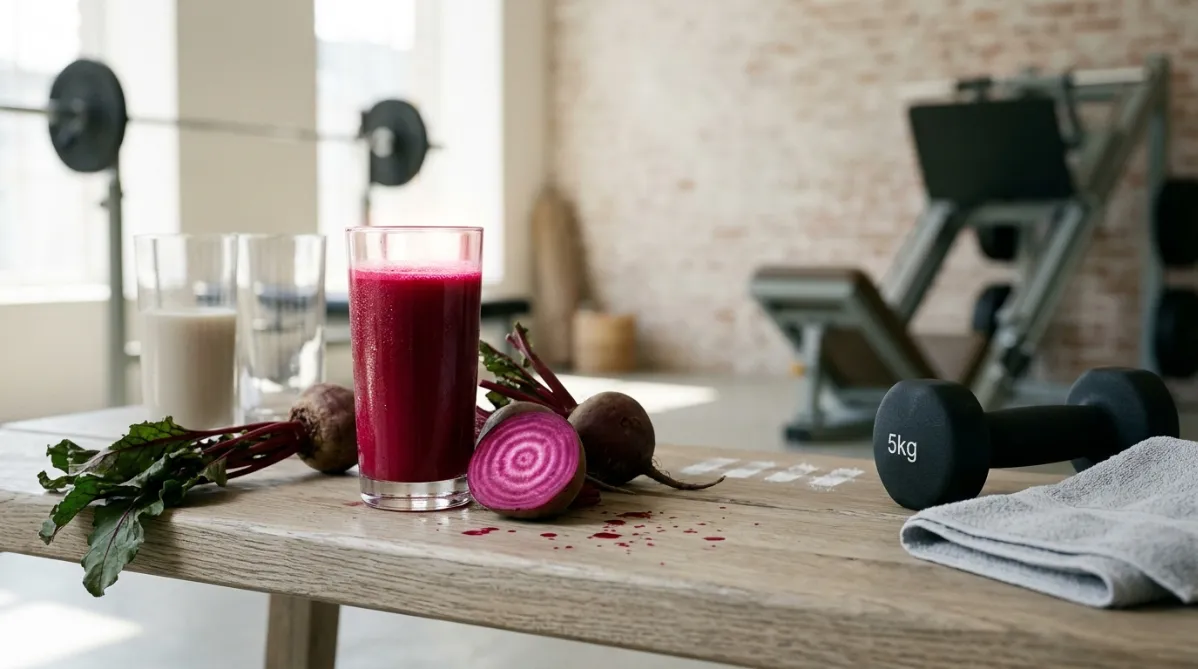
A wide, editorial-style still life photographed in soft natural window light, set on a pale oak gym bench or a light concrete surface. In the center foreground, a tall clear glass of deep magenta-crimson beetroot juice catches the light, with a faint luminous glow along its rim and condensation beading on the outside. Two other glasses sit slightly behind it, one holding a pale, neutral-colored liquid and one empty. They suggest the placebo and no-treatment conditions without any labels. Beside the glasses, a halved raw beetroot shows concentric rings of vivid fuchsia and violet. A few whole beets with their leafy stems and dark green and burgundy leaves are scattered casually nearby.

On the right side of the frame, slightly out of focus, a matte black women's-size dumbbell and a neatly folded light gray towel rest on the bench. Behind them, the soft blur of a minimalist, airy training space includes a barbell rack and a leg press machine in muted tones. The background is bright and neutral, in warm off-white, soft sand, and light gray, so the magenta of the juice is the dominant accent color.

A small, restrained motif of four evenly spaced chalk marks or four small round weight plates arranged in a neat row on the bench hints at the "four sets" of the trial. A few drops of beet juice have splashed onto the surface, forming a tasteful organic pattern.

The composition follows the rule of thirds, with the glass of juice on the left third and open negative space on the right for headline text. Shallow depth of field, crisp focus on the glass and beet, subtle film-like grain, and a calm, modern, trendy magazine aesthetic. The palette is magenta, deep burgundy, sage green, cream, and soft gray. The mood is quiet, skeptical, and scientific without any laboratory imagery, with clean lines and an elegant, minimal feel.
supplements

Il succo di barbabietola non aggiunge nemmeno una ripetizione alle donne allenate alla resistenza

BY DR. GYMBRO ·

Il succo di barbabietola è promosso come stimolatore naturale delle ripetizioni, ma uno studio doppio cieco su donne che praticano allenamento di resistenza non ha trovato alcun beneficio. Sedici partecipanti hanno bevuto succo ricco di nitrati (12,8 mmol), un placebo o niente prima di quattro serie di panca e leg press fino all'esaurimento. Il numero totale di ripetizioni, la percezione dello sforzo, la frequenza cardiaca, la pressione sanguigna e il lattato sono rimasti invariati. I risultati non mettono definitivamente a tacere la barbabietola, ma suggeriscono che l’effetto ergogenico dei nitrati sia limitato per questo gruppo e questo protocollo.

A sunlit, minimalist kitchen counter in a modern home, photographed from a slightly elevated three-quarter angle with soft natural morning light spilling in from a window on the left. In the center sits a matte white ceramic mug of black coffee with a thin curl of steam, beside a small glass jar of deep magenta beetroot powder with a wooden scoop resting on the lid. A scattering of fine crimson powder dusts the pale oak surface in an artful, casual swirl. Nearby, a halved raw beetroot reveals vivid concentric rings of purple and pink, next to a few roasted coffee beans and a neatly folded charcoal gym towel. In the soft-focus background, a pair of clean white running shoes and a stainless steel water bottle sit on a floating shelf, hinting at a pre-workout routine. A single sprig of green beet leaves adds a fresh accent.

The color palette is warm and editorial: creamy neutrals, espresso browns, and rich beet magenta, with gentle highlights and long soft shadows. The composition has generous negative space on the right side for headline text, shallow depth of field, and a crisp, tactile texture on the ceramic, powder, and wood grain. The mood is calm, health-conscious, and contemporary, like a lifestyle feature in a premium wellness magazine or a trendy nutrition journal. Clean, balanced, natural, with subtle film-like grain and a slightly muted, high-end finish.
science research

La caffeina pre‑allenamento irrigidisce le arterie; la polvere di barbabietola la neutralizza

BY DR. GYMBRO ·

Un nuovo studio crossover randomizzato ha mostrato che una dose di caffeina pari a 6 mg/kg, tipica dei pre‑workout, aumenta i marker di rigidità arteriosa entro 2,5 ore. L’assunzione contemporanea di una polvere di barbabietola contenente 400 mg di nitrati riporta questi marker ai livelli del placebo. Pressione sanguigna e funzione endoteliale non sono cambiati, quindi si tratta di un effetto sottile, non di un allarme. Lo studio, però, ha coinvolto solo 24 giovani adulti sani e una singola dose, lasciando molte incognite sul lungo periodo e su soggetti più anziani o ipertesi. Ecco cosa mostrano i dati, cosa non mostrano, e come interpretarli se usi la caffeina prima di allenarti.

This page is available in