Dr. Gymbro
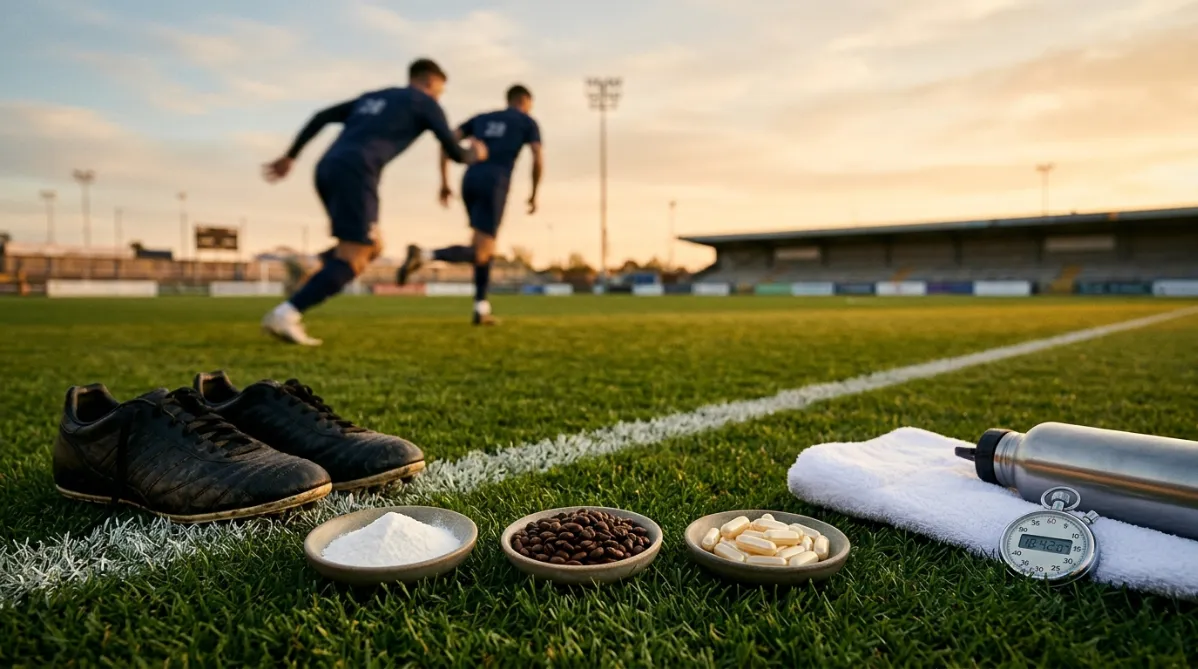
A wide, editorial-style photograph of a professional soccer pitch at golden hour, shot from a low angle at the edge of the grass. In the foreground, slightly off-center to the left, a pair of worn leather cleats sits beside a scatter of three small matte ceramic dishes. One holds fine white taurine powder, one holds dark roasted coffee beans, and one holds pale cream-colored softgel capsules. Soft warm light catches the textures: the grain of the beans, the powder's fine crystalline sheen, the glossy curve of the capsules. A clean white sports towel and a brushed-steel water bottle rest nearby, with a small stopwatch lying on the turf, its face softly glowing.

Behind them, the field stretches into a gentle blur. A lone player in a muted navy training kit mid-sprint leaves a faint streak of motion across the frame, with painterly bokeh from stadium floodlights and distant stands. The grass is a rich, deep green with crisp white line markings curving across the midground and leading the eye toward the athlete. Long amber shadows stretch across the pitch, and a hazy peach and pale blue sky fills the upper right, leaving open negative space for a title overlay.

The palette is restrained and modern: deep green, warm cream, soft amber, charcoal, and a touch of muted coral. The depth of field is shallow, with sharp detail on the supplements and cleats. The mood is calm, premium, and scientific without feeling clinical, like a contemporary sports-science magazine or wellness journal cover. The lighting is natural and cinematic, with gentle film grain and a subtle vignette. The composition follows the rule of thirds, with clean lines and no text, logos, or clutter.
Nutrition

Taurina, caffeina e PS: vantaggi per i calciatori professionisti. Il rovescio della medaglia?

Dr. Gymbro · · 4 min read

Risultato principale e le piccole stampe che contano

I calciatori professionisti che hanno assunto uno stack di taurina, caffeina e fosfatidilserina (PS) per due settimane hanno completato lo sprint di 30 m con tempi più rapidi rispetto al gruppo placebo. Hanno inoltre ottenuto punteggi migliori in diversi test di tempo di reazione e di affaticamento mentale. I ricercatori sottolineano però che lo studio non dimostra che lo stack renda gli atleti più resistenti alla fatica, e non è possibile stabilire se la PS sia responsabile di parte degli effetti.

Questa ambiguità è ciò che rende il nuovo trial randomizzato pubblicato su Nutrients degno di un’attenta lettura.

Cosa hanno effettivamente fatto i ricercatori

Lo studio ha coinvolto 97 calciatori professionisti maschi in un disegno randomizzato, triplo cieco, controllato con placebo e a gruppi paralleli. I partecipanti sono stati suddivisi in quattro gruppi per 14 giorni:

  • Placebo (PLA): n = 24
  • Taurina + caffeina (TC): n = 24
  • Taurina + caffeina + 300 mg/giorno di PS (TCP‑300): n = 24
  • Taurina + caffeina + 600 mg/giorno di PS (TCP‑600): n = 25

La dose di taurina era di 1 500 mg al giorno e quella di caffeina di 200 mg al giorno in tutti i gruppi attivi. Successivamente i giocatori hanno eseguito un protocollo di esercizio specifico per il calcio. Il team ha misurato il tempo di sprint su 30 m, i tempi di reazione visiva e uditiva, le performance nel compito Stroop, l’affaticamento mentale percepito e le variabili locomotorie ricavate dal GPS.

I successi: sprint, tempo di reazione e affaticamento mentale

Correggendo per i valori di partenza, l’analisi ha evidenziato un effetto significativo del trattamento sul tempo di sprint post‑intervento su 30 m. Dopo la correzione Holm‑Bonferroni per confronti multipli, gli effetti rimangono significativi per tre risultati cognitivi e psicomotori:

  • Tempo di reazione nel test Stroop
  • Tempo di reazione visiva
  • Affaticamento mentale percepito

Il tempo di reazione uditiva non è risultato significativo (p‑value non corretto = 0,074; p‑value Holm‑corretto = 0,096).

Anche le variabili locomotorie ricavate dal GPS durante il protocollo differivano in modo significativo tra i gruppi, una volta aggiustate per i valori di base. In generale, gli stack attivi erano associati a risultati più favorevoli rispetto al placebo.

300 mg vs 600 mg di PS: quasi nessuna differenza

È allettante pensare che raddoppiare la dose di PS raddoppi i benefici, ma i dati non lo confermano. Alcuni esiti erano numericamente più favorevoli nel gruppo da 600 mg, e le più piccole perdite di prestazione dal primo al secondo tempo si sono generalmente osservate nel TCP‑600. Tuttavia, gli autori dichiarano che le differenze tra TCP‑300 e TCP‑600 erano modeste e non costantemente statisticamente significative. Lo studio inoltre non era dimensionato per valutare una relazione dose‑risposta.

In parole povere, 600 mg sembrava leggermente migliore sulla carta, ma questo trial non può affermare che valga la pena assumere capsule aggiuntive rispetto a 300 mg.

L’avvertenza principale: non è prova di resistenza alla fatica

Il trial ha anche misurato gli indici di perdita di prestazione dal primo al secondo tempo, che indicano quanto la performance diminuisce durante il protocollo. I gruppi differivano su questi indici dopo l’intervento. Questo potrebbe suggerire un vantaggio in termini di resistenza alla fatica, ma gli autori avvertono esplicitamente di non interpretarlo così. Gli indici di declino comparabili non erano disponibili alla baseline, perciò non è possibile dimostrare che lo stack abbia cambiato il modo in cui i giocatori si affaticano. Le differenze post‑intervento non possono essere considerate un miglioramento della resistenza alla fatica dovuto all’intervento.

Una seconda limitazione è altrettanto importante. La PS non è mai stata testata da sola. Ogni gruppo attivo ha ricevuto taurina e caffeina, e il disegno non ha isolato la PS. I risultati riflettono i protocolli multi‑ingrediente, non la PS per sé. La caffeina è uno stimolante noto, quindi potrebbe spiegare gran parte degli effetti su sprint e tempo di reazione. Questo trial non è in grado di separare i contributi.

Punti chiave pratici: lo stack così come è stato studiato

Ecco cosa è stato utilizzato nel trial, così potete confrontarlo con i vostri piani:

  • Taurina: 1 500 mg/giorno
  • Caffeina: 200 mg/giorno
  • Fosfatidilserina: 300 o 600 mg/giorno (differenze solo modeste)
  • Durata: 14 giorni

L’abstract non specifica come la dose giornaliera sia stata temporizzata rispetto a allenamenti o partite, quindi non esiste una regola basata sull’evidenza da riportare qui. Consultate l’articolo completo per quei dettagli prima di replicare il protocollo.

A chi è destinato?

Le evidenze si applicano a calciatori professionisti maschi in condizioni di un trial di 14 giorni. Non si riferiscono direttamente ad atleti amatoriali, giocatrici, altri sport o all’uso a lungo termine. Se siete un giocatore competitivo curioso di migliorare la prontezza cognitiva verso la fine delle partite, questo è un segnale interessante, non una prescrizione. Chi è sensibile alla caffeina, assume farmaci o ha condizioni di salute particolari dovrebbe prima parlare con un dietista sportivo o un medico. Le squadre dovrebbero inoltre assicurarsi che qualsiasi integratore sia testato per sostanze vietate.

Conclusioni

Questo trial aggiunge evidenza che gli stack multi‑ingrediente possono migliorare il tempo di reazione, ridurre l’affaticamento mentale percepito e migliorare le prestazioni di sprint negli elite footballers. Le note di testa rimangono reali, però. La PS non è stata isolata, il divario tra 300 mg e 600 mg era modesto, e la questione della resistenza alla fatica resta aperta. Consideratelo come un’indicazione promettente per studi futuri che includano bracci con PS sola e misure di fatica alla baseline, non come prova che uno stack a tre ingredienti sia una soluzione miracolosa per il giorno di partita.
Original study

Read the original research on pubmed.ncbi.nlm.nih.gov →

This article summarizes published research for general information. It is not medical advice.

DG

Written by

Dr. Gymbro

Dr. Gymbro writes for Dr. Gymbro: science-backed fitness, nutrition & performance.

Related Articles

nutrition

La caffeina ha reso i calciatori più veloci, ma non più reattivi

BY DR. GYMBRO ·

Molti credono che la caffeina migliori tutti gli aspetti della performance sportiva, ma uno studio controllato su calciatori amatoriali dipinge un quadro più sfumato. Una dose di 300 mg (circa 3,7 mg/kg) ha aumentato l’agilità pianificata e l’altezza del salto, mentre i benefici sulla reattività a luci o avversari umani sono stati minimi o non significativi. Scopri cosa ha evidenziato lo studio, come interpretare i risultati e a chi possono davvero servire questi dati.

A wide, editorial-style photograph of a soccer pitch at golden hour, shot from a low angle at the edge of the touchline. In the foreground, a pair of worn leather cleats sits beside a small, matte white scoop and a minimalist ceramic jar of fine white powder resting on the dewy grass. A few loose grains of powder dust the blades of grass and catch the warm light. The jar is unbranded, with a clean, modern look.

In the midground, slightly out of focus, a lone player in a plain charcoal training kit stands mid-stride on the pitch, caught in a sprint. The motion blur in the legs suggests speed, and long shadows stretch across the freshly mowed stripes of the turf. A soccer ball rests a few meters ahead of the player.

Behind them, the stadium stands curve softly into the distance, rendered in a hazy, muted gradient of peach, soft amber, and pale blue sky. The mowing pattern on the grass forms clean diagonal lines that lead the eye toward the horizon. A thin white chalk line cuts across the frame, adding a subtle graphic element.

The palette is warm and restrained: sage and deep green grass, cream white, soft apricot light, and touches of charcoal. The mood is calm, thoughtful, and slightly skeptical rather than hyped, like a magazine feature on sports science. Shallow depth of field with a creamy bokeh background, fine film grain, and gentle natural contrast. The composition follows the rule of thirds, with the jar and cleats in the lower left and open negative space in the upper right, which leaves room for a headline overlay. The look is contemporary and clean, like a premium health and performance journal.
nutrition

Creatina per il calcio: 41 studi, una scomoda verità sugli sprint

BY DR. GYMBRO ·

La creatina è ovunque, e le intense esigenze di sprint del calcio la fanno apparire come l’abbinamento ideale. Una nuova revisione sistematica di 41 studi ha messo alla prova questa idea, rivelando risultati più prudenti rispetto al marketing. Alcuni trial hanno mostrato benefici per sprint ripetuti, potenza anaerobica e forza, ma le prove sono incoerenti e di bassa certezza. Le affermazioni sul recupero hanno ricevuto poco supporto, e il peso corporeo è spesso aumentato senza chiari guadagni di massa magra. Ecco cosa emerge, chi può trarne vantaggio e chi dovrebbe riflettere prima di usarla.

A wide, editorial-style still life photographed on a pale, matte stone countertop in soft morning window light. On the left, a small ceramic cup of black coffee sits beside a scattering of whole roasted coffee beans, with a thin wisp of steam rising. At the center, a shallow wooden bowl holds dried Rhodiola rosea root pieces, rust-orange and tan, with a few fresh succulent-like Rhodiola rosette stems with blue-green leaves and yellow-gold flowers laid across the surface. On the right, a minimalist matte white scoop and two small glass vials of fine powder, one dark brown and one soft amber, are lined up neatly like a measured dose. Behind them, softly out of focus, a blurred athletic setting suggests a training space: a muted sage-green wall, a folded gray towel, and a worn soccer ball resting on a low bench. A stopwatch with a clean white face lies in the foreground, slightly angled, hinting at timing and performance. The palette is warm and earthy: cream, terracotta, deep espresso brown, moss green, and a touch of marigold yellow. Shadows are long and gentle, with a shallow depth of field and fine natural texture in the stone, wood, and plant material. The composition is balanced and uncluttered, with generous negative space on the upper left for headline text. The overall look is modern, calm, and trendy, like a contemporary wellness and science journal cover, with crisp detail, subtle film grain, and a natural, tactile feel.
supplements

Rhodiola + caffeina: la combinazione che supera il placebo nella potenza massima del test Wingate

BY DR. GYMBRO ·

Un piccolo studio crossover su dieci calciatori ha mostrato che una dose di 3 mg/kg di caffeina e Rhodiola rosea, assunta 60 minuti prima del test Wingate, aumenta la potenza di picco rispetto al placebo. I biomarcatori salivari di cortisolo, α‑amilasi e IgA mostrano cambiamenti differenti, ma i risultati restano preliminari a causa del campione ridotto e della singola somministrazione.

A lone trail runner pauses on a high alpine ridge at dawn, holding a small enamel camp mug of steaming coffee, with thin ribbons of steam curling into crisp, cold air. She wears a fitted charcoal running vest and a muted sage windbreaker, and her breath is faintly visible. Behind her, layered mountain ranges fade into soft blue and lavender haze, and a sea of low clouds fills the valley below. Warm golden sunlight skims the ridgeline and rim-lights her profile, shoulders, and the rising steam. In the foreground, a scattering of dried alpine grasses and lichen-covered stones is in sharp focus, with a worn trail snaking toward the summit. Near the mug sits a small pair of trail running shoes with dusty soles and a simple analog wristwatch resting on a flat rock.

The composition follows a wide 16:9 editorial layout. The subject sits slightly right of center on the rule of thirds, leaving generous negative space in the pale peach-and-powder-blue sky on the left, where headline text could sit. The palette is restrained and modern: warm amber, soft cream, dusty sage, slate blue, and a touch of terracotta. The look is cinematic but natural, with shallow depth of field on the foreground details, gentle film grain, and a slightly matte finish. It evokes a high-end outdoor lifestyle magazine or a contemporary wellness journal. The mood is calm, focused, and quietly determined, capturing the contrast between thin, cold altitude air and the warmth of a coffee ritual. The image has no text, logos, or futuristic elements, and no gym equipment, only natural light, texture, and atmosphere.
nutrition

Caffeina in Alta Quota: il boost di resistenza che l'ipossia non può cancellare

BY DR. GYMBRO ·

L'aria rarefatta penalizza la resistenza, ma una nuova meta‑analisi suggerisce che la caffeina può recuperare parte di quel deficit. Analizzando nove studi crossover controllati con placebo (117 partecipanti), gli autori hanno riscontrato un aumento delle prestazioni di medio‑grande entità in ipossia (g = 0,76). Sorprendentemente, la saturazione di ossigeno e la percezione dello sforzo non sono cambiate, mentre frequenza cardiaca, lattato e ventilazione sono aumentati. La prova è di bassa certezza e solo 19 partecipanti erano donne, perciò il risultato è promettente ma non definitivo.

This page is available in