Dr. Gymbro
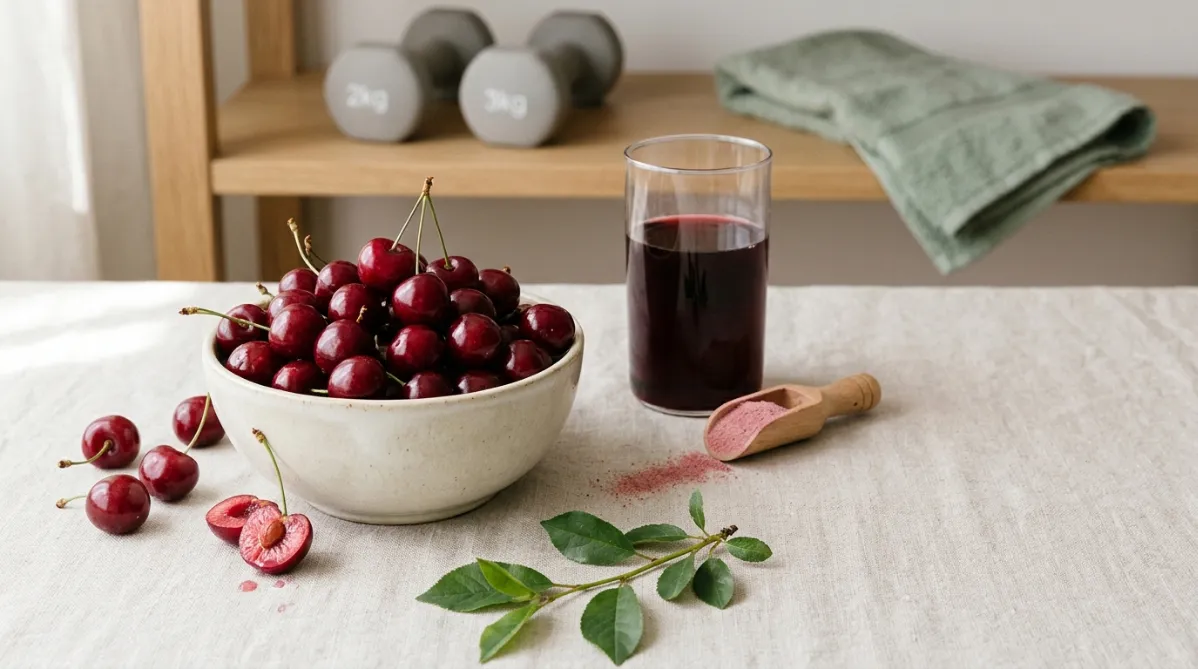
A wide, softly lit editorial still life on a pale oatmeal linen surface. In the center-left, a rustic ceramic bowl in matte cream glaze holds a generous heap of glossy deep-crimson tart cherries, some with stems still attached, a few spilling onto the table. Beside the bowl, a halved cherry reveals its pit and bright ruby flesh, with tiny droplets of juice catching the light. To the right, a tall clear glass of dark burgundy cherry juice sits beside a small wooden scoop holding fine rose-colored cherry powder, a light dusting of which trails across the linen in a gentle arc.

In the soft-focus background, a pair of neutral gray dumbbells and a folded sage-green towel sit on a light oak shelf, hinting at exercise without dominating the scene. A single sprig of green cherry leaves lies diagonally across the foreground, adding a fresh contrast.

Natural morning window light enters from the upper left, casting long, gentle shadows and warm highlights on the cherry skins. The palette is restrained and modern: deep crimson, blush pink, cream, sage green, and warm oak, with plenty of negative space on the right third for title overlay. Shallow depth of field, crisp focus on the cherries, creamy bokeh behind. A subtle film-like grain and slightly muted tones give it a contemporary wellness-magazine feel, clean, tactile, and calm. Shot from a slightly elevated three-quarter angle, composed with an off-center balance and an airy, minimalist layout.
supplements

タートチェリーで筋肉タンパク質が再構築されるも、回復は速くならず

Dr. Gymbro · · 4 min read

Tart cherry juice has a loyal following among lifters, runners and anyone who has hobbled down stairs after a brutal leg day.

The usual pitch is that Montmorency cherries blunt soreness and speed recovery. A new paper in Frontiers in Nutrition (2026) from Sabou, O'Leary and Jackman complicates that story in an interesting way. Seven days of tart cherry (TC) supplementation before damaging exercise did not accelerate the recovery of muscle function. It did, however, profoundly change what was happening inside the muscle.

The Twist: Molecular Change Without a Faster Recovery

The headline finding is a mismatch. The authors report that 7 days of TC supplementation before exercise‑induced muscle damage (EIMD) increased TC‑derived phenolic acids in the blood. It also "profoundly" altered the balance of structural and contractile proteins in the exercised muscle, and changed macrophage infiltration into that tissue. Yet these molecular shifts happened without TC accelerating the return of muscle function.

That is the opposite of how tart cherry is usually marketed. Most previous work has focused on outcomes such as soreness and strength, and many of those studies suggested a recovery benefit. This study looked underneath, using a proteomic approach to see which proteins were turned up or down. The result is evidence that tart cherry is biologically active in human muscle, even if it did not translate into a faster functional rebound in this trial.

Why Researchers Went Looking

The study starts from two gaps in the literature. First, polyphenol‑rich TC has repeatedly been linked to better recovery from EIMD, but no studies had examined how different doses of TC influence that recovery. Second, nobody had a clear picture of the molecular mechanisms behind the effect. Antioxidant and anti‑inflammatory explanations are popular, but they are often assumed rather than demonstrated in muscle tissue itself.

EIMD is a useful model for this question. Eccentric exercise, where the muscle lengthens under load, as in downhill running or the lowering phase of a lift, disrupts muscle fibers and triggers an inflammatory repair response. If a supplement changes that response, the muscle proteome should show it. The trial is registered on ClinicalTrials.gov (NCT04725149), which adds transparency about its design.

Plasma Phenolic Acids and the Hippuric Acid Signal

Polyphenols in tart cherry are not absorbed intact in any simple way. Gut metabolism and the body's own processing convert them into smaller circulating phenolic acids, and those are the compounds the muscle is plausibly exposed to. The study confirmed that TC supplementation raised these TC‑derived phenolic acids in plasma, which is an important check that the intervention reached the bloodstream.

One metabolite stood out: hippuric acid. The authors found that plasma hippuric acid concentrations were positively correlated with muscle function in young active males. Correlation is not causation, and hippuric acid may simply be a marker of how well someone absorbs and metabolizes dietary polyphenols. Still, it hints at a useful idea. Individual differences in how people process these compounds may help explain why some people seem to respond to tart cherry and others do not.

Structural and Contractile Proteins Shifted

The proteomic result is the most intriguing part. The authors describe a profound change in the balance of structural and contractile muscle proteins after TC supplementation. Structural proteins help muscle fibers hold their shape and transmit force. Contractile proteins do the actual work of generating force. Changing the balance between them after damage suggests that the repair and remodeling program differed in the TC group.

The abstract does not claim that this shift is better or worse, and it is worth not over‑reading it. A different protein profile during recovery could reflect faster remodeling, a more adaptive repair signal, or simply a different path to the same destination. What the finding does establish is that tart cherry is not a passive bystander in damaged muscle. It is associated with measurable changes in the machinery that rebuilds it.

Macrophages: The Cleanup Crew Responds

Macrophage infiltration also changed. These immune cells arrive at damaged muscle to clear debris and help coordinate regeneration. Inflammation after hard training is not simply a problem to suppress, because it is part of the signal that drives adaptation. That is why altered macrophage presence is such a compelling result: it points to tart cherry modulating the immune side of repair rather than just blunting it.

This fits with the authors' closing suggestion that TC warrants exploration as an intervention that may enhance musculoskeletal adaptations to training stimuli. It is a more nuanced pitch than "less soreness, faster recovery." It frames tart cherry as a possible modifier of how muscle responds to training over time.

What This Means for Lifters and Athletes

Tart cherry is popular with endurance athletes, team‑sport players and strength trainees who want to manage DOMS between hard sessions. This study does not invalidate that use, but it does temper the expectations. In young active males, a 7‑day pre‑load changed the muscle's molecular profile without speeding the recovery of muscle function. If your goal is a quick return of strength after a damaging session, this trial does not show that tart cherry delivers it.

The more interesting takeaway concerns long‑term adaptation. If tart cherry can reshape the repair response, it may influence how muscle adapts to repeated training, though that remains a hypothesis rather than a demonstrated benefit. Longer trials that track training adaptations, and that compare doses directly, are the logical next step. Until then, treat tart cherry as a biologically active food with a promising but unproven role, and not a guaranteed shortcut to feeling fresher.

Limits and Open Questions

Several caveats apply. The participants were young, active males, so the results may not generalize to women, older adults or elite athletes. The abstract also notes that dose‑response effects of TC on recovery were an open question motivating the work, and it does not claim to have settled it. Finally, proteomic changes show that something is different, not that the difference is beneficial. Even so, this paper shifts the conversation from whether tart cherry works to how it acts on muscle, which is the right question to be asking.
Original study

Read the original research on pubmed.ncbi.nlm.nih.gov →

This article summarizes published research for general information. It is not medical advice.

DG

Written by

Dr. Gymbro

Dr. Gymbro writes for Dr. Gymbro: science-backed fitness, nutrition & performance.

Related Articles

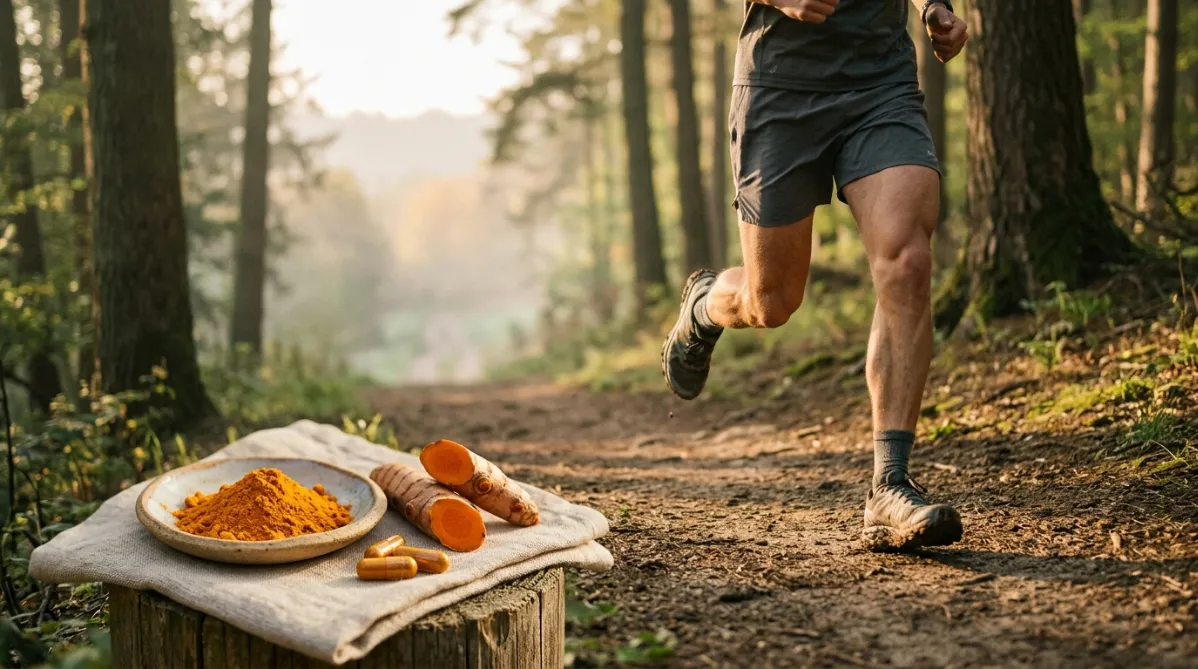
A wide, editorial-style photograph of a male runner mid-stride on a gently sloping forest trail at early morning, shot from a low three-quarter angle. Soft golden light filters through tall trees and casts long dappled shadows across the packed dirt path. The runner is captured from the waist down and slightly from the side, wearing charcoal running shorts and worn trail shoes, with the quadriceps and thigh muscles defined and naturally lit. A fine mist hangs in the background, and the slope descends toward a blurred, softly glowing horizon.

In the foreground, slightly out of focus on a weathered wooden post or flat mossy stone at the trail's edge, rests a small ceramic dish holding a pile of vivid golden-orange turmeric powder. Beside it sit two fresh turmeric roots, one cut open to show a deep saffron interior, and a few amber capsules. A thin linen cloth is draped beneath them. The saturated yellow-orange of the turmeric contrasts with the cool green and muted brown tones of the forest, creating a strong color anchor on the left third of the frame.

The composition follows the rule of thirds, with the turmeric in the lower left foreground and the runner in the right two-thirds, leaving open negative space in the upper left for headline text. Shallow depth of field, creamy bokeh, and natural film-like grain give it a refined, modern health-and-science magazine feel. The palette is warm and earthy: golden amber, moss green, soft cream, and deep umber. The lighting is natural and gentle, with subtle rim light on the runner's calves and hamstrings. No text, no logos, no graphics, and no futuristic elements. The result should feel clean, calm, and aspirational, like a cover image for a premium wellness and sports-nutrition journal.
recovery

Merivaウコンがダウンヒルランニング後のMRI所見で示す筋損傷を軽減

BY DR. GYMBRO ·

2014 年に実施された小規模なランダム化比較試験で、イタリアのインデナ社が開発したレシチン結合型ウコン(Meriva)が、ダウンヒルランニング後の太ももの MRI 画像に見える筋損傷を低減させる可能性が示されました。20 名の男性被験者は 1 日 2 回、1 g の Meriva を、ランニング開始 48 時間前から開始し、ラン後 24 時間まで服用しました。画像上の差は顕著でしたが、痛みの軽減は大腿前部に限られました。酸化ストレス指標や筋組織の組織学的変化には有意差が見られませんでした。

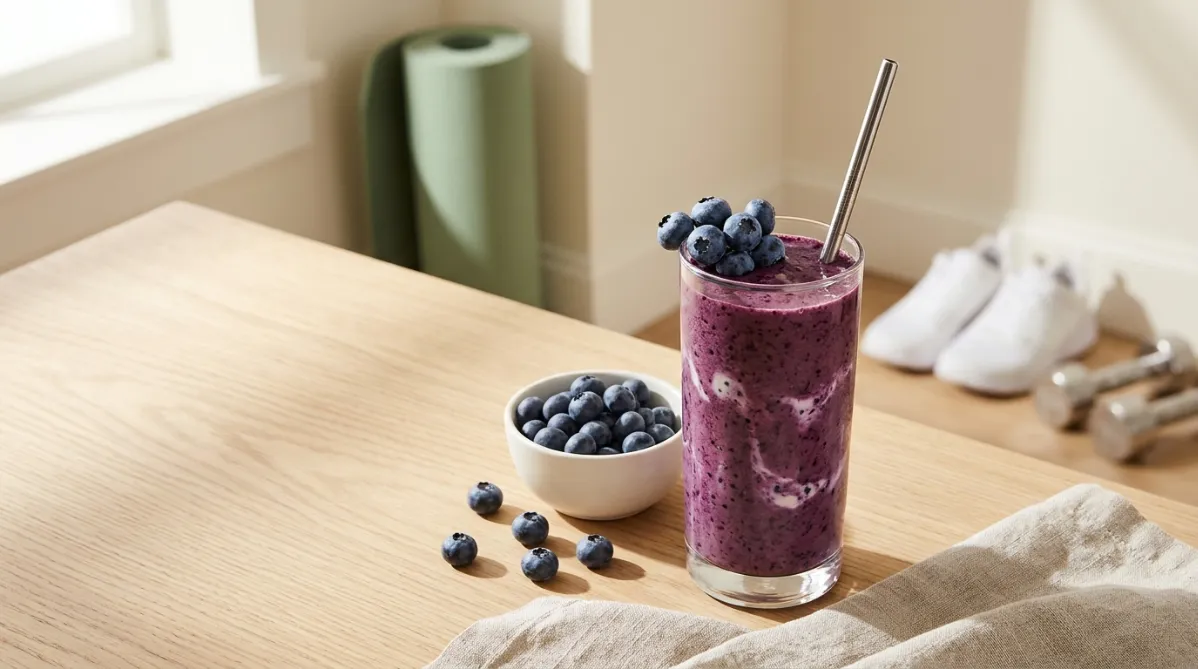
A bright, airy editorial photograph shot from above at a slight angle, showing a tall clear glass of deep violet blueberry smoothie on a pale oak wooden table. The smoothie has a creamy, velvety texture with a few lighter swirls, and a small cluster of fresh blueberries with dusty blue skins rests on the rim of the glass. A matte white ceramic bowl of whole blueberries sits to the left, with a few berries scattered naturally across the tabletop. A folded linen napkin in soft oatmeal tones and a stainless steel straw add subtle texture.

In the softly blurred background, a rolled-up sage green yoga mat leans against a light wall next to a pair of clean white running shoes and a small pair of brushed-metal dumbbells. A sliver of warm morning sunlight enters from the left window, casting gentle diagonal shadows and a golden glow across the table, with soft highlights on the glass and the berries' surface bloom.

The color palette is fresh and modern: deep indigo and violet from the smoothie, balanced by cream, warm beige, soft sage green, and touches of white. The composition follows the rule of thirds, with the glass placed on the right third and generous negative space on the left, suitable for headline overlay. Shallow depth of field, crisp focus on the glass and berries, creamy bokeh in the background. The mood is calm, healthy, and aspirational, like a contemporary wellness magazine or a trendy health journal website. Natural, realistic, high-end food and lifestyle photography style, 16:9 landscape format, clean and uncluttered.
nutrition

ブルーベリースムージーが脚の回復力を高めた

BY DR. GYMBRO ·

女性10名を対象に、300回の偏心性大腿四頭筋収縮とブルーベリースムージーの併用を検証したランダム化クロスオーバー試験を実施しました。抗酸化能が等しいプラセボと比較して、等尺性ピークトルクの回復が60時間以内に有意に早まった(p=0.047)ことが示されました。ただし、統計的に有意だったアウトカムは1つだけで、サンプルサイズも極めて小さいため「有望だが決定的ではない」段階です。以下で研究の概要と実生活への応用方法を解説します。

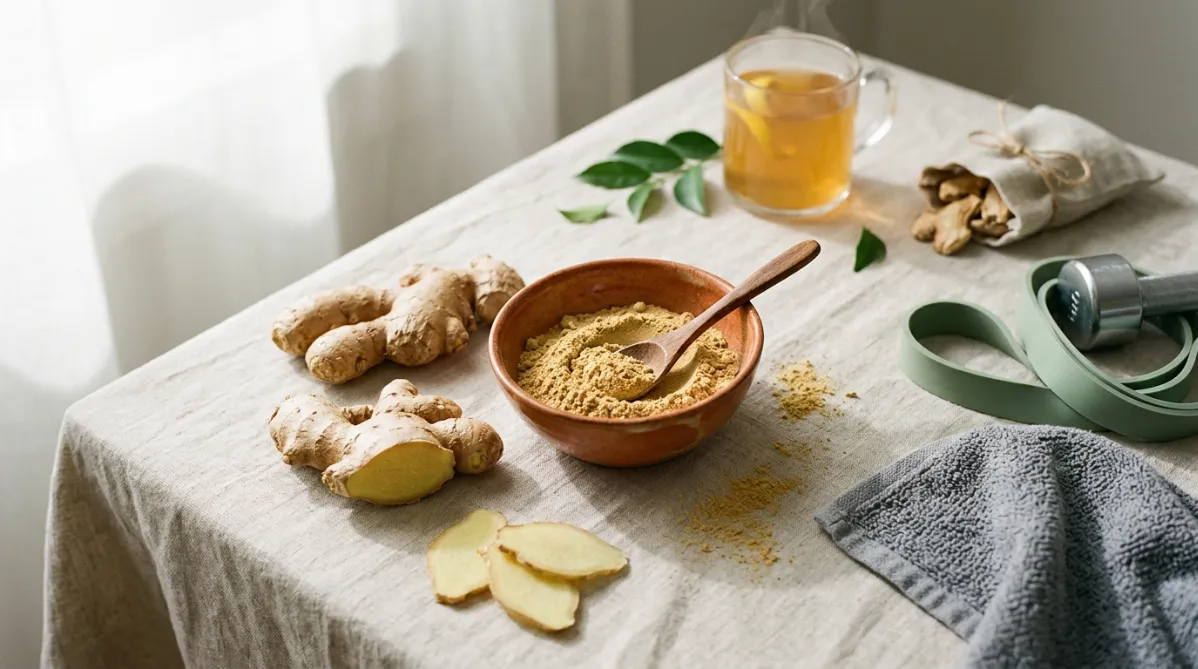
A wide, editorial-style still life photographed from slightly above on a pale oat-colored linen surface, lit by soft natural window light from the left. At the center sits a rustic ceramic bowl of finely ground golden-tan ginger powder, with a small wooden spoon resting in it and a light dusting of spice across the cloth. Beside it lie several whole ginger rhizomes, knobby and honey-brown. One is sliced open to show its pale yellow, fibrous interior, and a few paper-thin slices fan out in the foreground. On the right, a folded heather-gray gym towel, a matte sage-green resistance band coiled loosely, and a single brushed-steel dumbbell sit just inside the frame, softly out of focus. A glass of warm amber ginger tea steams faintly near the upper right, with a thin curl of lemon peel inside. A few fresh green leaves and a small linen pouch of dried ginger add texture. The palette is warm and muted: cream, soft gold, sage, terracotta, and charcoal accents. The shallow depth of field keeps the ginger bowl and sliced root crisp while the gym elements melt into a gentle blur. Shadows are long and soft, and the negative space on the upper left leaves room for a headline. The mood is calm, clean, and modern, like a contemporary wellness or science journal cover. It is a natural, tactile, high-resolution photograph with subtle film grain and no text, no people, and no futuristic elements.
recovery

ジンジャー2 gの摂取で翌日の筋肉痛が約25%軽減 – 2つの試験で判明

BY DR. GYMBRO ·

身近なキッチンスパイスであるジンジャーが、ジムで最も頻繁に聞かれる不満――翌日の遅延性筋肉痛(DOMS)に対して効果があるか検証しました。二重盲検試験で、2 gのジンジャーを11日間摂取した参加者は、過酷な偏心運動後の痛みが約25%低減したと報告しています。ただし、筋力や腫れの改善は認められず、イブプロフェンとの直接比較は行われていません。研究結果の概要、考えられる作用機序、エビデンスの限界、そして実際に試すべき人について解説します。

recovery

タートチェリーでマラソン後の炎症が37%低下、足の感覚に変化なし

BY DR. GYMBRO ·

マラソン実験で、タートチェリーパウダー摂取が炎症マーカーhs‑CRPを約37%低減させたことが分かりました。ただし、筋力回復やジャンプ性能、筋肉痛、筋肉損傷(CK)には差が見られませんでした。本研究はあまり知られていないVistula品種を用い、35名のレクリエーションランナーを対象に7日間のプロトコルで実施したものです。資金提供は原料供給者からで、サンプル数は小規模です。持久系アスリートにとって、炎症が下がっても足の感覚が変わらないという結果は何を示唆するのでしょうか。

This page is available in