Dr. Gymbro
A wide editorial still life shot from a slightly elevated angle on a pale ash-wood bench in a bright, airy training hall. In the center sits a small matte ceramic dish holding a few translucent coral-red softgel capsules, their glossy surfaces catching soft window light. Beside the dish rests a folded white taekwondo dobok with a black belt loosely coiled on top. A sprig of fresh red microalgae-toned seaweed and a halved blood orange add natural color accents. A clean glass of water with subtle condensation stands to one side.

In the softly blurred background, the silhouette of a martial artist in a white uniform stretches near tall windows, with diffused morning light streaming across a sprung wooden floor. A pair of red and blue sparring gloves hangs on a minimal wall hook. Thin, elegant shadows stretch across the bench.

The palette is restrained and modern: warm off-white, soft sand, muted charcoal, with a vivid coral-red accent pulled from the capsules. Shallow depth of field, crisp focus on the capsules and dish, creamy bokeh behind. Natural, gentle lighting with a subtle film-like grain, reminiscent of a contemporary wellness and science magazine cover. Generous negative space on the left third of the frame for headline text. Calm, precise, and quietly athletic in mood, with no text, logos, or futuristic elements.
Science & Research

12 mg astaxanthine voor 28 dagen: spierbeschadiging en burn‑out bij vechters

Dr. Gymbro · · 3 min read

12 mg astaxanthine voor 28 dagen: spierbeschadiging en burn‑out bij vechters

Astaxanthine, het rode carotenoïde dat zalm en krill hun kleur geeft, wordt al jaren gepromoot bij duursporters. Een nieuwe gerandomiseerde studie in Nutrition Journal (Shu et al., 2026) vraagt zich af of het ook iets voor een andere groep doet: jonge mannelijke taekwondo‑atleten, die steeds weer intensieve gevechten, zware impact en veel mentale belasting ervaren. Het antwoord is veelbelovend, maar vraagt om een zorgvuldige lezing.

Wat de onderzoekers deden

Het team voerde een 28‑daagse gerandomiseerde, dubbel‑blinde, placebogecontroleerde proef uit. De deelnemers kregen ofwel 12 mg astaxanthine per dag of een placebo. Drie parameters werden gedurende de maand gemeten: oxidatieve‑stress‑markers, een spierbeschadigingsmarker en de psychologische status met behulp van de Athlete Burnout Questionnaire (ABQ).

De metingen betroffen creatine‑kinase (CK) als spierbeschadigingsmarker, superoxide dismutase (SOD) als antioxidant‑enzym, malondialdehyde (MDA) als marker van lipideperoxidatie, en de ABQ‑subschalen voor burn‑out. De data werden geanalyseerd met een mixed‑design ANOVA, die test of de twee groepen zich verschillend ontwikkelden over de tijd (groep‑×‑tijd‑interactie).

Het hoofdresultaat: creatine‑kinase

De meest robuuste bevinding betrof CK. De analyse liet een significante groep‑×‑tijd‑interactie zien, wat betekent dat de astaxanthine‑ en placebogroep verschillende trajecten volgden over de vier weken. CK is een gangbare, al dan niet perfecte, indicator van door inspanning veroorzaakte spierbeschadiging, omdat het vrijkomt in het bloed wanneer spiervezels onder stress staan. Het andere traject suggereert dat astaxanthine mogelijk een deel van die schade tijdens de training heeft verminderd.

Dit is de bevinding die de meeste aandacht verdient, omdat hij voortkomt uit de vooraf gespecificeerde interactietest – de statistisch sterkste manier om een studie als deze te interpreteren.

Antioxidant‑markers: SOD omhoog, MDA verkennend

SOD vertoonde significante hoofdeffecten van zowel groep als tijd. Exploratieve tussen‑groepsvergelijkingen suggereerden een hogere SOD‑activiteit in de astaxanthine‑groep in week 2 en week 4. Dat past bij de reputatie van astaxanthine als een krachtige vrij‑radicaal‑schraper en als modulator van de eigen antioxidante verdediging van het lichaam.

MDA is lastiger. Er was geen significante groep‑×‑tijd‑interactie. Alleen in exploratieve vergelijkingen had de astaxanthine‑groep lagere MDA‑concentraties in week 4. Dat is een aanwijzing, geen bevestiging, en moet als zodanig worden geïnterpreteerd.

Burn‑out: een smal, exploratief signaal

De psychologische bevindingen vergen de meeste voorzichtigheid. Van de ABQ‑subschalen vertoonde alleen de subschaal emotionele en fysieke uitputting (ABQa) een verschil tussen de groepen in week 4, en dat alleen in een exploratieve analyse. Geen enkele burn‑out‑subschaal liet een significante groep‑×‑tijd‑interactie zien.

De auteurs concluderen zelf dat de effecten op andere dimensies van burn‑out beperkt lijken. Simpel gezegd, astaxanthine veranderde burn‑out niet duidelijk als geheel. Het kan het uitputtingscomponent een kleine extra boost hebben gegeven, maar het bewijs is niet sterk genoeg om het als een mentaal‑herstelmiddel te bestempelen.

Beperkingen om in gedachten te houden

  • Kleine proef. Bescheiden steekproefgroottes beperken de statistische power en maken de exploratieve bevindingen kwetsbaar.
  • Biomarkers, geen prestatie. De studie meette bloedmarkers en vragenlijsten, niet wedstrijdresultaten, vermogensoutput, blessuregraad of herstelsnelheid in de sportschool.
  • Beperkte populatie. Alleen jonge mannen uit één sport werden bestudeerd, waardoor de resultaten mogelijk niet gelden voor vrouwen, oudere sporters of andere disciplines.
  • Korte duur. Vier weken zeggen weinig over langetermijnvoordelen of -veiligheid.
  • Exploratieve vergelijkingen. Diverse aantrekkelijke resultaten (MDA, ABQa, SOD op specifieke weken) komen uit tests zonder significante interactie, waardoor het risico op vals‑positieve bevindingen stijgt.

Praktische conclusies

Als je nieuwsgierig bent naar astaxanthine, zie dan hoe de proef zich vertaalt naar de praktijk:

  • Dosering: 12 mg per dag, de hoeveelheid die in de studie werd gebruikt.
  • Duur: 28 dagen. Voordelen op deze dosis zijn nog niet aangetoond buiten dit tijdsbestek.
  • Inname met voedsel: Astaxanthine is vetoplosbaar, dus innemen met een maaltijd die vet bevat ondersteunt de absorptie. De publicatie vermeldt dit niet expliciet; het is algemeen carotenoïd‑advies en geen directe bevinding uit de studie.
  • Wie het kan overwegen: Atleten in vechtsporten en andere disciplines met een hoog volume en hoge impact, waar spierbeschadiging en cumulatieve vermoeidheid constante zorgen zijn.
  • Wie geen wonderen moet verwachten: Iedereen die hoopt op een duidelijke oplossing voor burn‑out. Slaap, load‑management en psychologische ondersteuning blijven de belangrijkste hulpmiddelen.

Conclusie

Deze proef levert voorlopig bewijs dat 12 mg astaxanthine per dag gedurende vier weken het patroon van spierbeschadiging bij taekwondo‑atleten verandert, met ondersteunende maar zwakkere signalen voor antioxidantstatus en emotionele uitputting. Er is geen verbetering in sportprestaties aangetoond, en er is geen algemene vermindering van burn‑out zichtbaar. Grotere, langere onderzoeken die prestatie‑uitkomsten en een diverse sportpopulatie includeren, zijn nodig om astaxanthine van "interessant" naar "aanbevolen" te brengen. Tot die tijd kun je het beschouwen als een low‑risk experiment om te bespreken met een sport‑diëtist of arts, niet als vervanging voor goede trainings‑ en herstelprincipes.
Original study

Read the original research on pubmed.ncbi.nlm.nih.gov →

This article summarizes published research for general information. It is not medical advice.

DG

Written by

Dr. Gymbro

Dr. Gymbro writes for Dr. Gymbro: science-backed fitness, nutrition & performance.

Related Articles

A cyclist's legs mid-pedal on a stationary road bike, shot in a bright, airy, minimalist studio with a soft warm-grey backdrop. In the foreground on a pale oak table sits a small ceramic dish holding four deep coral-red softgel capsules, with a few translucent droplets of red-orange oil glistening beside them. Beside the dish is a sprig of dried red microalgae-toned seaweed and a halved wild salmon fillet, its coral flesh echoing the capsule color. Behind the table, slightly out of focus, a cyclist in a fitted charcoal jersey and matte black shorts rides a bike on an indoor trainer. Only the torso and legs are visible, with no face. A white towel hangs over the handlebars and a clear water bottle catches the light.

Soft diffused morning light streams from a large window on the left, creating long gentle shadows and a subtle golden-hour glow on the skin and the glossy capsules. The palette is restrained and editorial: warm cream, sand, soft grey and charcoal, with vivid coral-red as the single accent color. A minimalist analog stopwatch with a clean white face sits on the table, its hands near the 85-minute mark. A thin, elegant line-graph shape is subtly suggested by a curved strip of red ribbon lying on the table, rising from left to right to hint at the performance gain without any text.

The composition follows the rule of thirds, with the capsules and stopwatch in the lower left and the cyclist's motion-blurred legs sweeping across the right. Shallow depth of field, crisp macro detail on the capsules, and a fine film-like grain. The overall feel is a modern health and science magazine cover: clean, calm, sophisticated, and natural, with negative space in the upper area for a headline. There are no futuristic elements, no glowing effects, no laboratory equipment, and no text or logos. Landscape 16:9 format.
nutrition

Astaxanthine verhoogt de tijd tot uitputting bij fietsen van 72 naar 85 minuten na vier dagen – een kleine studie

BY DR. GYMBRO ·

Vier dagen astaxanthine (28 mg per dag) verlengden de tijd tot uitputting bij een fietstest van ongeveer 72 naar 85 minuten in een kleine gerandomiseerde proef, een winst van circa 18 %. Hetzelfde protocol dempte de toename van spierbeschadigingsmarkers (CK en LDH) en lipideperoxidatie (MDA) na een zware rit op 75 % VO₂max. Ontstekingsmarkers en het brandstofgebruik bleven ongewijzigd, waardoor het onderliggende mechanisme onduidelijk blijft. De gebruikte dosis ligt ver boven wat de meeste softgels leveren en de studie betrof slechts tien jonge mannen. Hieronder zie je wat de cijfers laten zien en waar het bewijs stopt.

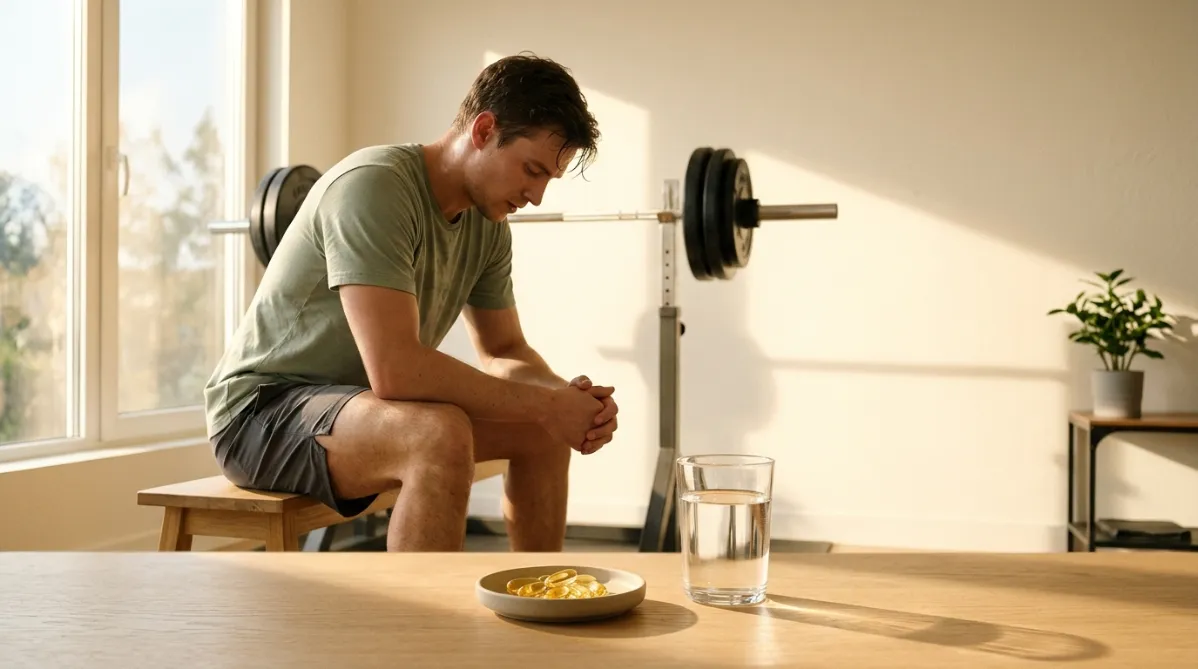
A sunlit, minimalist home gym corner photographed in soft golden morning light, with a young athletic man seated on a wooden bench, leaning forward with his elbows resting on his knees, catching his breath after a hard leg session. He wears a muted sage-green t-shirt and charcoal shorts, his face turned slightly away from the camera, calm and focused. A matte ceramic dish in the foreground holds a few small, translucent golden softgel capsules, with a glass of water beside it catching the light and casting a soft caustic shadow across a pale oak floor. Behind him, a loaded barbell rests on a squat rack, slightly out of focus, and a tall window pours warm sunlight diagonally across the scene, creating long gentle shadows and a hazy glow. A small potted green plant sits on a shelf at the edge of the frame. The color palette is warm and editorial: cream, soft gold, sage green, pale wood, and charcoal accents. Shallow depth of field, with crisp focus on the capsules and glass in the lower third and a creamy bokeh background. The composition leaves generous negative space on the right side for a headline overlay. The mood is clean, modern, and aspirational, like a high-end wellness magazine or a trendy health journal feature. Shot on a 50mm lens, natural light, fine film grain, subtle matte finish, landscape 16:9 framing.
recovery

Vitamine D versnelt krachtherstel bij mannen met voldoende vitamine‑D‑status

BY DR. GYMBRO ·

Mannen met volledig normale vitamine‑D‑waarden herstelden hun kracht sneller na een zware beentraining toen ze dagelijks 4.000 IU innamen. In deze gerandomiseerde, placebogecontroleerde proef met 28 actieve mannen was de piek‑isometrische kracht na 24 uur gemiddeld 8 % hoger. Markers voor spierschade, ALT en AST, stegen eveneens minder. Spierpijn bleef echter onaangedaan.

A bright, airy editorial photograph shot from above at a slight angle, showing a tall clear glass of deep violet blueberry smoothie on a pale oak wooden table. The smoothie has a creamy, velvety texture with a few lighter swirls, and a small cluster of fresh blueberries with dusty blue skins rests on the rim of the glass. A matte white ceramic bowl of whole blueberries sits to the left, with a few berries scattered naturally across the tabletop. A folded linen napkin in soft oatmeal tones and a stainless steel straw add subtle texture.

In the softly blurred background, a rolled-up sage green yoga mat leans against a light wall next to a pair of clean white running shoes and a small pair of brushed-metal dumbbells. A sliver of warm morning sunlight enters from the left window, casting gentle diagonal shadows and a golden glow across the table, with soft highlights on the glass and the berries' surface bloom.

The color palette is fresh and modern: deep indigo and violet from the smoothie, balanced by cream, warm beige, soft sage green, and touches of white. The composition follows the rule of thirds, with the glass placed on the right third and generous negative space on the left, suitable for headline overlay. Shallow depth of field, crisp focus on the glass and berries, creamy bokeh in the background. The mood is calm, healthy, and aspirational, like a contemporary wellness magazine or a trendy health journal website. Natural, realistic, high-end food and lifestyle photography style, 16:9 landscape format, clean and uncluttered.
nutrition

Blauwe bessen‑smoothie hielp vermoeide benen sneller hun kracht terug te krijgen

BY DR. GYMBRO ·

Tien vrouwen, 300 intensieve excentrische quadriceps‑contracties en één blauwe bessen‑smoothie. In deze gerandomiseerde crossover‑studie versnelde de bessendrank het herstel van de maximale isometrische kracht gedurende 60 uur (p = 0,047), terwijl een placebosmoothie met dezelfde antioxidantcapaciteit dat niet deed. Het suggereert dat het effect niet louter door antioxidanten wordt verklaard. Aangezien slechts één uitkomst significant was en de steekproef klein, blijven de bevindingen veelbelovend maar niet doorslaggevend.

A wide, landscape editorial photograph with soft natural morning light. In the foreground, a rustic matte ceramic bowl rests on a pale oak wooden table, filled with vivid deep-green spirulina powder heaped in a gentle mound. A small wooden spoon dusted with the powder lies beside it, and a few scattered green flecks dust the surface. Next to the bowl sits a clear glass of water with a swirl of emerald green just blending in, catching sunlight and casting soft green-tinted shadows.

In the middle ground, slightly out of focus, a pair of worn running shoes in muted sage and cream tones sits on the edge of the table, laces loosely undone. A simple analog stopwatch with a clean white face lies beside them, its hands frozen at a moment suggesting a close finish. A folded linen towel in warm oatmeal tone drapes casually nearby.

The background is a softly blurred outdoor setting seen through a large window: a quiet tree-lined running path at dawn, with golden-hazy light, dewy greenery, and a faint mist. The color palette is calm and modern: deep emerald, sage, cream, warm wood, and touches of soft gold. The composition leaves generous negative space on the right side for headline text, with a shallow depth of field, crisp detail on the powder texture, and a clean, minimalist, lifestyle-magazine aesthetic. Subtle film-like grain, natural shadows, and a fresh, healthy, energetic mood. No people, no text, no logos.
nutrition

Spirulina liet hardlopers 32 % langer doorgaan – maar er is een addertje onder het gras

BY DR. GYMBRO ·

Hardlopers die vier weken spirulina innamen, konden een maximale inspanning ongeveer 32 % langer volhouden na een uitputtende twee‑uur durende run. De studie liet ook een stijging van 10,9 % in vetoxidatie en hogere glutathionwaarden zien. Het addertje onder het gras? Er waren slechts negen mannelijke deelnemers, en de praktische winst bedroeg slechts zo’n 39 seconden. Hieronder lees je wat de studie precies liet zien, waarom het kan werken en hoe je het veilig kunt uitproberen.

This page is available in