Dr. Gymbro
A wide, landscape editorial photograph of a clean, sunlit kitchen counter or pale stone tabletop, styled like a modern wellness magazine spread. Two scoops sit side by side on a matte ceramic surface. The left one is a plain, humble wooden scoop heaped with fine white creatine powder. The right is a glossy, ornate brushed-gold scoop holding the same white powder, which hints at "premium" branding. Behind each scoop stands a tub. The left tub is minimal, matte, and cream-colored with simple sans-serif lettering and no readable words. The right tub is sleek black with metallic gold accents and an overly polished look. A few fine grains of powder are scattered across the surface, catching the light.

The composition uses a shallow depth of field. The foreground scoops are crisp, and the background softly blurs into a warm neutral palette of oatmeal, soft sage green, and muted terracotta. Soft morning window light comes in from the left, casting long, gentle shadows and a subtle highlight along the scoops' edges. A small price tag shape, blank and unmarked, sits near the gold scoop, with a slightly crumpled paper texture to suggest the "pricey" angle without any text. A glass of water with condensation and a folded linen napkin sit at the edge of the frame. A single green sprig or eucalyptus stem adds a natural accent.

The overall mood is calm, intelligent, and quietly skeptical, with the plain option feeling confident and the flashy one a bit overdressed. The color grading is soft and slightly desaturated with creamy highlights, and there is fine film grain. The layout leaves generous negative space on the right third for a headline overlay. It looks like a high-end lifestyle and science journal cover, with a minimalist, tactile, trendy feel and no futuristic or sci-fi elements.
Science & Research

Creatine ethyl‑ester versus monohydraat: het dure alternatief verliest

Dr. Gymbro · · 4 min read

Creatine ethyl‑ester versus monohydraat: het dure alternatief verliest

Supplementen‑marketing houdt van het woord “geavanceerd”. Als een basisingrediënt al decennialang wordt bestudeerd, verschijnt er iemand met een aangepaste versie die beter wordt opgenomen, meer kracht levert en milder is voor de maag. Creatine ethyl‑ester (CEE) is hier een schoolvoorbeeld van. Een gerandomiseerde, dubbel‑blinde studie uit 2009, gepubliceerd in Journal of the International Society of Sports Nutrition, zette het tegenover de gewone creatine monohydraat. De nieuwere vorm kwam niet als winnaar uit de bus.

Wat CEE claimt

Creatine monohydraat is de standaard, de vorm die in de meeste onderzoeken wordt gebruikt. Veel alternatieve formuleringen zijn ontwikkeld om de opname van creatine te maximaliseren, en van CEE werd beweerd de biologische beschikbaarheid te vergroten. De verkooppraat is simpel: voeg een ethyl‑ester‑groep toe, dan zou creatine efficiënter in de bloedbaan en spieren terechtkomen, zodat je minder nodig hebt en meer effect krijgt.

Dat is een toetsbare bewering, en Spillane en collega's hebben die getest. De vraag was of CEE de serum‑ en spier‑creatine zou verhogen en de trainingsresultaten ten minste even goed als monohydraat zou verbeteren.

Studiemethode en doseringen

De onderzoekers werven 30 mannen die nog geen weerstandstraining deden. De deelnemers werden willekeurig, dubbel‑blind, toegewezen aan één van de drie groepen:

  • Placebo (maltodextrine)
  • Creatine monohydraat (CRT)
  • Creatine ethyl‑ester (CEE)

Iedereen volgde een zwaar weerstandstrainingsprogramma gedurende zeven weken. Het supplementenregime bestond uit een laadfase van 0,30 g per kg vetvrije massa (ongeveer 20 g per dag) gedurende vijf dagen, gevolgd door een onderhoudsdosis van 0,075 g/kg (ongeveer 5 g per dag) voor de resterende 42 dagen. De groepen kregen gelijke doseringen, zodat eventuele verschillen alleen aan het type creatine konden worden toegeschreven.

Het team meette lichaamssamenstelling, spiermassa, kracht en explosiviteit, serum‑ en spier‑creatine, en serum‑creatinine.

Het serum‑creatinine‑resultaat

Dit was het meest opvallende resultaat. Serum‑creatine was significant hoger in de placebo‑groep (p = 0,007) en de monohydraat‑groep (p = 0,005) dan in de CEE‑groep. Een “beter opname” creatine die minder creatine in het bloed laat circuleren, strookt niet met de marketing.

Serum‑creatinine, het afbraakproduct van creatine, was hoger in de CEE‑groep dan in placebo (p = 0,001) of monohydraat (p = 0,001). Het was verhoogd op dag 6, 27 en 48. Dit patroon past bij de mogelijkheid dat CEE degradeert tot creatinine in plaats van als bruikbare creatine te worden gebruikt. De interpretatie is gebaseerd op bloedmarkers; de studie analyseerde niet direct de chemische afbraak. Maar de richting is duidelijk: de ester‑vorm resulteerde in meer afvalproduct.

Er is een praktisch gevolg. Serum‑creatinine is een standaardmarker die artsen gebruiken om de nierfunctie te schatten. Een supplement dat deze waarde doet stijgen, kan routine‑bloedonderzoek minder helder maken. De publicatie meldt geen nierschade, en een hogere creatininewaarde moet hier niet meteen als schadelijk worden gezien. Toch, als je creatine neemt en een bloedtest moet ondergaan, meld dit dan aan je arts zodat hij de cijfers in de juiste context kan interpreteren.

Spier‑creatine‑resultaten

De spierdata zijn genuanceerder. Totale spier‑creatine was significant hoger in zowel de monohydraat‑groep (p = 0,026) als de CEE‑groep (p = 0,041) ten opzichte van placebo, en er was geen significant verschil tussen de twee creatine‑vormen. Dus CEE verhoogde spier‑creatine vergeleken met placebo.

De auteurs concludeerden echter dat CEE niet zo effectief was als monohydraat voor het verhogen van serum‑ en spier‑creatine. Spier‑niveaus verschilden niet significant tussen de twee creatine‑groepen, maar de serum‑resultaten kozen duidelijk voor monohydraat, en CEE bood geen extra voordeel op enige uitkomst.

Verschilden kracht of omvang?

Nee, en dit gold voor alle groepen. Lichaamssamenstelling, lichaamswater, spierkracht en explosiviteit veranderden allemaal significant in de loop van de tijd, maar er waren geen significante verschillen tussen de groepen. Zelfs de placebogroep verbeterde even hard als de creatine‑groepen.

De auteurs concludeerden dat de verbeteringen waarschijnlijk toe te schrijven waren aan de training zelf en niet aan de supplementatie. Dit was een zeven‑weekse trial bij ongetrainde beginners, een populatie die snel vooruitgang boekt met bijna elk gestructureerd programma, waardoor kleinere supplement‑effecten gemakkelijk kunnen verdwijnen. De trial kan niet stellen dat CEE nooit spieropbouw stimuleert, alleen dat het hier geen voordeel liet zien. Ook toonde monohydraat geen duidelijk voordeel ten opzichte van placebo op kracht in deze sample, dus het is beter te lezen als “CEE bood geen voordeel” dan als een triomf van monohydraat.

Conclusie en praktische tips

De marketing beloofde betere opname. De data lieten lagere serum‑creatine, hogere serum‑creatinine, vergelijkbare spier‑creatine met monohydraat, en geen extra winst in lichaamssamenstelling, kracht of explosiviteit zien.

  • Blijf bij creatine monohydraat. Het is de best onderzochte vorm en doorgaans het goedkoopst. Een gangbare dosering is 3‑5 g per dag.
  • Laden is optioneel. Deze studie gebruikte een vijf‑daagse laadschema van ongeveer 20 g per dag, maar een constante dagelijkse dosis is een gebruikelijk alternatief dat langzaam tot dezelfde resultaten leidt.
  • Betaal geen premie voor “geavanceerde” vormen tenzij er solide vergelijkende onderzoeken bestaan – bij CEE wijst het bewijs in de andere richting.
  • Let op je bloedwaarden. Een hoge serum‑creatininewaarde, vooral bij CEE, kan nierfunctietests vertroebelen. Meld je supplementen aan je arts.
  • Training staat op de eerste plaats. In deze trial leverde het trainingsprogramma het grootste deel van de resultaten.

Bron

Spillane M, et al. The effects of creatine ethyl ester supplementation combined with heavy resistance training on body composition, muscle performance, and serum and muscle creatine levels. J Int Soc Sports Nutr. 2009. DOI: 10.1186/1550-2783-6-6. PubMed: 19228401.
Original study

Read the original research on pubmed.ncbi.nlm.nih.gov →

This article summarizes published research for general information. It is not medical advice.

DG

Written by

Dr. Gymbro

Dr. Gymbro writes for Dr. Gymbro: science-backed fitness, nutrition & performance.

Related Articles

A wide landscape editorial photograph of a bright, airy sunlit living room with pale oak floors and a large window with sheer linen curtains. In the center, a woman in her late 50s with silver-streaked hair, wearing soft sage-green athletic wear, rises from a simple wooden chair, caught mid-motion with a calm, determined expression. Her hands are lightly extended forward for balance. Beside her on a small round oak side table sits a ceramic mug of tea, a glass of water, and a small matte white jar with a wooden scoop resting beside it, a few fine white crystalline grains scattered on the tabletop. In the soft-focus foreground, a pair of light-gray dumbbells and a rolled terracotta-colored yoga mat rest on the floor. A trailing green pothos plant spills from a shelf in the background, with a stack of books and a small analog kitchen timer nearby.

The color palette is warm and muted: cream, sage green, soft terracotta, natural wood, and gentle morning-gold light. Light streams diagonally across the scene, creating long soft shadows and a subtle glow on the woman's shoulders. Shallow depth of field blurs the background gently, while the woman and the table remain crisp. The composition follows the rule of thirds, with the woman on the right and generous negative space on the left, suited for headline overlay. The mood is hopeful, grounded, and modern, like a high-end wellness magazine or a trendy health journal. Natural film-like grain, soft contrast, and a slight matte finish give it a contemporary lifestyle photography feel. There are no futuristic elements, no digital overlays, and no text.
science research

Creatine hielp vrouwen met slechte knieën beter opstaan – niet om de reden die je denkt

BY DR. GYMBRO ·

Creatine wordt meestal gepromoot bij jonge krachtsporters, maar een gerandomiseerde, dubbelblinde studie onderzocht het bij postmenopauzale vrouwen met kniegewricht‑artrose. Na twaalf weken beentraining steeg de timed‑stands‑score van de creatine‑groep van 15,7 naar 18,1, terwijl de placebogroep vrijwel onveranderd bleef. Creatine verbeterde bovendien stijfheid, lean‑massa en de kwaliteit van leven. Pijnvermindering en maximale leg‑press‑kracht waren echter niet beter dan bij placebo. Hieronder zie je wat de cijfers laten zien en voor wie dit echt relevant kan zijn.

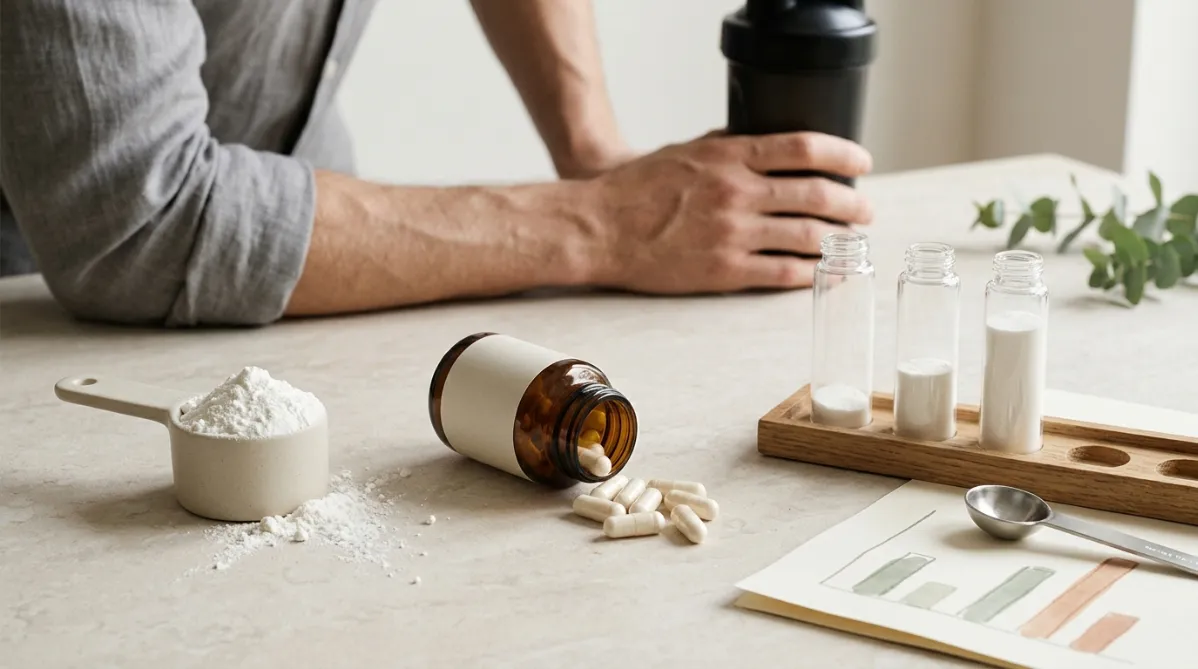
A modern editorial still life photographed from a slightly elevated angle on a pale, matte stone surface in soft natural window light. On the left, a heaping mound of fine white creatine monohydrate powder spills from a matte ceramic scoop, with a few crisp grains scattered across the surface. In the center, a small, minimalist amber glass capsule bottle sits tipped on its side, with a handful of off-white capsules spilling out. The label is blank and clean. On the right, a neat row of three clear glass lab-style vials rests on a slim oak tray. The vials hold different amounts of white powder: the first nearly empty, the second slightly fuller, the third filled almost to the brim. This quietly suggests the difference in dose and result. Beside the tray lies a simple stainless steel measuring spoon and a folded sheet of cream paper with soft, abstract bar-chart lines in muted sage green and terracotta. The lines are hand-drawn and unlabeled.

Behind the objects, slightly out of focus, a lean athletic forearm in a gray linen sleeve rests on the edge of the surface, one hand loosely holding a matte shaker bottle. This hints at a training context without showing a face. A single sprig of eucalyptus in the corner adds a soft organic touch.

The palette is warm neutral: bone white, oatmeal, soft sage, muted terracotta, and touches of amber. Shadows are gentle and long, with a shallow depth of field that gives creamy bokeh in the background. The mood is calm, clean, and trustworthy, like a premium health and science journal's feature spread, with generous negative space at the top and right for headline overlay. The composition is wide, balanced, and uncluttered, with subtle film-like grain and a natural, true-to-life color grade. No text, no logos, no futuristic elements.
nutrition

Labeldosering van Kre‑Alkalyn verhoogt spiercreatine niet, blijkt uit biopsieën

BY DR. GYMBRO ·

Gebufferde creatine, zoals Kre‑Alkalyn, belooft een betere opname, lagere doseringen en minder opgeblazen gevoel. Een dubbelblinde studie van Texas A&M heeft dit getest met echte spierbiopsieën bij 36 getrainde lifters gedurende 28 dagen. Bij de door de fabrikant aanbevolen dosis van 1,5 g per dag steeg de spiercreatine nauwelijks, terwijl creatine monohydraat duidelijk meer toenam. Kracht, lichaamssamenstelling en bijwerkingen lieten geen enkel voordeel van het gebufferde product zien. Hieronder staan de cijfers en hoe je creatine op de juiste manier doseert.

A landscape editorial photograph of a clean, sunlit kitchen-counter or light oak table, shot from slightly above at a gentle angle. Three small matte ceramic bowls in muted sage green, warm sand, and soft white sit in a loose row. Each holds a different fine white powder, and each has a small wooden scoop resting beside it. The middle bowl is slightly closer to the camera and sharper in focus, with a faint dusting of powder spilling onto the surface. In the soft-focus background, a stainless steel shaker bottle and a half-peeled orange sit beside a folded linen napkin, suggesting citrus without being literal. A single lemon wedge sits near the left bowl, and a small dried apricot sits near the right, a subtle visual nod to citrate and pyruvate.

In the background, a blurred athletic scene: a running shoe resting on a wooden bench and a small notebook with a pen, suggesting a training log. Soft diffused morning light enters from the left through a window and casts long, gentle shadows. The palette is warm neutrals, creamy whites, soft greens, and a hint of terracotta orange. The look is a modern wellness magazine with a shallow depth of field, a fine-grain film feel, and generous negative space on the right third of the frame for title text. The mood is calm, trustworthy, and scientific yet approachable, with no text, labels, or logos.
nutrition

Creatinepyruvaat vs. citraat: één vorm houdt de kracht langer hoog

BY DR. GYMBRO ·

Twee chique creatine‑vormen versloegen placebo in een proef van 28 dagen, maar slechts één hield de spierkracht gedurende alle tien de all‑out intervallen hoog, terwijl de andere vervaagde. Creatinepyruvaat verhoogde de kracht in elke interval (p < 0.001), terwijl het voordeel van creatinecitraat tegen de zesde interval verdween. Alleen pyruvaat verbeterde bovendien de relaxatiesnelheid en het zuurstofverbruik in rust. De studie bevatte echter geen creatine‑monohydraatgroep. Hieronder lees je wat de cijfers laten zien, wat de studie niet kan bewijzen en hoe je een keuze maakt.

A wide, editorial-style still life photographed from slightly above on a pale oak surface in soft morning window light. At the center, a small matte white supplement tub with a plain, unlabeled front sits tipped on its side, spilling a modest pile of fine white powder across the wood. Beside it, a wooden scoop rests in the powder, and a few white capsules are scattered in a loose arc. To the left, a clean glass of water catches the light and throws a delicate caustic shadow. To the right, a neatly arranged group of whole foods sits in contrast: two brown eggs, a small wedge of salmon fillet on parchment, a handful of raw almonds, and a sprig of rosemary. A matte black steel dumbbell handle is partly visible at the top edge of the frame, grounding the fitness theme. In the lower foreground, a slim, open linen-bound notebook holds a hand-drawn line graph with a single line trending gently downward, a thin ink pen lying across the page. The palette is muted and warm: cream, soft sage green, pale oak, charcoal accents, and a touch of terracotta from a ceramic dish holding the almonds. Shallow depth of field blurs the background, a softly lit minimalist kitchen counter with a hint of a plant leaf. The mood is calm, thoughtful, and scientific without being clinical, like a cover image for a contemporary health and nutrition journal. Natural shadows, subtle film grain, and generous negative space on the upper left leave room for a headline overlay. Crisp focus on the powder and scoop, with refined, understated composition and no text or logos visible.
nutrition

D‑asparaginezuur verlaagde testosteron bij 6 g/dag bij getrainde krachtsporters

BY DR. GYMBRO ·

D‑asparaginezuur wordt geprezen als een natuurlijke testosteronbooster, maar in een gerandomiseerde studie met 24 ervaren gewichtheffers verlaagde een inneming van 6 g per dag zowel totaal‑ als vrij testosteron. Een dosis van 3 g – de hoeveelheid die op veel etiketten staat – had geen meetbaar effect. Een latere drie‑maanden‑studie toonde evenmin een kracht‑ of spiervoordeel. Hier lees je wat de studie aantoont, waarom getrainde mannen anders kunnen reageren dan sedentair, en waar je supplementengeld beter aan kunt besteden.

This page is available in