Dr. Gymbro
A landscape editorial still life on a pale oatmeal-colored linen surface, photographed in soft morning window light with long, gentle shadows. On the left, a small matte ceramic bowl holds fine white creatine powder, with a wooden measuring spoon resting beside it, a few grains scattered across the fabric. Next to it sits a minimalist amber glass supplement jar with a plain cream label and no readable text, its lid set beside it. In the center, a rumpled white cotton pillow and a loosely folded sage-green blanket suggest a night without sleep. On top rests a vintage brass alarm clock with its hands at a pre-dawn hour. To the right, a thin glass of water and a ceramic mug of black coffee send up a faint curl of steam, backed by a half-drawn sheer curtain that lets in pale blue-gray dawn light with a warm peach glow at the horizon.

Along the back edge, a few delicate botanical stems of dried eucalyptus and a small sprig of green leaves add organic texture. Nearby lies an open notebook with abstract hand-drawn graph lines, a simple line chart with two diverging curves, and a pencil. The notebook symbolizes the study's mixed findings, one line rising and the other flat, without any legible words or numbers.

The palette is muted and modern: warm cream, soft sage, dusty terracotta, muted amber, and cool dawn blue. The composition follows the rule of thirds, with generous negative space on the upper right for headline overlay. The shallow depth of field blurs the background into a creamy bokeh. The mood is quiet, contemplative, and slightly tired but hopeful, like a trendy wellness and science journal cover with a refined, tactile, natural feel. High-resolution photography with subtle film grain, no people, no text, and no futuristic elements.
Science & Research

Creatine + GAA na een slapeloze nacht: hersenboost of illusie?

Dr. Gymbro · · 4 min read

Een slapeloze nacht, één supplement en een hersensignaal dat niemand verwachtte

Je hebt een hele nacht doorgehaald en een op creatine gebaseerd supplement zou de zuurstofvoorziening in je frontale en temporale cortex kunnen hebben veranderd. In deze studie maakte het je echter niet meetbaar scherper. Die kloof tussen wat de hersenscans laten zien en wat de aandachtstesten aantonen, is het meest intrigerende aspect van een nieuwe gerandomiseerde trial van een Servisch onderzoeksteam, gepubliceerd in Nutrition and Health.

Wat is GAA en waarom combineren met creatine?

Guanidinezuur (GAA) is de directe metabole voorloper van creatine. Het lichaam maakt het uit de aminozuren arginine en glycine, waarna het in een laatste methylatiestap wordt omgezet in creatine. Beide verbindingen zijn betrokken bij het cellulaire energie‑bufferen, waardoor ze interessant zijn voor onderzoekers die zich richten op spier‑ en hersenbio‑energetiek. De proef onderzocht een gecombineerd creatine‑GAA‑product in plaats van de afzonderlijke stoffen.

Hoe de studie is opgezet

Zesentwintig gezonde jonge volwassenen voltooiden een protocol van 24 uur slaapdeprivatie. Ze werden willekeurig toegewezen aan één van vier condities:

  • creatine‑GAA
  • inademing van moleculaire waterstof
  • cafeïne
  • placebo

Onderzoekers maten regionale hersenoxygenatie met functionele nabij‑infraroodspectroscopie (fNIRS) in de frontale, temporale en occipitale cortex. Deelnemers deden dit terwijl ze een aangepaste Attention Network Test (ANT) uitvoerden. Deze test leverde bovendien scores op voor waakzaamheid, executieve controle, oriëntatie, reactietijd en nauwkeurigheid.

Wat verbeterde

De creatine‑GAA‑groep liet duidelijke stijgingen in zuurstofverzadiging zien:

  • Frontale cortex: van 50,8 % ± 4,1 % naar 61,0 % ± 5,9 % (P = 0,01; Cohen's d = 2,00)
  • Temporale cortex: van 63,1 % ± 4,8 % naar 70,2 % ± 2,6 % (P = 0,01; Cohen's d = 1,83)

De tijd‑bij‑behandeling‑interacties, die testen of groepen verschillend veranderden over tijd, waren significant voor frontale zuurstofverzadiging (P = 0,043), temporale zuurstofverzadiging (P = 0,021) en occipitale totale hemoglobine (P = 0,022). De auteurs benadrukken de frontale en temporale regio's als de belangrijkste plekken van voordeel.

Wat niet verbeterde

Dit is het cruciale punt. Er waren geen significante tussen‑groepverschillen in aandachtgerelateerde uitkomsten. Waakzaamheid, executieve controle, oriëntatie, reactietijd en nauwkeurigheid verschilden de behandelingen niet meetbaar. In de samenvatting staat dat de zuurstofwinsten kwamen "zonder meetbare verbeteringen in aandachtgerelateerde prestaties." Een hogere zuurstofwaarde op een scan vertaalde zich hier dus niet naar betere testresultaten.

Lees de cijfers met voorzichtigheid

Verschillende beperkingen gelden, en de auteurs noemen de bevindingen zelf preliminair:

  • Kleine steekproef. Tweeëntwintig deelnemers over vier armen betekenen zeer weinig per groep (rond de vijf‑ tot zes personen). Kleine trials leveren vaak opgeblazen effectgroottes op; een Cohen's d rond 2 is ongewoon groot.
  • Alleen gezonde jonge volwassenen. De resultaten zijn mogelijk niet generaliseerbaar naar ouderen, klinische populaties of mensen met chronisch slaaptekort.
  • Acute, eenmalige blootstelling. Het was een korte interventie na één nacht zonder slaap. Het zegt niets over herhaald gebruik.
  • Surrogaatuitkomst. fNIRS‑oxygenatie is een indirecte hersenmaat; de paper toont niet dat dit leidt tot functionele winst in de echte wereld.
  • Menselijke trial, maar geen grootschalige. Het is geen dier‑ of celstudie, maar ook geen definitief bewijs. De auteurs roepen op tot grotere gerandomiseerde trials.

De samenvatting beschrijft bovendien niet hoe de vergelijkingsgroepen scoorden op zuurstof, dus er kunnen geen conclusies worden getrokken over creatine‑GAA versus cafeïne of waterstofinhalatie.

Dosis en timing: wat we wel en niet kunnen zeggen

De samenvatting vermeldt niet de creatine‑GAA‑dosis, de verhouding tussen de twee stoffen, of precies wanneer het werd ingenomen ten opzichte van de test. Controleer de volledige tekst (DOI: 10.1177/02601060261499900) voordat je een protocol kopieert. Elke doseringsaanbeveling hier zou giswerk zijn, en dit artikel biedt er geen.

Wie zou het kunnen interesseren (en wie moet niet overdrijven)

De voor de hand liggende doelgroepen zijn ploegendienstwerkers, studenten die laat moeten studeren en atleten die te maken hebben met verstoorde slaap of reizen. De studie toont geen praktische voordelen voor deze groepen. Het onderzocht gezonde jonge volwassenen na één nacht slaapverlies en vond geen verbetering in aandacht. Voor deze groepen is de bevinding een onderzoeks‑lead, geen prestatie‑strategie.

GAA verschilt ook van standaard creatine‑monohydraat, dat een veel grotere hoeveelheid veiligheid‑ en effectiviteitsonderzoek kent. De samenvatting zegt niets over bijwerkingen, dus iedereen met een medische aandoening, of die zwanger is of medicijnen gebruikt, moet eerst een arts raadplegen voordat hij een nieuw supplement uitprobeert.

Praktische take‑aways

  1. Slaap blijft eerst. Geen enkel supplement in deze trial herstelde de gemeten aandacht na een nacht zonder slaap.
  2. Het zuurstofsignaal is reëel in deze dataset, maar geen bewijs van functionele betekenis. Het is een intrigerend vroeg resultaat, geen bewijs van beter denken.
  3. Dosis en timing zijn ongespecificeerd in de samenvatting. Kijk naar het volledige artikel, niet naar supplement‑marketing.
  4. Wacht op replicatie. Grotere gerandomiseerde trials met functionele uitkomsten zijn nodig voordat dit een aanbeveling wordt.

De conclusie

Creatine‑GAA lijkt de frontale en temporale hersenoxygenatie te verhogen na 24 uur slaaptekort. Of dat van belang is voor concentratie, veiligheid of prestaties blijft onduidelijk. Voor nu is dit een veelbelovend signaal voor onderzoekers om verder te volgen, geen reden om je all‑night‑routine te herstructureren.
Original study

Read the original research on pubmed.ncbi.nlm.nih.gov →

This article summarizes published research for general information. It is not medical advice.

DG

Written by

Dr. Gymbro

Dr. Gymbro writes for Dr. Gymbro: science-backed fitness, nutrition & performance.

Related Articles

A wide, softly lit morning scene on a pale oak desk beside a window, shot from a slightly elevated three-quarter angle. In the foreground, a clear glass of water is half-filled with dissolved white creatine powder, tiny suspended particles catching the light. A wooden scoop heaped with fine white powder rests beside it, with a few grains scattered across the wood. A matte ceramic mug of black coffee sits slightly out of focus to the right, with a thin curl of steam. Behind them, a rumpled linen-white bed with a muted sage-green throw blanket suggests a sleepless night. Early dawn light spills through sheer curtains and creates long, gentle shadows and a warm peach-and-pale-blue gradient on the wall. On the desk, a minimalist analog alarm clock reads close to 6 a.m., and a small open notebook with a pen lies beside it, its handwriting blurred. A single green plant in a terracotta pot adds a fresh organic touch at the left edge. The color palette is calm and editorial: cream, soft sage, warm oak, dusty peach and muted slate blue. The depth of field is shallow, with crisp focus on the glass and scoop and a creamy bokeh background. The mood is quiet, restorative and contemplative, like a modern wellness magazine or a trendy health journal cover. The composition leaves open negative space in the upper left for title overlay. The image has a natural film-like texture, soft contrast and a clean, minimalist, lifestyle-photography look, with no text, logos or futuristic elements.
nutrition

Een 0,35 g/kg creatine‑dosis bestrijdt slaapgebrek‑gerelateerde hersenmist in enkele uren

BY DR. GYMBRO ·

Creatine is het meest gebruikte supplement in de sportschool, maar een studie uit 2024 suggereert dat een enkele hoge dosis ook binnen enkele uren slaapgebrek‑gerelateerde hersenmist kan verminderen. De proeftoestand kreeg één dosis van 0,35 g/kg – ongeveer 25‑28 g voor de meeste volwassenen – en toonde veranderingen in hersen‑energie‑markers, preventie van een dalende hersen‑pH en verbeterde cognitieve prestaties tijdens 21 uur zonder slaap. De dosis is vijf keer de gebruikelijke onderhoudsdosering van 3‑5 g; de studie was klein en laboratorium‑gebaseerd en ging gepaard met een verhoogd risico op maag‑ en darmklachten.

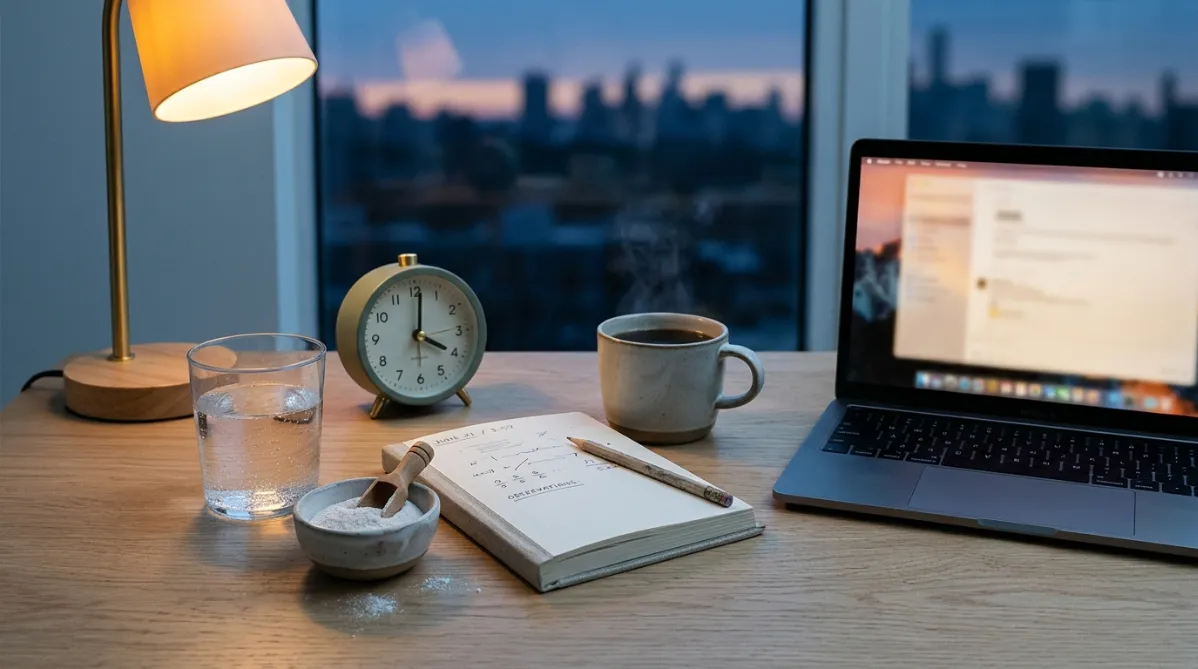
A wide, softly lit editorial still life photographed on a pale oak desk at the blue hour just before dawn. In the center-left foreground, a clear glass of water sits beside a small ceramic dish holding a mound of fine white powder, with a matte wooden scoop resting beside it, a light dusting of powder scattered across the wood grain. Behind them, a minimalist analog alarm clock in muted sage green reads close to 4:00. Next to it is an open linen-bound notebook with a pencil and a few abstract handwritten lines, plus a ceramic mug of black coffee with a thin trail of steam. To the right, a slim laptop is open to a blurred, softly glowing screen with no legible text. A window in the background shows a deep indigo sky turning peach at the horizon, with soft city silhouettes out of focus. Warm light from a small brass desk lamp creates a gentle pool of amber on the desk, contrasting with the cool blue ambient light from the window. The palette is muted and modern: dusty blue, warm cream, soft sage, and a touch of apricot. Shallow depth of field, fine film grain, and generous negative space on the right third for title overlay. The mood is calm, focused, and slightly weary but hopeful, like a contemporary health and science magazine cover. Clean composition, natural textures, subtle shadows, and a high-end lifestyle photography aesthetic.
nutrition

Creatine vóór een nacht zonder slaap? Een lagere dosis vermindert nog steeds de hersencrash

BY DR. GYMBRO ·

Wat als één grote lepel creatine de hersenmist van een slapeloze nacht zou kunnen verzachten? Een nieuwe studie in *Nutrients* toont aan dat een enkele dosis van 0,2 g/kg – ongeveer 14‑16 g voor de meeste volwassenen – de achteruitgang in logische, numerieke, taalsnelheids‑ en waakzaamheidstaken tijdens 21 uur slaapdeprivatie vermindert, met verbeteringen tot wel 12 %. Vrouwen lijken er meer baat bij te hebben. De studie betrof echter slechts 29 deelnemers, de dosis ligt meerdere malen hoger dan de gebruikelijke onderhoudsdosis, en het effect is kleiner dan in de eerdere 0,35 g/kg‑studie van dezelfde onderzoeksgroep. Hieronder lees je wat de gegevens wel en niet laten zien.

A wide, editorial-style still life photographed from slightly above on a pale oat-colored linen surface, lit by soft morning window light from the left. In the center sits a small matte ceramic bowl holding a mound of fine white powder, with a minimalist wooden scoop resting beside it. Next to the bowl is an open amber glass supplement jar with a plain cream label, and a few white capsules spill across the linen in a loose arc.

To the right, a neatly arranged cluster of analog "study" objects suggests careful measurement: a vintage stopwatch with a clean white face, a slim notebook with a sage-green cover open to a hand-drawn bar chart (blurred, no legible text), and a mechanical pencil lying across the page. A small row of six identical ceramic dishes, each holding a pinch of powder, is lined up along the top edge of the frame to hint at the six-week trial. One dish is slightly out of alignment, a subtle visual cue for ambiguity.

A shallow glass of water and a single sprig of green eucalyptus add a calm, organic note in the foreground. Soft, long shadows fall across the textured linen, and the palette stays restrained: warm cream, soft sage, muted terracotta, pale gray, and touches of amber from the glass jar. A few translucent paper cutouts in two tones (sage and blush) overlap in the upper right corner as a modern graphic accent, evoking overlapping data points without showing any numbers.

Depth of field is shallow, with the bowl and stopwatch in crisp focus and the edges gently softened. The composition leaves generous negative space on the left third for title text overlay. The overall mood is thoughtful, balanced, and quietly skeptical, in the style of a contemporary wellness and science magazine: clean, tactile, minimal, with a subtle film-like grain and natural color grading. No people, no futuristic or sci-fi elements, no readable text or logos.
nutrition

GAA‑breinbooster? De resultaten van de 6‑weekse proef zijn gemengd

BY DR. GYMBRO ·

GAA, de creatine‑voorloper die als breinbooster wordt aangeprezen, heeft nu zijn eerste serieuze onderzoek bij mensen ondergaan. In een dubbelblind, placebo‑gecontroleerd onderzoek van zes weken met 58 gezonde volwassenen leverde GAA iets snellere reactietijden op en een bont palet aan stemmings‑ en stresssignalen. De meeste cognitieve tests toonden echter geen effect en veel opvallende bevindingen waren slechts trends. Veiligheidsmarkers waren ongestoord, maar de studie was klein, verkennend en miste een zuivere creatine‑controlergroep. Hieronder lees je wat de resultaten echt betekenen, voor wie ze interessant kunnen zijn en waarom het oordeel gemengd is.

A landscape editorial photograph of a sunlit kitchen table in soft morning light. An older adult's hands, with silver hair and a cream knit sleeve just visible, rest around a ceramic mug. Beside the mug are two small matte white ceramic dishes. One holds a mound of fine white powder, and the other holds a slightly different crystalline white powder. Two wooden spoons lie next to them. A handheld hand-grip dynamometer in muted sage green sits on a linen placemat in the foreground, slightly out of focus. A small open notebook with a pencil and a pair of round tortoiseshell reading glasses sit nearby, with no legible text.

The tabletop is pale oak with a visible grain. Behind it, a window with sheer curtains lets in warm golden light, and the blurred shapes of a trailing green pothos plant and a pale terracotta vase show in the background. The color palette is warm cream, sage green, soft terracotta, and pale wood, with a touch of muted navy from a folded napkin. The mood is calm, thoughtful, and quietly scientific without any laboratory feel.

The composition follows the rule of thirds. The hands and dishes sit in the left-center, and generous negative space on the right is suitable for a title overlay. Shallow depth of field, 50mm lens look, gentle film grain, and soft shadows. Modern lifestyle-magazine and health-journal aesthetic, natural and unstaged, high-end editorial photography.
nutrition

Voorloper van creatine verslaat creatine voor gripkracht bij 65‑plussers

BY DR. GYMBRO ·

Een acht‑weekse pilot met 21 ouderen (≥ 65 jaar) liet zien dat guanidinoazijnzuur (GAA), de directe voorloper van creatine, de handgreepkracht meer verhoogde dan creatine‑monohydraat. De studie had geen trainingsinterventie, de betrouwbaarheidsintervallen kropen net boven nul en de resultaten waren voornamelijk gebaseerd op bio‑elektrische impedantie. GAA onderdrukte myostatin sterker en leverde volgens BIA‑metingen een grotere winst in spiergerelateerde parameters, hoewel dit deels door vochtverschuivingen kan komen. Een mogelijke verhoging van homocysteïne blijft een aandachtspunt, omdat de omzetting van GAA methylgroepen verbruikt. Hieronder lees je wat de studie toonde, wat de beperkingen zijn en waarom creatine‑monohydraat nog steeds de beproefde standaard is.

This page is available in