Dr. Gymbro
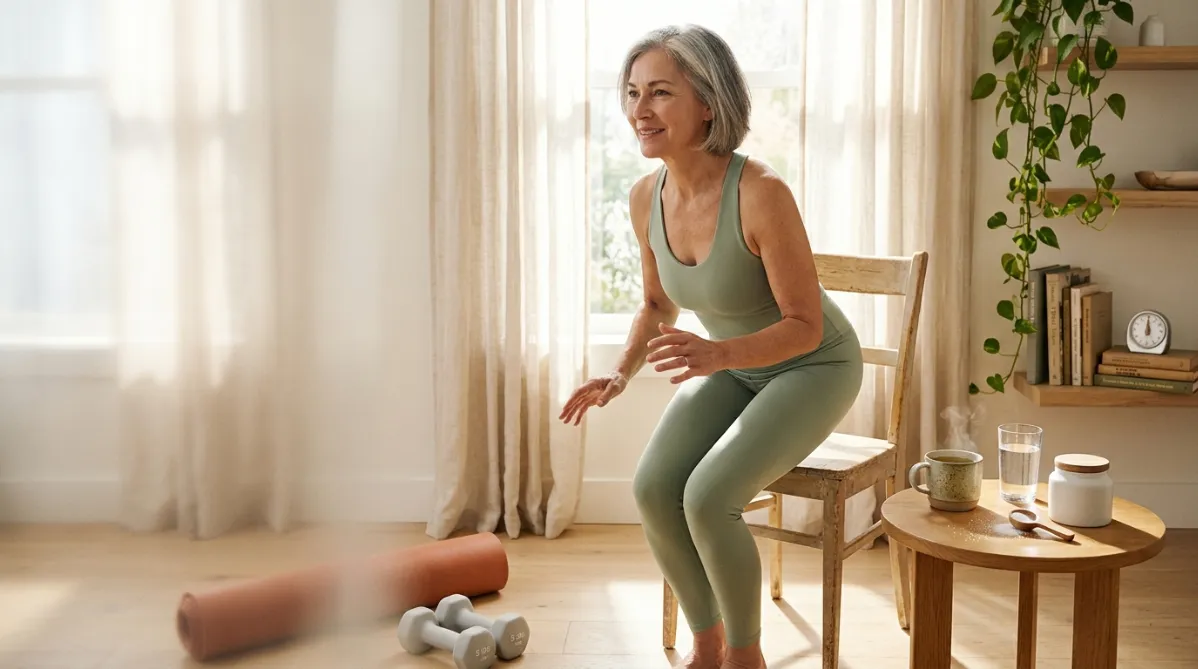
A wide landscape editorial photograph of a bright, airy sunlit living room with pale oak floors and a large window with sheer linen curtains. In the center, a woman in her late 50s with silver-streaked hair, wearing soft sage-green athletic wear, rises from a simple wooden chair, caught mid-motion with a calm, determined expression. Her hands are lightly extended forward for balance. Beside her on a small round oak side table sits a ceramic mug of tea, a glass of water, and a small matte white jar with a wooden scoop resting beside it, a few fine white crystalline grains scattered on the tabletop. In the soft-focus foreground, a pair of light-gray dumbbells and a rolled terracotta-colored yoga mat rest on the floor. A trailing green pothos plant spills from a shelf in the background, with a stack of books and a small analog kitchen timer nearby.

The color palette is warm and muted: cream, sage green, soft terracotta, natural wood, and gentle morning-gold light. Light streams diagonally across the scene, creating long soft shadows and a subtle glow on the woman's shoulders. Shallow depth of field blurs the background gently, while the woman and the table remain crisp. The composition follows the rule of thirds, with the woman on the right and generous negative space on the left, suited for headline overlay. The mood is hopeful, grounded, and modern, like a high-end wellness magazine or a trendy health journal. Natural film-like grain, soft contrast, and a slight matte finish give it a contemporary lifestyle photography feel. There are no futuristic elements, no digital overlays, and no text.
Science & Research

Creatine hielp vrouwen met slechte knieën beter opstaan – niet om de reden die je denkt

Dr. Gymbro · · 4 min read

De onverwachte vondst in een knie‑artrose‑studie

Creatine heeft een reputatieprobleem: het wordt vaak gezien als het supplement voor 22‑jarigen die naar een personal record jagen. Maar een gerandomiseerde proef, gepubliceerd in Medicine & Science in Sports & Exercise, onderzocht het bij een heel andere doelgroep: postmenopauzale vrouwen met knie‑artrose (OA). De creatine‑groep stond sneller op uit een stoel. Hun krachttoename was niet groter dan die van de placebogroep en er was ook geen extra pijnvermindering.

Hier lees je wat de studie werkelijk aantoonde en wat er niet uit blijkt.

De studie in één oogopslag

  • Opzet: Gerandomiseerde, dubbelblinde, placebogecontroleerde trial (Neves et al., 2011, University of São Paulo)
  • Deelnemers: Postmenopauzale vrouwen met knie‑OA
  • Steekproef: Het gepubliceerde abstract vermeldt het aantal deelnemers niet. Raadpleeg de volledige tekst voordat je de resultaten sterk laat meewegen; dergelijke trials zijn vaak klein.
  • Interventie: Creatine (20 g/dag gedurende 1 week, daarna 5 g/dag) of placebo
  • Training: Alle deelnemers volgden een onderlichaam‑weerstandstrainingsprogramma
  • Duur: 12 weken, met metingen bij start en aan het einde
  • Primaire uitkomst: Lichamelijke functie, gemeten met de timed‑stands‑test

Omdat beide groepen trainden, ging de vraag niet "verslaat creatine niets doen?", maar "voegt creatine iets toe bovenop krachttraining?".

Het kopnummer: sneller opstaan

De timed‑stands‑score van de creatine‑groep steeg van 15,7 ± 1,4 naar 18,1 ± 1,8, een winst van 2,4 punten (≈ 15 %). De placebogroep ging van 15,0 ± 1,8 naar 15,2 ± 1,2 – praktisch onveranderd. De verbetering binnen de creatine‑groep was statistisch significant (p = 0,006) en ook het verschil tussen groepen (p = 0,004).

De placebogroep deed dezelfde training maar vertoonde geen betekenisvolle verandering op deze test. Dat maakt het resultaat intrigerend.

Meer winst, alleen bij creatine

De voordelen beperkten zich niet tot de primaire test. Alleen de creatine‑groep liet significante verbeteringen zien in:

  • WOMAC fysieke functie: p = 0,005
  • WOMAC stijfheid: p = 0,024
  • Lean‑massa onderlichaam: p = 0,04
  • Kwaliteit van leven: p = 0,01

De placebogroep vertoonde geen significante veranderingen in de WOMAC‑subschalen functie en stijfheid (p > 0,05). De WOMAC is een gestandaardiseerde vragenlijst waarbij patiënten zelf hun pijn, stijfheid en moeite met dagelijkse taken beoordelen, dus dit zijn veranderingen die de vrouwen zelf merkten.

Waar creatine niet won

Hier kan een te enthousiaste kop snel misleiden, dus de kanttekeningen zijn belangrijk.

Pijn: Beide groepen rapporteerden een significante pijnvermindering (p < 0,05). Creatine was hier niet beter dan placebo. De meest waarschijnlijke oorzaak is het gezamenlijke element: de begeleide weerstandstraining, hoewel de studie dat niet afzonderlijk kan aantonen. Creatine blijkt geen pijnstiller te zijn voor artritische knieën.

Maximale kracht: Het één‑herhalingsmaximum (1RM) op de leg‑press steeg in beide groepen (p = 0,005), zonder verschil tussen hen (p = 0,81). Creatine maakte deze vrouwen niet sterker op de leg‑press dan placebo.

Kortom, het verhaal is niet "creatine bouwt meer kracht". Iets anders lijkt te gebeuren: betere functionele prestaties en meer lean‑massa zonder een meetbare winst in 1RM. De auteurs concluderen dat het effect beperkt is tot fysieke functie, onderlichaam‑lean‑massa en kwaliteit van leven.

Waarom kan functie verbeteren zonder een krachtvoordeel?

Het abstract van de paper geeft hier geen eenduidig antwoord, dus beschouw het volgende als onderbouwde speculatie. Chair‑stand‑tests belonen herhaalde inspanningen, niet één maximale lift. Creatine ondersteunt snelle energietransacties in spier tijdens korte, herhaalde inspanningen – precies wat een herhalings‑test vereist. De extra lean‑massa in de benen kan ook hebben bijgedragen. Een 1RM‑test en een herhaalde‑staan‑test meten verschillende aspecten, waardoor verschillend kan worden gereageerd.

Wat dit voor jou betekent

Dosering: De trial gebruikte een laadfase van 1 week met 20 g/dag, daarna 5 g/dag. De gebruikelijke onderhoudsdosis is 5 g/dag; dat is het deel om je op te focussen. Laden maakte deel uit van dit protocol, maar de studie testte niet of het weglaten van de laadfase de resultaten zou veranderen.

Timing: Het abstract vermeldt niet wanneer de deelnemers het supplement innamen, dus er kunnen geen uitspraken over een optimaler tijdstip worden gedaan. Consistentie is belangrijker dan het uur van de dag.

Training: Creatine werd gecombineerd met onderlichaam‑weerstandstraining gedurende 12 weken. Het resultaat geldt dus voor creatine plus training, niet voor creatine op zichzelf. Als je geen krachttraining doet, kun je dezelfde winst niet verwachten.

Voor wie relevant: Postmenopauzale vrouwen met knie‑OA die al aan een begeleide beenspierversterking doen, of die hiermee willen beginnen, en die een extra stapje willen zetten in alledaagse functionaliteit zoals opstaan, staan en minder stijfheid.

Voor wie je beter kunt uitkijken of eerst een arts raadplegen:

  • Personen met nierziekte of verminderde nierfunctie, of die medicijnen gebruiken die de nieren belasten
  • Iedereen die pijnverlichting verwacht van creatine zelf, aangezien de trial geen voordeel boven placebo liet zien
  • Mannen, jongvolwassenen en mensen met andere vormen van artritis, want die populaties werden niet bestudeerd
  • Personen met ernstige medische aandoeningen of een complex medicatie‑regime; hier moet eerst een arts geconsulteerd worden voordat supplementen worden ingenomen

De kleine lettertjes

Dit is één 12‑weekse trial in één populatie, en het abstract vermeldt de steekproefgrootte niet. Replicatie is noodzakelijk voordat klinische richtlijnen worden aangepast. De resultaten zijn bemoedigend maar niet definitief, en vooral de secundaire uitkomsten moeten worden gezien als ondersteunend, niet als sluitend bewijs.

Desondanks is de praktische conclusie helder: voor vrouwen met knie‑OA die krachttraining doen, leverde een toevoeging van 5 g/dag creatine een merkbare functionele verbetering op die training + placebo niet behaalden. Pijn en maximale kracht bleven gelijk. Creatine kan dus nuttig zijn ver buiten de jonge lifter‑demografie, maar het werkt in combinatie met de squat‑rack of leg‑press, niet als vervanging daarvan.
Original study

Read the original research on pubmed.ncbi.nlm.nih.gov →

This article summarizes published research for general information. It is not medical advice.

DG

Written by

Dr. Gymbro

Dr. Gymbro writes for Dr. Gymbro: science-backed fitness, nutrition & performance.

Related Articles

A wide, landscape editorial photograph of a clean, sunlit kitchen counter or pale stone tabletop, styled like a modern wellness magazine spread. Two scoops sit side by side on a matte ceramic surface. The left one is a plain, humble wooden scoop heaped with fine white creatine powder. The right is a glossy, ornate brushed-gold scoop holding the same white powder, which hints at "premium" branding. Behind each scoop stands a tub. The left tub is minimal, matte, and cream-colored with simple sans-serif lettering and no readable words. The right tub is sleek black with metallic gold accents and an overly polished look. A few fine grains of powder are scattered across the surface, catching the light.

The composition uses a shallow depth of field. The foreground scoops are crisp, and the background softly blurs into a warm neutral palette of oatmeal, soft sage green, and muted terracotta. Soft morning window light comes in from the left, casting long, gentle shadows and a subtle highlight along the scoops' edges. A small price tag shape, blank and unmarked, sits near the gold scoop, with a slightly crumpled paper texture to suggest the "pricey" angle without any text. A glass of water with condensation and a folded linen napkin sit at the edge of the frame. A single green sprig or eucalyptus stem adds a natural accent.

The overall mood is calm, intelligent, and quietly skeptical, with the plain option feeling confident and the flashy one a bit overdressed. The color grading is soft and slightly desaturated with creamy highlights, and there is fine film grain. The layout leaves generous negative space on the right third for a headline overlay. It looks like a high-end lifestyle and science journal cover, with a minimalist, tactile, trendy feel and no futuristic or sci-fi elements.
science research

Creatine ethyl‑ester versus monohydraat: het dure alternatief verliest

BY DR. GYMBRO ·

Supplementen‑marketing ademt “geavanceerd”. Een dubbel‑blind onderzoek uit 2009 vergeleek creatine‑ethyl‑ester met monohydraat en een placebo bij 30 ongetrainde mannen gedurende zeven weken intensief trainen. CEE leverde lagere serum‑creatine maar juist hogere serum‑creatinine op, wat wijst op afbraak tot afvalproduct. Spier‑creatine steeg in beide creatine‑groepen, maar er waren geen verschillen in kracht, power of lichaamssamenstelling tussen de groepen. Conclusie: sla de dure variant over en houd het simpel.

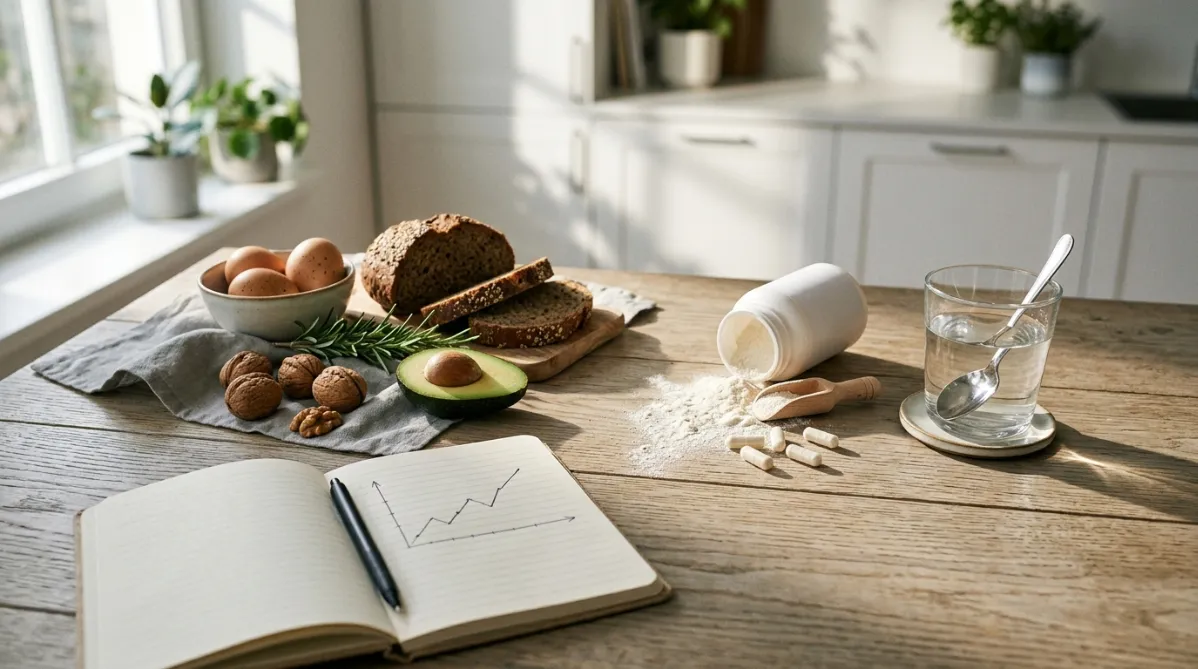
A wide, editorial-style still life photographed from slightly above on a pale oak surface in soft morning window light. At the center, a small matte white supplement tub with a plain, unlabeled front sits tipped on its side, spilling a modest pile of fine white powder across the wood. Beside it, a wooden scoop rests in the powder, and a few white capsules are scattered in a loose arc. To the left, a clean glass of water catches the light and throws a delicate caustic shadow. To the right, a neatly arranged group of whole foods sits in contrast: two brown eggs, a small wedge of salmon fillet on parchment, a handful of raw almonds, and a sprig of rosemary. A matte black steel dumbbell handle is partly visible at the top edge of the frame, grounding the fitness theme. In the lower foreground, a slim, open linen-bound notebook holds a hand-drawn line graph with a single line trending gently downward, a thin ink pen lying across the page. The palette is muted and warm: cream, soft sage green, pale oak, charcoal accents, and a touch of terracotta from a ceramic dish holding the almonds. Shallow depth of field blurs the background, a softly lit minimalist kitchen counter with a hint of a plant leaf. The mood is calm, thoughtful, and scientific without being clinical, like a cover image for a contemporary health and nutrition journal. Natural shadows, subtle film grain, and generous negative space on the upper left leave room for a headline overlay. Crisp focus on the powder and scoop, with refined, understated composition and no text or logos visible.
nutrition

D‑asparaginezuur verlaagde testosteron bij 6 g/dag bij getrainde krachtsporters

BY DR. GYMBRO ·

D‑asparaginezuur wordt geprezen als een natuurlijke testosteronbooster, maar in een gerandomiseerde studie met 24 ervaren gewichtheffers verlaagde een inneming van 6 g per dag zowel totaal‑ als vrij testosteron. Een dosis van 3 g – de hoeveelheid die op veel etiketten staat – had geen meetbaar effect. Een latere drie‑maanden‑studie toonde evenmin een kracht‑ of spiervoordeel. Hier lees je wat de studie aantoont, waarom getrainde mannen anders kunnen reageren dan sedentair, en waar je supplementengeld beter aan kunt besteden.

A wide, editorial-style still life photographed from slightly above on a pale oat-colored linen surface, lit by soft morning window light from the left. In the center sits a small matte ceramic bowl holding a mound of fine white powder, with a minimalist wooden scoop resting beside it. Next to the bowl is an open amber glass supplement jar with a plain cream label, and a few white capsules spill across the linen in a loose arc.

To the right, a neatly arranged cluster of analog "study" objects suggests careful measurement: a vintage stopwatch with a clean white face, a slim notebook with a sage-green cover open to a hand-drawn bar chart (blurred, no legible text), and a mechanical pencil lying across the page. A small row of six identical ceramic dishes, each holding a pinch of powder, is lined up along the top edge of the frame to hint at the six-week trial. One dish is slightly out of alignment, a subtle visual cue for ambiguity.

A shallow glass of water and a single sprig of green eucalyptus add a calm, organic note in the foreground. Soft, long shadows fall across the textured linen, and the palette stays restrained: warm cream, soft sage, muted terracotta, pale gray, and touches of amber from the glass jar. A few translucent paper cutouts in two tones (sage and blush) overlap in the upper right corner as a modern graphic accent, evoking overlapping data points without showing any numbers.

Depth of field is shallow, with the bowl and stopwatch in crisp focus and the edges gently softened. The composition leaves generous negative space on the left third for title text overlay. The overall mood is thoughtful, balanced, and quietly skeptical, in the style of a contemporary wellness and science magazine: clean, tactile, minimal, with a subtle film-like grain and natural color grading. No people, no futuristic or sci-fi elements, no readable text or logos.
nutrition

GAA‑breinbooster? De resultaten van de 6‑weekse proef zijn gemengd

BY DR. GYMBRO ·

GAA, de creatine‑voorloper die als breinbooster wordt aangeprezen, heeft nu zijn eerste serieuze onderzoek bij mensen ondergaan. In een dubbelblind, placebo‑gecontroleerd onderzoek van zes weken met 58 gezonde volwassenen leverde GAA iets snellere reactietijden op en een bont palet aan stemmings‑ en stresssignalen. De meeste cognitieve tests toonden echter geen effect en veel opvallende bevindingen waren slechts trends. Veiligheidsmarkers waren ongestoord, maar de studie was klein, verkennend en miste een zuivere creatine‑controlergroep. Hieronder lees je wat de resultaten echt betekenen, voor wie ze interessant kunnen zijn en waarom het oordeel gemengd is.

A wide, softly lit editorial still life on a pale warm-gray concrete surface, shot from a slightly elevated three-quarter angle. In the center-left, two matte ceramic scoops sit side by side. One holds fine ivory whey powder, the other holds slightly coarser, pale golden collagen peptide powder. A small, elegant dusting of both powders spills between them and blends into a soft swirl. Behind them, three minimalist cream and sage-green supplement tubs with no legible text stand in a staggered row, with a frosted glass shaker bottle of creamy liquid beside them.

On the right, a brushed-steel barbell plate and a compact chalk-dusted kettlebell rest slightly out of focus, suggesting resistance training. Pale wisps of chalk hang in the air. A folded charcoal gym towel and a pair of worn leather lifting straps lie in the foreground. A single cross-section of a clean white bone model, a stylized vertebra, rests on a small oak block at the far right. It subtly signals the bone-density theme without looking clinical.

Natural window light enters from the left, casting long, gentle shadows and a warm highlight on the powders. The palette is muted and modern: oatmeal, bone white, sage green, soft charcoal, and touches of warm amber. Shallow depth of field keeps the scoops tack-sharp and melts the background into creamy blur. Leave generous negative space in the upper right for headline overlay. The overall feel is a premium health and science journal cover: clean, tactile, minimalist, with fine film-like grain and a calm, editorial mood.
nutrition

Whey + collage overtreft whey alleen met een knal

BY DR. GYMBRO ·

Het combineren van 30 g whey met 10 g collage leverde betere resultaten op dan alleen whey, alleen collage of placebo in een nieuw 8‑weekse onderzoek bij weerstandstraining. De stack voegde 2,66 kg spiermassa toe (BIA), vergrootte de botmineralendichtheid van de lumbale wervelkolom en verbeterde squat‑, bench‑press‑kracht en bot‑turnover‑markers. Collage alleen beïnvloedde het bot, whey alleen de spier. Met slechts 40 deelnemers, ongelijke eiwitdoseringen en een opvallend grote BMD‑sprong is er echter een kanttekening.

This page is available in