Dr. Gymbro
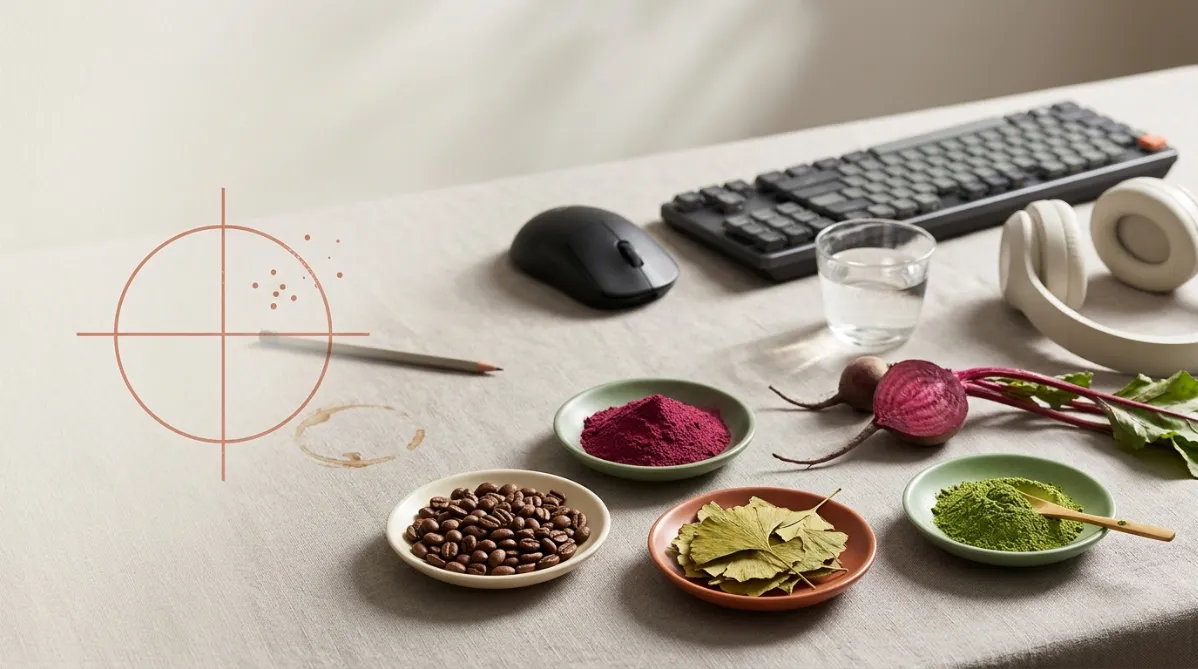
A landscape editorial still life on a softly textured warm-gray linen surface, shot from a slightly elevated three-quarter angle in diffused natural window light. In the foreground, four small ceramic dishes are arranged in a gentle arc. One holds roasted coffee beans, one holds deep magenta beetroot powder, one holds dried golden-green Ginkgo biloba leaves, and one holds bright jade matcha-style green tea powder with a tiny bamboo scoop. Each dish has a distinct, saturated color that stands out against the muted backdrop. Behind them, slightly out of focus, sits a minimalist matte-black gaming mouse beside a sleek, low-profile mechanical keyboard. A pair of matte off-white headphones rests on the right. A single fresh beetroot with its leafy stem and a halved beet showing concentric magenta rings lie casually near the dishes. A small glass of water catches the light, casting soft refracted highlights across the linen.

On the left, a clean, graphic crosshair motif is rendered as a thin circle and cross lines in soft terracotta ink, as if stamped on the paper surface, with a few tiny scattered dots clustered just off-center to hint at drifting aim. A subtle ring of coffee residue and a pencil lie near it, suggesting a researcher's desk. The color palette is warm and earthy: cream, sage green, terracotta, deep beet magenta, charcoal black, and touches of gold. The shallow depth of field gives creamy bokeh in the background, with soft shadows falling to the left. The mood is calm, modern, and intelligent, like a premium health and performance magazine cover, with generous negative space on the upper left for headline text. The composition is balanced and uncluttered, with crisp detail on the ingredients, fine natural textures like leaf veins and powder grain, and a refined, trendy editorial feel. There are no people, no text, and no futuristic elements.
Nutrition

Een oververmoeid brein, een slechte aim: welk supplement werkt echt?

Dr. Gymbro · · 4 min read

Je bent al drie uur lang ranked aan het grinden. Je richtpunt voelt zwaarder, je flicks landen een paar pixels naast en je tracking is wankel. Het is geen mechanisch probleem, maar mentale vermoeidheid. Een nieuw crossover‑onderzoek van de Wuhan Sports University suggereert dat een paar supplementen je kunnen helpen herstellen, maar laat ook zien dat sommige aspecten die je wilt verbeteren niet met een pilje te repareren zijn.

Wat de onderzoekers precies deden

De studie, gepubliceerd in Journal of the International Society of Sports Nutrition, rekruteerde 20 top‑FPS‑atleten. Elke speler voltooide een Stroop‑taak, een klassiek cognitief onderzoek dat mentale vermoeidheid veroorzaakt door automatische reacties te onderdrukken. Vervolgens namen ze één van de vijf condities in: cafeïne, nitraat (de bietensap‑verbinding), Ginkgo biloba‑extract, groene‑thee‑catechinen of placebo. Na 60 minuten rust werden ze getest op de KovaaK’s aim‑trainer voor schiet‑nauwkeurigheid, schiet‑stabiliteit, ruimtelijke lokalisatie en multitasking. Hartslagvariabiliteit (HRV) werd gedurende de hele sessie gemeten.

Het gerandomiseerde crossover‑design is een sterke kant van de studie. Elke speler fungeerde als zijn eigen controle, waardoor veel ruis door individuele vaardigheids‑ en focusverschillen werd geëlimineerd.

De head‑to‑head resultaten

Schiet‑nauwkeurigheid: Alle vier supplementen presteerden beter dan placebo na mentale vermoeidheid (alle p < 0.05). Er waren geen significante verschillen tussen de supplementen. Cafeïne overtrof de biet niet, en Ginkgo lag niet achter de groene thee.

Schiet‑stabiliteit: Cafeïne, nitraat en catechinen leverden een significante verbetering ten opzichte van placebo, wederom zonder betekenisvolle onderlinge verschillen. Ginkgo was hier de uitzondering en herstelde de stabiliteit niet.

Ruimtelijke lokalisatie en multitasking: Geen van de vier supplementen hielp boven placebo. Spelers verbeterden op beide gebieden na de rustperiode, maar de auteurs schrijven dit toe aan natuurlijke recuperatie. Zestig minuten downtime deden het werk, niet het supplement.

HRV: Indexen zoals RMSSD en SDNN veranderden onder sommige supplementcondities. De auteurs stellen dat dit mogelijke veranderingen in autonome regulatie tijdens herstel kan weerspiegelen, maar trekken geen definitieve conclusies.

Wat dit betekent: het scorebord is in wezen gelijkspel

De krantenkop is dat er geen duidelijke winnaar is. Als je puur op dit bewijs kiest, gaat de vraag niet over welk supplement het beste is, maar welk supplement past bij jouw tolerantie, schema en regels. Cafeïne, nitraat en catechinen vormen een drievoudige tier die zowel nauwkeurigheid als stabiliteit verbeterde. Ginkgo verbeterde alleen de nauwkeurigheid.

Het ontbreken van verschillen tussen de groepen bewijst niet dat de supplementen gelijk zijn. Met slechts 20 spelers kan de studie simpelweg niet genoeg statistische power hebben om bescheiden verschillen tussen actieve stoffen te detecteren. “Geen significant verschil” is niet hetzelfde als “identiek”.

Praktische tips voor gamers en vaardigheidssport‑atleten

De publicatie vermeldt niet de exacte doseringen die werden gebruikt, dus de onderstaande richtlijnen komen uit de bredere supplement‑literatuur, niet uit dit onderzoek. Beschouw ze als startpunten en raadpleeg een arts als je een medische aandoening hebt of medicatie gebruikt.

  • Cafeïne: Meestal 3‑6 mg/kg in sportonderzoek, al doen velen het prima aan de lage kant, en minder als je gevoelig bent. Trillen kunnen fijne motoriek schaden, dus test het eerst in de praktijk, niet in een toernooi.
  • Nitraat (biet): Studies gebruiken vaak 400‑800 mg nitraat, ongeveer een geconcentreerde bietensap‑shot of twee. Het is een solide cafeïnevrij alternatief, al kunnen sommige mensen last krijgen van maagklachten en kan de urine tijdelijk roze kleuren.
  • Groene‑thee‑catechinen: Extracten die enkele honderden milligrammen EGCG leveren zijn gebruikelijk. Controleer of het product cafeïne bevat, en vermijd extreem hoge doses van geconcentreerde extracten vanwege mogelijke leverklachten.
  • Ginkgo biloba: Rond de 120‑240 mg gestandaardiseerd extract is gangbaar. Het kan interageren met bloedverdunners, dus extra voorzichtigheid is geboden. Aangezien het hier de zwakste was, heeft het de laagste prioriteit.

Timing: In het protocol rustten spelers 60 minuten na inname, dus neem je supplement ongeveer een uur vóór je moet presteren.

Cafeïnevrije alternatieven: Als je gevoelig bent voor stimulerende middelen, laat‑nacht‑sessies speelt, of onder restrictieve regels competeert, zijn nitraat en gedecafeïnerde catechinen de evidence‑based opties, omdat beide nauwkeurigheid en stabiliteit verbeterden.

Wat geen enkel supplement zal repareren

De resultaten voor ruimtelijke lokalisatie en multitasking vormen een nuttige reality‑check. Die vaardigheden herstelden met rust, ongeacht welk supplement werd ingenomen. Als je game‑sense, map‑bewustzijn en vermogen om informatie te jongleren “gebakken” zijn, suggereert de data dat een pauze, niet een pil, het belangrijkste instrument is. Slaap, pauzes tussen sessies en een verstandig rooster blijven de basis.

Eerlijke beperkingen

Dit is een kleine studie met 20 spelers, getest op één aim‑trainer platform met één vermoeidheidsprotocol. Een Stroop‑taak is een laboratorium‑substituut voor de vermoeidheid van een echte toernooidag, die stress, lange uren, slaaptekort en sociale druk omvat. Scores op een aim‑trainer vertalen zich niet per se naar wedstrijd‑prestaties. De HRV‑bevindingen zijn exploratief, en de auteurs roepen zelf op tot verder onderzoek. Het is ook het vermelden waard dat alle vier supplementen beter dan placebo in een kleine steekproef deels kunnen wijzen op verwachtingseffecten, zelfs in een placebogecontroleerd design, als spelers konden raden welke pil ze namen, wat plausibel is bij cafeïne.

Bottom line

Als je aim instort wanneer je brein uitgeput is, tonen cafeïne, nitraat en groene‑thee‑catechinen tekenen van herstel van zowel nauwkeurigheid als stabiliteit, terwijl Ginkgo alleen de nauwkeurigheid hielp. Geen van hen overtrof de anderen, en geen van hen herstelde ruimtelijke bewustzijn of multitasking boven wat rust al deed. Kies op basis van je tolerantie, test in de praktijk, neem ongeveer een uur van tevoren in, en beschouw de resultaten als veelbelovend maar voorlopig.
Original study

Read the original research on pubmed.ncbi.nlm.nih.gov →

This article summarizes published research for general information. It is not medical advice.

DG

Written by

Dr. Gymbro

Dr. Gymbro writes for Dr. Gymbro: science-backed fitness, nutrition & performance.

Related Articles

A wide, editorial-style photograph of a professional soccer pitch at golden hour, shot from a low angle at the edge of the grass. In the foreground, slightly off-center to the left, a pair of worn leather cleats sits beside a scatter of three small matte ceramic dishes. One holds fine white taurine powder, one holds dark roasted coffee beans, and one holds pale cream-colored softgel capsules. Soft warm light catches the textures: the grain of the beans, the powder's fine crystalline sheen, the glossy curve of the capsules. A clean white sports towel and a brushed-steel water bottle rest nearby, with a small stopwatch lying on the turf, its face softly glowing.

Behind them, the field stretches into a gentle blur. A lone player in a muted navy training kit mid-sprint leaves a faint streak of motion across the frame, with painterly bokeh from stadium floodlights and distant stands. The grass is a rich, deep green with crisp white line markings curving across the midground and leading the eye toward the athlete. Long amber shadows stretch across the pitch, and a hazy peach and pale blue sky fills the upper right, leaving open negative space for a title overlay.

The palette is restrained and modern: deep green, warm cream, soft amber, charcoal, and a touch of muted coral. The depth of field is shallow, with sharp detail on the supplements and cleats. The mood is calm, premium, and scientific without feeling clinical, like a contemporary sports-science magazine or wellness journal cover. The lighting is natural and cinematic, with gentle film grain and a subtle vignette. The composition follows the rule of thirds, with clean lines and no text, logos, or clutter.
nutrition

Taurine, cafeïne + PS‑stack gaf profvoetballers een voorsprong: de addertjes onder het gras

BY DR. GYMBRO ·

Profvoetballers die 14 dagen taurine, cafeïne en fosfatidylserine innamen, behaalden betere 30‑m sprints, snellere reactietijden en lagere scores op mentale vermoeidheid dan de placebogroep in een gerandomiseerde studie met 97 spelers. Het verdubbelen van de PS‑dosering van 300 naar 600 mg leverde echter slechts een bescheiden, inconsistente verbetering op. De auteurs benadrukken bovendien dat de gegevens geen betere vermoeidheidsresistentie aantonen en dat PS nooit afzonderlijk is getest. Hieronder staat wat deze stack inhield, wat hij deed en wat hij niet kan garanderen.

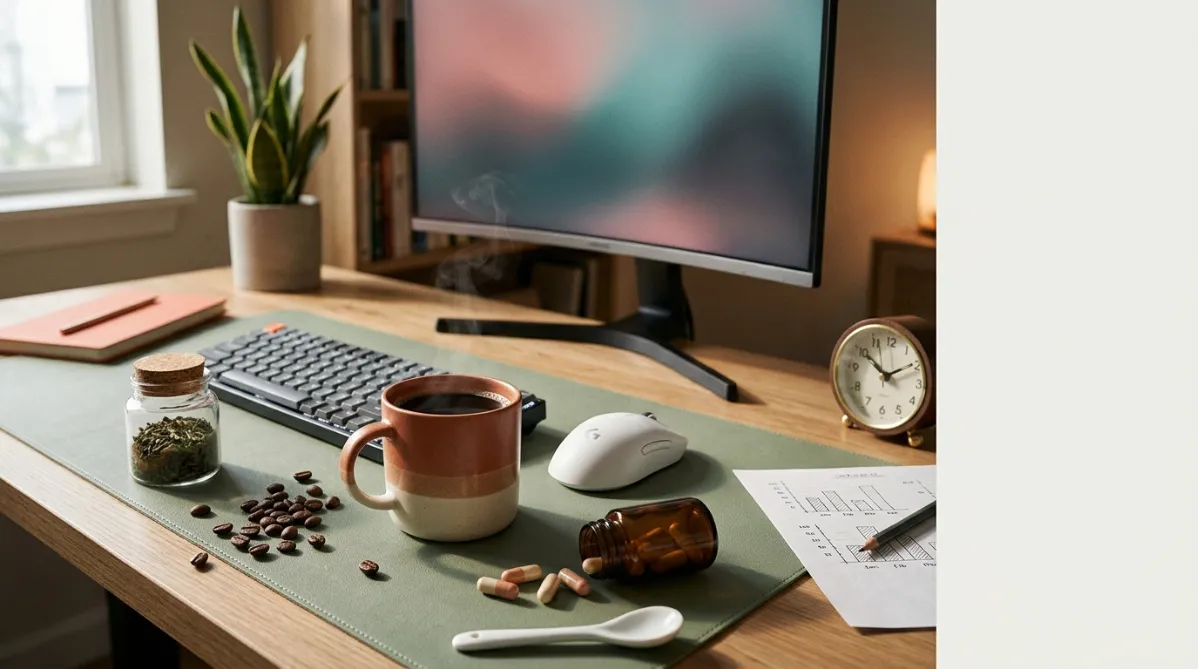
A landscape editorial still life on a softly lit desk, shot from a slightly elevated three-quarter angle with shallow depth of field. In the center sits a ceramic cup of black coffee with a thin curl of steam, on a matte sage-green desk mat. Beside it, a sleek white wireless gaming mouse and a minimal, low-profile keyboard are partly in focus. Scattered in the foreground are a few whole roasted coffee beans and a small glass jar of loose green tea leaves, as a quiet nod to caffeine sources. To the left, a few unlabeled supplement capsules in muted peach and cream spill from a small amber glass bottle onto the mat. Their blurred, ordinary look hints that they are less important than the coffee. In the background, a monitor glows with a soft, abstract, out-of-focus gradient of dusty rose and teal, with no readable game interface. A small analog alarm clock sits at the edge of the frame, its hands near late evening, suggesting sleep concerns. A sheet of paper with simple hand-drawn bar charts and a pencil rests near the cup, hinting at research and data without any legible text.

The palette is warm and modern: cream, sage, terracotta, charcoal, with a single accent of coral. Soft window light comes from the left, casting gentle long shadows and a subtle film-like grain. The composition is clean and uncluttered, with generous negative space on the right third for a title overlay. The look is contemporary and trendy, like a lifestyle-science magazine cover, calm, tactile, and sophisticated, with no sci-fi or neon cyberpunk elements.
supplements

Het gaming‑supplement met echt bewijs is niet wat de advertenties beloven

BY DR. GYMBRO ·

Gaming‑supplement‑advertenties beloven laserfocus en bliksemsnelle reflexen, maar een nieuw systematisch overzicht van 13 gerandomiseerde onderzoeken (466 spelers) laat zien dat het bewijs vrijwel uitsluitend op één ingrediënt rust: cafeïne. Deze vond plaats in 14 van de 18 geteste protocollen en werd gekoppeld aan betere aandacht, executieve functies, stemming, schietprecisie en reactietijd. Inositol‑verrijkt arginine‑silicaat, GABA en micro‑algene‑extracten werden ook getest, maar met veel minder onderbouwing. De auteurs waarschuwen dat kleine steekproeven, amateurspelers en een hoog bias‑risico de bevindingen voorlopig maken.

A bright, editorial flat-lay photograph shot from slightly above on a pale oat-colored linen surface in soft natural window light. At the center, a small white ceramic cup of black coffee sits on a matte saucer, with a delicate curl of steam. To its left, a shallow wooden bowl holds glossy red coffee cherries, the fruit of the coffee plant, with a few scattered on the linen and one sliced open to show the pale seed inside. To the right, three identical small amber glass vials with minimalist cream labels stand in a row, and a few loose beige capsules and a small pile of fine tan powder rest on a speckled stone dish beside them. A few roasted coffee beans are scattered casually across the composition. A thin sprig of green coffee leaves with waxy, dark foliage arcs in from the top edge. A brass measuring spoon and a folded cream notepad with a pencil sit near the lower right, hinting at a lab-style comparison without any clinical equipment. The palette is warm and restrained: terracotta red, cream, espresso brown, soft sage green, and touches of amber and brushed brass. Shadows are gentle and diffuse, with shallow depth of field that softens the background edges. The composition leaves generous negative space on the left third for title text, and the whole scene feels calm, modern, and curated, like a lifestyle and wellness magazine cover. Fine film-like grain, true-to-life color, and crisp textures in the linen weave, the glossy cherry skins, and the glass vials. No text, no logos, no people, wide 16:9 landscape framing.
science research

Koffievruchtextract faalt tegenover 75 mg cafeïne in een nieuwe studie

BY DR. GYMBRO ·

Koffievruchtextract wordt aangeprezen als een slimmer, milder energiemiddel, maar een recent dubbelblind crossover‑onderzoek vergeleek het met gewone cafeïne en vond een duidelijk verschil. Bij 28 volwassenen leverden noch 100 mg noch 300 mg koffie‑berry‑extract geen verandering op in alertheid, mentale energie, mentale vermoeidheid of fietsprestaties. Een bescheiden dosis van 75 mg cafeïne verbeterde wel tijdelijk de alertheid en mentale energie. Het was een acute studie met één enkele dosis, dus geen definitief oordeel. Hieronder lees je wat het onderzoek aantoonde, wat het niet kon zeggen en hoe je supplementen‑etiketten moet lezen.

A sunlit outdoor running track in late afternoon, shot from a low angle with shallow depth of field. In the foreground, a matte black bottle with a minimal off-white label sits on the edge of a warm terracotta-colored track lane, beside a folded white towel and a small glass of amber liquid catching golden light. Condensation beads on the bottle. A faint heat shimmer rises from the track surface and softens the background.

In the midground, slightly out of focus, a lean athlete in a sage-green tank top and charcoal shorts runs on a treadmill-like stretch of track, a thin sheen of sweat on their shoulders, their expression focused and calm. Their motion is gently blurred, suggesting endurance and rhythm. Long soft shadows stretch across the lane lines.

The background fades into hazy peach, apricot, and pale yellow tones, with the suggestion of tall trees and a distant stadium wall. Warm sun flare enters from the upper right, creating a subtle glow and a few soft light streaks across the frame.

Subtle editorial touches: a small notebook with a pencil and a stopwatch rest beside the bottle, hinting at data and timing without any text legible. The color palette is warm and muted, with terracotta, cream, sage, and charcoal accents, and a fine film-like grain. The composition leaves open negative space on the left third for a headline overlay. The overall mood is clean, modern, and health-journal inspired, natural and aspirational, with a calm scientific curiosity rather than hype.
nutrition

Ketondranken in de hitte: langer uithoudingsvermogen en scherper geheugen?

BY DR. GYMBRO ·

Ketondranken worden vaak gezien als een hulpmiddel voor vetverbrandende biohackers, maar een nieuwe hitte‑stressstudie suggereert dat ze je ook sterker kunnen laten finishen. Bij 17 getrainde mannen verlengde keton‑monoester plus cafeïne de tijd tot uitputting tot 8,9 minuten tegenover 7,0 minuten met koolhydraten plus cafeïne, na een 90‑minuten‑intensieve loopbandtraining bij 34 °C. Het werkgeheugen verbeterde eveneens bij de 1‑back‑taak, terwijl hartslag en kerntemperatuur nauwelijks verschilden. De studie is echter klein, uitsluitend mannelijk en éénmalig, waardoor de resultaten met voorzichtigheid moeten worden geïnterpreteerd.

This page is available in