Dr. Gymbro
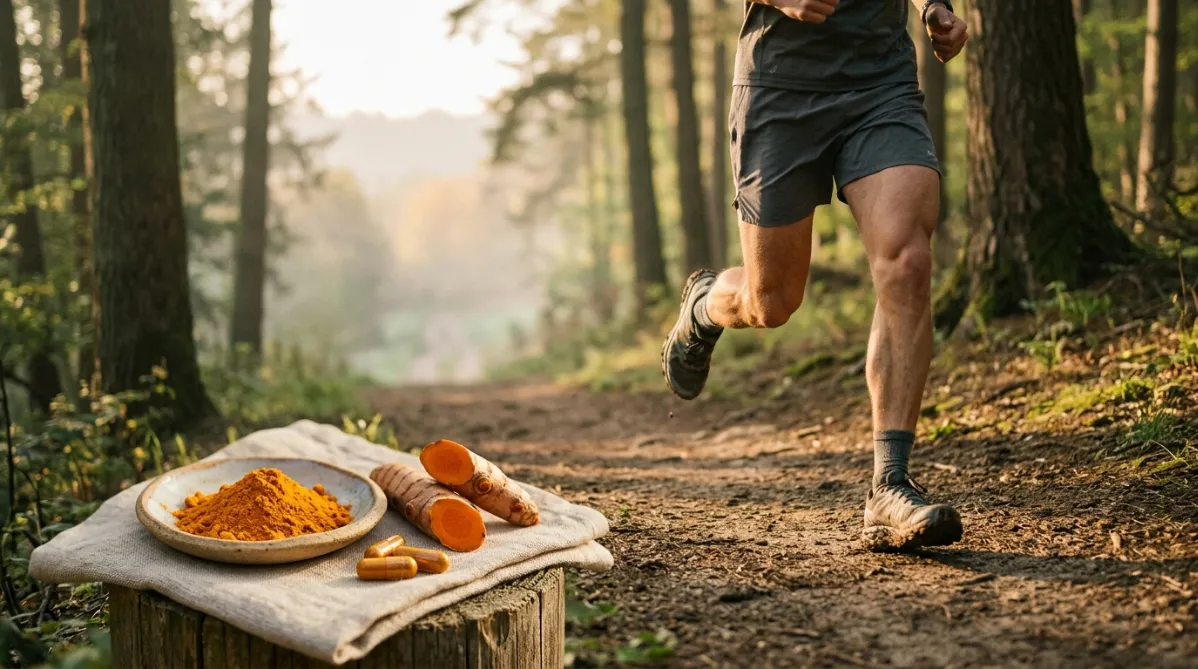
A wide, editorial-style photograph of a male runner mid-stride on a gently sloping forest trail at early morning, shot from a low three-quarter angle. Soft golden light filters through tall trees and casts long dappled shadows across the packed dirt path. The runner is captured from the waist down and slightly from the side, wearing charcoal running shorts and worn trail shoes, with the quadriceps and thigh muscles defined and naturally lit. A fine mist hangs in the background, and the slope descends toward a blurred, softly glowing horizon.

In the foreground, slightly out of focus on a weathered wooden post or flat mossy stone at the trail's edge, rests a small ceramic dish holding a pile of vivid golden-orange turmeric powder. Beside it sit two fresh turmeric roots, one cut open to show a deep saffron interior, and a few amber capsules. A thin linen cloth is draped beneath them. The saturated yellow-orange of the turmeric contrasts with the cool green and muted brown tones of the forest, creating a strong color anchor on the left third of the frame.

The composition follows the rule of thirds, with the turmeric in the lower left foreground and the runner in the right two-thirds, leaving open negative space in the upper left for headline text. Shallow depth of field, creamy bokeh, and natural film-like grain give it a refined, modern health-and-science magazine feel. The palette is warm and earthy: golden amber, moss green, soft cream, and deep umber. The lighting is natural and gentle, with subtle rim light on the runner's calves and hamstrings. No text, no logos, no graphics, and no futuristic elements. The result should feel clean, calm, and aspirational, like a cover image for a premium wellness and sports-nutrition journal.
Recovery

Meriva‑curcumine vermindert MRI‑spierbeschadiging na afdalinghardlopen

Dr. Gymbro · · 4 min read

De Hook: Minder beschadigde spieren op MRI

Afdalend hardlopen belast je quadriceps en hamstrings zwaar. Elke stap is een excentrische contractie, waardoor een steile afdaling je dagenlang het gevoel kan geven dat je achteruit trapt. Een gerandomiseerde studie uit 2014, gepubliceerd in het Journal of the International Society of Sports Nutrition, onderzocht of een biologisch goed opneembare curcumine schade kon dempen. Het opvallende resultaat: minder deelnemers die curcumine innamen hadden MRI‑zichtbare spierblessuren in het posterieure en mediale compartiment van beide dijen dan de placebogroep.

De studie is klein en kent kanttekeningen, die hieronder worden besproken. Het beeldvormingsresultaat is echter het meest intrigerende en verdient een nauwkeurige blik.

Wat de onderzoekers hebben gedaan

Drobnic en collega's rekruteerden 20 gezonde, matig actieve mannen en randomiseerden hen naar curcumine of een vergelijkbaar placebo. Het onderzoek was een single‑blind pilot‑studie, wat betekent dat de deelnemers niet wisten welk product ze kregen, terwijl de onderzoekers dat vermoedelijk wel deden.

Beide groepen ondergingen daarna een afdalingstest om excentrische spierschade te veroorzaken. Veertig‑acht uur later maten de onderzoekers de schade op drie manieren:

  • MRI van de dijspieren
  • Bloedmarkers voor spierschade en ontsteking
  • Spierbiopsie‑histologie

Deelnemers rapporteerden bovendien hun pijnintensiteit.

De dosering en timing

Het protocol is eenvoudig te reproduceren:

  • Product: Meriva, een curcumine‑lecithine Phytosome‑delivery‑systeem
  • Dosis: 1 g tweemaal per dag, oftewel 2 g Meriva per dag
  • Werkelijke curcumine: circa 200 mg per dosis, dus ongeveer 400 mg curcumine per dag
  • Start: 48 uur voor de afdaling
  • Einde: 24 uur na de afdaling
  • Totale duur: 4 dagen

Het getal "2 g" heeft betrekking op het volledige Meriva‑complex, niet op pure curcumine. Veel mensen verwarren die waarden bij het vergelijken van etiketten, dus controleer hoeveel curcumine jouw product werkelijk per portie bevat.

Wat wel werkte

Het sterkste resultaat kwam van de beeldvorming. Significant minder proefpersonen in de curcuminegroep toonden MRI‑bewijs van spierblessuur in het posterieure of mediale compartiment van beide dijen. MRI is objectiever dan pijnrapportage, waardoor dit resultaat overtuigender is dan louter zelf‑gerapporteerde scores.

Bloedmarkers voor spierschade en ontsteking waren over het algemeen lager bij curcumine. Slechts één bereikte statistische significantie: interleukine‑8 twee uur na de inspanning.

Wat niet werkte: pijn en werkingsmechanisme

Het pijnresultaat is minder sterk dan de koppen doen vermoeden. Curcumine‑gebruikers rapporteerden minder pijn in de onderste ledematen, maar significante verschillen verschenen alleen in de rechter‑ en linkervoorste dij. Het was geen algehele afname van spierpijn.

Twee andere uitkomsten lieten niets zien:

  • Oxidatieve‑stressmarkers: geen verschillen
  • Spierhistologie: geen verschillen

Dat is relevant, want de rationale van de studie was dat curcumine oxidatieve stress zou dempen. Zonder veranderingen in die markers blijft het werkingsmechanisme onduidelijk. De auteurs benoemen dit en roepen op tot grotere studies om "het werkingsmechanisme verder te verduidelijken".

Kritische kanttekening: industriële connecties en de bio‑beschikbare vorm

Meriva is een merkproduct van Indena SpA uit Milaan, en de samenvatting benoemt het bedrijf expliciet. Studies met propriëtaire ingrediënten betrekken vaak personen die verbonden zijn aan de fabrikant. Beschouw de resultaten niet als volledig neutraal zonder eerst de volledige conflicterende‑interessesverklaring te lezen.

De leveringsvorm is bovendien cruciaal. Standaard curcumine wordt slecht geabsorbeerd. Meriva bindt curcumine aan lecitine om de bio‑beschikbaarheid te verhogen. Deze resultaten gelden alleen voor die formulering, niet voor keukenturmeric of een willekeurige curcumine‑capsule. Ga er niet van uit dat een goedkoop poeder hetzelfde effect heeft.

Beperkingen

  • Slechts 20 deelnemers, waardoor de studie ondergesampled en verkennend is.
  • Single‑blind, waardoor bias mogelijk is.
  • Alleen gezonde, matig actieve mannen. De resultaten zijn mogelijk niet toepasbaar op vrouwen, ouderen of topsporters.
  • Gemengde secundaire uitkomsten, met één significante bloedmarker van de meerdere die werden gemeten.
  • Geen prestatiedata. Minder MRI‑schade bewijst geen sneller herstel of betere trainingsoutput.

De auteurs concluderen dat curcumine "potentieel" heeft om DOMS te voorkomen. Dat is een voorzichtige formulering en sluit beter aan bij de data dan beweringen dat het "voorkomt" of "geneest".

Praktische toepassing

Wil je het protocol zelf uitproberen? De studie biedt een bruikbaar sjabloon:

  1. Kies een bio‑beschikbare vorm, bij voorkeur de lecitine‑gebaseerde Phytosome die hier werd gebruikt.
  2. Volg de dosering: 2 g van het complex per dag, verdeeld over twee doses van 1 g.
  3. Start twee dagen vóór een bekend spier‑schade‑gevend evenement, zoals een afdalingwedstrijd, een nieuw excentrisch‑intensieve trainingsblock of een zware wandeltocht.
  4. Ga door tot 24 uur daarna.
  5. Houd de verwachtingen bescheiden. Je kunt minder schade zien, maar het pijnvoordeel was beperkt.

Dit is geen medisch advies. Curcumine‑supplementen kunnen een wisselwerking hebben met bloedverdunners en zijn mogelijk ongeschikt voor mensen met galblaasproblemen; overleg eerst met een zorgverlener als dat op jou van toepassing is.

Conclusie

Deze pilotstudie levert een veelbelovend maar voorlopig signaal. Het MRI‑resultaat springt eruit, het pijnvoordeel is regionaal en de biochemische onderbouwing is dun. Een grotere, dubbel‑blind, onafhankelijk gefinancierde replicatie zou moeten uitwijzen of Meriva‑curcumine een vaste plek verdient in een herstel‑stack.
Original study

Read the original research on pubmed.ncbi.nlm.nih.gov →

This article summarizes published research for general information. It is not medical advice.

DG

Written by

Dr. Gymbro

Dr. Gymbro writes for Dr. Gymbro: science-backed fitness, nutrition & performance.

Related Articles

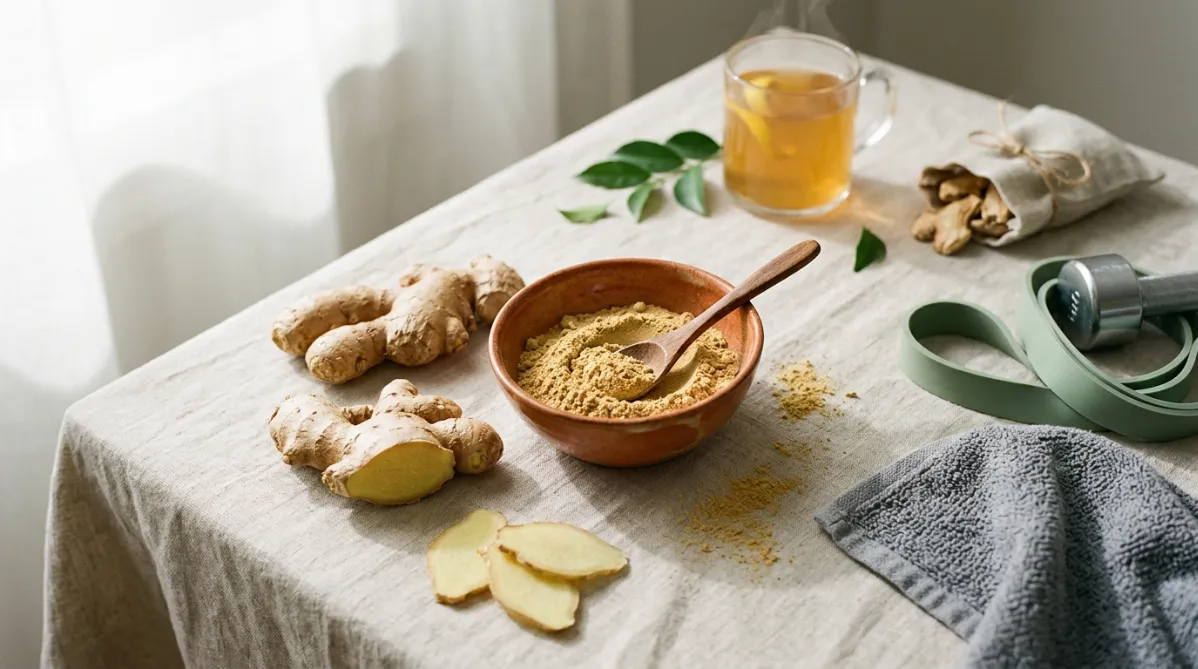
A wide, editorial-style still life photographed from slightly above on a pale oat-colored linen surface, lit by soft natural window light from the left. At the center sits a rustic ceramic bowl of finely ground golden-tan ginger powder, with a small wooden spoon resting in it and a light dusting of spice across the cloth. Beside it lie several whole ginger rhizomes, knobby and honey-brown. One is sliced open to show its pale yellow, fibrous interior, and a few paper-thin slices fan out in the foreground. On the right, a folded heather-gray gym towel, a matte sage-green resistance band coiled loosely, and a single brushed-steel dumbbell sit just inside the frame, softly out of focus. A glass of warm amber ginger tea steams faintly near the upper right, with a thin curl of lemon peel inside. A few fresh green leaves and a small linen pouch of dried ginger add texture. The palette is warm and muted: cream, soft gold, sage, terracotta, and charcoal accents. The shallow depth of field keeps the ginger bowl and sliced root crisp while the gym elements melt into a gentle blur. Shadows are long and soft, and the negative space on the upper left leaves room for a headline. The mood is calm, clean, and modern, like a contemporary wellness or science journal cover. It is a natural, tactile, high-resolution photograph with subtle film grain and no text, no people, and no futuristic elements.
recovery

2 gram gember vermindert spierpijn de volgende dag met ongeveer 25 % in twee onderzoeken

BY DR. GYMBRO ·

Een alledaags keukenkruid ging de strijd aan met een van de meest voorkomende klachten in de sportschool: spierpijn de dag na een zware training. In twee dubbelblinde onderzoeken bleek dat het innemen van 2 gram gember per dag gedurende 11 dagen ongeveer 25 % minder pijn opleverde 24 uur na een intensieve excentrische oefening. Gember verbeterde echter niet duidelijk de kracht of zwelling, en er is geen vergelijking gemaakt met ibuprofen. Hier lees je wat de studies tonen, waarom het zou kunnen werken, waar de bewijzen tekortschieten en wie het kan proberen.

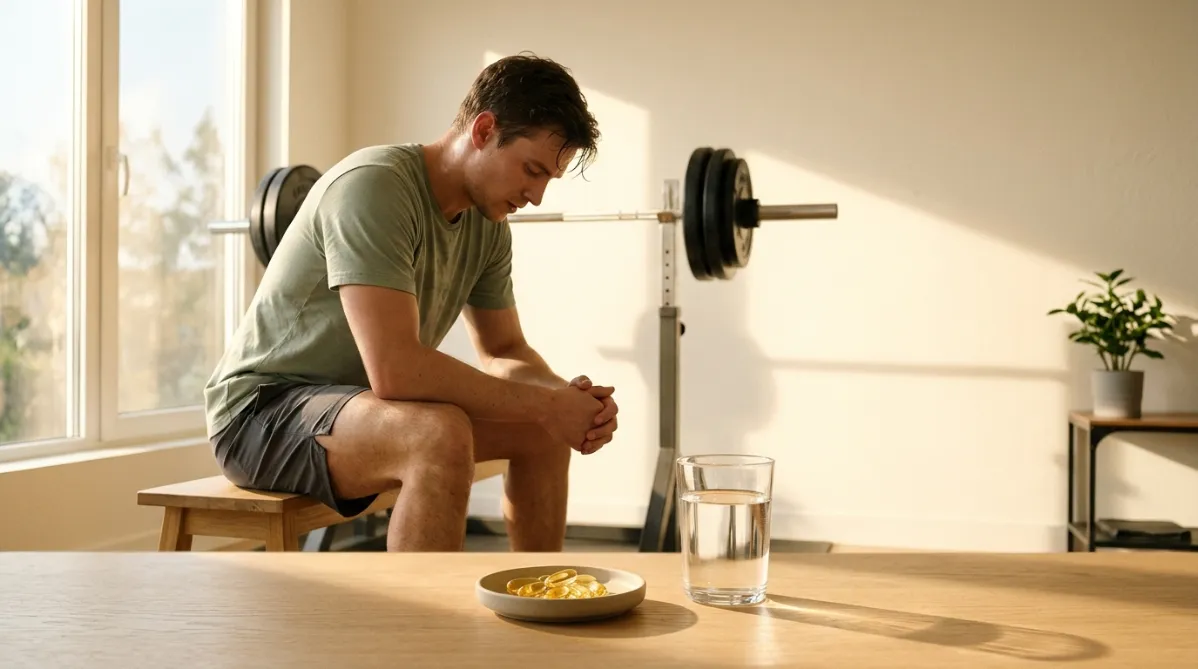
A sunlit, minimalist home gym corner photographed in soft golden morning light, with a young athletic man seated on a wooden bench, leaning forward with his elbows resting on his knees, catching his breath after a hard leg session. He wears a muted sage-green t-shirt and charcoal shorts, his face turned slightly away from the camera, calm and focused. A matte ceramic dish in the foreground holds a few small, translucent golden softgel capsules, with a glass of water beside it catching the light and casting a soft caustic shadow across a pale oak floor. Behind him, a loaded barbell rests on a squat rack, slightly out of focus, and a tall window pours warm sunlight diagonally across the scene, creating long gentle shadows and a hazy glow. A small potted green plant sits on a shelf at the edge of the frame. The color palette is warm and editorial: cream, soft gold, sage green, pale wood, and charcoal accents. Shallow depth of field, with crisp focus on the capsules and glass in the lower third and a creamy bokeh background. The composition leaves generous negative space on the right side for a headline overlay. The mood is clean, modern, and aspirational, like a high-end wellness magazine or a trendy health journal feature. Shot on a 50mm lens, natural light, fine film grain, subtle matte finish, landscape 16:9 framing.
recovery

Vitamine D versnelt krachtherstel bij mannen met voldoende vitamine‑D‑status

BY DR. GYMBRO ·

Mannen met volledig normale vitamine‑D‑waarden herstelden hun kracht sneller na een zware beentraining toen ze dagelijks 4.000 IU innamen. In deze gerandomiseerde, placebogecontroleerde proef met 28 actieve mannen was de piek‑isometrische kracht na 24 uur gemiddeld 8 % hoger. Markers voor spierschade, ALT en AST, stegen eveneens minder. Spierpijn bleef echter onaangedaan.

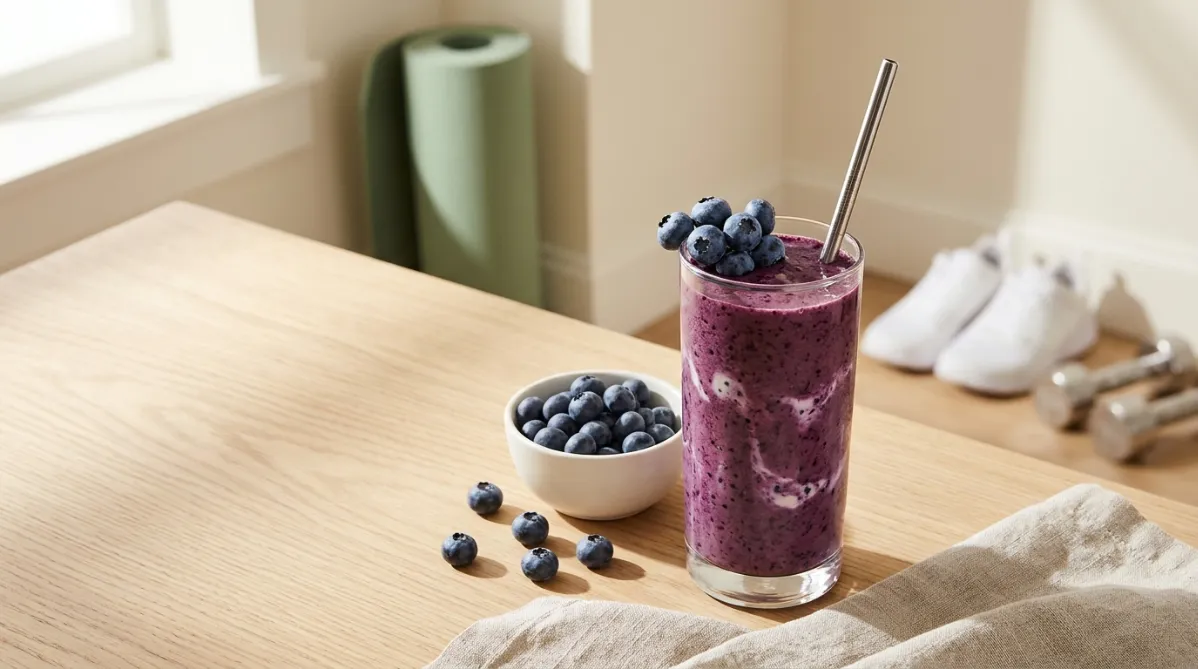
A bright, airy editorial photograph shot from above at a slight angle, showing a tall clear glass of deep violet blueberry smoothie on a pale oak wooden table. The smoothie has a creamy, velvety texture with a few lighter swirls, and a small cluster of fresh blueberries with dusty blue skins rests on the rim of the glass. A matte white ceramic bowl of whole blueberries sits to the left, with a few berries scattered naturally across the tabletop. A folded linen napkin in soft oatmeal tones and a stainless steel straw add subtle texture.

In the softly blurred background, a rolled-up sage green yoga mat leans against a light wall next to a pair of clean white running shoes and a small pair of brushed-metal dumbbells. A sliver of warm morning sunlight enters from the left window, casting gentle diagonal shadows and a golden glow across the table, with soft highlights on the glass and the berries' surface bloom.

The color palette is fresh and modern: deep indigo and violet from the smoothie, balanced by cream, warm beige, soft sage green, and touches of white. The composition follows the rule of thirds, with the glass placed on the right third and generous negative space on the left, suitable for headline overlay. Shallow depth of field, crisp focus on the glass and berries, creamy bokeh in the background. The mood is calm, healthy, and aspirational, like a contemporary wellness magazine or a trendy health journal website. Natural, realistic, high-end food and lifestyle photography style, 16:9 landscape format, clean and uncluttered.
nutrition

Blauwe bessen‑smoothie hielp vermoeide benen sneller hun kracht terug te krijgen

BY DR. GYMBRO ·

Tien vrouwen, 300 intensieve excentrische quadriceps‑contracties en één blauwe bessen‑smoothie. In deze gerandomiseerde crossover‑studie versnelde de bessendrank het herstel van de maximale isometrische kracht gedurende 60 uur (p = 0,047), terwijl een placebosmoothie met dezelfde antioxidantcapaciteit dat niet deed. Het suggereert dat het effect niet louter door antioxidanten wordt verklaard. Aangezien slechts één uitkomst significant was en de steekproef klein, blijven de bevindingen veelbelovend maar niet doorslaggevend.

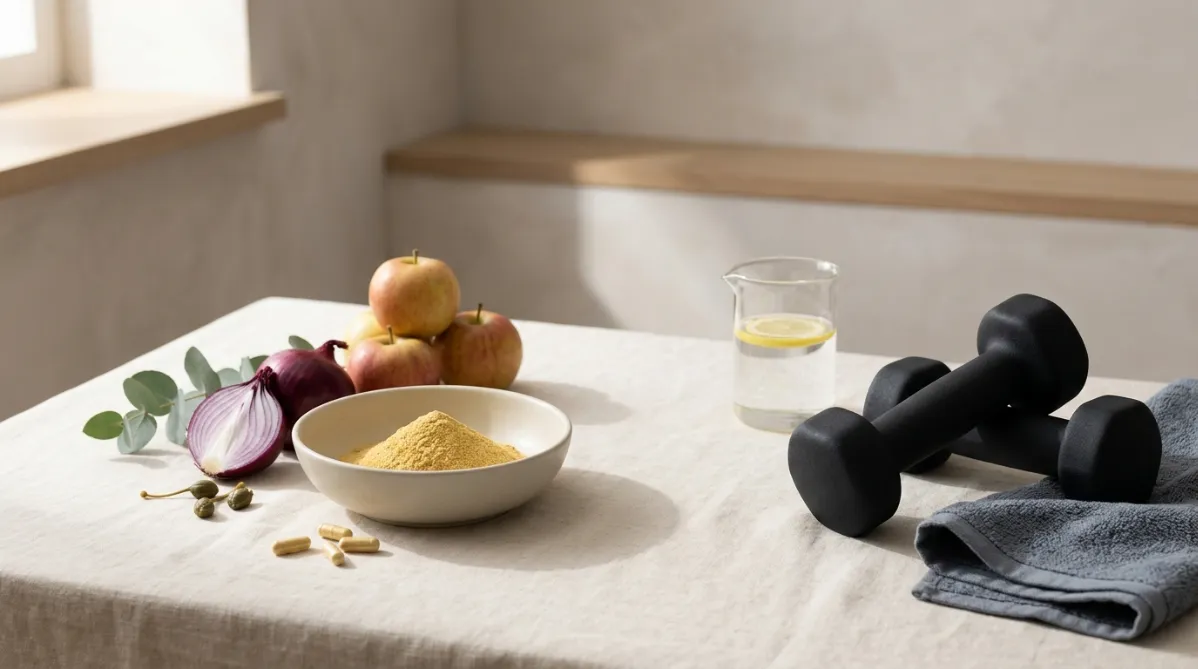
A wide, softly lit editorial still life on a warm off-white linen surface. At the center-left, a matte ceramic bowl holds a small mound of fine golden-yellow quercetin powder, with a few scattered capsules beside it. Next to the bowl sit fresh red onions (one halved to show its translucent purple layers), a few capers, and a small cluster of ripe apples with the skin on, all natural quercetin sources. On the right side of the frame, a sleek matte-black dumbbell rests at an angle beside a folded slate-gray gym towel. A minimalist glass beaker of water with a thin lemon slice sits just behind it.

Soft diffused morning window light enters from the upper left, casting gentle long shadows and subtle highlights on the powder and glossy onion skin. The color palette is muted and sophisticated: butter yellow, deep plum, warm cream, charcoal, with small touches of sage green from a single eucalyptus sprig. A subtle, out-of-focus background of pale plaster wall and a wooden shelf adds depth.

Shallow depth of field, shot from a slightly elevated three-quarter angle with a 50mm lens feel. Generous negative space in the upper right for a title overlay. The mood is clean, calm, and modern, like a premium wellness and science journal feature: tactile textures, natural materials, restrained composition, high-end editorial photography, and no text or logos.
science research

1 g/dag quercetine voor excentrische curls: de IGF‑wending

BY DR. GYMBRO ·

Wat gebeurt er als je twee weken vóór een zware excentrische biceps‑training 1 g/dag quercetine inneemt? In een kleine, placebogecontroleerde crossover‑studie daalden schade‑markers als CK, LDH en myoglobine, evenals IL‑6. Nog opvallender: de IGF‑I‑respons werd sterker en de IGF‑II‑piek trad eerder op dan normaal. Met slechts twaalf deelnemers en zonder hypertrofie‑data is dit een veelbelovend herstel‑signaal, geen garantie voor spiergroei. Hieronder lees je wat de studie aantoonde en hoe je het verstandig kunt toepassen.

This page is available in