Dr. Gymbro
A wide editorial still life shot from a slightly elevated angle on a pale ash-wood bench in a bright, airy training hall. In the center sits a small matte ceramic dish holding a few translucent coral-red softgel capsules, their glossy surfaces catching soft window light. Beside the dish rests a folded white taekwondo dobok with a black belt loosely coiled on top. A sprig of fresh red microalgae-toned seaweed and a halved blood orange add natural color accents. A clean glass of water with subtle condensation stands to one side.

In the softly blurred background, the silhouette of a martial artist in a white uniform stretches near tall windows, with diffused morning light streaming across a sprung wooden floor. A pair of red and blue sparring gloves hangs on a minimal wall hook. Thin, elegant shadows stretch across the bench.

The palette is restrained and modern: warm off-white, soft sand, muted charcoal, with a vivid coral-red accent pulled from the capsules. Shallow depth of field, crisp focus on the capsules and dish, creamy bokeh behind. Natural, gentle lighting with a subtle film-like grain, reminiscent of a contemporary wellness and science magazine cover. Generous negative space on the left third of the frame for headline text. Calm, precise, and quietly athletic in mood, with no text, logos, or futuristic elements.
Science & Research

12 mg de Astaxantina por 28 dias: danos musculares e burnout em lutadores

Dr. Gymbro · · 4 min read

Astaxantina, o carotenoide vermelho que confere cor ao salmão e ao krill, vem sendo divulgada para atletas de resistência há anos. Um novo ensaio randomizado, publicado no Nutrition Journal (Shu et al., 2026), investigou se essa substância traz algum benefício para outro grupo: jovens atletas masculinos de taekwondo, que enfrentam sequências repetidas de alta intensidade, fortes impactos e considerável pressão mental. O resultado é promissor, mas exige leitura cuidadosa.

O que os pesquisadores fizeram

A equipe conduziu um estudo randomizado, duplo‑cego e controlado por placebo com duração de 28 dias. Os atletas tomaram diariamente 12 mg de astaxantina ou um placebo. Durante o mês, foram acompanhados três aspectos: marcadores de estresse oxidativo, um marcador de dano muscular e o estado psicológico, avaliado com o Athlete Burnout Questionnaire (ABQ).

Os parâmetros medidos foram:

  • Creatina quinase (CK), indicador de dano muscular;
  • Superóxido dismutase (SOD), enzima antioxidante;
  • Malondialdeído (MDA), marcador de peroxidação lipídica;
  • As subescalas do ABQ para burnout.

Os dados foram analisados por ANOVA de delineamento misto, que verifica se os grupos evoluem de forma diferente ao longo do tempo (interação grupo × tempo).

Resultado principal: creatina quinase

A descoberta mais robusta foi a diferença nas trajetórias de CK. A análise revelou uma interação grupo × tempo significativa, isto é, os grupos de astaxantina e placebo seguiram caminhos distintos ao longo das quatro semanas. CK é um biomarcador comum – embora imperfeito – de dano muscular induzido por exercício, pois seu nível sanguíneo aumenta quando as fibras são lesionadas. Uma trajetória diferente sugere que a astaxantina pode ter atenuado parte desse dano durante os treinos.

Esse é o resultado que merece maior atenção, pois provém do teste de interação pré‑especificado, a forma estatisticamente mais forte de interpretar um ensaio desse tipo.

Marcadores antioxidantes: SOD em alta, MDA apenas exploratório

SOD apresentou efeitos principais significativos tanto para o fator grupo quanto para o fator tempo. Comparações exploratórias indicaram maior atividade de SOD no grupo que recebeu astaxantina nas semanas 2 e 4, o que está alinhado com a reputação da substância como potente capturadora de radicais livres e moduladora das defesas antioxidantes do organismo.

MDA foi mais complicado. Não houve interação grupo × tempo significativa. Apenas nas análises exploratórias o grupo da astaxantina mostrou concentrações menores de MDA na semana 4. Trata‑se de um indício, não de confirmação, devendo ser interpretado como tal.

Burnout: sinal estreito e exploratório

Os achados psicológicos exigem cautela. Entre as subescalas do ABQ, somente a exaustão emocional e física (ABQa) diferiu entre os grupos na semana 4, e isso apenas em análises exploratórias. Nenhuma subescala de burnout apresentou interação grupo × tempo significativa.

Os próprios autores concluem que os efeitos nas demais dimensões do burnout parecem limitados. Lido de forma simples, a astaxantina não alterou claramente o burnout de modo geral. Pode ter suavizado ligeiramente o componente de exaustão, mas a evidência ainda não é suficientemente forte para considerá‑la um recurso de recuperação mental.

Limitações a ter em mente

  • Ensaio pequeno. Amostras modestamente dimensionadas reduzem o poder estatístico e tornam os achados exploratórios frágeis.
  • Biomarcadores, não desempenho. O estudo mediu marcadores sanguíneos e questionários, não resultados de competição, potência, taxa de lesões ou velocidade de recuperação na academia.
  • População restrita. Apenas homens jovens de um único esporte foram incluídos, o que limita a extrapolação para mulheres, atletas mais velhos ou outras modalidades.
  • Duração curta. Quatro semanas dizem pouco sobre benefícios ou segurança a longo prazo.
  • Comparações exploratórias. Vários dos resultados mais atraentes (MDA, ABQa, SOD em semanas específicas) surgiram de testes sem interação significativa, aumentando o risco de falsos positivos.

Lições práticas

Se você tem curiosidade sobre a astaxantina, veja como o ensaio pode ser traduzido para a prática:

  • Dose: 12 mg por dia, a quantidade utilizada no estudo.
  • Duração: 28 dias. Benefícios com essa dose ainda não foram demonstrados além desse período.
  • Tomar com alimento: Por ser lipossolúvel, ingerir a astaxantina junto a uma refeição que contenha gordura favorece a absorção. O resumo do ensaio não especificou isso, sendo mais uma orientação geral para carotenoides do que um achado do estudo.
  • Quem pode se interessar: Atletas de esportes de combate e outros que treinam em alto volume e alto impacto, onde dano muscular e fadiga acumulada são preocupações constantes.
  • Quem não deve esperar milagres: Quem procura uma solução clara para burnout. Sono adequado, manejo de carga e apoio psicológico continuam sendo as principais ferramentas.

Conclusão

Este ensaio oferece evidência inicial razoável de que 12 mg de astaxantina ao dia durante quatro semanas alteram os padrões de dano muscular em atletas de taekwondo, com sinais de apoio ao estado antioxidante e à exaustão emocional, ainda que modestos. Não há demonstração de melhora de desempenho nem de redução geral do burnout. Estudos maiores, mais longos e que incluam resultados de desempenho e atletas mais diversificados são necessários para transformar a astaxantina de "interessante" para "recomendada". Até lá, encare-a como um experimento de baixo risco, a ser discutido com um nutricionista esportivo ou médico, e não como substituto dos fundamentos de treino e recuperação.
Original study

Read the original research on pubmed.ncbi.nlm.nih.gov →

This article summarizes published research for general information. It is not medical advice.

DG

Written by

Dr. Gymbro

Dr. Gymbro writes for Dr. Gymbro: science-backed fitness, nutrition & performance.

Related Articles

A cyclist's legs mid-pedal on a stationary road bike, shot in a bright, airy, minimalist studio with a soft warm-grey backdrop. In the foreground on a pale oak table sits a small ceramic dish holding four deep coral-red softgel capsules, with a few translucent droplets of red-orange oil glistening beside them. Beside the dish is a sprig of dried red microalgae-toned seaweed and a halved wild salmon fillet, its coral flesh echoing the capsule color. Behind the table, slightly out of focus, a cyclist in a fitted charcoal jersey and matte black shorts rides a bike on an indoor trainer. Only the torso and legs are visible, with no face. A white towel hangs over the handlebars and a clear water bottle catches the light.

Soft diffused morning light streams from a large window on the left, creating long gentle shadows and a subtle golden-hour glow on the skin and the glossy capsules. The palette is restrained and editorial: warm cream, sand, soft grey and charcoal, with vivid coral-red as the single accent color. A minimalist analog stopwatch with a clean white face sits on the table, its hands near the 85-minute mark. A thin, elegant line-graph shape is subtly suggested by a curved strip of red ribbon lying on the table, rising from left to right to hint at the performance gain without any text.

The composition follows the rule of thirds, with the capsules and stopwatch in the lower left and the cyclist's motion-blurred legs sweeping across the right. Shallow depth of field, crisp macro detail on the capsules, and a fine film-like grain. The overall feel is a modern health and science magazine cover: clean, calm, sophisticated, and natural, with negative space in the upper area for a headline. There are no futuristic elements, no glowing effects, no laboratory equipment, and no text or logos. Landscape 16:9 format.
nutrition

Astaxantina por 4 dias aumentou o tempo de exaustão no ciclismo de 72 para 85 minutos em um pequeno estudo

BY DR. GYMBRO ·

Quatro dias de astaxantina a 28 mg/dia aumentaram o tempo de exaustão no ciclismo de cerca de 72 para 85 minutos em um pequeno ensaio randomizado, um ganho de aproximadamente 18 %. O mesmo protocolo reduziu o aumento dos marcadores de dano muscular (CK e LDH) e da peroxidação lipídica (MDA) após um esforço intenso a 75 % do VO2máx. Os marcadores inflamatórios e o consumo de combustível não mudaram, portanto o mecanismo ainda é incerto. A dose também está bem acima do que a maioria das cápsulas oferece, e o estudo contou apenas com dez jovens adultos. Veja o que os números revelam e onde a evidência termina.

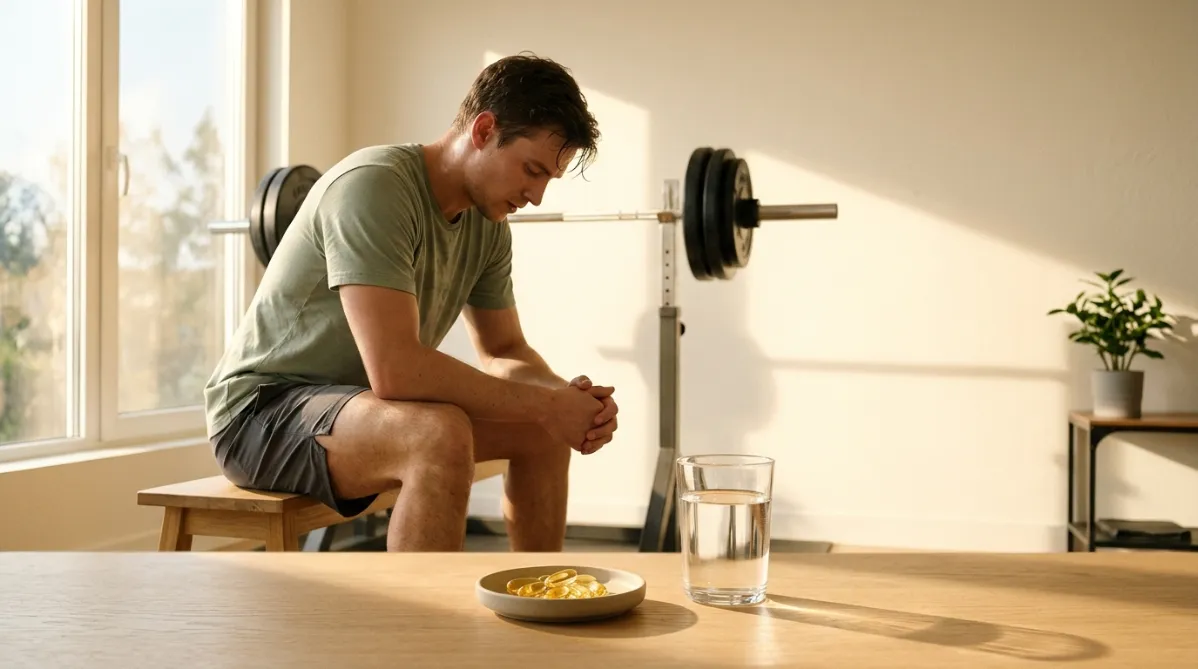
A sunlit, minimalist home gym corner photographed in soft golden morning light, with a young athletic man seated on a wooden bench, leaning forward with his elbows resting on his knees, catching his breath after a hard leg session. He wears a muted sage-green t-shirt and charcoal shorts, his face turned slightly away from the camera, calm and focused. A matte ceramic dish in the foreground holds a few small, translucent golden softgel capsules, with a glass of water beside it catching the light and casting a soft caustic shadow across a pale oak floor. Behind him, a loaded barbell rests on a squat rack, slightly out of focus, and a tall window pours warm sunlight diagonally across the scene, creating long gentle shadows and a hazy glow. A small potted green plant sits on a shelf at the edge of the frame. The color palette is warm and editorial: cream, soft gold, sage green, pale wood, and charcoal accents. Shallow depth of field, with crisp focus on the capsules and glass in the lower third and a creamy bokeh background. The composition leaves generous negative space on the right side for a headline overlay. The mood is clean, modern, and aspirational, like a high-end wellness magazine or a trendy health journal feature. Shot on a 50mm lens, natural light, fine film grain, subtle matte finish, landscape 16:9 framing.
recovery

Vitamina D acelera a recuperação de força em homens que não eram deficientes

BY DR. GYMBRO ·

Homens com níveis perfeitamente normais de vitamina D ainda recuperaram a força mais rapidamente após um treino de pernas intenso ao tomarem 4.000 UI por dia. Em um ensaio randomizado, controlado por placebo, com 28 homens ativos, a força isométrica máxima retornou cerca de 8 % melhor em 24 h. Os marcadores de dano muscular ALT e AST também aumentaram menos. Contudo, a dor muscular não melhorou. Veja o que o estudo encontrou, suas limitações e quem realmente pode se interessar.

A bright, airy editorial photograph shot from above at a slight angle, showing a tall clear glass of deep violet blueberry smoothie on a pale oak wooden table. The smoothie has a creamy, velvety texture with a few lighter swirls, and a small cluster of fresh blueberries with dusty blue skins rests on the rim of the glass. A matte white ceramic bowl of whole blueberries sits to the left, with a few berries scattered naturally across the tabletop. A folded linen napkin in soft oatmeal tones and a stainless steel straw add subtle texture.

In the softly blurred background, a rolled-up sage green yoga mat leans against a light wall next to a pair of clean white running shoes and a small pair of brushed-metal dumbbells. A sliver of warm morning sunlight enters from the left window, casting gentle diagonal shadows and a golden glow across the table, with soft highlights on the glass and the berries' surface bloom.

The color palette is fresh and modern: deep indigo and violet from the smoothie, balanced by cream, warm beige, soft sage green, and touches of white. The composition follows the rule of thirds, with the glass placed on the right third and generous negative space on the left, suitable for headline overlay. Shallow depth of field, crisp focus on the glass and berries, creamy bokeh in the background. The mood is calm, healthy, and aspirational, like a contemporary wellness magazine or a trendy health journal website. Natural, realistic, high-end food and lifestyle photography style, 16:9 landscape format, clean and uncluttered.
nutrition

Smoothie de mirtilo ajuda pernas doloridas a recuperar a força mais rápido

BY DR. GYMBRO ·

Dez mulheres, 300 contrações excêntricas intensas do quadríceps e um smoothie de mirtilo. Neste ensaio cruzado randomizado, a bebida à base de fruta acelerou a recuperação da força isométrica máxima em 60 h (p = 0,047), enquanto o placebo com capacidade antioxidante semelhante não trouxe benefício. Isso indica que a vantagem não se deve apenas aos antioxidantes. Apenas um desfecho foi significativo e a amostra foi pequena, de modo que a evidência é promissora, mas não conclusiva. A seguir, explicamos como o estudo foi realizado, o que encontrou e como aplicar a estratégia nos treinos de pernas mais exigentes.

A wide, landscape editorial photograph with soft natural morning light. In the foreground, a rustic matte ceramic bowl rests on a pale oak wooden table, filled with vivid deep-green spirulina powder heaped in a gentle mound. A small wooden spoon dusted with the powder lies beside it, and a few scattered green flecks dust the surface. Next to the bowl sits a clear glass of water with a swirl of emerald green just blending in, catching sunlight and casting soft green-tinted shadows.

In the middle ground, slightly out of focus, a pair of worn running shoes in muted sage and cream tones sits on the edge of the table, laces loosely undone. A simple analog stopwatch with a clean white face lies beside them, its hands frozen at a moment suggesting a close finish. A folded linen towel in warm oatmeal tone drapes casually nearby.

The background is a softly blurred outdoor setting seen through a large window: a quiet tree-lined running path at dawn, with golden-hazy light, dewy greenery, and a faint mist. The color palette is calm and modern: deep emerald, sage, cream, warm wood, and touches of soft gold. The composition leaves generous negative space on the right side for headline text, with a shallow depth of field, crisp detail on the powder texture, and a clean, minimalist, lifestyle-magazine aesthetic. Subtle film-like grain, natural shadows, and a fresh, healthy, energetic mood. No people, no text, no logos.
nutrition

Spirulina ajudou corredores a durar 32 % mais tempo — o detalhe

BY DR. GYMBRO ·

Corredores que usaram spirulina por quatro semanas conseguiram aguentar cerca de 32 % a mais em um esforço máximo após uma corrida exaustiva de duas horas. O mesmo estudo registrou um aumento de 10,9 % na oxidação de gordura e níveis mais elevados do antioxidante glutationa. Mas antes de encher o carrinho, há um detalhe: apenas nove homens participaram e o ganho real foi de cerca de 39 segundos. Veja o que a pesquisa revelou, por que pode funcionar e como testar com segurança.

This page is available in