Dr. Gymbro
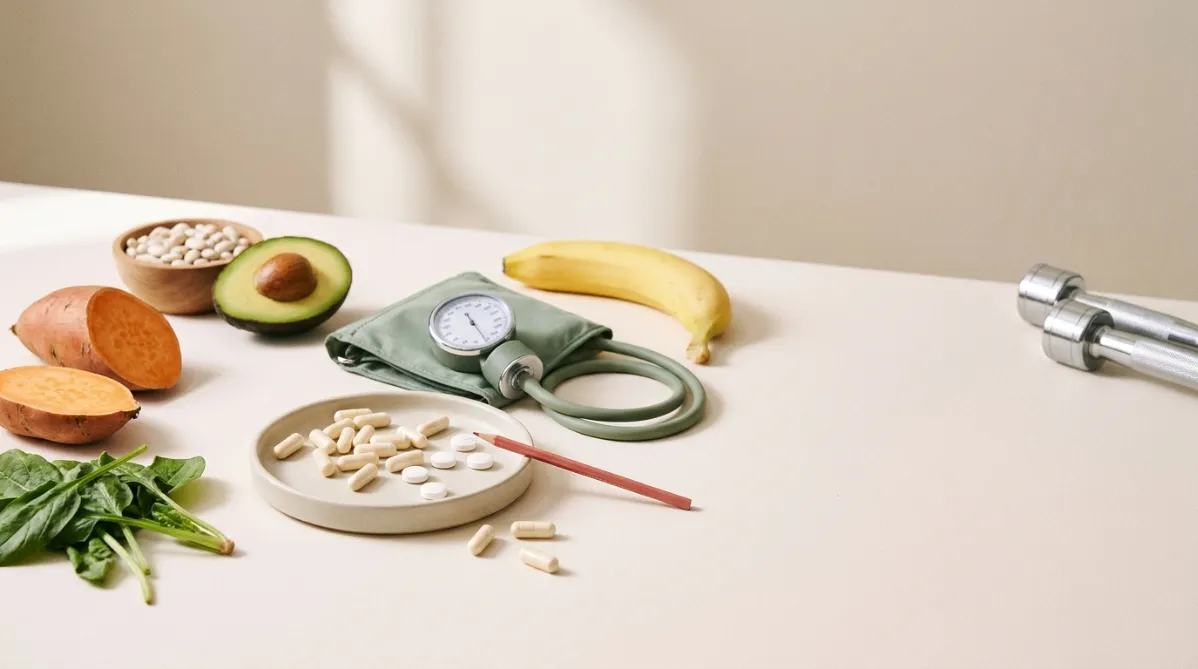
A bright, minimalist editorial still life on a soft warm-white surface, shot from a slightly elevated angle in natural morning light. In the center-left, a small matte ceramic dish holds a handful of pale cream capsules and tablets, a few spilling casually onto the surface. Beside it sits a sleek analog blood pressure cuff, softly coiled, in muted sage green fabric. Fresh potassium-rich foods are arranged in a loose, balanced composition around the pills: a halved ripe avocado with its pit, a peeled banana, a cut sweet potato with glowing orange flesh, a few leafy spinach stems, and a small cluster of white beans in a wooden bowl. A single slim pair of chrome dumbbell handles or a small chalked kettlebell rests discreetly at the right edge, hinting at the lifter audience without dominating the frame.

The palette is soft and modern: warm cream, sage green, terracotta orange, and buttery yellow, with subtle blush-pink shadows. The background is a smooth, out-of-focus pale oatmeal wall with a gentle diagonal shadow from a window, creating a calm, airy mood. The right third of the frame has generous negative space for headline text. A faint, delicate line of hand-drawn-style red accent, such as a small red ribbon or a thin red pencil resting near the pills, adds a quiet "caution" note without feeling alarming.

The overall look is clean, contemporary health-journal photography with shallow depth of field, crisp focus on the pills and produce, soft diffused highlights, and fine natural texture in the ceramic, linen, and food surfaces. Subtle film-like grain, editorial styling, and a calm, trustworthy, slightly cautionary tone. 16:9 landscape composition.
Science & Research

Comprimidos de Potássio Reduzem Pressão Arterial em 5 mmHg em 4 Semanas, Mas Há um Problema

Dr. Gymbro · · 4 min read

Você pode baixar a pressão sistólica em torno de 5 mmHg em aproximadamente um mês usando um suplemento de potássio. Parece um ótimo negócio, até que se lê a letra miúda: quem tomou o suplemento relatou efeitos adversos quase quatro vezes mais frequentemente que quem recebeu placebo. Uma meta‑análise publicada no Journal of the American Heart Association (2026) avaliou os suplementos orais de potássio e os resultados são ao mesmo tempo encorajadores, confusos e um pouco arriscados.

O Número de Destaque: Cerca de 5 mmHg em Aproximadamente 4 Semanas

Pesquisadores da Universidad Peruana Cayetano Heredia, em Lima, reuniram dados de 19 ensaios randomizados que incluíram 803 adultos com hipertensão primária não tratada. Quatorze dos estudos foram do tipo cruzado (crossover) e cinco paralelos, com duração mediana de apenas 4 semanas. Os participantes receberam potássio oral e foram comparados a placebo, cloreto de sódio ou nenhum tratamento.

Nas medições clínicas, o potássio reduziu a pressão sistólica em 5,3 mmHg (IC 95 %, 4,4‑6,3) e a pressão diastólica em 4,5 mmHg (IC 95 %, 3,9‑5,1). Para uma intervenção nutricional, esse deslocamento é significativo. A revisão foi registrada prospectivamente no PROSPERO e utilizou ferramentas padrão como Cochrane Risk of Bias 2 e GRADE para avaliar a qualidade e a certeza da evidência.

A Reviravolta: Leituras Ambulatoriais Mostram um Efeito Mais Modesto

A pressão medida no consultório representa um instante; a monitorização ambulatorial de 24 horas oferece uma visão mais realista da exposição ao longo do dia. Nessa avaliação, o efeito foi menor: 2,8 mmHg de redução sistólica (IC 95 %, 1,3‑4,3) e 3,2 mmHg de redução diastólica (IC 95 %, 2,2‑4,2).

Os autores destacam que os dados ambulatoriais eram escassos. Assim, o número chamativo de 5 mmHg é real, mas refere‑se apenas às leituras de clínica; o benefício ao longo do dia parece mais modesto. Eles caracterizam o efeito geral como redução modesta.

O Problema: Efeitos Colaterais Quase Quatro Vezes Mais Frequentes

Eventos adversos ocorreram em 12,8 % dos participantes que receberam potássio, contra 3,2 % nos grupos de controle – quase quatro vezes mais. Apesar disso, as desistências por efeitos adversos foram raras, indicando que a maioria dos participantes tolerou o suplemento suficientemente para concluir o estudo. Contudo, os dados de segurança são limitados e os ensaios foram curtos.

O resumo original não especifica quais foram os efeitos colaterais, portanto não devemos especular. O ponto permanece: um aumento significativo de eventos adversos com potássio merece atenção cuidadosa.

Por Que Você Deve Ler a Letra Miúda

  • Aplica‑se apenas à hipertensão não tratada. Os estudos incluíram adultos com hipertensão primária ainda sem medicação. Os resultados não se estendem automaticamente a quem tem pressão normal ou já usa fármacos anti‑hipertensivos.
  • Heterogeneidade considerável. Os efeitos variaram bastante entre os estudos, de modo que a média pode esconder diferenças importantes.
  • Acompanhamento curto. Uma mediana de 4 semanas não permite inferir sobre segurança ou eficácia a longo prazo.
  • Dados ambulatoriais escassos. O benefício menor observado na monitorização de 24 horas merece a mesma consideração que o número maior obtido na clínica.

Os próprios autores recomendam cautela na interpretação – e esse é o principal aprendizado.

Dicas Práticas

Alimentação Primeiro, Suplementos Depois

Esta meta‑análise avaliou a suplementação oral de potássio, não a ingestão dietética. Ainda assim, o ponto de partida sensato para a maioria das pessoas são alimentos integrais ricos em potássio, como frutas, legumes, leguminosas e batatas. Esses alimentos também fornecem fibras e outros nutrientes e são muito mais difíceis de se exagerar do que uma cápsula concentrada. Suplementos devem ser uma decisão médica, não um acréscimo casual.

Quem Precisa Consultar um Médico Antes de Usar

Suplementos de potássio podem ser perigosos para algumas pessoas. A principal preocupação é a hipercalemia, que pode causar arritmias cardíacas. Consulte um médico antes de iniciar o uso se você:

  • Tem doença renal, pois os rins comprometidos podem não eliminar o potássio adequadamente.
  • Usa inibidores da ECA ou ARBs, que podem elevar os níveis séricos de potássio.
  • Usa diuréticos poupadores de potássio, que também favorecem a retenção desse mineral.

A revisão não avaliou essas combinações, portanto não encare os achados como um sinal verde. A dose e o monitoramento devem ser orientados por um profissional de saúde.

O Que Isso Significa para Quem Treina

Muitos praticantes de musculação consomem bastante proteína, mas pouco de frutas e legumes, sobretudo durante períodos de “cut” ou dietas restritas. Se esse for o seu caso, a estratégia prática é observar o que está no prato antes de recorrer a um suplemento. Incluir verduras, batatas e leguminosas pode melhorar a ingestão de potássio e, ao mesmo tempo, apoiar a nutrição geral. Se a sua pressão arterial está elevada, meça‑a e discuta com um médico ao invés de se automedicar. Treinos intensos não tornam você imune à hipertensão.

Conclusão

A suplementação de potássio reduziu a pressão sistólica clínica em cerca de 5 mmHg em aproximadamente quatro semanas em indivíduos com hipertensão primária não tratada – um resultado promissor. Contudo, as reduções observadas na monitorização ambulatorial foram menores, os efeitos colaterais foram mais frequentes (12,8 % vs 3,2 %) e a evidência provém de estudos curtos e heterogêneos. Portanto, o potássio deve ser considerado um assunto para a consulta médica, não um atalho da prateleira de suplementos.

Original study

Read the original research on pubmed.ncbi.nlm.nih.gov →

This article summarizes published research for general information. It is not medical advice.

DG

Written by

Dr. Gymbro

Dr. Gymbro writes for Dr. Gymbro: science-backed fitness, nutrition & performance.

Related Articles

A wide, editorial-style still life photographed on a pale warm-gray concrete surface in soft morning window light. In the center sits an open, matte white supplement tub with a scoop resting beside it, a small mound of fine white powder spilling onto the surface. Next to it is a clear glass of water with a faint cloudy swirl of dissolved powder. A few loose capsules in muted coral and cream tones are scattered casually in the foreground. Behind them, slightly out of focus, is a clean running track lane in terracotta red with crisp white lines curving across the background. A pair of minimalist off-white sprint spikes rests on the edge of the track, laces loosely undone. A stopwatch with a brushed metal casing lies partially in frame at the right, its face reading a blurred, indistinct time.

The composition uses generous negative space on the left third, leaving a calm area of soft gray and cream for headline text. Shadows are long, gentle, and slightly cool, contrasting with the warm terracotta of the track. The palette is restrained: terracotta, bone white, soft sage green accents from a small leaf sprig tucked near the tub, and charcoal gray details. Shallow depth of field with a crisp focus on the scoop and powder, creamy bokeh behind. The mood is thoughtful, skeptical, and calm, like a modern wellness or science journal cover. Subtle film grain, natural color grading, and a tactile, tangible feel, with no text, no logos, and no futuristic elements.
nutrition

Beta‑alanina está em quase todos os pré‑treinos; dados de sprints sugerem que pode não funcionar

BY DR. GYMBRO ·

A beta‑alanina está presente em quase todos os suplementos pré‑treino, e o formigamento que provoca costuma nos levar a crer que está funcionando. Contudo, uma meta‑análise multilevel de 2026 que reuniu 17 ensaios controlados randomizados não encontrou benefício algum para a capacidade de sprint repetido, seja medindo desempenho médio, pico ou declínio de fadiga. Dose, duração e nível de treinamento não alteraram esse panorama. Os autores sugerem que a limitação nos sprints repetidos está mais relacionada à recuperação de fosfocreatina do que à acidose, alvo da beta‑alanina. Veja quem ainda pode se beneficiar, quem pode dispensar o suplemento e o que o estudo não pode nos dizer.

A wide, editorial-style still life photographed in soft natural window light on a pale oak gym bench. In the foreground, a small rustic ceramic bowl in warm sand tones holds a mound of fine golden-beige ashwagandha root powder, with a few dried gnarled ashwagandha roots and a sprig of green leaves with tiny orange-red berries resting beside it. A wooden scoop dusted with powder lies at an angle. Just behind, a matte black barbell with a single chalk-dusted steel plate sits slightly out of focus, a light haze of white chalk hanging in the air and catching the sunlight.

On the left side, a neat stack of printed research papers with a sharp black pen and a few muted sage-green sticky tabs. One page shows a simple, abstract forest-plot-style line graph with small squares and horizontal lines, subtly out of focus, hinting at statistics without legible text. A pair of minimal round reading glasses rests on the pages. A small linen gym towel is folded near the edge of the bench.

The palette is restrained and modern: warm cream, soft sage green, muted terracotta, charcoal black, and brushed steel highlights. The background is a softly blurred minimalist studio space with a pale plaster wall and a long soft shadow cast by a window frame, giving a calm, contemplative mood. Shallow depth of field, crisp detail on the powder and roots, gentle film-like grain, and generous negative space on the right third of the frame for a headline overlay. The overall look is a clean, trendy health-and-science journal cover, thoughtful and skeptical rather than promotional, balancing the natural herbal element against the discipline of strength training.
nutrition

Ashwagandha para Levantadores: Impulso de Força ou Miragem Estatística?

BY DR. GYMBRO ·

Ashwagandha é promovida como potenciador de força e volume para quem levanta pesos. Uma nova meta‑análise de ensaios clínicos de treinamento de resistência mostrou ganhos de 1RM em supino e agachamento que parecem impressionantes no papel. Contudo, apenas três estudos com 161 participantes puderam ser combinados e os efeitos perderam significância em testes mais rigorosos. A classificação GRADE apontou evidência de baixa a muito baixa, sem efeito confiável sobre a gordura corporal. Veja o que realmente os dados demonstram e quem ainda pode se interessar em experimentar.

A lone trail runner pauses on a high alpine ridge at dawn, holding a small enamel camp mug of steaming coffee, with thin ribbons of steam curling into crisp, cold air. She wears a fitted charcoal running vest and a muted sage windbreaker, and her breath is faintly visible. Behind her, layered mountain ranges fade into soft blue and lavender haze, and a sea of low clouds fills the valley below. Warm golden sunlight skims the ridgeline and rim-lights her profile, shoulders, and the rising steam. In the foreground, a scattering of dried alpine grasses and lichen-covered stones is in sharp focus, with a worn trail snaking toward the summit. Near the mug sits a small pair of trail running shoes with dusty soles and a simple analog wristwatch resting on a flat rock.

The composition follows a wide 16:9 editorial layout. The subject sits slightly right of center on the rule of thirds, leaving generous negative space in the pale peach-and-powder-blue sky on the left, where headline text could sit. The palette is restrained and modern: warm amber, soft cream, dusty sage, slate blue, and a touch of terracotta. The look is cinematic but natural, with shallow depth of field on the foreground details, gentle film grain, and a slightly matte finish. It evokes a high-end outdoor lifestyle magazine or a contemporary wellness journal. The mood is calm, focused, and quietly determined, capturing the contrast between thin, cold altitude air and the warmth of a coffee ritual. The image has no text, logos, or futuristic elements, and no gym equipment, only natural light, texture, and atmosphere.
nutrition

Cafeína no Ar Rarefeito: O Impulso de Endurance que a Hipóxia Não Apaga

BY DR. GYMBRO ·

O ar rarefeito compromete a resistência, mas uma nova meta‑análise indica que a cafeína pode recuperar parte desse déficit. Ao agrupar nove estudos controlados por placebo em desenho cruzado (117 participantes), os pesquisadores observaram um aumento de desempenho moderado a grande em hipóxia (g = 0.76). Surpreendentemente, a saturação de oxigênio e a percepção de esforço permaneceram inalteradas, enquanto a frequência cardíaca, o lactato e a ventilação aumentaram. A evidência tem baixa certeza e apenas 19 participantes eram mulheres, portanto o achado é promissor, não definitivo. A seguir, quem pode se beneficiar, quem deve evitar e como pensar em dose e timing.

A soft-lit editorial still life on a pale warm-gray concrete surface, shot from a slightly elevated three-quarter angle in a wide landscape frame. On the left, a single amber glass supplement bottle with a minimalist cream label, its lid set beside it. A few golden-yellow softgel capsules are scattered in a loose arc across the surface, catching the light like small drops of honey. At the center-right, a matte sage-green yoga mat is partly unrolled, with a polished chrome dumbbell resting on it. Next to the dumbbell sits a worn canvas hand gripper, a nod to the handgrip finding. Behind them, a wooden gym bench is slightly out of focus, and a folded linen towel sits on top of it.

Warm morning sunlight enters from the upper left through a large window. It casts long, gentle diagonal shadows and a faint golden glow across the scene, a quiet reference to vitamin D and sunshine. A sprig of dried eucalyptus or a small potted succulent adds an organic touch near the bottom right. A small, neatly stacked pile of two or three matte pastel-toned weight plates in butter yellow and dusty terracotta adds color blocking.

The palette is muted and modern: butter yellow, sage, warm sand, soft terracotta, and off-white, with a single strong amber accent from the bottle. The depth of field is shallow, with crisp focus on the capsules and bottle and a creamy blur falling off toward the background. The negative space on the upper right is clean and uncluttered, which leaves room for a headline overlay. The overall feel is calm, minimalist, and contemporary, like a premium health and wellness magazine or a trendy online journal. The grain is subtle, the contrast gentle, and the textures tactile: brushed metal, frosted glass, linen, and concrete. There are no people, no text, and no futuristic elements.
science research

Vitamina D não vai definir seu corpo nem construir músculos, exceto em um caso

BY DR. GYMBRO ·

Uma meta‑análise de dose‑resposta com 28 ensaios randomizados e 1.675 adultos avaliou se a suplementação de vitamina D potencializa os efeitos do exercício. Os níveis sanguíneos de 25(OH)D subiram cerca de 34 nmol/L, mas peso, IMC, massa gorda, percentual de gordura e massa magra não melhoraram além do treinamento isolado. A força no leg press também não teve benefício. A única exceção foi um ganho modesto na extensão do joelho (+4,36 kg) e melhorias na preensão manual em idosos que receberam doses mais altas. Veja quem realmente pode se beneficiar e o que fazer antes de comprar outro frasco.

This page is available in