Dr. Gymbro
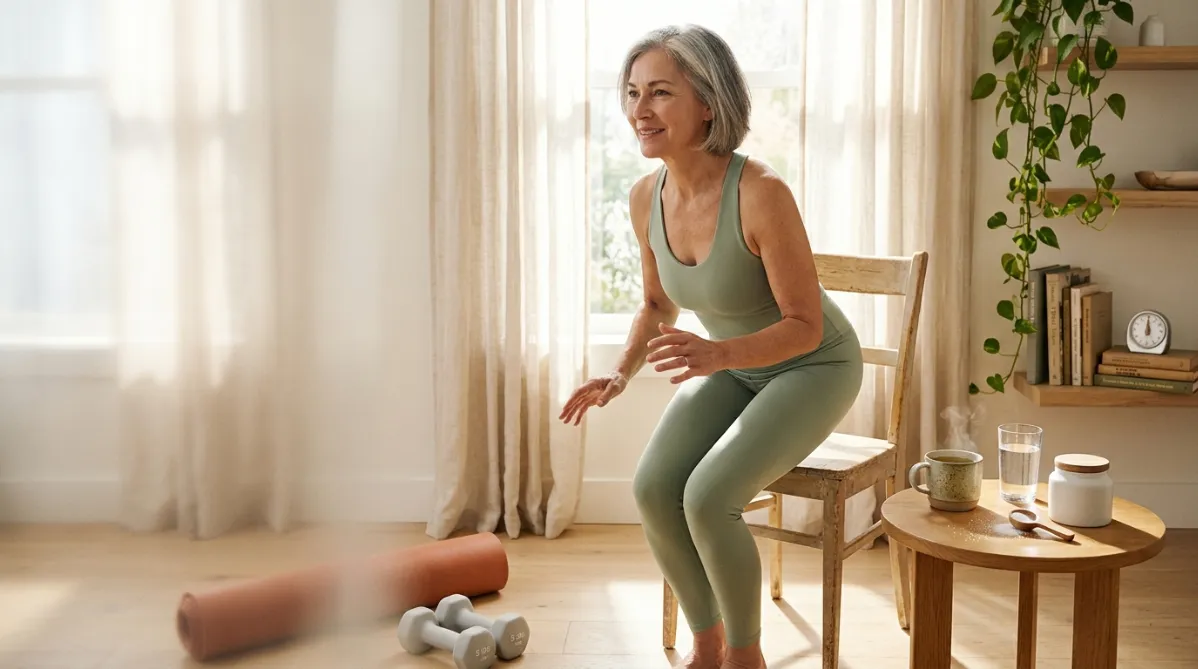
A wide landscape editorial photograph of a bright, airy sunlit living room with pale oak floors and a large window with sheer linen curtains. In the center, a woman in her late 50s with silver-streaked hair, wearing soft sage-green athletic wear, rises from a simple wooden chair, caught mid-motion with a calm, determined expression. Her hands are lightly extended forward for balance. Beside her on a small round oak side table sits a ceramic mug of tea, a glass of water, and a small matte white jar with a wooden scoop resting beside it, a few fine white crystalline grains scattered on the tabletop. In the soft-focus foreground, a pair of light-gray dumbbells and a rolled terracotta-colored yoga mat rest on the floor. A trailing green pothos plant spills from a shelf in the background, with a stack of books and a small analog kitchen timer nearby.

The color palette is warm and muted: cream, sage green, soft terracotta, natural wood, and gentle morning-gold light. Light streams diagonally across the scene, creating long soft shadows and a subtle glow on the woman's shoulders. Shallow depth of field blurs the background gently, while the woman and the table remain crisp. The composition follows the rule of thirds, with the woman on the right and generous negative space on the left, suited for headline overlay. The mood is hopeful, grounded, and modern, like a high-end wellness magazine or a trendy health journal. Natural film-like grain, soft contrast, and a slight matte finish give it a contemporary lifestyle photography feel. There are no futuristic elements, no digital overlays, and no text.
Science & Research

Creatina ajuda mulheres com joelho comprometido a levantar‑se melhor – mas não da forma que você imagina

Dr. Gymbro · · 5 min read

A surpresa oculta em um ensaio de osteoartrite de joelho

A creatina tem uma reputação de suplemento dos levantadores de 22 anos que buscam bater novos recordes. Contudo, um estudo randomizado publicado na Medicine & Science in Sports & Exercise a testou em um grupo bem diferente: mulheres pós‑menopáusicas com osteoartrite (OA) de joelho.

O grupo que tomou creatina ficou melhor ao levantar da cadeira. Os ganhos de força e a redução de dor, entretanto, não foram maiores que os observados no grupo placebo. A seguir, explicamos o que o estudo realmente encontrou e o que ele não provou.

O estudo em resumo

  • Desenho: Ensaio randomizado, duplo‑cego, controlado por placebo (Neves et al., 2011, Universidade de São Paulo)
  • Participantes: Mulheres pós‑menopáusicas com OA de joelho
  • Tamanho da amostra: O resumo publicado não informa o número de participantes. Consulte o texto completo antes de confiar nos resultados e lembre‑se de que ensaios desse tipo costumam ser pequenos.
  • Intervenção: Creatina (20 g/dia durante 1 semana – fase de carregamento – e depois 5 g/dia) ou placebo
  • Treinamento: Todos seguiram um programa de resistência para os membros inferiores
  • Duração: 12 semanas, com avaliações na linha de base e ao final
  • Desfecho primário: Função física, medida pelo teste de ficar em pé cronometrado

Como ambos os grupos treinaram, a pergunta não era "a creatina supera a inatividade?", mas sim "a creatina aporta algo a mais ao treinamento de força?".

O número de destaque: levantar‑se mais rápido

No teste de ficar em pé, o escore do grupo que recebeu creatina subiu de 15,7 ± 1,4 para 18,1 ± 1,8 pontos – um ganho de 2,4 pontos, ou cerca de 15 %. O placebo, por sua vez, passou de 15,0 ± 1,8 para 15,2 ± 1,2, essencialmente estável. A melhora intra‑grupo da creatina foi significativa (p = 0,006) e a diferença entre os grupos também (p = 0,004).

O fato de o grupo placebo ter realizado o mesmo treinamento, mas não ter apresentado mudança relevante nesse teste, é o que torna o resultado interessante.

Outros benefícios só observados com a creatina

Além do desfecho primário, o grupo que recebeu creatina mostrou melhorias significativas em:

  • Função física (WOMAC): p = 0,005
  • Rigidez (WOMAC): p = 0,024
  • Massa magra dos membros inferiores: p = 0,04
  • Qualidade de vida: p = 0,01

O placebo não apresentou alterações significativas nas sub‑escalas de função e rigidez do WOMAC (p > 0,05). O WOMAC é um questionário padrão no qual os pacientes avaliam dor, rigidez e dificuldade nas atividades diárias; portanto, são mudanças percebidas pelas próprias mulheres.

Onde a creatina não venceu

Dor: Ambos os grupos relataram redução significativa da dor (p < 0,05), mas a creatina não superou o placebo. O provável responsável foi o treinamento de resistência supervisionado, embora o estudo não consiga isolar esse efeito. Não há evidência de que a creatina seja analgésico para joelhos artróticos.

Força máxima: O 1RM no leg‑press aumentou ao longo do estudo em ambos os grupos (p = 0,005), sem diferença entre eles (p = 0,81). Assim, a creatina não tornou essas mulheres mais fortes no leg‑press em comparação ao placebo.

Portanto, a história não é "creatina aumenta a força". O que parece acontecer é melhora funcional e ganho de massa magra, sem vantagem mensurável no 1RM. A conclusão dos autores limita‑se à função física, à massa magra dos membros inferiores e à qualidade de vida.

Por que a função pode melhorar sem aumento de força?

O resumo do artigo não esclarece o motivo, então o que segue é especulação informada. Testes de levantar da cadeira recompensam esforços repetidos, não um único levantamento máximo. O papel mais conhecido da creatina é apoiar a rápida renovação de energia muscular durante curtos episódios repetidos de esforço, o que combina bem com um teste baseado em repetições. O acréscimo de massa magra nas pernas também pode ter contribuído.

Um teste de 1RM e um teste de levantar repetidamente medem coisas diferentes; portanto, é plausível que eles respondam de maneira distinta.

O que isso significa para você

  • Dose: O ensaio utilizou uma fase de carregamento de 1 semana com 20 g/dia, seguida de manutenção de 5 g/dia. A dose de manutenção de 5 g/dia é a que deve ser considerada. O carregamento fez parte do protocolo, mas o estudo não avaliou se pular essa fase alteraria os resultados.
  • Horário: O resumo não informa em que horário do dia os participantes tomaram o suplemento, portanto não há conclusões acerca do timing. A consistência diária é mais importante que a hora exata.
  • Treinamento: A creatina foi combinada com treinamento de resistência para os membros inferiores durante 12 semanas. O benefício observado vale para creatina mais treinamento, não para a creatina isolada. Se você não faz treino de força, não espere o mesmo benefício.
  • Para quem pode ser relevante: Mulheres pós‑menopáusicas com OA de joelho que já estejam praticando – ou pretendam iniciar – um programa supervisionado de fortalecimento de pernas e que desejem melhorar a função diária, como levantar‑se, ficar em pé e reduzir a rigidez.
  • Para quem deve evitar ou consultar um médico primeiro:
    • Pessoas com doença renal ou função renal reduzida, ou que utilizem medicamentos que afetem os rins;
    • Quem busca alívio da dor apenas com a creatina, já que o ensaio não mostrou vantagem sobre placebo;
    • Homens, adultos mais jovens e indivíduos com outros tipos de artrite, que não foram estudados aqui;
    • Quem tem condições médicas significativas ou usa múltiplos fármacos, devendo sempre validar suplementos com um profissional de saúde.

O detalhe importante

Trata‑se de um único ensaio de 12 semanas em uma população específica, e o resumo não informa o número de participantes. É preciso replicar o estudo antes que ele altere diretrizes clínicas. Os resultados são encorajadores, mas não definitivos, e os desfechos secundários devem ser vistos como apoio, não como prova conclusiva.

Ainda assim, a mensagem prática fica clara: para mulheres com OA de joelho que estão treinando força, acrescentar 5 g/dia de creatina gerou ganhos funcionais significativos que treinamento + placebo não produziu. Dor e força máxima permaneceram iguais nos dois grupos. A creatina pode ser útil fora do universo dos levantadores jovens, mas funciona ao lado da barra ou da máquina de leg‑press, não como substituto.

Original study

Read the original research on pubmed.ncbi.nlm.nih.gov →

This article summarizes published research for general information. It is not medical advice.

DG

Written by

Dr. Gymbro

Dr. Gymbro writes for Dr. Gymbro: science-backed fitness, nutrition & performance.

Related Articles

A wide, landscape editorial photograph of a clean, sunlit kitchen counter or pale stone tabletop, styled like a modern wellness magazine spread. Two scoops sit side by side on a matte ceramic surface. The left one is a plain, humble wooden scoop heaped with fine white creatine powder. The right is a glossy, ornate brushed-gold scoop holding the same white powder, which hints at "premium" branding. Behind each scoop stands a tub. The left tub is minimal, matte, and cream-colored with simple sans-serif lettering and no readable words. The right tub is sleek black with metallic gold accents and an overly polished look. A few fine grains of powder are scattered across the surface, catching the light.

The composition uses a shallow depth of field. The foreground scoops are crisp, and the background softly blurs into a warm neutral palette of oatmeal, soft sage green, and muted terracotta. Soft morning window light comes in from the left, casting long, gentle shadows and a subtle highlight along the scoops' edges. A small price tag shape, blank and unmarked, sits near the gold scoop, with a slightly crumpled paper texture to suggest the "pricey" angle without any text. A glass of water with condensation and a folded linen napkin sit at the edge of the frame. A single green sprig or eucalyptus stem adds a natural accent.

The overall mood is calm, intelligent, and quietly skeptical, with the plain option feeling confident and the flashy one a bit overdressed. The color grading is soft and slightly desaturated with creamy highlights, and there is fine film grain. The layout leaves generous negative space on the right third for a headline overlay. It looks like a high-end lifestyle and science journal cover, with a minimalist, tactile, trendy feel and no futuristic or sci-fi elements.
science research

Ester Etílico de Creatina vs Monoidrato: A Forma Cara que se Perdeu

BY DR. GYMBRO ·

Fabricantes de suplementos adoram vender “creatina avançada” como mais absorvível que a tradicional. Um estudo duplo‑cego de 2009 comparou o ester etílico da creatina (CEE) com monoidrato e placebo em 30 homens não treinados ao longo de sete semanas de treino intenso. O CEE resultou em menor creatina sérica e muito maior creatinina sérica, indicando que se decompõe em resíduos. A creatina muscular aumentou nos dois grupos de creatina, mas força, potência e composição corporal não diferiram entre os grupos. Conclusão: evite a forma premium e fique com a simples.

A wide, editorial-style still life photographed from slightly above on a pale oak surface in soft morning window light. At the center, a small matte white supplement tub with a plain, unlabeled front sits tipped on its side, spilling a modest pile of fine white powder across the wood. Beside it, a wooden scoop rests in the powder, and a few white capsules are scattered in a loose arc. To the left, a clean glass of water catches the light and throws a delicate caustic shadow. To the right, a neatly arranged group of whole foods sits in contrast: two brown eggs, a small wedge of salmon fillet on parchment, a handful of raw almonds, and a sprig of rosemary. A matte black steel dumbbell handle is partly visible at the top edge of the frame, grounding the fitness theme. In the lower foreground, a slim, open linen-bound notebook holds a hand-drawn line graph with a single line trending gently downward, a thin ink pen lying across the page. The palette is muted and warm: cream, soft sage green, pale oak, charcoal accents, and a touch of terracotta from a ceramic dish holding the almonds. Shallow depth of field blurs the background, a softly lit minimalist kitchen counter with a hint of a plant leaf. The mood is calm, thoughtful, and scientific without being clinical, like a cover image for a contemporary health and nutrition journal. Natural shadows, subtle film grain, and generous negative space on the upper left leave room for a headline overlay. Crisp focus on the powder and scoop, with refined, understated composition and no text or logos visible.
nutrition

Ácido D‑aspártico reduziu a testosterona em 6 g/dia em praticantes treinados

BY DR. GYMBRO ·

O ácido D‑aspártico (DAA) é divulgado como um impulsionador natural de testosterona, porém um estudo controlado com 24 homens treinados revelou que a dose de 6 g/dia realmente reduziu tanto a testosterona total quanto a livre. A dose de 3 g, frequente nas embalagens, não produziu efeito mensurável. Um ensaio de acompanhamento de três meses também não constatou ganho de força ou massa muscular. Saiba o que a pesquisa mostrou, por que praticantes podem reagir de forma distinta dos sedentários e onde seu dinheiro tem mais retorno.

A wide, editorial-style still life photographed from slightly above on a pale oat-colored linen surface, lit by soft morning window light from the left. In the center sits a small matte ceramic bowl holding a mound of fine white powder, with a minimalist wooden scoop resting beside it. Next to the bowl is an open amber glass supplement jar with a plain cream label, and a few white capsules spill across the linen in a loose arc.

To the right, a neatly arranged cluster of analog "study" objects suggests careful measurement: a vintage stopwatch with a clean white face, a slim notebook with a sage-green cover open to a hand-drawn bar chart (blurred, no legible text), and a mechanical pencil lying across the page. A small row of six identical ceramic dishes, each holding a pinch of powder, is lined up along the top edge of the frame to hint at the six-week trial. One dish is slightly out of alignment, a subtle visual cue for ambiguity.

A shallow glass of water and a single sprig of green eucalyptus add a calm, organic note in the foreground. Soft, long shadows fall across the textured linen, and the palette stays restrained: warm cream, soft sage, muted terracotta, pale gray, and touches of amber from the glass jar. A few translucent paper cutouts in two tones (sage and blush) overlap in the upper right corner as a modern graphic accent, evoking overlapping data points without showing any numbers.

Depth of field is shallow, with the bowl and stopwatch in crisp focus and the edges gently softened. The composition leaves generous negative space on the left third for title text overlay. The overall mood is thoughtful, balanced, and quietly skeptical, in the style of a contemporary wellness and science magazine: clean, tactile, minimal, with a subtle film-like grain and natural color grading. No people, no futuristic or sci-fi elements, no readable text or logos.
nutrition

GAA: Potencializador Cerebral? Resultado do Estudo de 6 Semanas é Complicado

BY DR. GYMBRO ·

GAA, precursor da creatina vendido como potencializador cerebral, acabou de receber seu primeiro teste humano sério. Em um estudo duplo‑cego de seis semanas com 58 adultos saudáveis, ele acelerou alguns tempos de reação e gerou indícios de mudanças no humor e no estresse. Contudo, a maioria dos testes cognitivos não revelou efeitos, e muitos dos resultados principais foram apenas tendências. Os marcadores de segurança permaneceram dentro da normalidade, mas o estudo foi pequeno, exploratório e não incluiu um grupo comparativo apenas com creatina. Veja o que realmente foi observado, quem pode se interessar e por que o veredicto é misto.

A wide, softly lit editorial still life on a pale warm-gray concrete surface, shot from a slightly elevated three-quarter angle. In the center-left, two matte ceramic scoops sit side by side. One holds fine ivory whey powder, the other holds slightly coarser, pale golden collagen peptide powder. A small, elegant dusting of both powders spills between them and blends into a soft swirl. Behind them, three minimalist cream and sage-green supplement tubs with no legible text stand in a staggered row, with a frosted glass shaker bottle of creamy liquid beside them.

On the right, a brushed-steel barbell plate and a compact chalk-dusted kettlebell rest slightly out of focus, suggesting resistance training. Pale wisps of chalk hang in the air. A folded charcoal gym towel and a pair of worn leather lifting straps lie in the foreground. A single cross-section of a clean white bone model, a stylized vertebra, rests on a small oak block at the far right. It subtly signals the bone-density theme without looking clinical.

Natural window light enters from the left, casting long, gentle shadows and a warm highlight on the powders. The palette is muted and modern: oatmeal, bone white, sage green, soft charcoal, and touches of warm amber. Shallow depth of field keeps the scoops tack-sharp and melts the background into creamy blur. Leave generous negative space in the upper right for headline overlay. The overall feel is a premium health and science journal cover: clean, tactile, minimalist, with fine film-like grain and a calm, editorial mood.
nutrition

Whey + colágeno supera qualquer outro suplemento em levantadores — mas há uma pegadinha

BY DR. GYMBRO ·

Misturar 30 g de whey com 10 g de colágeno superou whey sozinho, colágeno sozinho e placebo em todos os desfechos em um novo estudo de 8 semanas com homens treinados em resistência. A combinação acrescentou 2,66 kg de músculo (por BIA), elevou a DMO da coluna lombar e melhorou agachamento, supino e marcadores de turnover ósseo. O colágeno sozinho movimentou o osso, o whey sozinho o músculo. Porém, com apenas 40 participantes, totais de proteína desiguais e um salto inesperadamente grande na DMO, há uma pegadinha. Veja o que a combinação ganhou, para quem pode ser adequada e quem deve evitá‑la.

This page is available in