Dr. Gymbro
A wide, editorial-style flat lay photographed from above on a pale warm-gray concrete surface, lit by soft natural window light with gentle shadows. On the left, three small matte ceramic bowls in sage green, soft terracotta, and cream, each holding a different white crystalline powder. The textures vary subtly: fine and powdery, slightly granular, and glittery with tiny crystalline flecks. Beside them rest three minimalist wooden scoops, a few scattered grains catching the light. In the center-right, a worn classic black-and-white soccer ball sits slightly off-frame, partially cropped by the edge, with a pair of muted navy cleats resting nearby, laces loosely draped. A small stopwatch with a brushed-steel finish and a folded sheet of graph paper with a hand-drawn bar chart in soft coral and teal pencil add a subtle sense of data and measurement. A few blades of fresh-cut grass and a sprig of eucalyptus add organic accents. The palette is calm and modern: warm neutrals, sage, terracotta, and muted navy, with one pop of coral. The composition leaves generous negative space in the upper right for headline text. The mood is clean, curious, and trustworthy, like a contemporary health and science journal. Shallow depth of field, crisp focus on the powders, with the soccer elements slightly softer. High-end editorial photography, 16:9 landscape.
Science & Research

Creatina HCl supera monoidrato em jogadores de futebol — ainda não abandone a sua

Dr. Gymbro · · 4 min read

O monoidrato tradicional acabou de perder espaço para os primos mais caros e da moda. Mas antes de sair comprando outra coisa, veja os detalhes: o estudo tem limitações reais e os resultados vão contra pesquisas anteriores.

O que os pesquisadores realmente testaram

Uma equipe do Departamento de Ciências do Esporte da Universidade Médica de Wenzhou, na China, liderada por Duan, publicou um ensaio randomizado, controlado por placebo, no Journal of the International Society of Sports Nutrition (2026). Foram recrutados 40 jogadores universitários de futebol masculino e divididos em quatro grupos paralelos de 10 atletas cada:

  • Creatina monoidrato (Cr‑Mon)
  • Creatina éster etílico (Cr‑Ee)
  • Creatina cloridrato (Cr‑HCl)
  • Placebo

Todos seguiram a mesma fase preparatória de 4 semanas de treinamento de sprint repetido – três sessões por semana, totalizando 12 sessões. Antes e depois da intervenção, os atletas foram avaliados em salto vertical com contramovimento (CMVJ), sprint de 20 m, teste de agilidade em L‑run, teste anaeróbio Wingate (potência de pico, potência média e índice de fadiga) e teste incremental de VO₂máx.

Resultado principal: as versões "premium" lideraram

Primeiro, o esperado: todos os grupos melhoraram, inclusive o placebo – algo típico de um mês de treinamento estruturado. Contudo, os grupos que ingeriram creatina apresentaram melhorias significativamente maiores que o placebo em desempenho físico, potência de pico e índice de fadiga (p = 0,001).

Em seguida, a surpresa. Segundo o resumo, as formas éster etílico e HCl geraram ganhos superiores (p < 0,05) em desempenho físico e potência de pico quando comparadas ao monoidrato. Os autores destacam especialmente o CMVJ, o sprint de 20 m, o L‑run e a potência de pico como áreas em que Cr‑Ee e Cr‑HCl tiveram vantagem.

Portanto, neste ensaio, as formas mais caras e amplamente divulgadas não só igualaram o monoidrato, como o superaram nas medidas explosivas e de curta duração que mais importam no futebol.

Onde as formas NÃO diferiram

Nem tudo se dividiu por formulação. O resumo não encontrou diferenças significativas entre os grupos para potência média ou VO₂máx. Isso está alinhado ao conhecido perfil da creatina, que beneficia esforços curtos e de alta intensidade (dependentes da fosfocreatina), mas não a capacidade aeróbica.

Por que ainda não se deve abandonar o monoidrato

Aqui entra a leitura crítica:

  • Tamanho da amostra pequeno. Apenas 10 atletas por braço; indivíduos excepcionalmente responsivos podem ter deslocado a média. Estudos com poucos participantes geram hipóteses, mas são fracos para fechar debates.
  • Curto período de intervenção. Quatro semanas não permitem avaliar efeitos a longo prazo, segurança ou desempenho ao longo de uma temporada completa.
  • Amostra homogênea. Todos eram jovens, do sexo masculino e jogadores universitários. Os resultados podem não se aplicar a mulheres, atletas mais velhos, outras modalidades ou praticantes menos intensos.
  • Ausência de medida direta de creatina muscular. Sem biopsias ou espectroscopia, não sabemos se as novas formas aumentaram realmente os estoques musculares ou se outro fator explicou a diferença. Além disso, o resumo não informa a dose usada para cada forma, dificultando comparações equitativas.
  • Contradição com pesquisas anteriores. Um estudo clássico de 2009 (Spillane et al.) mostrou que o éster etílico não era superior ao monoidrato em composição corporal e desempenho, além de elevar a creatinina sérica. Um único ensaio novo não elimina esse achado.
  • Monoidrato ainda tem a maior base de evidências. É a forma mais estudada, amplamente disponível e geralmente a mais barata. Uma vantagem momentânea em um estudo pequeno não garante que seja a escolha mais vantajosa.

Os autores declararam não ter conflitos de interesse – um ponto positivo, mas que não corrige as limitações metodológicas.

Dicas práticas

  • Dose: O resumo não especifica a dose para cada forma; portanto, não reproduza o protocolo do artigo. Se usar monoidrato, siga a dosagem recomendada no rótulo de um produto confiável ou a orientação de um nutricionista esportivo. Caso opte por HCl, siga as instruções do fabricante.
  • Horário: A suplementação foi diária ao longo de 4 semanas, concomitante ao treinamento de sprint. O horário exato de ingestão não foi informado; o mais importante é a constância, não o momento do dia.
  • Quem pode se beneficiar: Atletas de campo e quadra que buscam melhorar sprint, salto, agilidade e potência de pico, sobretudo em blocos de pré‑temporada. Quem tem desconforto gastrointestinal com monoidrato pode considerar HCl, embora este estudo não tenha avaliado tolerabilidade.
  • Quem deve ter cautela ou evitar: Pessoas com doença renal ou outras condições médicas, usuários de medicação e menores de 18 anos devem consultar um médico antes de suplementar. O éster etílico merece atenção extra devido ao relato anterior de elevação de creatinina.

Conclusão

Este ensaio indica que creatina HCl e o éster etílico podem oferecer vantagem em salto, sprint, agilidade e potência de pico em um curto bloco de treinamento. Contudo, 40 atletas, 4 semanas de intervenção e a falta de detalhamento das doses tornam o estudo mais um convite para pesquisas adicionais do que um motivo para abandonar o monoidrato.

Até que estudos maiores, mais longos e com medições de creatina muscular confirmem o benefício, o monoidrato continua sendo a opção comprovada e acessível, enquanto a HCl permanece um candidato intrigante a ser observado.
Original study

Read the original research on pubmed.ncbi.nlm.nih.gov →

This article summarizes published research for general information. It is not medical advice.

DG

Written by

Dr. Gymbro

Dr. Gymbro writes for Dr. Gymbro: science-backed fitness, nutrition & performance.

Related Articles

A modern editorial still life photographed from a slightly elevated angle on a pale, matte stone surface in soft natural window light. On the left, a heaping mound of fine white creatine monohydrate powder spills from a matte ceramic scoop, with a few crisp grains scattered across the surface. In the center, a small, minimalist amber glass capsule bottle sits tipped on its side, with a handful of off-white capsules spilling out. The label is blank and clean. On the right, a neat row of three clear glass lab-style vials rests on a slim oak tray. The vials hold different amounts of white powder: the first nearly empty, the second slightly fuller, the third filled almost to the brim. This quietly suggests the difference in dose and result. Beside the tray lies a simple stainless steel measuring spoon and a folded sheet of cream paper with soft, abstract bar-chart lines in muted sage green and terracotta. The lines are hand-drawn and unlabeled.

Behind the objects, slightly out of focus, a lean athletic forearm in a gray linen sleeve rests on the edge of the surface, one hand loosely holding a matte shaker bottle. This hints at a training context without showing a face. A single sprig of eucalyptus in the corner adds a soft organic touch.

The palette is warm neutral: bone white, oatmeal, soft sage, muted terracotta, and touches of amber. Shadows are gentle and long, with a shallow depth of field that gives creamy bokeh in the background. The mood is calm, clean, and trustworthy, like a premium health and science journal's feature spread, with generous negative space at the top and right for headline overlay. The composition is wide, balanced, and uncluttered, with subtle film-like grain and a natural, true-to-life color grade. No text, no logos, no futuristic elements.
nutrition

Dose de Rótulo do Kre‑Alkalyn Não Aumentou a Creatina Muscular, Revelam Biópsias

BY DR. GYMBRO ·

A creatina tamponada Kre‑Alkalyn é divulgada como mais absorvível, exigindo doses menores e provocando menos inchaço. Um estudo duplo‑cego da Texas A&M, com 36 praticantes durante 28 dias, analisou biópsias musculares. Na dose recomendada de 1,5 g/dia, a creatina muscular praticamente não mudou, enquanto a monohidratada aumentou de forma clara. Não houve diferença em força, composição corporal ou efeitos colaterais. Veja os números e a dosagem correta da creatina.

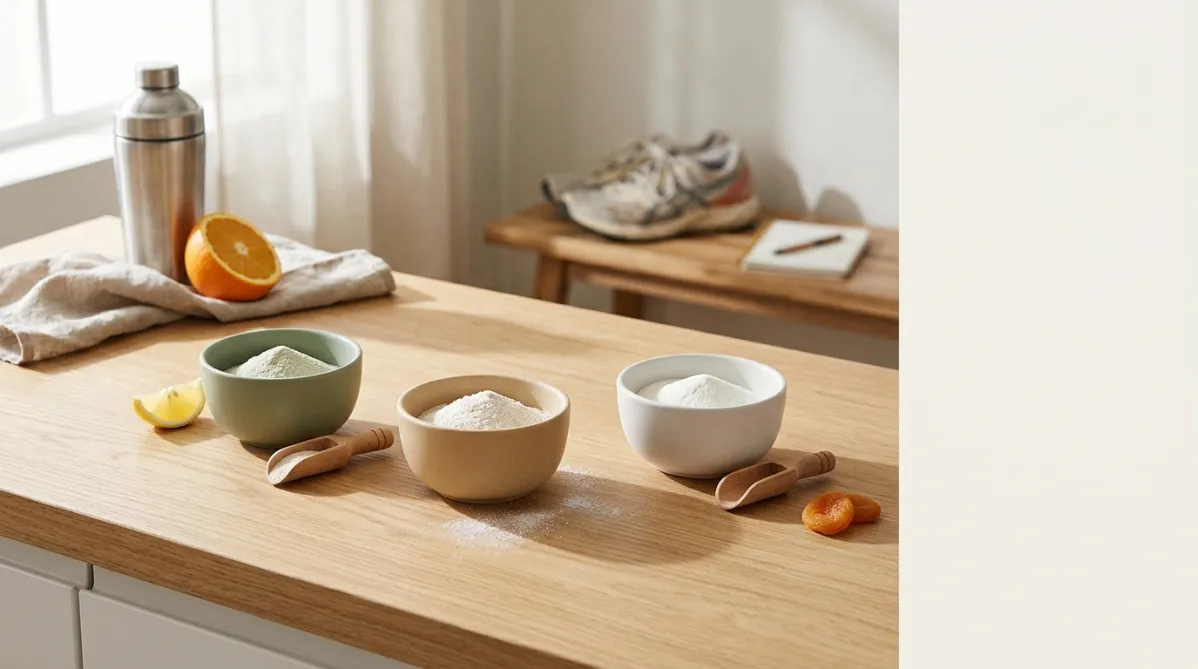
A landscape editorial photograph of a clean, sunlit kitchen-counter or light oak table, shot from slightly above at a gentle angle. Three small matte ceramic bowls in muted sage green, warm sand, and soft white sit in a loose row. Each holds a different fine white powder, and each has a small wooden scoop resting beside it. The middle bowl is slightly closer to the camera and sharper in focus, with a faint dusting of powder spilling onto the surface. In the soft-focus background, a stainless steel shaker bottle and a half-peeled orange sit beside a folded linen napkin, suggesting citrus without being literal. A single lemon wedge sits near the left bowl, and a small dried apricot sits near the right, a subtle visual nod to citrate and pyruvate.

In the background, a blurred athletic scene: a running shoe resting on a wooden bench and a small notebook with a pen, suggesting a training log. Soft diffused morning light enters from the left through a window and casts long, gentle shadows. The palette is warm neutrals, creamy whites, soft greens, and a hint of terracotta orange. The look is a modern wellness magazine with a shallow depth of field, a fine-grain film feel, and generous negative space on the right third of the frame for title text. The mood is calm, trustworthy, and scientific yet approachable, with no text, labels, or logos.
nutrition

Creatina Piruvato vs Citrato: Qual Mantém a Força Por Mais Tempo?

BY DR. GYMBRO ·

Dois tipos de creatina avançados superaram o placebo em um estudo de 28 dias, mas apenas um manteve a força muscular elevada ao longo de dez séries de esforço máximo, enquanto o outro perdeu efeito. A creatina piruvato aumentou a força em todos os intervalos (p < 0,001), ao passo que o benefício da creatina citrato desapareceu já no sexto intervalo. Só o piruvato também melhorou a velocidade de relaxamento e o consumo de oxigênio em repouso. Antes de mudar seu suplemento, atenção: o estudo não incluiu um grupo usando creatina monohidratada.

A wide, landscape editorial photograph of a clean, sunlit kitchen counter or pale stone tabletop, styled like a modern wellness magazine spread. Two scoops sit side by side on a matte ceramic surface. The left one is a plain, humble wooden scoop heaped with fine white creatine powder. The right is a glossy, ornate brushed-gold scoop holding the same white powder, which hints at "premium" branding. Behind each scoop stands a tub. The left tub is minimal, matte, and cream-colored with simple sans-serif lettering and no readable words. The right tub is sleek black with metallic gold accents and an overly polished look. A few fine grains of powder are scattered across the surface, catching the light.

The composition uses a shallow depth of field. The foreground scoops are crisp, and the background softly blurs into a warm neutral palette of oatmeal, soft sage green, and muted terracotta. Soft morning window light comes in from the left, casting long, gentle shadows and a subtle highlight along the scoops' edges. A small price tag shape, blank and unmarked, sits near the gold scoop, with a slightly crumpled paper texture to suggest the "pricey" angle without any text. A glass of water with condensation and a folded linen napkin sit at the edge of the frame. A single green sprig or eucalyptus stem adds a natural accent.

The overall mood is calm, intelligent, and quietly skeptical, with the plain option feeling confident and the flashy one a bit overdressed. The color grading is soft and slightly desaturated with creamy highlights, and there is fine film grain. The layout leaves generous negative space on the right third for a headline overlay. It looks like a high-end lifestyle and science journal cover, with a minimalist, tactile, trendy feel and no futuristic or sci-fi elements.
science research

Ester Etílico de Creatina vs Monoidrato: A Forma Cara que se Perdeu

BY DR. GYMBRO ·

Fabricantes de suplementos adoram vender “creatina avançada” como mais absorvível que a tradicional. Um estudo duplo‑cego de 2009 comparou o ester etílico da creatina (CEE) com monoidrato e placebo em 30 homens não treinados ao longo de sete semanas de treino intenso. O CEE resultou em menor creatina sérica e muito maior creatinina sérica, indicando que se decompõe em resíduos. A creatina muscular aumentou nos dois grupos de creatina, mas força, potência e composição corporal não diferiram entre os grupos. Conclusão: evite a forma premium e fique com a simples.

A wide, editorial-style still life photographed from slightly above on a pale oat-colored linen surface, lit by soft morning window light from the left. In the center sits a small matte ceramic bowl holding a mound of fine white powder, with a minimalist wooden scoop resting beside it. Next to the bowl is an open amber glass supplement jar with a plain cream label, and a few white capsules spill across the linen in a loose arc.

To the right, a neatly arranged cluster of analog "study" objects suggests careful measurement: a vintage stopwatch with a clean white face, a slim notebook with a sage-green cover open to a hand-drawn bar chart (blurred, no legible text), and a mechanical pencil lying across the page. A small row of six identical ceramic dishes, each holding a pinch of powder, is lined up along the top edge of the frame to hint at the six-week trial. One dish is slightly out of alignment, a subtle visual cue for ambiguity.

A shallow glass of water and a single sprig of green eucalyptus add a calm, organic note in the foreground. Soft, long shadows fall across the textured linen, and the palette stays restrained: warm cream, soft sage, muted terracotta, pale gray, and touches of amber from the glass jar. A few translucent paper cutouts in two tones (sage and blush) overlap in the upper right corner as a modern graphic accent, evoking overlapping data points without showing any numbers.

Depth of field is shallow, with the bowl and stopwatch in crisp focus and the edges gently softened. The composition leaves generous negative space on the left third for title text overlay. The overall mood is thoughtful, balanced, and quietly skeptical, in the style of a contemporary wellness and science magazine: clean, tactile, minimal, with a subtle film-like grain and natural color grading. No people, no futuristic or sci-fi elements, no readable text or logos.
nutrition

GAA: Potencializador Cerebral? Resultado do Estudo de 6 Semanas é Complicado

BY DR. GYMBRO ·

GAA, precursor da creatina vendido como potencializador cerebral, acabou de receber seu primeiro teste humano sério. Em um estudo duplo‑cego de seis semanas com 58 adultos saudáveis, ele acelerou alguns tempos de reação e gerou indícios de mudanças no humor e no estresse. Contudo, a maioria dos testes cognitivos não revelou efeitos, e muitos dos resultados principais foram apenas tendências. Os marcadores de segurança permaneceram dentro da normalidade, mas o estudo foi pequeno, exploratório e não incluiu um grupo comparativo apenas com creatina. Veja o que realmente foi observado, quem pode se interessar e por que o veredicto é misto.

This page is available in