Dr. Gymbro
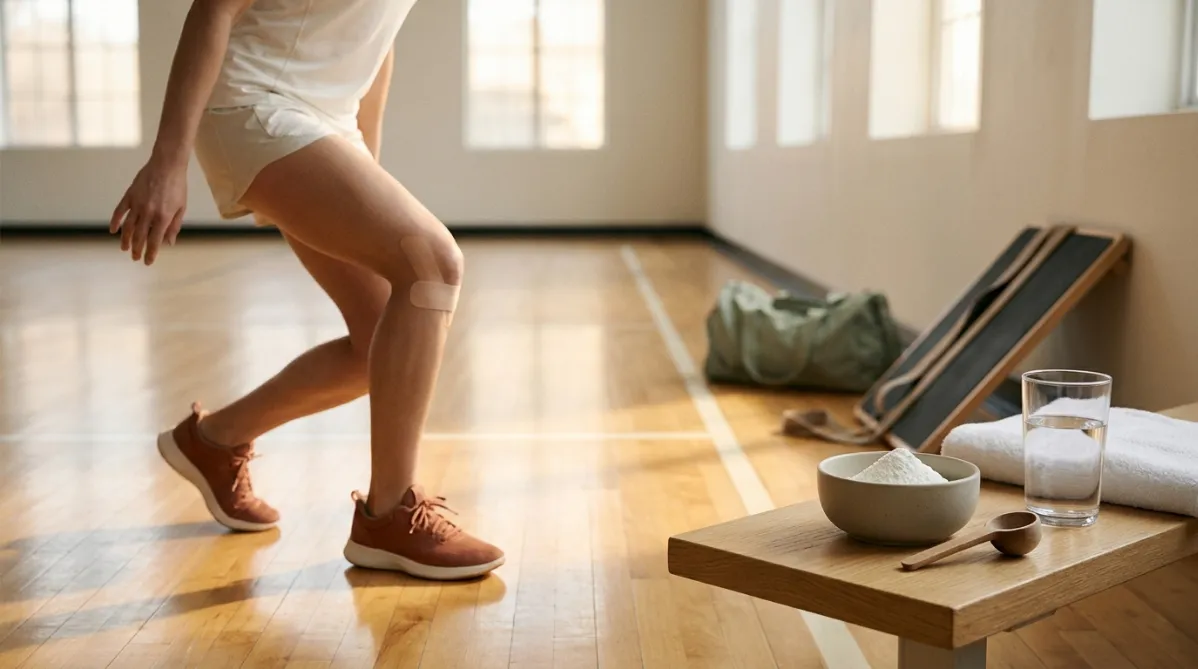
A wide, editorial-style photograph of a volleyball player mid-landing from a jump on a sunlit indoor court, captured from a low side angle. The athlete's knee is slightly bent and the patellar tendon area is in sharp focus, with soft natural muscle definition and a light strip of kinesiology tape just below the kneecap. The polished honey-toned hardwood floor reflects warm window light, and the background falls away into a creamy blur of pale court lines and tall windows.

In the lower right foreground, slightly out of focus, a matte ceramic bowl holds a small mound of fine white creatine powder. A wooden scoop rests beside it, next to a clear glass of water and a folded white towel. This sits on a light oak bench at the edge of the court. A resistance band and a slanted decline board, used for eccentric rehab, lean softly against the wall behind the bench.

The palette is warm and natural: cream, soft white, honey oak, muted sage green accents from a gym bag, and a touch of terracotta from the athlete's sneakers. Light is golden-hour and diffused, with gentle shadows and a subtle film-grain finish. The composition follows the rule of thirds, with the athlete on the left and the supplement still life on the right. Negative space in the upper portion leaves room for a headline overlay.

The overall mood is calm, modern, and health-focused, like a contemporary wellness or sports-science journal cover. Shallow depth of field, a clean minimalist aesthetic, and true-to-life color. No text, no logos, no futuristic or digital elements.
Recovery

Creatina para Joelho do Saltador? Alívio da Dor Surgiu na Semana 4

Dr. Gymbro · · 5 min read

Você já fez agachamentos excêntricos, já enfrentou sessões de ondas de choque e, mesmo assim, seu joelho lateja a cada aterrissagem. E se um suplemento barato e bem estudado pudesse encurtar essa recuperação? Um novo ensaio randomizado oferece uma resposta preliminar, e os detalhes são mais importantes que o título chamativo.

A Versão Curta

Pesquisadores testaram creatina monohidratada (Creapure®) associada a um programa de reabilitação estruturado em atletas com tendinopatia patelar, mais conhecida como joelho do saltador. Na semana 8, tanto o grupo que recebeu creatina quanto o grupo placebo apresentaram melhora significativa. A diferença surgiu antes: na semana 4, apenas o grupo que ingiriu creatina registrou aumento estatisticamente significativo no escore do VISA‑P – questionário que pontua dor e função – e também demonstrou ganho significativo na altura do salto em contramovimento (CMJ).

Isso é promissor, mas não constitui prova definitiva. Mais detalhes a seguir.

O Que o Estudo Realmente Fez

O ensaio, liderado por Sánchez‑Gómez e colaboradores, foi publicado no Journal of the International Society of Sports Nutrition (2026). Tratou‑se de um estudo triplo‑cego, randomizado. Vinte atletas federados (idade média de cerca de 34 anos) com tendinopatia patelar foram divididos em um grupo de creatina (n = 9) e um grupo placebo (n = 11).

Todos seguiram o mesmo plano de reabilitação:

  • treinamento excêntrico diário e alongamento;
  • terapia por ondas de choque extracorpóreas (ESWT) a cada 10 dias;
  • terapia manual para o tendão e músculos adjacentes.

O suplemento foi tomado no final de cada sessão de treinamento excêntrico: três cápsulas de creatina monohidratada Creapure®, ou sacarose para o placebo. Os pesquisadores avaliaram os participantes na linha de base, nas 4 semanas e nas 8 semanas, medindo VISA‑P, espessura do tendão por ultrassom, composição corporal por bioimpedância, altura do CMJ e carga máxima de extensão do joelho (5‑RM) na perna lesionada.

Os Números que Chamaram Atenção

Dor e função (VISA‑P). Os escores aumentaram significativamente ao longo do tempo em ambos os grupos. Ao final das 8 semanas, o grupo creatina passou de 60,6 para 78,0 pontos, enquanto o placebo subiu de 60,0 para 75,2. Nesse ponto, os grupos estavam semelhantes.

A diferença ocorreu no meio do caminho: na semana 4, o grupo creatina chegou a 70,2 pontos – melhora estatisticamente significativa em relação à linha de base (p = 0,027). O resumo não relata mudança significativa comparável para o placebo nessa mesma época.

Altura do salto. No grupo creatina, o CMJ subiu de 34,3 cm para 36,8 cm na semana 4 (p = 0,019) e depois para 37,6 cm na semana 8 (p = 0,015). Para atletas de esportes que exigem salto, isso importa porque o tendão está sendo reconstruído para tolerar esse tipo de carga.

Espessura do tendão e força. Ambos os grupos melhoraram ao longo do tempo na espessura do tendão, medida por ultrassom, e no 5‑RM de extensão da perna. A creatina não acrescentou nenhum benefício evidente aqui, o que sugere que a própria reabilitação fez o “trabalho pesado”.

Limitações e Considerações

Antes de incluir creatina no seu plano de reabilitação, reflita sobre o que esses dados realmente sustentam.

  • Amostra diminuta. Com apenas 20 atletas ao todo, e somente 9 no braço da creatina, os resultados são frágeis.
  • Efeito apenas tendencial. A interação entre grupos ao longo do tempo foi p = 0,099 (η² parcial = 0,126), não atingindo o limiar usual de 0,05. Dizer que “a creatina funcionou na semana 4 e o placebo não” compara significância dentro de cada grupo – evidência mais fraca que uma diferença significativa entre grupos.
  • Retorno ao jogo não foi medido. A ideia de “retorno mais rápido à competição” é uma inferência a partir do alívio precoce da dor e do ganho de salto; ninguém cronometrou o retorno efetivo.
  • Acompanhamento curto. Oito semanas não dizem nada sobre reincidência ou saúde do tendão a longo prazo.
  • População heterogênea. Os participantes tinham idade média de 33,7 anos; os achados podem não se aplicar a adolescentes ou atletas de elite.

Os próprios autores concluem apenas que a creatina “poderia ser considerada” um auxiliar ergogênico de recuperação. É uma formulação cuidadosa e deve permanecer assim.

Quem Pode Se Interessar

O público mais relevante são atletas de esportes que exigem salto ou carga (vôlei, basquete, atletismo etc.) que já estejam seguindo um programa excêntrico estruturado para tendinopatia patelar e busquem um pequeno extra. A creatina está entre os suplementos mais estudados no esporte e, além de barata, apresenta risco de efeitos adversos geralmente baixo em adultos saudáveis. Pessoas com problemas renais ou outras condições médicas devem consultar um profissional antes de iniciar.

A creatina não substitui o treinamento. No ensaio, ela foi um acréscimo a um programa exigente que incluía trabalho excêntrico diário, terapia por ondas de choque e tratamento manual. Todos melhoraram a espessura e a força do tendão principalmente por causa desse programa.

Dicas Práticas: Dose e Momento

  • Momento: No estudo, a creatina foi ingerida logo após cada sessão excêntrica. É fácil de reproduzir, embora o artigo não mostre que esse timing seja superior a outras horas do dia.
  • Dose: O resumo indica três cápsulas de Creapure® ao dia, mas não especifica a quantidade de gramas por cápsula. Muitos protocolos utilizam cerca de 3 – 5 g/dia; verifique o texto completo ou o rótulo do produto para confirmar.
  • Forma: Utilizou‑se creatina monohidratada, a forma mais investigada e de alta pureza. Não há evidência aqui para versões mais “sofisticadas”.
  • Expectativas: Considere a creatina como um possível pequeno acelerador no primeiro mês, não como cura. Na semana 8, o grupo placebo já havia alcançado quase a mesma pontuação de dor.
  • Trabalhe com seu profissional: A reabilitação de tendinopatia deve ser orientada por alguém que possa ajustar a carga conforme seus sintomas.

Conclusão

Este ensaio piloto sugere que a creatina pode acelerar o alívio precoce da dor e a recuperação do salto em pacientes com joelho do saltador. Como a interação entre grupos foi apenas tendencial (p = 0,099) e a amostra contou com apenas 20 atletas, o estudo serve mais como estímulo para pesquisas maiores do que como base para mudar protocolos de reabilitação. Se já usa creatina ou está pensando em incluí‑la, há um racional plausível, mas o trabalho excêntrico ainda precisa ser feito.

Fonte: Sánchez‑Gómez et al. "Could creatine supplementation combined with physical rehabilitation accelerate return to play in athletes with patellar tendinopathy?" J Int Soc Sports Nutr (2026). DOI: https://doi.org/10.1080/15502783.2026.2718846 | PubMed
Original study

Read the original research on pubmed.ncbi.nlm.nih.gov →

This article summarizes published research for general information. It is not medical advice.

DG

Written by

Dr. Gymbro

Dr. Gymbro writes for Dr. Gymbro: science-backed fitness, nutrition & performance.

Related Articles

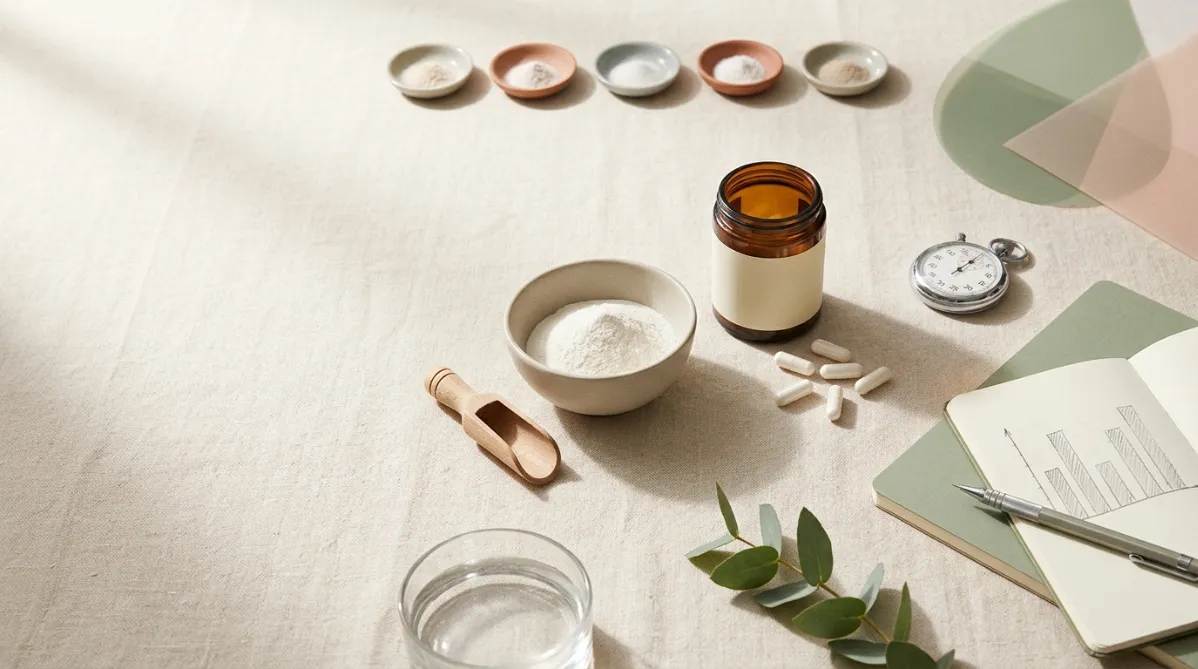
A wide, editorial-style still life photographed from slightly above on a pale oat-colored linen surface, lit by soft morning window light from the left. In the center sits a small matte ceramic bowl holding a mound of fine white powder, with a minimalist wooden scoop resting beside it. Next to the bowl is an open amber glass supplement jar with a plain cream label, and a few white capsules spill across the linen in a loose arc.

To the right, a neatly arranged cluster of analog "study" objects suggests careful measurement: a vintage stopwatch with a clean white face, a slim notebook with a sage-green cover open to a hand-drawn bar chart (blurred, no legible text), and a mechanical pencil lying across the page. A small row of six identical ceramic dishes, each holding a pinch of powder, is lined up along the top edge of the frame to hint at the six-week trial. One dish is slightly out of alignment, a subtle visual cue for ambiguity.

A shallow glass of water and a single sprig of green eucalyptus add a calm, organic note in the foreground. Soft, long shadows fall across the textured linen, and the palette stays restrained: warm cream, soft sage, muted terracotta, pale gray, and touches of amber from the glass jar. A few translucent paper cutouts in two tones (sage and blush) overlap in the upper right corner as a modern graphic accent, evoking overlapping data points without showing any numbers.

Depth of field is shallow, with the bowl and stopwatch in crisp focus and the edges gently softened. The composition leaves generous negative space on the left third for title text overlay. The overall mood is thoughtful, balanced, and quietly skeptical, in the style of a contemporary wellness and science magazine: clean, tactile, minimal, with a subtle film-like grain and natural color grading. No people, no futuristic or sci-fi elements, no readable text or logos.
nutrition

GAA: Potencializador Cerebral? Resultado do Estudo de 6 Semanas é Complicado

BY DR. GYMBRO ·

GAA, precursor da creatina vendido como potencializador cerebral, acabou de receber seu primeiro teste humano sério. Em um estudo duplo‑cego de seis semanas com 58 adultos saudáveis, ele acelerou alguns tempos de reação e gerou indícios de mudanças no humor e no estresse. Contudo, a maioria dos testes cognitivos não revelou efeitos, e muitos dos resultados principais foram apenas tendências. Os marcadores de segurança permaneceram dentro da normalidade, mas o estudo foi pequeno, exploratório e não incluiu um grupo comparativo apenas com creatina. Veja o que realmente foi observado, quem pode se interessar e por que o veredicto é misto.

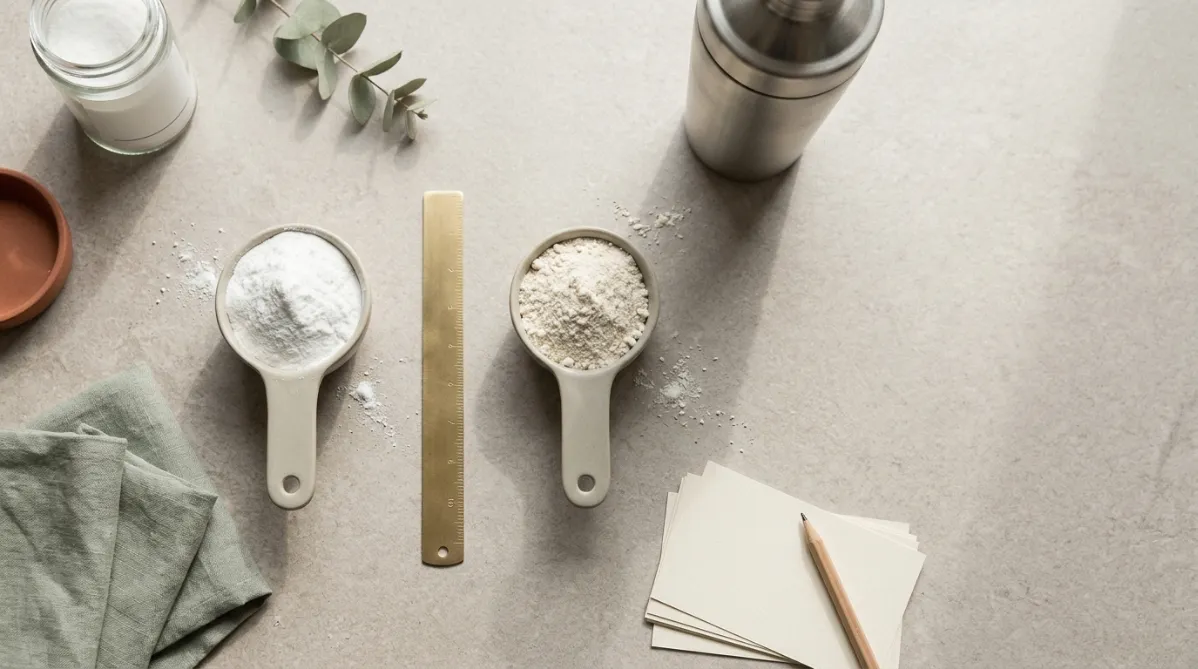
A bright, minimalist flat-lay photograph of two supplement scoops on a pale warm-gray stone surface, shot from directly above in soft natural window light. On the left, a matte ceramic scoop holds fine white creatine monohydrate powder, heaped in a clean mound. On the right, a second scoop of the same shape holds slightly coarser off-white beta-alanine powder, with a small, deliberate gap between the two. Each scoop sits in its own soft shadow, which suggests separation rather than combination. Between them, a thin brushed-brass ruler or a single slim line of fine powder runs across the surface and subtly divides the composition.

Around the scoops, a few restrained props in a muted editorial palette of sage green, cream, terracotta, and soft charcoal: a small glass jar with a minimalist label that has no readable text, a folded linen napkin, a single sprig of eucalyptus, and a stainless-steel shaker bottle softly out of focus in the upper corner. A few loose powder grains are scattered naturally across the stone. A small stack of blank cream index cards with a pencil rests in the lower right, hinting at research and note-taking without any legible writing.

The composition follows a clean rule-of-thirds layout, with generous negative space on the right third for headline overlay. The lighting is gentle and diffused, with long, soft shadows falling to the lower left. The color grading is calm and slightly desaturated, with creamy highlights and a subtle film-like grain. The overall look is a modern wellness and science journal cover, with an airy, trustworthy, contemporary editorial feel, shallow depth of field, and crisp detail on the powders.
nutrition

Creatina + Beta‑Alanina: O Bônus de Combinação que os Pesquisadores Não Encontraram

BY DR. GYMBRO ·

A combinação de creatina e beta‑alanina é divulgada como o casal‑potência para a performance, mas uma nova meta‑análise de rede com 52 ensaios randomizados não encontrou sinergia entre elas. A creatina, isolada, melhorou significativamente sprint, salto, sprints repetidos e resistência muscular da parte superior em comparação ao placebo. Os efeitos da beta‑alanina foram não significativos ou dependentes do contexto, e a combinação não acrescentou nada além da criatina. Veja o que o estudo fez, suas limitações e o que isso significa para o seu orçamento de suplementos.

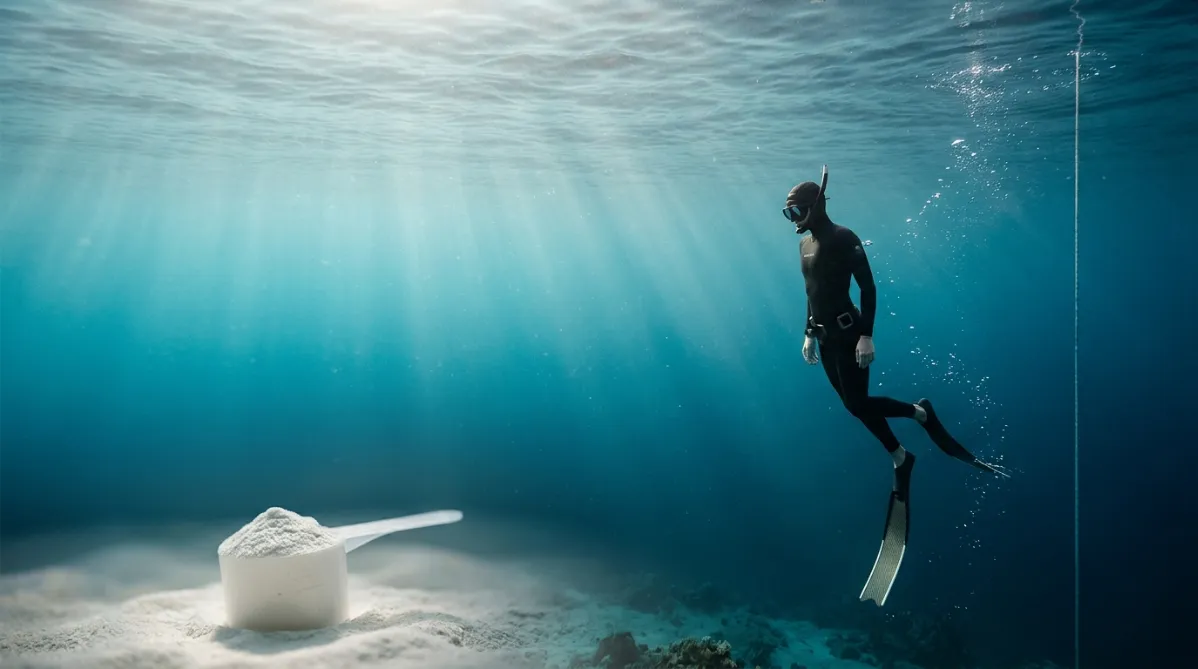
A wide, cinematic landscape photograph of a freediver suspended mid-water in a calm, sunlit turquoise sea, shot from slightly below so the surface glimmers above like rippling silver glass. The diver wears a sleek matte black wetsuit and a long, elegant pair of carbon fins. Their body is streamlined, arms relaxed at their sides, head tilted slightly down in a state of serene focus. Shafts of soft golden sunlight pierce the water diagonally and illuminate fine floating particles and a trail of tiny bubbles rising from the diver's fins. A single thin dive line descends vertically into deeper blue at the right of the frame, adding a graphic compositional element.

In the lower left foreground, slightly out of focus, a minimalist still-life element rests on a pale sandy seabed: a small, clean white scoop with a mound of fine white powder, casually echoing creatine without any text or labels. The scoop is softly lit and has a shallow depth of field blur, creating a gentle visual link between supplement and sport.

The color palette is refined and modern: deep teal, aquamarine, soft cerulean, warm cream highlights, and touches of sunlit gold. The water gradients smoothly from bright, luminous turquoise near the top to a rich inky navy at the bottom, giving depth and a sense of quiet intensity. Leave generous negative space on the left third of the image for headline placement, with the diver positioned on the right third following the rule of thirds.

The mood is calm, athletic, and contemplative, like an editorial image from a premium health and science magazine. Style: high-end editorial photography, natural light, subtle film grain, soft contrast, crisp detail on the diver and gentle bokeh in the background. No text, no logos, no futuristic or sci-fi elements, no graphics overlays.
nutrition

Creatina funciona mesmo quando você não respira: estudo com freedivers demonstra

BY DR. GYMBRO ·

A creatina é famosa por ajudar a levantar mais peso e acelerar nas sprints, mas será que ela funciona quando você não respira? Um ensaio duplo‑cego com freedivers treinados descobriu que uma fase de carregamento de 7 dias, com 20 g/dia, aumentou o trabalho total e o tempo até a exaustão em um teste de ciclismo com apneia. Curiosamente, o lactato sanguíneo ficou mais baixo no grupo que recebeu creatina do que no placebo, apesar do melhor desempenho. Saiba o que o estudo fez, quem pode se beneficiar e por que a amostra de apenas 20 mergulhadores exige cautela nas expectativas.

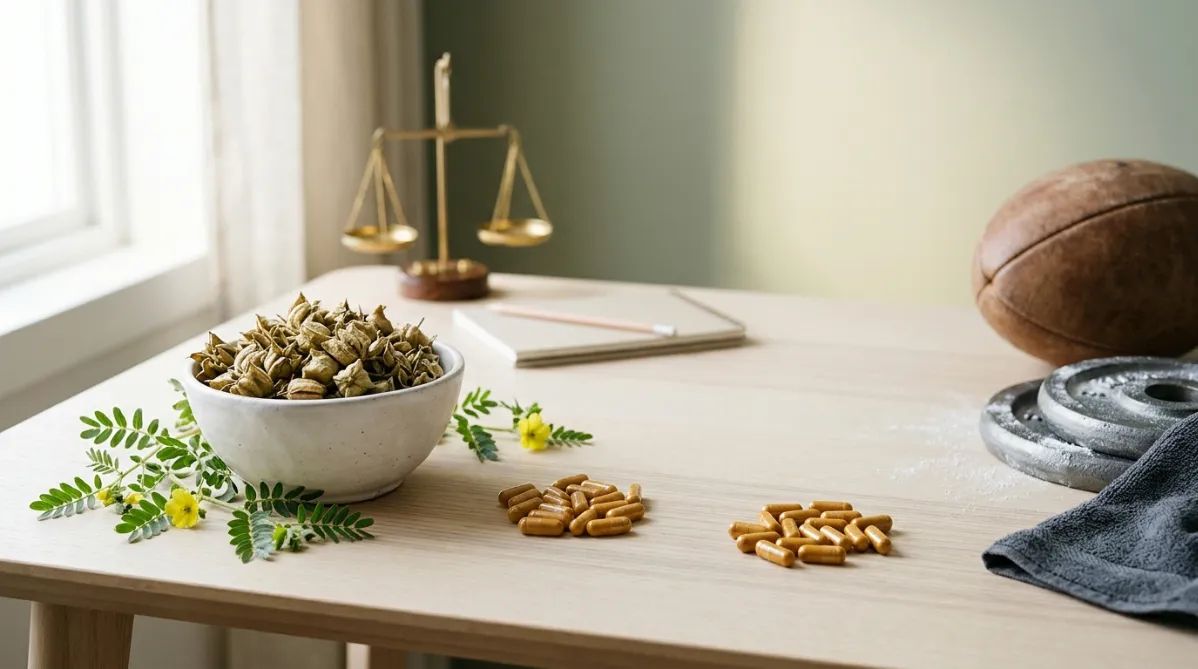
A wide, landscape editorial photograph shot from slightly above, showing a rustic matte-white ceramic bowl of dried tribulus terrestris, spiky star-shaped seed pods in warm tan and khaki tones, with a few fresh green trailing vines and tiny yellow flowers draped beside it. The bowl sits at the left third of the frame on a pale ash-wood table. Scattered nearby are two identical sets of plain, unlabeled amber supplement capsules, one pile slightly apart from the other, hinting at a placebo comparison. To the right, slightly out of focus, a worn leather rugby ball rests next to a chalk-dusted steel barbell plate and a folded charcoal-gray athletic towel.

Soft diffused natural light streams in from a window on the left, creating gentle long shadows and a calm, clean atmosphere. The background is a muted sage-green and cream gradient with a shallow depth of field, leaving generous negative space on the right side for title overlay. A small, minimal notebook with a pencil and a simple balance scale made of brushed brass sits subtly in the midground, suggesting scientific scrutiny without any laboratory clutter.

The color palette is earthy and refined: sage green, sand, warm amber, charcoal, and off-white. The style is modern lifestyle-magazine photography, crisp textures, subtle film grain, and a high-end wellness journal feel. The composition is balanced, uncluttered, and minimalist, with a quiet, thoughtful mood that conveys skepticism and evidence-based inquiry. No text, no logos, no people, no futuristic or sci-fi elements.
science research

Tribulus Terrestris falha em jogadores de rugby de elite: ensaio de 5 semanas

BY DR. GYMBRO ·

Tribulus terrestris é anunciado como um impulsionador natural de testosterona que promove aumento de massa muscular em menos de um mês. Por isso, pesquisadores o testaram em jogadores de elite de rugby league em um ensaio duplo‑cego. Todos ficaram mais fortes e ganharam massa magra, mas o grupo placebo apresentou os mesmos resultados. O suplemento também não alterou a relação urinária testosterona/epitestosterona (T/E). Veja o que o estudo revelou, suas limitações e onde seu dinheiro rende mais.

This page is available in