Dr. Gymbro
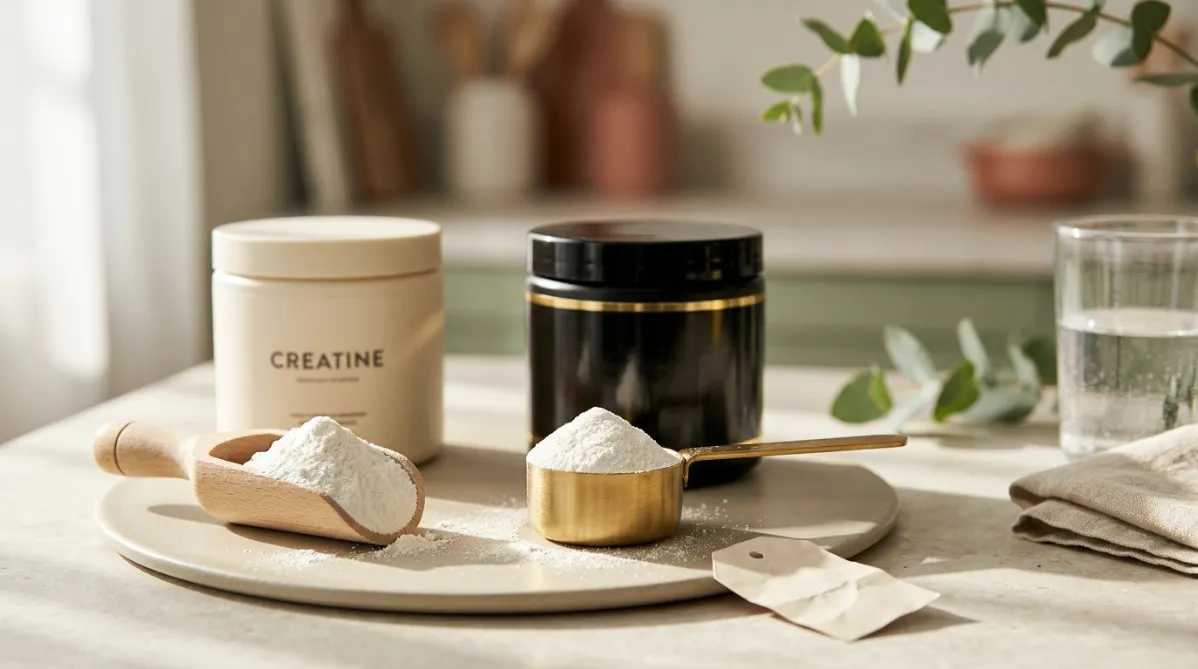
A wide, landscape editorial photograph of a clean, sunlit kitchen counter or pale stone tabletop, styled like a modern wellness magazine spread. Two scoops sit side by side on a matte ceramic surface. The left one is a plain, humble wooden scoop heaped with fine white creatine powder. The right is a glossy, ornate brushed-gold scoop holding the same white powder, which hints at "premium" branding. Behind each scoop stands a tub. The left tub is minimal, matte, and cream-colored with simple sans-serif lettering and no readable words. The right tub is sleek black with metallic gold accents and an overly polished look. A few fine grains of powder are scattered across the surface, catching the light.

The composition uses a shallow depth of field. The foreground scoops are crisp, and the background softly blurs into a warm neutral palette of oatmeal, soft sage green, and muted terracotta. Soft morning window light comes in from the left, casting long, gentle shadows and a subtle highlight along the scoops' edges. A small price tag shape, blank and unmarked, sits near the gold scoop, with a slightly crumpled paper texture to suggest the "pricey" angle without any text. A glass of water with condensation and a folded linen napkin sit at the edge of the frame. A single green sprig or eucalyptus stem adds a natural accent.

The overall mood is calm, intelligent, and quietly skeptical, with the plain option feeling confident and the flashy one a bit overdressed. The color grading is soft and slightly desaturated with creamy highlights, and there is fine film grain. The layout leaves generous negative space on the right third for a headline overlay. It looks like a high-end lifestyle and science journal cover, with a minimalist, tactile, trendy feel and no futuristic or sci-fi elements.
Science & Research

Ester Etílico de Creatina vs Monoidrato: A Forma Cara que se Perdeu

Dr. Gymbro · · 4 min read

Ester Etílico de Creatina vs Monoidrato: A Forma Cara que se Perdeu

O marketing de suplementos adora a palavra “avançado”. Quando um ingrediente já foi estudado por décadas, surge sempre alguém para vender uma versão “modificada” prometendo maior absorção, mais potência ou menos desconforto gástrico. O ester etílico da creatina (CEE) é um exemplo clássico. Um estudo randomizado, duplo‑cego de 2009, publicado no Journal of the International Society of Sports Nutrition, colocou o CEE frente a frente com a tradicional creatina monoidratada. A forma mais nova não saiu na frente.

O que o CEE prometia

A creatina monoidratada é o padrão‑ouro, utilizada na maioria das pesquisas. Diversas formulações foram desenvolvidas com o objetivo de melhorar a biodisponibilidade da creatina, e o CEE foi apresentado como capaz de aumentar a absorção. O discurso era simples: ao acrescentar um grupo éster etílico, a creatina supostamente entraria na corrente sanguínea e nos músculos de forma mais eficiente, permitindo usar menos produto e obter mais resultados.

Essa afirmação é testável, e Spillane e colegas a colocaram à prova. A pergunta era se o CEE elevaria a creatina sérica e muscular e melhoraria o desempenho ao menos tanto quanto o monoidrato.

Desenho do estudo e dosagens

Foram recrutados 30 homens sedentários (sem prática de treinamento de resistência). Os participantes foram distribuídos aleatoriamente, em um esquema duplo‑cego, para um dos três grupos:

  • Placebo (maltodextrina)
  • Creatina monoidratada (CRT)
  • Ester etílico de creatina (CEE)

Todos seguiram um programa intenso de treinamento de resistência durante sete semanas. A suplementação consistiu em fase de carga de 0,30 g/kg de massa corporal magra (cerca de 20 g/dia) por cinco dias, seguida de dose de manutenção de 0,075 g/kg (aproximadamente 5 g/dia) pelos 42 dias restantes. As doses foram equivalentes entre os grupos, de modo que qualquer diferença poderia ser atribuída à forma da creatina, e não à quantidade.

A equipe avaliou composição corporal, massa muscular, força, potência, creatina sérica e muscular, e creatinina sérica.

O achado da creatinina sérica

Esse foi o resultado mais revelador. A creatina sérica foi significativamente maior nos grupos placebo (p = 0,007) e monoidrato (p = 0,005) do que no grupo CEE. Uma creatina “melhor absorvida” que deixa menos creatina no sangue é difícil de conciliar com as promessas de marketing.

A creatinina sérica – produto de degradação da creatina – foi muito mais alta no grupo CEE comparado ao placebo (p = 0,001) ou ao monoidrato (p = 0,001). Esse aumento persistiu nos dias 6, 27 e 48. O padrão indica que o CEE se degrada em creatinina em vez de ser armazenado como creatina nos tecidos.

Há um efeito colateral prático. A creatinina sérica é um marcador padrão usado por médicos para estimar a função renal. Um suplemento que eleva esse valor pode dificultar a interpretação de exames de sangue de rotina. O estudo não relatou dano renal e o aumento da creatinina não deve ser interpretado como evidência de prejuízo, mas quem utiliza creatina deve avisar o médico antes de fazer exames.

Resultados da creatina muscular

Os dados musculares foram mais sutis. A creatina muscular total aumentou significativamente tanto no grupo monoidrato (p = 0,026) quanto no CEE (p = 0,041) em relação ao placebo, mas não houve diferença entre as duas formas de creatina. Ou seja, o CEE elevou a creatina muscular comparado ao placebo, mas não foi superior ao monoidrato.

Os autores concluíram que, embora o CEE tenha aumentado a creatina muscular, ele não foi tão eficaz quanto o monoidrato para elevar a creatina sérica e não trouxe vantagem em nenhum outro desfecho.

Força, potência e composição corporal

Nenhum dos grupos apresentou diferenças significativas em composição corporal, água corporal, força ou potência. Todos melhoraram ao longo das sete semanas, mas os ganhos foram semelhantes entre placebo e suplementos. Os autores interpretam que as melhorias derivaram sobretudo do próprio treinamento, especialmente porque a amostra consistia em iniciantes que respondem rapidamente a um programa bem estruturado.

Conclusão e recomendações práticas

O marketing prometia melhor absorção. Os dados mostraram:

  • Menor creatina sérica e maior creatinina sérica com o CEE;
  • Creatina muscular semelhante à obtida com monoidrato;
  • Nenhum ganho extra em força, potência ou composição corporal.

Recomendações

  • Fique com creatina monoidratada. É a forma mais estudada, geralmente a mais barata, e funciona bem em doses de 3‑5 g/dia.
  • A fase de carga é opcional. O estudo utilizou 20 g/dia por cinco dias, mas a ingestão contínua de 3‑5 g/dia atinge níveis musculares semelhantes, só que de forma mais gradual.
  • Não pague extra por “formas avançadas” sem evidência clara de superioridade; no caso do CEE, os resultados apontam exatamente para o contrário.
  • Fique atento aos exames de sangue. O CEE pode elevar a creatinina sérica e confundir a avaliação da função renal. Avise seu médico sobre qualquer suplemento que esteja usando.
  • Treino vem em primeiro lugar. Neste estudo, o programa de treinamento foi responsável pela maior parte dos ganhos.

Fonte

Spillane M, et al. The effects of creatine ethyl ester supplementation combined with heavy resistance training on body composition, muscle performance, and serum and muscle creatine levels. J Int Soc Sports Nutr. 2009. DOI: 10.1186/1550-2783-6-6. PubMed: 19228401.
Original study

Read the original research on pubmed.ncbi.nlm.nih.gov →

This article summarizes published research for general information. It is not medical advice.

DG

Written by

Dr. Gymbro

Dr. Gymbro writes for Dr. Gymbro: science-backed fitness, nutrition & performance.

Related Articles

A wide landscape editorial photograph of a bright, airy sunlit living room with pale oak floors and a large window with sheer linen curtains. In the center, a woman in her late 50s with silver-streaked hair, wearing soft sage-green athletic wear, rises from a simple wooden chair, caught mid-motion with a calm, determined expression. Her hands are lightly extended forward for balance. Beside her on a small round oak side table sits a ceramic mug of tea, a glass of water, and a small matte white jar with a wooden scoop resting beside it, a few fine white crystalline grains scattered on the tabletop. In the soft-focus foreground, a pair of light-gray dumbbells and a rolled terracotta-colored yoga mat rest on the floor. A trailing green pothos plant spills from a shelf in the background, with a stack of books and a small analog kitchen timer nearby.

The color palette is warm and muted: cream, sage green, soft terracotta, natural wood, and gentle morning-gold light. Light streams diagonally across the scene, creating long soft shadows and a subtle glow on the woman's shoulders. Shallow depth of field blurs the background gently, while the woman and the table remain crisp. The composition follows the rule of thirds, with the woman on the right and generous negative space on the left, suited for headline overlay. The mood is hopeful, grounded, and modern, like a high-end wellness magazine or a trendy health journal. Natural film-like grain, soft contrast, and a slight matte finish give it a contemporary lifestyle photography feel. There are no futuristic elements, no digital overlays, and no text.
science research

Creatina ajuda mulheres com joelho comprometido a levantar‑se melhor – mas não da forma que você imagina

BY DR. GYMBRO ·

A creatina costuma ser associada a jovens levantadores, mas um ensaio randomizado, duplo‑cego, avaliou seu efeito em mulheres pós‑menopáusicas com osteoartrite de joelho. Após 12 semanas de treino de pernas, o escore do teste de ficar em pé cronometrado do grupo que recebeu creatina subiu de 15,7 para 18,1, enquanto o placebo praticamente não mudou (15,0 para 15,2). A creatina também melhorou rigidez, massa magra e qualidade de vida, mas alívio da dor e força máxima no leg press não foram superiores ao placebo. Veja o que os números realmente indicam e quem pode se beneficiar.

A modern editorial still life photographed from a slightly elevated angle on a pale, matte stone surface in soft natural window light. On the left, a heaping mound of fine white creatine monohydrate powder spills from a matte ceramic scoop, with a few crisp grains scattered across the surface. In the center, a small, minimalist amber glass capsule bottle sits tipped on its side, with a handful of off-white capsules spilling out. The label is blank and clean. On the right, a neat row of three clear glass lab-style vials rests on a slim oak tray. The vials hold different amounts of white powder: the first nearly empty, the second slightly fuller, the third filled almost to the brim. This quietly suggests the difference in dose and result. Beside the tray lies a simple stainless steel measuring spoon and a folded sheet of cream paper with soft, abstract bar-chart lines in muted sage green and terracotta. The lines are hand-drawn and unlabeled.

Behind the objects, slightly out of focus, a lean athletic forearm in a gray linen sleeve rests on the edge of the surface, one hand loosely holding a matte shaker bottle. This hints at a training context without showing a face. A single sprig of eucalyptus in the corner adds a soft organic touch.

The palette is warm neutral: bone white, oatmeal, soft sage, muted terracotta, and touches of amber. Shadows are gentle and long, with a shallow depth of field that gives creamy bokeh in the background. The mood is calm, clean, and trustworthy, like a premium health and science journal's feature spread, with generous negative space at the top and right for headline overlay. The composition is wide, balanced, and uncluttered, with subtle film-like grain and a natural, true-to-life color grade. No text, no logos, no futuristic elements.
nutrition

Dose de Rótulo do Kre‑Alkalyn Não Aumentou a Creatina Muscular, Revelam Biópsias

BY DR. GYMBRO ·

A creatina tamponada Kre‑Alkalyn é divulgada como mais absorvível, exigindo doses menores e provocando menos inchaço. Um estudo duplo‑cego da Texas A&M, com 36 praticantes durante 28 dias, analisou biópsias musculares. Na dose recomendada de 1,5 g/dia, a creatina muscular praticamente não mudou, enquanto a monohidratada aumentou de forma clara. Não houve diferença em força, composição corporal ou efeitos colaterais. Veja os números e a dosagem correta da creatina.

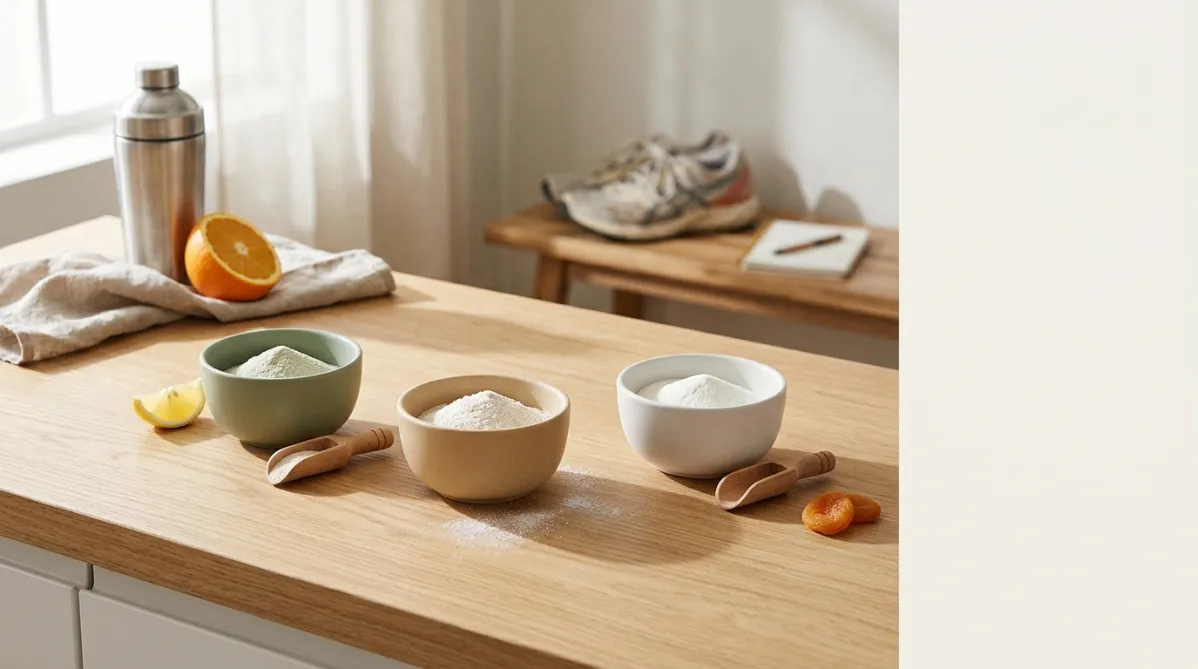
A landscape editorial photograph of a clean, sunlit kitchen-counter or light oak table, shot from slightly above at a gentle angle. Three small matte ceramic bowls in muted sage green, warm sand, and soft white sit in a loose row. Each holds a different fine white powder, and each has a small wooden scoop resting beside it. The middle bowl is slightly closer to the camera and sharper in focus, with a faint dusting of powder spilling onto the surface. In the soft-focus background, a stainless steel shaker bottle and a half-peeled orange sit beside a folded linen napkin, suggesting citrus without being literal. A single lemon wedge sits near the left bowl, and a small dried apricot sits near the right, a subtle visual nod to citrate and pyruvate.

In the background, a blurred athletic scene: a running shoe resting on a wooden bench and a small notebook with a pen, suggesting a training log. Soft diffused morning light enters from the left through a window and casts long, gentle shadows. The palette is warm neutrals, creamy whites, soft greens, and a hint of terracotta orange. The look is a modern wellness magazine with a shallow depth of field, a fine-grain film feel, and generous negative space on the right third of the frame for title text. The mood is calm, trustworthy, and scientific yet approachable, with no text, labels, or logos.
nutrition

Creatina Piruvato vs Citrato: Qual Mantém a Força Por Mais Tempo?

BY DR. GYMBRO ·

Dois tipos de creatina avançados superaram o placebo em um estudo de 28 dias, mas apenas um manteve a força muscular elevada ao longo de dez séries de esforço máximo, enquanto o outro perdeu efeito. A creatina piruvato aumentou a força em todos os intervalos (p < 0,001), ao passo que o benefício da creatina citrato desapareceu já no sexto intervalo. Só o piruvato também melhorou a velocidade de relaxamento e o consumo de oxigênio em repouso. Antes de mudar seu suplemento, atenção: o estudo não incluiu um grupo usando creatina monohidratada.

A wide, editorial-style still life photographed from slightly above on a pale oak surface in soft morning window light. At the center, a small matte white supplement tub with a plain, unlabeled front sits tipped on its side, spilling a modest pile of fine white powder across the wood. Beside it, a wooden scoop rests in the powder, and a few white capsules are scattered in a loose arc. To the left, a clean glass of water catches the light and throws a delicate caustic shadow. To the right, a neatly arranged group of whole foods sits in contrast: two brown eggs, a small wedge of salmon fillet on parchment, a handful of raw almonds, and a sprig of rosemary. A matte black steel dumbbell handle is partly visible at the top edge of the frame, grounding the fitness theme. In the lower foreground, a slim, open linen-bound notebook holds a hand-drawn line graph with a single line trending gently downward, a thin ink pen lying across the page. The palette is muted and warm: cream, soft sage green, pale oak, charcoal accents, and a touch of terracotta from a ceramic dish holding the almonds. Shallow depth of field blurs the background, a softly lit minimalist kitchen counter with a hint of a plant leaf. The mood is calm, thoughtful, and scientific without being clinical, like a cover image for a contemporary health and nutrition journal. Natural shadows, subtle film grain, and generous negative space on the upper left leave room for a headline overlay. Crisp focus on the powder and scoop, with refined, understated composition and no text or logos visible.
nutrition

Ácido D‑aspártico reduziu a testosterona em 6 g/dia em praticantes treinados

BY DR. GYMBRO ·

O ácido D‑aspártico (DAA) é divulgado como um impulsionador natural de testosterona, porém um estudo controlado com 24 homens treinados revelou que a dose de 6 g/dia realmente reduziu tanto a testosterona total quanto a livre. A dose de 3 g, frequente nas embalagens, não produziu efeito mensurável. Um ensaio de acompanhamento de três meses também não constatou ganho de força ou massa muscular. Saiba o que a pesquisa mostrou, por que praticantes podem reagir de forma distinta dos sedentários e onde seu dinheiro tem mais retorno.

This page is available in