Dr. Gymbro
A bright, airy editorial still life photographed from slightly above on a pale oak table in soft morning window light. At the center sits a shallow ceramic bowl in matte oatmeal glaze filled with fine, creamy-beige inulin powder. A wooden spoon rests beside it, with a few fine grains scattered across the wood. Around the bowl, several fresh chicory roots with pale tan skin and delicate taper lie on a folded linen napkin. Next to them are a few crisp, leafy chicory heads in muted green and soft magenta tones, and a halved root that shows its pale, fibrous interior.

On the right side of the frame, a pair of older adult hands in a soft cream knit sleeve rest gently on a knee covered by relaxed linen trousers. A glass of water stands nearby, along with a small ceramic cup of herbal tea. A folded pair of simple tortoiseshell reading glasses and a minimalist notebook with a thin pencil sit in the background, hinting at a considered, research-minded atmosphere. A slim yoga mat edge and a pair of light-gray walking shoes appear softly out of focus in the far corner, suggesting gentle exercise and mobility without overwhelming the scene.

The color palette is calm and modern: warm creams, sage green, soft terracotta, and touches of dusty rose from the chicory leaves. Shadows are gentle and long, with natural light raking across the table and highlighting the textures of powder, linen, wood, and root. The depth of field is shallow, with the bowl and roots in crisp focus and the background melting into a creamy blur. The composition leaves generous negative space on the left third of the frame, suitable for headline overlay, and the overall feel is clean, wholesome, and contemporary, like a lifestyle-meets-science feature in a trendy online health journal. Fine film-like grain, true-to-life color, and a quiet, optimistic mood.
Recovery

Fibra barata do intestino supera placebo na dor no joelho: redução de 1,11 pontos

Dr. Gymbro · · 5 min read

Fibra barata do intestino supera placebo na dor no joelho: redução de 1,11 pontos

A dor no joelho interrompe treinamentos sem nenhum aviso. Ela diminui a profundidade do agachamento, reduz o volume de corrida e, em alguns casos, transforma subir escadas em um grande obstáculo. Agora, um ensaio randomizado indica que um pó barato e discreto, extraído da raiz de chicória, pode aliviar um pouco esse incômodo. Durante seis semanas, 20 g/dia de inulina diminuíram a dor no joelho em 1,11 ponto numa escala de 0‑10, em comparação ao placebo. Além disso, a força de preensão ficou maior, e os pesquisadores acreditam que o intestino pode ser a causa.

Antes de encher a despensa de suplementos, leia a letra miúda. Este não foi um estudo com jovens atletas, e o resultado não é um milagre.

O que o estudo fez

O ensaio, do programa INSPIRE da Universidade de Nottingham, foi publicado por Kouraki A., Franks S., Vijay A., Kurien T., Taylor M.A., Smith S.L., Smith B., Kelly A. e Valdes A.M. em Nutrients (2026; 18(5):714). Trata‑se de um ensaio randomizado controlado 2 × 2 fatorial com 117 adultos da comunidade que tinham osteoartrite de joelho (OA).

Os participantes foram distribuídos em uma das quatro intervenções por seis semanas:

  • 20 g/dia de inulina, uma fibra prebiótica;
  • Exercício suportado por fisioterapia digital (PSE), via aplicativo Joint Academy;
  • Inulina + PSE;
  • Placebo: 10 g/dia de maltodextrina.

O desfecho primário foi a dor medida em Escala Numérica de Avaliação (ENA). Os desfechos secundários incluíram o teste de levantar da cadeira em 30 segundos, o Timed Up‑and‑Go (TUG), força de preensão e teste sensorial quantitativo. A equipe também analisou nos sangue níveis de ácidos graxos de cadeia curta (SCFAs) e o hormônio intestinal GLP‑1.

Os resultados: os números que importam

Em comparação ao placebo, a inulina reduziu a dor em 1,11 ponto após ajuste ao baseline (IC 95 % –2,18 a –0,04; p = 0,045). Esse valor ultrapassa o limiar clinicamente relevante de 1 ponto. O intervalo de confiança chega próximo a zero, indicando que o achado é promissor, mas ainda não robusto.

Outras constatações:

  • Força de preensão aumentou com a inulina em relação ao placebo (p = 0,002);
  • Sensibilidade à dor melhorou: os limiares de dor à pressão (p = 0,009) e a soma temporal (p = 0,025) mudaram na direção esperada. A soma temporal é um marcador da rapidez com que o sistema nervoso amplifica estímulos dolorosos repetidos;
  • Butirato, um SCFA, elevou‑se apenas nos grupos que tomaram inulina (p = 0,0248), assim como GLP‑1 (p = 0,0109);
  • Desistência foi de 3,6 % no grupo inulina versus 21 % na fisioterapia digital (p < 0,01).

O estudo relata um valor de 1,67 ponto para o braço combinado inulina + PSE, mas não encontrou sinergia entre as duas intervenções, possivelmente porque o tamanho da amostra não era suficiente para detectar interação.

Por que uma fibra poderia ajudar a articulação?

A hipótese gira em torno de um eixo intestino‑articulação‑músculo. A inulina é fermentada pelas bactérias intestinais, produzindo SCFAs como o butirato. Evidências emergentes ligam o microbioma intestinal à forma como o organismo processa dor crônica.

O aumento da força de preensão acrescenta uma dimensão muscular. Níveis mais altos de GLP‑1 foram associados a maior força de preensão, o que os autores interpretam como um possível elo intestino‑músculo. É importante enfatizar que se trata de associação, não de prova de causalidade. O ensaio mostrou que a inulina elevou butirato e GLP‑1 e que dor e força de preensão melhoraram, mas não demonstra que esses hormônios foram os responsáveis pelas melhorias.

Limitações honestas

É aqui que o clickbait termina.

  • Não são atletas. A idade média dos participantes foi de 67,5 ± 9,4 anos, com IMC de 29,5 kg/m² e OA de joelho. A dor basal média era 3,96/10. Não sabemos se levantadores mais jovens com dor por sobrecarga responderiam da mesma forma.
  • Fisioterapia fez mais pela dor. O exercício suportado por fisioterapia reduziu a dor em 1,55 ponto (p = 0,002), superior à inulina. Também melhorou TUG (p = 0,02) e o teste de cadeira de 30 segundos (p = 0,0004), efeitos que a inulina não apresentou.
  • Apenas seis semanas. Não há dados sobre efeitos a longo prazo ou manutenção dos benefícios.
  • Amostra modesta e significância marginal. O resultado de dor com inulina ficou em p = 0,045.
  • Nenhuma sinergia demonstrada. O estudo não tinha poder estatístico para testar interação; “empilhar” ainda não está comprovado.
  • Conflitos de interesse. Dois autores participam de conselhos consultivos de empresas de nutrição e bebidas. O artigo afirma que isso não influenciou o estudo, mas a informação deve ser considerada.

Os números de retenção são dignos de nota: a fisioterapia digital perdeu 21 % dos participantes, enquanto a inulina perdeu apenas 3,6 %. O artigo relata efeitos gastrointestinais leves, sem desistências por esse motivo.

Dicas práticas

O que o ensaio utilizou: 20 g/dia de inulina, fibra prebiótica de raiz de chicória, misturada em bebida ou alimento, por seis semanas.

Dosagem e aumento gradual: A dose experimental foi 20 g/dia. Começar com quantidade menor e aumentar gradualmente pode limitar gases e sensação de inchaço. Essa estratégia é recomendada de forma geral, não foi testada especificamente neste estudo. O material original não especifica horário de ingestão, portanto não há evidência de “melhor hora do dia”.

Quem pode se beneficiar:

  • Adultos mais velhos ou com sobrepeso que têm OA de joelho e buscam um complemento de baixo custo;
  • Pessoas que têm dificuldade em manter programas de exercício estruturados;
  • Quem tem liberação médica para aumentar a ingestão de fibras.

Quem deve evitar ou consultar antes:

  • Quem tem sensibilidade a alimentos ricos em fibra ou problemas intestinais recorrentes;
  • Pessoas com dor no joelho ainda não diagnosticada, que precisam de avaliação clínica primeiro;
  • Quem espera que a inulina substitua a reabilitação. No estudo, a fisioterapia baseada em exercício foi a única intervenção a melhorar as medidas de funcionalidade.

O caminho inteligente: Continue treinando e mantendo a fisioterapia. A inulina pode ser um extra, não um substituto. A dor diminuiu em todos os grupos ativos, e o braço de exercício melhorou as métricas de mobilidade.

Conclusão

Uma fibra barata superou o placebo na dor de joelho, aumentou levemente a força de preensão e elevou butirato e GLP‑1, tudo isso em um pequeno estudo de seis semanas com adultos mais velhos. O efeito na dor é suficientemente real para ser relevante, mas modesto, o que exige cautela. Para quem levanta pesos e tem joelhos irritados, é um motivo para observar a área e conversar com profissional de saúde. Não é motivo para abandonar o trabalho de reabilitação.

Fonte: Kouraki A., Franks S., Vijay A., et al. Effect of Prebiotic Supplementation With and Without Physiotherapy on Pain and Pain Sensitivity in People with Knee Osteoarthritis. Nutrients. 2026; 18(5):714. doi:10.3390/nu18050714. PubMed record
Original study

Read the original research on pubmed.ncbi.nlm.nih.gov →

This article summarizes published research for general information. It is not medical advice.

DG

Written by

Dr. Gymbro

Dr. Gymbro writes for Dr. Gymbro: science-backed fitness, nutrition & performance.

Related Articles

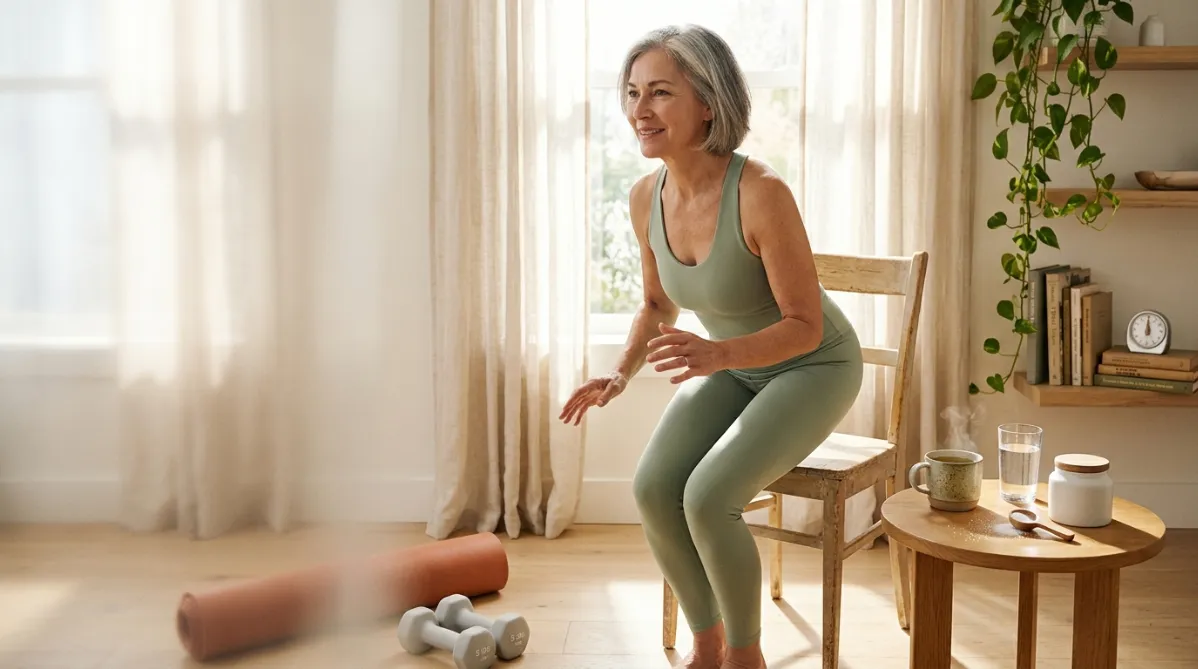
A wide landscape editorial photograph of a bright, airy sunlit living room with pale oak floors and a large window with sheer linen curtains. In the center, a woman in her late 50s with silver-streaked hair, wearing soft sage-green athletic wear, rises from a simple wooden chair, caught mid-motion with a calm, determined expression. Her hands are lightly extended forward for balance. Beside her on a small round oak side table sits a ceramic mug of tea, a glass of water, and a small matte white jar with a wooden scoop resting beside it, a few fine white crystalline grains scattered on the tabletop. In the soft-focus foreground, a pair of light-gray dumbbells and a rolled terracotta-colored yoga mat rest on the floor. A trailing green pothos plant spills from a shelf in the background, with a stack of books and a small analog kitchen timer nearby.

The color palette is warm and muted: cream, sage green, soft terracotta, natural wood, and gentle morning-gold light. Light streams diagonally across the scene, creating long soft shadows and a subtle glow on the woman's shoulders. Shallow depth of field blurs the background gently, while the woman and the table remain crisp. The composition follows the rule of thirds, with the woman on the right and generous negative space on the left, suited for headline overlay. The mood is hopeful, grounded, and modern, like a high-end wellness magazine or a trendy health journal. Natural film-like grain, soft contrast, and a slight matte finish give it a contemporary lifestyle photography feel. There are no futuristic elements, no digital overlays, and no text.
science research

Creatina ajuda mulheres com joelho comprometido a levantar‑se melhor – mas não da forma que você imagina

BY DR. GYMBRO ·

A creatina costuma ser associada a jovens levantadores, mas um ensaio randomizado, duplo‑cego, avaliou seu efeito em mulheres pós‑menopáusicas com osteoartrite de joelho. Após 12 semanas de treino de pernas, o escore do teste de ficar em pé cronometrado do grupo que recebeu creatina subiu de 15,7 para 18,1, enquanto o placebo praticamente não mudou (15,0 para 15,2). A creatina também melhorou rigidez, massa magra e qualidade de vida, mas alívio da dor e força máxima no leg press não foram superiores ao placebo. Veja o que os números realmente indicam e quem pode se beneficiar.

A wide, softly lit editorial still life on a pale oatmeal-colored linen surface, shot from a slightly elevated three-quarter angle. In the center-left, a small matte ceramic dish holds a tiny pile of fine white powder, with a single minuscule measuring spoon resting beside it. To the right, a much larger wooden scoop is heaped high with the same pale powder, spilling gently onto the linen, creating a striking visual contrast of tiny versus large quantity. Behind them, a cream-colored supplement tub with a blank, minimalist label sits slightly out of focus, along with a few amber glass capsules scattered casually.

In the soft-focus background, a runner's well-worn sneaker and a chalk-dusted, wrapped knee sleeve rest on a light ash-wood bench, hinting at gym and road without showing a person. A thin brushed-steel stopwatch lies in the foreground, its hands paused, subtly suggesting timing and endurance. A sprig of dried eucalyptus and a folded sheet of paper with out-of-focus handwritten notes add a quiet, editorial research feel.

Natural morning light streams in from the left through a sheer curtain, casting long, gentle shadows and a warm, creamy glow. The palette is restrained and modern: warm ivory, sand, soft sage green, muted terracotta, and touches of brushed silver. Shallow depth of field with crisp detail on the powders and stopwatch, creamy bokeh in the background. The composition leaves open negative space on the right third for headline text. The overall mood is calm, trustworthy, and contemporary, like a premium health and wellness journal cover, with fine film-like grain and clean, minimalist styling.
recovery

Uma dose de 40 mg de colágeno dobra o tempo até a dor no joelho: o que isso significa

BY DR. GYMBRO ·

Os joelhos doem na barra ou na pista? Um ensaio randomizado mostrou que apenas 40 mg diários de colágeno tipo II não desnaturado (UC‑II) atrasaram o início da dor, de 1,4 para 2,8 minutos, e melhoraram a extensão do joelho. Isso equivale a cerca de 250 vezes menos que o típico scoop de 10 g de colágeno hidrolisado, e trata‑se de um produto completamente diferente. Porém o estudo foi pequeno, financiado pela indústria e realizado em pessoas saudáveis, não em pacientes com artrite. Veja o que os dados realmente indicam, o contexto por trás da manchete e como interpretar rótulos.

A bright, airy editorial still life photographed from slightly above on a pale oat-colored linen surface, in soft natural window light with gentle long shadows. In the foreground, a rustic ceramic bowl holds halved and whole oranges, glossy red bell pepper slices, and a few kiwi halves with emerald flesh. Beside it sit loose strawberries and a small pile of bright yellow lemon wedges. Their colors pop against the muted neutral palette. A single clear glass of water with a slice of orange rests nearby, catching the light.

On the right side of the frame, a pair of well-worn but clean walking sneakers in sage green and cream sits casually on the surface, with one lace loosely trailing. Behind them, a simple wooden chair with a light ash finish is partly visible and slightly out of focus, a quiet nod to the sit-to-stand test. A small stainless-steel stopwatch lies next to the shoes, with a subtle reflective glint.

A minimalist ceramic dish holds a few small, round, pale-yellow vitamin capsules, kept understated. A sprig of green leaves and a folded cotton napkin in soft terracotta add a warm accent. A small open notebook with a pencil rests in the upper left, its page blank except for faint, abstract pencil lines suggesting a simple rising graph, with no legible text.

The composition leaves generous negative space on the left third for title overlay, with a soft cream-to-peach gradient background. The mood is fresh, healthy, and contemplative, like a modern wellness magazine or a trendy online journal. The color palette is warm citrus orange, sunny yellow, sage green, and soft cream, with gentle terracotta accents. The depth of field is shallow, with crisp focus on the fruit and shoes and a creamy blur in the background. The overall look is clean, natural, and editorial, with fine film-like grain, true-to-life color, and a calm, optimistic tone. Landscape 16:9 framing.
nutrition

Vitamina C barata associada a pernas mais fortes à medida que você envelhece

BY DR. GYMBRO ·

Um amplo estudo britânico com mais de 5 mil adultos entre 48 e 92 anos mostrou que quem tem níveis ótimos de vitamina C no sangue (≥ 50 µmol/L) caminha mais rápido e se levanta de uma cadeira com mais agilidade que quem apresenta níveis baixos. Nas mulheres, a força de preensão manual ajustada à altura também foi maior; nos homens, não houve essa associação. A ingestão de vitamina C pelos alimentos correlacionou-se apenas de forma irregular e somente nas mulheres. Como o desenho do estudo é transversal, não há evidência de causa‑efeito. Veja o que os números revelam, o que eles não mostram e por que pode valer a pena conferir seu nível sanguíneo.

A wide, editorial-style still life photographed in soft natural window light on a pale oak table, styled like a modern wellness journal cover. In the foreground, a pair of worn white boxing hand wraps lies loosely coiled beside a small amber glass jar of probiotic capsules, its lid set to the side and a few cream-colored capsules spilled onto the wood. Next to them sits a tall glass of water with a thin slice of lemon, condensation beading on the surface. A neat bundle of fresh gut-friendly foods is arranged in the midground: a small bowl of plain yogurt with a drizzle of honey, sliced green banana, a few sprigs of fresh herbs, and a halved kiwi with glistening seeds. Behind them, slightly out of focus, a compact digital kitchen scale shows a lowered weight on its display, and a folded gray athletic towel rests beside a pair of black boxing gloves hanging from a hook against a muted sage-green plaster wall. The color palette is calm and sophisticated: sage green, warm oatmeal, soft cream, faint amber highlights, and touches of charcoal. Light streams in from the left, casting long, gentle shadows and a subtle golden glow across the textures of linen, wood, and glass. Shallow depth of field with a creamy bokeh background, crisp detail on the capsules and the hand wraps. Clean negative space on the right third of the frame leaves room for a headline overlay. The mood is fresh, restorative, and athletic, with a minimalist and refined composition, shot as if on a full-frame camera with an 50mm lens, high-end lifestyle magazine photography.
nutrition

Cortar peso destrói seu intestino: probiótico reduz marcadores de permeabilidade intestinal

BY DR. GYMBRO ·

Cortes de peso rápidos antes de uma luta são famosos por comprometer a digestão, e um novo estudo randomizado indica que um probiótico pode ajudar. Em 24 atletas de combate de elite, quatro semanas de um probiótico esportivo de múltiplas cepas, tomado duas vezes ao dia, reduziram os sintomas gastrointestinais e baixaram os níveis de zonulina, I‑FABP e D‑lactato em comparação ao placebo. O grupo probiótico também apresentou maior SIgA, menor inflamação e mais bactérias produtoras de butirato. O estudo é pequeno, usa um produto multicepas e não traz dados de desempenho; os achados são promissores, mas ainda não definitivos.

This page is available in