Dr. Gymbro
A bright, airy editorial flat-lay shot from slightly above, on a soft warm-white linen surface with gentle natural window light and long, soft shadows. Two small ceramic dishes sit side by side at the center. The left dish holds a single small capsule in muted terracotta. The right dish holds one small capsule in the same color, with a noticeable empty space beside it to suggest rhythm and spacing. Between them lies a minimalist wooden calendar block or a row of seven small round ceramic discs in alternating tones, dusty rose and cream, evoking an every-other-day pattern. Around the dishes are fresh, iron-rich foods arranged with restraint: a halved blood orange, a few deep green spinach leaves, a small scattering of pumpkin seeds, and a sprig of parsley. A folded sage-green athletic towel and a slim, modern water bottle sit at the upper edge, hinting at women who train. A matte ceramic mug of herbal tea sits at the right with a faint curl of steam. A small notebook with a pen lies open at the lower left, its pages blank, suggesting lab results and tracking without any legible text. The palette is soft and cohesive: warm cream, dusty rose, terracotta, sage green, with small accents of deep coral. The mood is calm, clean, and wellness-oriented, like a contemporary health and science journal feature. Shallow depth of field keeps the capsules sharp and softly blurs the edges of the frame. The composition leaves generous negative space on the left third for title overlay. The look is a high-end lifestyle photograph with subtle film grain, natural textures, and refined minimalism, with no people, no text, and no futuristic or laboratory elements.
Nutrition

Menos Ferro em Dias Alternados: Ganhos de Ferritina Iguais em Mulheres

Dr. Gymbro · · 4 min read

A curiosidade: por que menos ferro poderia funcionar igual?

Quando a ferritina está baixa, a recomendação padrão é simples: tomar ferro todos os dias até que os níveis voltem ao normal. Um ensaio randomizado publicado no European Journal of Nutrition em 2026 (Valerii et al.) testou outra ideia: administrar uma dose menor, apenas em dias alternados, e observar se as reservas de ferro ainda se recuperam.

Em 66 mulheres com deficiência de ferro, isso aconteceu. A ferritina sérica aumentou significativamente em ambos os grupos ao longo de 42 dias, e a diferença entre os dois esquemas não foi estatisticamente relevante. O grupo que tomou ferro em dias alternados alcançou esse resultado consumindo muito menos ferro total.

O problema da hepcidina

A lógica começa com a hepcidina, o hormônio que regula quanto ferro o intestino permite absorver. Os autores do estudo apontam a regulação mediada por hepcidina como uma das razões pelas quais o ferro oral costuma ser pouco eficaz. A ideia por trás da dose em dias alternados é que uma ingestão de ferro pode disparar uma resposta de hepcidina que diminui a absorção da dose seguinte. Espaçar as doses pode dar tempo para que essa resposta se estabilize.

Vale notar que o resumo do artigo não inclui a hepcidina entre os desfechos medidos. O ensaio demonstra que a estratégia funcionou em termos de marcadores de status de ferro, mas não comprova, conforme relatado, que a hepcidina seja a explicação.

O que o ensaio realmente fez

O estudo foi randomizado, paralelo e controlado por outra forma de ferro ativo. As participantes eram mulheres de 18 a 50 anos com ferritina sérica abaixo de 30 ng/mL. Por 42 dias, receberam um dos dois regimes:

  • Braço de dose reduzida: ferro piróxido micronizado e dispersível, fornecendo 21 mg de ferro elementar a cada 48 h, além de um modulador diário da microbiota intestinal.
  • Braço comparador: ferro piróxido sucrosomal, fornecendo 30 mg de ferro elementar por dia.

O desfecho primário foi a ferritina sérica. Os desfechos secundários incluíram ferro sérico, transferrina, saturação de transferrina (TSAT), capacidade total de ligação do ferro (TIBC), hemoglobina e contagem de eritrócitos.

Os resultados

A ferritina aumentou de forma significativa ao longo do tempo em ambos os grupos (p < 0,001) sem diferença estatisticamente relevante entre eles. Ferro sérico, transferrina, TSAT e TIBC também melhoraram de modo comparável. A hemoglobina permaneceu estável, o que faz sentido para uma população selecionada por baixa ferritina e não por anemia, além de o período de 42 dias ser relativamente curto.

A tolerabilidade foi boa em ambos os braços. Os autores relataram apenas eventos gastrointestinais leves e transitórios e nenhuma mudança clinicamente relevante nos marcadores inflamatórios.

A diferença de exposição cumulativa é grande. Em 42 dias, 21 mg a cada outro dia correspondem a cerca de 21 doses, ou aproximadamente 441 mg de ferro elementar (considerando aderência total). Já 30 mg diários resultam em cerca de 1.260 mg – aproximadamente três vezes mais ferro, não o dobro, embora a própria conclusão do artigo mencione apenas “exposição cumulativa menor de ferro”.

Uma leitura honesta

É um achado encorajador, mas apresenta limitações reais:

  • Comparável, não superior. O ensaio demonstra ganhos de ferritina semelhantes. Não prova que o regime em dias alternados seja melhor.
  • Sem placebo. Ambos os braços receberam ferro ativo, portanto o desenho não informa como qualquer um deles se compara à ausência de suplementação.
  • Duas variáveis mudaram simultaneamente. As formulações de ferro eram diferentes (micronizado dispersível versus sucrosomal) e o braço de teste ainda continha um modulador da microbiota. Não se pode atribuir o resultado apenas ao intervalo de dosagem.
  • Pequeno e curto. Sessenta e seis mulheres por seis semanas não resolvem questões sobre reposição a longo prazo, recaídas ou efeitos adversos raros.
  • População específica. Os resultados se aplicam a mulheres em idade fértil com deficiência de ferro, não a todos os indivíduos.

Lições práticas para mulheres que treinam

A deficiência de ferro é comum entre mulheres que levantam peso, correm ou praticam esportes de resistência, e a baixa ferritina pode se manifestar como fadiga e recuperação prejudicada. Este estudo acrescenta ao crescente corpo de evidências de que mais nem sempre é melhor com ferro oral. Uma dose menor, espaçada, pode ser suficiente para reconstruir as reservas e ainda poupar o trato gastrointestinal.

  1. Faça o teste primeiro. O ensaio incluiu mulheres com ferritina abaixo de 30 ng/mL. Solicite a dosagem de ferritina e um painel completo de ferro antes de iniciar a suplementação. Fadiga isolada não confirma deficiência de ferro.
  2. Não se autodiagnostique com anemia. A hemoglobina estável aqui indica que a ferritina pode melhorar antes que a hemoglobina mude. Interpretar esses marcadores e investigar a causa da baixa reserva é trabalho do profissional de saúde.
  3. Pergunte sobre a dosagem em dias alternados. Se o ferro diário incomoda seu estômago ou você já abandonou a suplementação, converse sobre espaçar as doses com seu médico ou nutricionista. Não presuma que os produtos específicos do estudo podem ser trocados por qualquer comprimido de ferro.
  4. Não copie o protocolo cegamente. As formulações e o modulador de microbiota fizeram parte do pacote testado. Os resultados não provam que qualquer comprimido de 21 mg tomado a cada dois dias terá o mesmo efeito.
  5. Reavalie. Refaça a dosagem de ferritina após um intervalo razoável para confirmar que a estratégia está funcionando, em vez de adivinhar.

Conclusão

O estudo indica que estratégias de ferro de dose mais baixa, baseadas em entendimento fisiológico, merecem atenção séria. Em mulheres com deficiência de ferro, 21 mg a cada 48 h equiparou‑se a 30 mg diários para elevar a ferritina ao longo de seis semanas, com efeitos gastrointestinais leves. São necessários ensaios maiores e mais longos, que separem o cronograma da formulação e, idealmente, meçam a hepcidina diretamente, para confirmar que o intervalo de dosagem foi o fator decisivo.
Original study

Read the original research on pubmed.ncbi.nlm.nih.gov →

This article summarizes published research for general information. It is not medical advice.

DG

Written by

Dr. Gymbro

Dr. Gymbro writes for Dr. Gymbro: science-backed fitness, nutrition & performance.

Related Articles

A wide, softly lit editorial still life on a pale warm-gray concrete surface, shot from a slightly elevated three-quarter angle. In the center-left, two matte ceramic scoops sit side by side. One holds fine ivory whey powder, the other holds slightly coarser, pale golden collagen peptide powder. A small, elegant dusting of both powders spills between them and blends into a soft swirl. Behind them, three minimalist cream and sage-green supplement tubs with no legible text stand in a staggered row, with a frosted glass shaker bottle of creamy liquid beside them.

On the right, a brushed-steel barbell plate and a compact chalk-dusted kettlebell rest slightly out of focus, suggesting resistance training. Pale wisps of chalk hang in the air. A folded charcoal gym towel and a pair of worn leather lifting straps lie in the foreground. A single cross-section of a clean white bone model, a stylized vertebra, rests on a small oak block at the far right. It subtly signals the bone-density theme without looking clinical.

Natural window light enters from the left, casting long, gentle shadows and a warm highlight on the powders. The palette is muted and modern: oatmeal, bone white, sage green, soft charcoal, and touches of warm amber. Shallow depth of field keeps the scoops tack-sharp and melts the background into creamy blur. Leave generous negative space in the upper right for headline overlay. The overall feel is a premium health and science journal cover: clean, tactile, minimalist, with fine film-like grain and a calm, editorial mood.
nutrition

Whey + colágeno supera qualquer outro suplemento em levantadores — mas há uma pegadinha

BY DR. GYMBRO ·

Misturar 30 g de whey com 10 g de colágeno superou whey sozinho, colágeno sozinho e placebo em todos os desfechos em um novo estudo de 8 semanas com homens treinados em resistência. A combinação acrescentou 2,66 kg de músculo (por BIA), elevou a DMO da coluna lombar e melhorou agachamento, supino e marcadores de turnover ósseo. O colágeno sozinho movimentou o osso, o whey sozinho o músculo. Porém, com apenas 40 participantes, totais de proteína desiguais e um salto inesperadamente grande na DMO, há uma pegadinha. Veja o que a combinação ganhou, para quem pode ser adequada e quem deve evitá‑la.

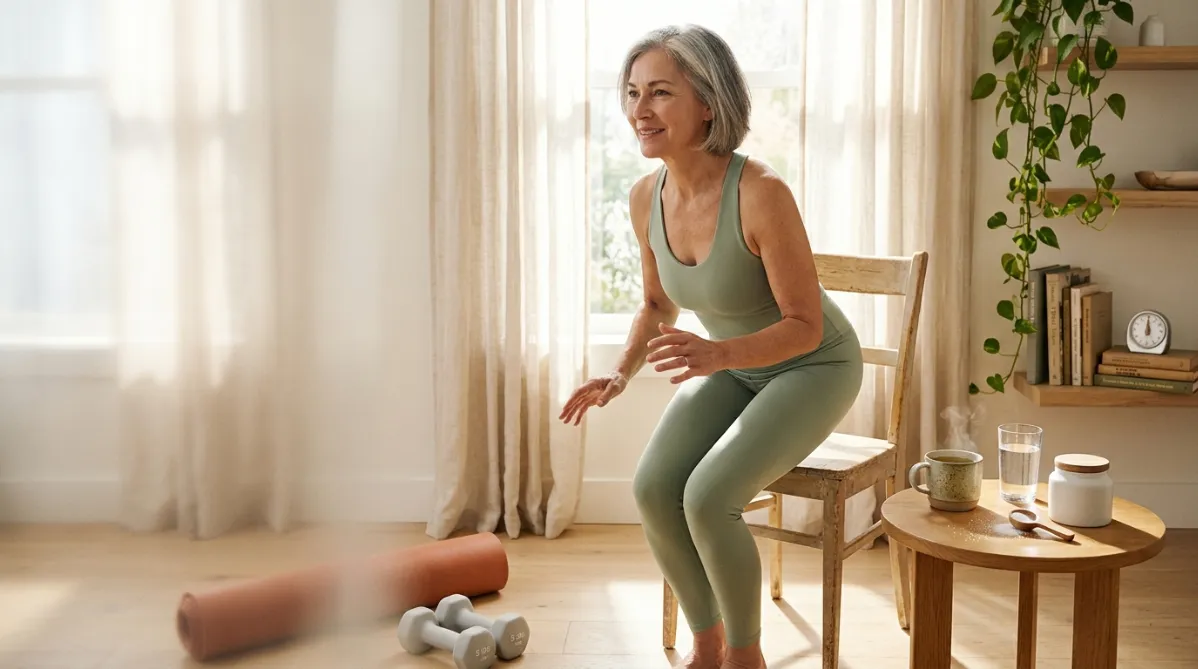
A wide landscape editorial photograph of a bright, airy sunlit living room with pale oak floors and a large window with sheer linen curtains. In the center, a woman in her late 50s with silver-streaked hair, wearing soft sage-green athletic wear, rises from a simple wooden chair, caught mid-motion with a calm, determined expression. Her hands are lightly extended forward for balance. Beside her on a small round oak side table sits a ceramic mug of tea, a glass of water, and a small matte white jar with a wooden scoop resting beside it, a few fine white crystalline grains scattered on the tabletop. In the soft-focus foreground, a pair of light-gray dumbbells and a rolled terracotta-colored yoga mat rest on the floor. A trailing green pothos plant spills from a shelf in the background, with a stack of books and a small analog kitchen timer nearby.

The color palette is warm and muted: cream, sage green, soft terracotta, natural wood, and gentle morning-gold light. Light streams diagonally across the scene, creating long soft shadows and a subtle glow on the woman's shoulders. Shallow depth of field blurs the background gently, while the woman and the table remain crisp. The composition follows the rule of thirds, with the woman on the right and generous negative space on the left, suited for headline overlay. The mood is hopeful, grounded, and modern, like a high-end wellness magazine or a trendy health journal. Natural film-like grain, soft contrast, and a slight matte finish give it a contemporary lifestyle photography feel. There are no futuristic elements, no digital overlays, and no text.
science research

Creatina ajuda mulheres com joelho comprometido a levantar‑se melhor – mas não da forma que você imagina

BY DR. GYMBRO ·

A creatina costuma ser associada a jovens levantadores, mas um ensaio randomizado, duplo‑cego, avaliou seu efeito em mulheres pós‑menopáusicas com osteoartrite de joelho. Após 12 semanas de treino de pernas, o escore do teste de ficar em pé cronometrado do grupo que recebeu creatina subiu de 15,7 para 18,1, enquanto o placebo praticamente não mudou (15,0 para 15,2). A creatina também melhorou rigidez, massa magra e qualidade de vida, mas alívio da dor e força máxima no leg press não foram superiores ao placebo. Veja o que os números realmente indicam e quem pode se beneficiar.

A sunlit outdoor running track in late afternoon, shot from a low angle with shallow depth of field. In the foreground, a matte black bottle with a minimal off-white label sits on the edge of a warm terracotta-colored track lane, beside a folded white towel and a small glass of amber liquid catching golden light. Condensation beads on the bottle. A faint heat shimmer rises from the track surface and softens the background.

In the midground, slightly out of focus, a lean athlete in a sage-green tank top and charcoal shorts runs on a treadmill-like stretch of track, a thin sheen of sweat on their shoulders, their expression focused and calm. Their motion is gently blurred, suggesting endurance and rhythm. Long soft shadows stretch across the lane lines.

The background fades into hazy peach, apricot, and pale yellow tones, with the suggestion of tall trees and a distant stadium wall. Warm sun flare enters from the upper right, creating a subtle glow and a few soft light streaks across the frame.

Subtle editorial touches: a small notebook with a pencil and a stopwatch rest beside the bottle, hinting at data and timing without any text legible. The color palette is warm and muted, with terracotta, cream, sage, and charcoal accents, and a fine film-like grain. The composition leaves open negative space on the left third for a headline overlay. The overall mood is clean, modern, and health-journal inspired, natural and aspirational, with a calm scientific curiosity rather than hype.
nutrition

Bebidas de Cetona no Calor: Mais Resistência e Memória Mais Aguçada?

BY DR. GYMBRO ·

Bebidas de cetona costumam ser associadas a biohackers que queimam gordura, mas um novo estudo sob estresse térmico indica que elas podem ajudar a terminar sessões mais intensas. Em 17 homens treinados, a combinação de cetona monoéster e cafeína aumentou o tempo até a exaustão para 8,9 minutos contra 7,0 minutos com carboidrato e cafeína, após 90 minutos de corrida em esteira a 34 °C. A precisão da memória de trabalho no teste de 1‑back também melhorou, enquanto frequência cardíaca e temperatura central não apresentaram diferenças relevantes. Contudo, não houve benefício no teste de 2‑back, no tempo de reação ou na tarefa de acertar e evitar. O estudo foi pequeno, apenas com homens e de sessão única. Veja o que os dados realmente revelam e o que ainda não foi comprovado.

A clean, modern editorial flat-lay on a pale oat-colored linen surface, shot from slightly above in soft diffused natural window light. At the center sits an amber glass supplement bottle with a minimalist cream label, unbranded, with a few capsules spilling onto the fabric in soft greens and ivory tones. Around it are fresh botanical elements: a sprig of green tea leaves, sliced ginger root, a small bundle of dried hibiscus petals, and a few pale green pineapple and papaya slices hinting at digestive enzymes. A small ceramic bowl of creamy plain yogurt with a wooden spoon suggests probiotics. To the left, a flexible tailor's measuring tape in soft blush pink loosely curls across the linen, with a slim brushed-brass scale partly visible at the frame edge. On the right, a minimalist white notebook lies open with a hand-drawn simple line chart showing two diverging lines, one trending downward and one flat, with no readable text. A pair of reading glasses with thin gold frames rests beside it, and a tiny pair of balanced brass scales sits in the background, subtly suggesting weighing evidence and caution.

The palette is muted sage green, warm cream, soft terracotta, and touches of blush and brass. Shadows are gentle and long, the depth of field is shallow with a creamy blurred background, and the negative space on the left third of the frame leaves room for a headline overlay. The overall feel is a contemporary health and science journal, calm, trustworthy, and slightly skeptical, in the style of a premium wellness magazine photographed with a 50mm lens, with crisp texture on linen, glass, and botanicals.
nutrition

SlimSEB: mistura probiótica e enzimática supera placebo — mas tem uma ressalva

BY DR. GYMBRO ·

Uma combinação de probióticos, enzimas e compostos botânicos, chamada SlimSEB, superou o placebo em um ensaio aleatorizado de 12 semanas com 87 adultos em risco de diabetes tipo 2. Os participantes obesos perderam 4,5 kg a mais que o grupo placebo e reduziram a circunferência da cintura em 11 cm, além de apresentarem melhora nos níveis de colesterol e na resistência à insulina. Contudo, o produto foi fornecido pelo próprio fabricante, o estudo foi pequeno e de curta duração, e a fórmula múltipla impede que se atribua o efeito a um único ingrediente. Acompanhe a seguir os detalhes dos dados, a comparação com os fármacos GLP‑1 e quem deve repensar o uso.

This page is available in