Dr. Gymbro
A softly lit editorial still life on a pale oatmeal-colored linen surface, shot from a slightly elevated three-quarter angle with a shallow depth of field. In the left foreground, a small ceramic dish holds several translucent golden-amber fish oil softgel capsules, glowing as if lit from within by warm morning window light. A few capsules are scattered casually beside it, catching crisp highlights. Just behind them, a sliced fresh salmon fillet with vivid coral-orange flesh rests on a matte slate board next to a sprig of dill, a halved lemon, and a small glass dropper bottle of golden oil.

In the soft-focus midground, a pair of weathered, capable older adult hands rests on the edge of the table, gently holding a pale sage-green resistance band, a hint of an active lifestyle. Beside them sits a modest set of brushed-steel dumbbells and a folded heather-gray towel. Subtle natural details add warmth: a glass of water, a small ceramic mug, and a sprig of eucalyptus in a bud vase.

On the right side, a tidy stack of printed research papers with a few pastel sticky tabs and a pair of thin tortoiseshell reading glasses sits on top, suggesting scholarly review. A fountain pen lies across the pages, with a few abstract handwritten notes and a simple hand-drawn bar chart visible but unreadable.

The palette is warm and calming: cream, soft sage, terracotta, honey gold, and coral accents against muted neutral tones. Window light enters from the left, producing long gentle shadows and a faint dappled leaf-shadow pattern across the linen. The background fades into a creamy blur of pale wall and a hint of a wooden shelf.

The composition leaves clean negative space across the upper right third for headline text overlay. The mood is trustworthy, health-forward, and modern, reminiscent of a contemporary wellness and science journal's photography. Fine film-like grain, natural color grading, high-resolution editorial photography, 16:9 landscape format.
Nutrition

Óleo de Peixe para Músculos Envelhecidos: O que 14 Estudos Realmente Mostram

Dr. Gymbro · · 4 min read

Óleo de Peixe para Músculos Envelhecidos: O Que 14 Estudos Realmente Mostram

O óleo de peixe tem sido vendido como solução para quase tudo, e agora está sendo ofertado como defesa contra a perda de massa muscular que acompanha o envelhecimento. Uma revisão umbrella (revisão de revisões) compilou as melhores evidências disponíveis sobre ômega‑3 e músculos envelhecidos. O resultado é mais interessante – e discreto – do que a propaganda dos corredores de suplementos sugere.

Visão geral do estudo

O artigo, de Shao e colaboradores, foi publicado no International Journal for Vitamin and Nutrition Research (2026; 96(5)). Trata‑se de uma revisão umbrella, ou seja, uma revisão da literatura existente, e não de um novo ensaio clínico. A equipe buscou no PubMed, Web of Science, EBSCO e ScienceDirect ensaios controlados randomizados (ECRs) e meta‑análises de ECRs que testaram a suplementação de ácidos graxos poli‑insaturados de cadeia longa (n‑3 PUFA) em adultos com 55 anos ou mais.

Sete ECRs e sete meta‑análises atenderam aos critérios – daí a cifra de "14 estudos". A revisão foi registrada no PROSPERO (CRD420251165901). As meta‑análises foram avaliadas com a ferramenta AMSTAR 2 e a certeza da evidência com o GRADE. Também foi mensurada a sobreposição dos estudos incluídos, usando o índice de área coberta corrigida (CCA).

O que foi realmente testado?

A maioria das intervenções utilizou misturas ricas em EPA e DHA, os ômega‑3 marinhos presentes no óleo de peixe. Algumas usaram óleo de linhaça, rico em ALA de origem vegetal. As doses variaram bastante, de 1,3 g/dia a 14 g/dia, e a duração dos protocolos foi de 6 semanas a 6 meses. Os desfechos primários foram massa muscular esquelética, força muscular e função física.

Essa amplitude importa. A revisão não identificou uma dose única comprovada; portanto, quem afirmar que há um “miligrama ideal” para músculos está extrapolando a evidência.

Principais achados: Modesto, mas mensurável

De modo geral, a suplementação com n‑3 PUFA foi associada a um pequeno, porém mensurável, aumento da força muscular. Também surgiram indícios de benefício para o desempenho físico dos membros inferiores e para a massa muscular. Os autores concluem que os n‑3 PUFA de origem marinha, em especial, "podem oferecer benefícios preliminares" na atenuação do declínio relacionado à idade em adultos saudáveis.

A linguagem é cautelosa: "modesto", "potencial", "preliminar". Nada no texto sugere que o óleo de peixe reconstrua músculo por si só.

Onde a evidência é mais forte (e mais fraca)

O padrão é assimétrico. A revisão encontrou certeza moderada para alguns desfechos:

  • Força dos membros inferiores
  • Função física dos membros inferiores

Outros desfechos foram classificados como baixa ou muito baixa certeza:

  • Força de preensão (aperto de mão)
  • Velocidade de caminhada
  • Força da parte superior do corpo

Os autores atribuem as avaliações mais fracas ao pequeno número de ensaios e a limitações metodológicas. Na prática, o sinal mais claro é para as pernas – os músculos essenciais para levantar de uma cadeira, subir escadas e manter o equilíbrio. Para preensão, velocidade de marcha e força de tronco ainda não há dados suficientes.

O detalhe crítico: muita sobreposição

Os 14 estudos não são 14 votos independentes. A revisão identificou um CCA de 14,02 %, indicando redundância substancial: as meta‑análises se basearam em grande parte nos mesmos ensaios originais. Isso pode fazer a evidência parecer mais consistente do que realmente é. Somado às classificações de baixa a muito baixa certeza para a maioria dos desfechos, os autores alertam que a confiabilidade geral dos achados "pode estar comprometida". Recomenda‑se a realização de ensaios clínicos grandes e rigorosos antes de se elaborar diretrizes baseadas em evidências para sarcopenia.

O que isso significa para você

Para quem pode ser útil: adultos com 55 anos ou mais, especialmente aqueles preocupados com a sarcopenia – a perda de massa e função muscular associada à idade. A evidência provém de adultos saudáveis, não de pacientes com doenças diagnosticadas.

Qual forma considerar: os ômega‑3 marinhos (EPA/DHA) foram os mais estudados e são apontados como os mais promissores. O ALA de linhaça apareceu em poucos estudos, portanto a evidência para ele é mais tênue.

Dosagem: a revisão abrangeu de 1,3 g a 14 g por dia e não define uma dose ótima. Doses maiores não mostraram ser superiores, e 14 g/dia está muito acima do consumo habitual. Verifique o conteúdo de EPA + DHA no rótulo, não apenas a quantidade total de óleo, e converse com um profissional de saúde para adequar a dose ao seu caso.

Duração: os ensaios duraram de 6 semanas a 6 meses. Pense em consumo contínuo por meses, não em “dias”. O horário da dose diária (antes ou depois das refeições) não foi investigado; tomar o suplemento com uma refeição é prática comum, mas não se trata de achado científico.

Combinar com treinamento: a revisão não demonstra que o óleo de peixe funcione sozinho. A forma sensata de usar um suplemento para melhorar músculos é combiná‑lo com as bases comprovadas: treinamento de resistência algumas vezes por semana e ingestão adequada de proteína. Considere o óleo de peixe como um possível aditivo, não como substituto.

Expectativas realistas: espere efeitos modestos, com maiores chances de melhoria na força das pernas. Não conte com mudanças dramáticas na preensão ou na velocidade de marcha com base nesta evidência.

Quem deve evitar ou consultar antes: embora não esteja no artigo, quem usa anticoagulantes, tem alergia a peixe ou crustáceos, está programado para cirurgia ou tem alguma condição crônica deve buscar orientação médica antes de iniciar doses altas de ômega‑3. Quem pensar em doses próximas ao limite superior estudado deve redobrar a cautela.

Conclusão

O óleo de peixe não é um construtor milagroso de músculos, mas esta revisão umbrella indica que ele pode oferecer uma ligeira vantagem para adultos mais velhos, sobretudo na força e função dos membros inferiores. A evidência ainda é incipiente, sobreposta e, em grande parte, de baixa certeza; portanto, a interpretação mais segura é "promissor, ainda não comprovado". Até que grandes ensaios cheguem, o treinamento de resistência e a boa nutrição permanecem a base, e os ômega‑3 marinhos são um complemento razoável e baseado em evidência para a população a partir dos 55 anos.
Original study

Read the original research on doi.org →

This article summarizes published research for general information. It is not medical advice.

DG

Written by

Dr. Gymbro

Dr. Gymbro writes for Dr. Gymbro: science-backed fitness, nutrition & performance.

Related Articles

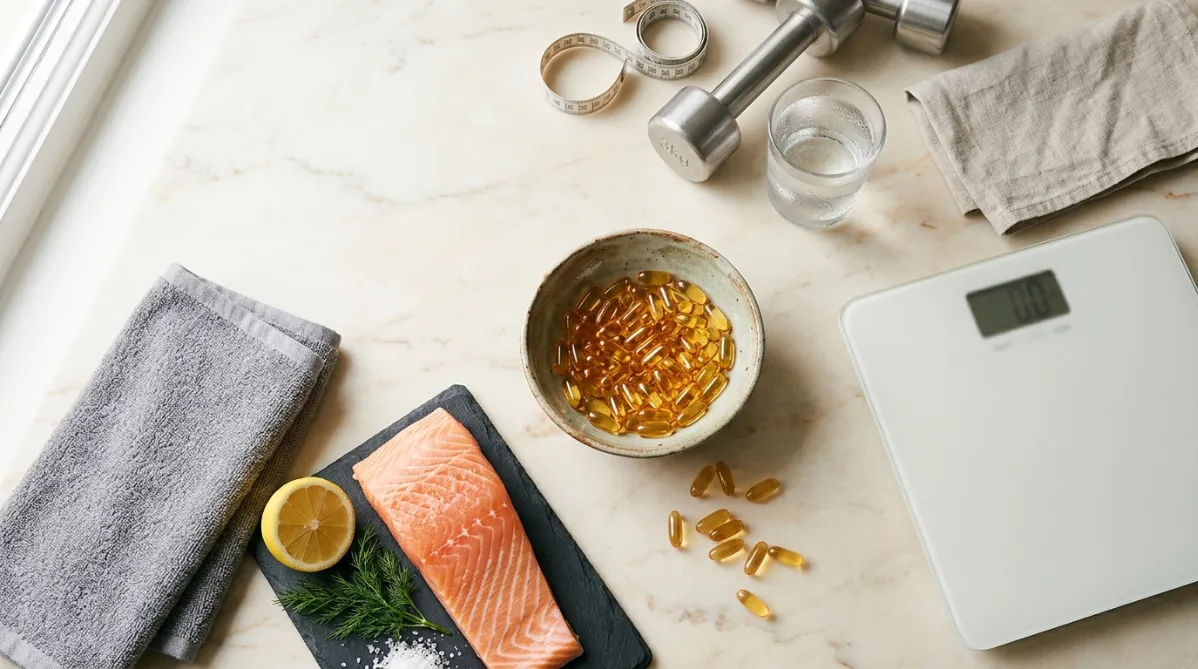
A wide, editorial-style flat lay photographed from above on a pale, warm-toned marble surface with soft natural window light coming from the left. At the center sits a shallow ceramic bowl filled with glistening golden-amber fish oil capsules, a few spilled casually onto the marble. Beside the bowl, a sleek minimalist bathroom scale in matte white sits at the right edge, its digital display blurred so it appears static. To the left, a neatly folded heather-gray athletic towel rests beside a small cluster of fresh ingredients: a halved lemon, a sprig of dill, and a fillet of raw salmon on a slate board, its coral-pink flesh with delicate white marbling catching the light. Near the top of the frame, a pair of brushed-steel dumbbells in a light finish and a soft tape measure curl loosely across the surface, suggesting body composition tracking without being clinical. A small glass of water with condensation and a linen napkin add quiet lifestyle detail. The color palette is calm and modern: cream, soft sage green, warm gold, coral, and muted gray. Shadows are soft and diffused, with gentle highlights on the capsules making them glow like tiny amber beads. The composition has generous negative space on the upper left for headline text, with a shallow depth of field that keeps the capsules and salmon crisp while the edges fall softly out of focus. The overall mood is clean, health-conscious, and contemporary, like a high-end wellness magazine or science journal cover, with a subtle film-like grain and natural, true-to-life tones. No people, no text, no futuristic elements.
nutrition

Óleo de peixe trocou gordura por músculo em 6 semanas; a balança não mudou

BY DR. GYMBRO ·

E se a balança permanecer igual, mas seu corpo estiver trocando silenciosamente gordura por músculo? Um ensaio duplo‑cego com 44 adultos saudáveis mostrou que 6 semanas de suplementação com óleo de peixe (cerca de 2,4 g de EPA + DHA por dia) alteraram a composição corporal em aproximadamente meio quilo em cada sentido, sem mudar o peso total. A queda no cortisol salivar acompanhou as mudanças, embora a relação seja apenas correlacional. O gasto energético em repouso não variou, e a amostra foi pequena. Veja o que os números realmente indicam e como interpretá‑los com sensatez.

A bright, airy editorial still life photographed from slightly above on a pale oat-colored linen surface, in soft natural window light with gentle long shadows. In the foreground, a rustic ceramic bowl holds halved and whole oranges, glossy red bell pepper slices, and a few kiwi halves with emerald flesh. Beside it sit loose strawberries and a small pile of bright yellow lemon wedges. Their colors pop against the muted neutral palette. A single clear glass of water with a slice of orange rests nearby, catching the light.

On the right side of the frame, a pair of well-worn but clean walking sneakers in sage green and cream sits casually on the surface, with one lace loosely trailing. Behind them, a simple wooden chair with a light ash finish is partly visible and slightly out of focus, a quiet nod to the sit-to-stand test. A small stainless-steel stopwatch lies next to the shoes, with a subtle reflective glint.

A minimalist ceramic dish holds a few small, round, pale-yellow vitamin capsules, kept understated. A sprig of green leaves and a folded cotton napkin in soft terracotta add a warm accent. A small open notebook with a pencil rests in the upper left, its page blank except for faint, abstract pencil lines suggesting a simple rising graph, with no legible text.

The composition leaves generous negative space on the left third for title overlay, with a soft cream-to-peach gradient background. The mood is fresh, healthy, and contemplative, like a modern wellness magazine or a trendy online journal. The color palette is warm citrus orange, sunny yellow, sage green, and soft cream, with gentle terracotta accents. The depth of field is shallow, with crisp focus on the fruit and shoes and a creamy blur in the background. The overall look is clean, natural, and editorial, with fine film-like grain, true-to-life color, and a calm, optimistic tone. Landscape 16:9 framing.
nutrition

Vitamina C barata associada a pernas mais fortes à medida que você envelhece

BY DR. GYMBRO ·

Um amplo estudo britânico com mais de 5 mil adultos entre 48 e 92 anos mostrou que quem tem níveis ótimos de vitamina C no sangue (≥ 50 µmol/L) caminha mais rápido e se levanta de uma cadeira com mais agilidade que quem apresenta níveis baixos. Nas mulheres, a força de preensão manual ajustada à altura também foi maior; nos homens, não houve essa associação. A ingestão de vitamina C pelos alimentos correlacionou-se apenas de forma irregular e somente nas mulheres. Como o desenho do estudo é transversal, não há evidência de causa‑efeito. Veja o que os números revelam, o que eles não mostram e por que pode valer a pena conferir seu nível sanguíneo.

A wide, softly lit editorial photograph of a rustic light-oak table by a sunny window. On it, a handful of dried brown kelp and wakame seaweed fronds spill from a handmade matte ceramic bowl in warm sand tones, their glossy, ruffled edges catching the light. Beside the bowl sits a small wooden scoop holding fine golden-beige powder, with a little of it dusted across the table. In the middle ground, an older adult's weathered but strong hand grips a smooth, rounded river stone, with the knuckles and tendons subtly emphasized to suggest strength and vitality. Only the hand and part of a forearm in a soft oatmeal linen sleeve are visible.

In the background, slightly out of focus, a pair of worn leather walking shoes rests on a windowsill next to a trailing green plant. Beyond the window, a blurred coastal path winds through dune grass toward a pale blue sea, hinting at walking and an active daily life. A simple analog wristwatch lies on the table's edge, a quiet nod to the twelve-week timeline.

The palette is muted and natural: sage green, warm sand, soft ocean teal, and creamy off-white, with deep olive-brown accents from the seaweed. Morning light streams in from the left, casting long, gentle shadows and a faint golden glow. The depth of field is shallow, with crisp focus on the hand and seaweed and a creamy bokeh background. The composition follows the rule of thirds, with the hand and bowl on the left and generous negative space on the right for headline text. The mood is calm and hopeful, with a clean, contemporary wellness-magazine feel. The image is shot as if on a 50mm lens with subtle film grain and a natural, uncluttered, tactile look.
science research

Fucoidana de Alga Marinha Aumenta a Força de Preensão em Pessoas com Mais de 60 Anos em 12 Semanas

BY DR. GYMBRO ·

Perder força com a idade é uma mudança comum e pouco discutida, e o treinamento de resistência nem sempre é viável. Um ensaio randomizado de 12 semanas mostrou que fucoidana de alga marinha de baixo peso molecular, consumida a 1 650 mg/dia, aumentou significativamente a força de preensão e o desempenho na caminhada de seis minutos em adultos com mais de 60 anos. Surpreendentemente, a massa muscular não mudou e a combinação com BCAAs e vitamina D não trouxe benefício adicional. O estudo é pequeno e testou um único produto de marca, sendo um indício promissor, mas não uma conclusão definitiva. Veja o que a pesquisa revelou e o que isso significa na prática.

A landscape editorial still life on a warm, softly textured oatmeal-colored linen surface, photographed from a slightly elevated three-quarter angle in gentle morning window light. At the center sits a small matte ceramic dish in muted terracotta holding a handful of pale amber capsules, with a few spilled casually onto the linen. Beside it is a rustic wooden scoop holding a pile of fine, golden-tan powdered root extract. Behind these, a loose arrangement of raw Tongkat Ali root pieces, gnarled and fibrous with pale cream interiors and rough brown bark, rests on a slab of pale travertine stone.

On the left, a pair of older adult hands, seen only from the wrists down, with natural skin texture, hold a simple matte-black hand dynamometer in a relaxed grip. The tone is dignified and healthy, not athletic or posed. A sage-green ceramic mug of tea sits slightly out of focus nearby, with a thin curl of steam.

On the right, a minimalist open notebook with blank cream pages and a slim brass pen lies beside a sprig of dried eucalyptus. A small frosted glass jar adds a quiet pharmacy-apothecary note.

The palette is earthy and calm: warm beige, terracotta, sage, soft brown, and cream, with subtle brass accents. The shadows are long and soft, the depth of field shallow with a creamy blurred background of a sunlit neutral wall and a hint of a leafy plant. Negative space on the upper right suits headline overlay.

The style is modern wellness-journal photography, like a high-end health magazine or a Kinfolk-inspired lifestyle site: tactile, calm, and refined, with subtle film grain and natural color grading. There is no text, no logos, no futuristic elements, and no clinical lab equipment.
nutrition

Tongkat Ali: 400 mg por 5 semanas aumentam a testosterona e a força de preensão

BY DR. GYMBRO ·

Tongkat Ali está entre os suplementos que supostamente aumentam a testosterona e tem ganhado cada vez mais buscas on‑line. Um pequeno estudo piloto com 25 adultos ativos entre 57 e 72 anos mostrou que 400 mg diários de extrato durante 5 semanas elevaram a testosterona total e livre, além de melhorar a força de preensão manual. Nas mulheres, a testosterona livre também subiu, aparentemente pela queda do SHBG. Como não houve grupo placebo, os resultados são promissores, mas não conclusivos. A seguir, veja o que o estudo encontrou, o que ele não pode provar e como interpretá‑lo com bom senso.

This page is available in