Dr. Gymbro
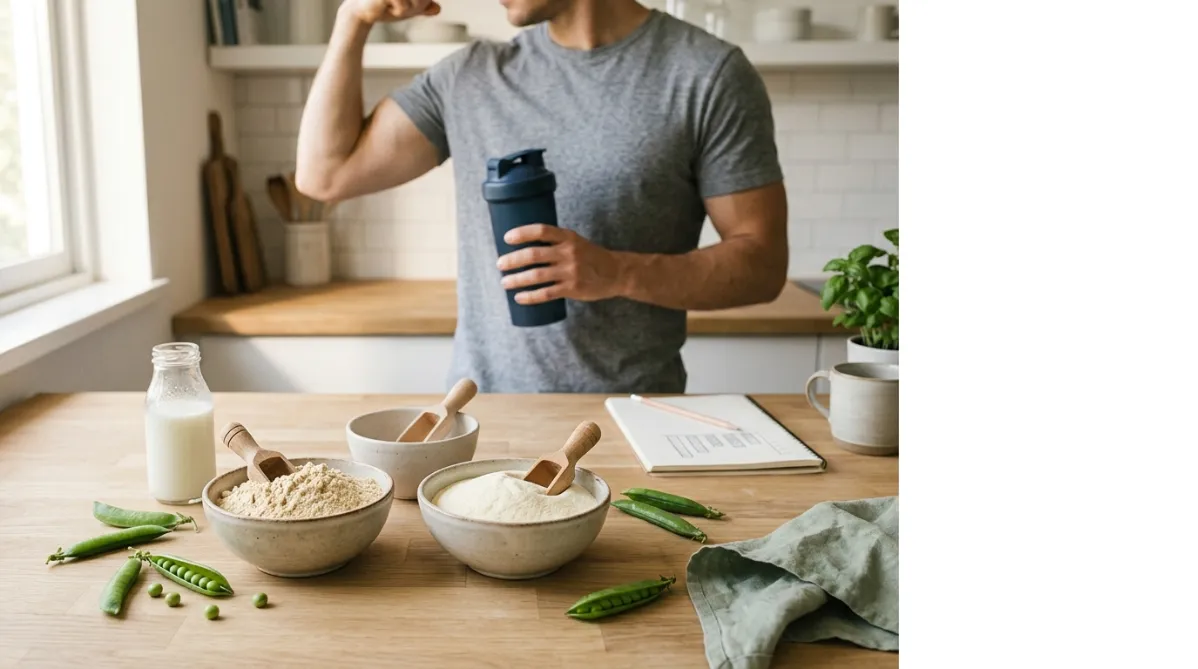
A bright, airy, minimalist kitchen counter in soft morning light, shot from a slightly elevated three-quarter angle in a wide landscape composition. Two matching ceramic bowls sit side by side on a pale oak butcher-block surface. The left bowl holds fine, creamy-beige pea protein powder with a small wooden scoop resting in it. The right bowl holds smooth, ivory-white whey powder with an identical scoop. Between and slightly behind them sits a third, smaller empty bowl with a plain scoop, hinting at the placebo. Scattered around the bowls are fresh green pea pods, some split open to reveal bright, round peas, and a small glass bottle of milk with delicate condensation. A sage-green linen napkin is folded loosely at the edge of the frame.

In the soft-focus background, a young man in a fitted heather-gray t-shirt is seen from the shoulders down, casually flexing one arm while holding a matte shaker bottle, the biceps subtly defined and the pose relaxed and natural. A minimalist notebook with a pencil and a simple hand-drawn bar chart lies open on the counter, suggesting analysis without legible text. A small potted herb plant and a ceramic mug add warmth.

The color palette is muted and editorial: warm cream, sage green, soft terracotta, pale wood, and touches of charcoal. Light streams in from a window on the left, casting gentle long shadows and a subtle golden glow across the powders so their textures look fine and tactile. Shallow depth of field keeps the bowls crisp while the background melts into a creamy blur. The look is modern lifestyle-magazine photography, clean and uncluttered, with generous negative space on the right third of the frame for headline overlay. It is natural, appetizing, and trustworthy, in the style of a contemporary wellness and nutrition journal.
Nutrition

Proteína de Ervilha vs Whey: O Resultado Surpreendente em Iniciantes

Dr. Gymbro · · 4 min read

Se você é vegano, intolerante à lactose ou simplesmente cansado do inchaço causado pelos laticínios, provavelmente já se perguntou: a proteína vegetal realmente consegue construir músculo?

Um ensaio duplo‑cego de 12 semanas, envolvendo 161 homens, colocou a proteína de ervilha frente a frente com whey e placebo. O resultado principal é impressionante, mas os detalhes são tão importantes quanto a manchete.

O que realmente foi testado

O estudo, publicado no Journal of the International Society of Sports Nutrition em 2015 por Babault e colaboradores, foi randomizado, duplo‑cego e controlado por placebo. Foram recrutados 161 homens entre 18 e 35 anos, distribuídos em três grupos:

  • Proteína de ervilha (marca NUTRALYS) – n = 53
  • Whey protein – n = 54
  • Placebo – n = 54

Todos seguiram 12 semanas de treinamento de resistência focado nos membros superiores. Cada participante ingeriu 25 g de proteína ou placebo duas vezes ao dia, totalizando cerca de 50 g diários. A espessura do bíceps braquial foi medida por ultrassom e a força, em dinamômetro isocinético, nos momentos basal, dia 42 e dia 84.

Resultados: todos cresceram, mas os grupos quase não se diferenciaram

Em toda a amostra, a espessura dos bíceps passou de 24,9 mm para 26,9 mm na metade do estudo e 27,3 mm ao final. Esse efeito do tempo foi altamente significativo (P < 0,0001), confirmando que o treinamento funcionou.

A diferença entre os grupos foi apenas uma tendência (P = 0,09), não atingindo significância estatística. A força também aumentou ao longo do tempo, sem diferença relevante entre ervilha, whey e placebo.

Portanto, no conjunto total, não se pode afirmar que a ervilha superou qualquer outro suplemento. Essa é apenas uma primeira impressão, e é aqui que a próxima parte ganha destaque.

A reviravolta para iniciantes

Os pesquisadores realizaram uma análise de sensibilidade nos participantes mais fracos, definidos pela força inicial. Essa análise serve como proxy razoável para pessoas novas na musculação ou que retornam após uma pausa. Nesse subgrupo, os grupos se separaram (P < 0,05):

  • Proteína de ervilha: +20,2 % de espessura do bíceps
  • Whey protein: +15,6 %
  • Placebo: +8,6 %

O ganho com a ervilha foi significativamente maior que o do placebo. O whey ficou no meio e não diferiu estatisticamente nem da ervilha nem do placebo. Assim, a proteína de ervilha não superou o whey; ambos se moveram na mesma direção, mas apenas a ervilha alcançou significância contra o placebo.

Os autores concluíram que a proteína de ervilha promoveu ganhos de espessura maiores que o placebo, sobretudo em quem estava iniciando ou retornando ao treinamento de força. Como os dois tipos de proteína não diferiram entre si, sugeriram a ervilha como alternativa ao whey.

O que você não pode deixar de notar

Aqui vai a dose de cautela que toda boa manchete necessita:

  • A comparação principal foi apenas uma tendência. A diferença entre grupos no conjunto total (P = 0,09) não foi significativa.
  • O achado positivo vem de um subgrupo. Análises de sensibilidade geram hipóteses úteis, mas são mais vulneráveis ao acaso que o resultado primário.
  • Vínculos com a indústria. Vários autores têm afiliação com a Roquette, empresa responsável pela NUTRALYS. Isso não invalida o estudo (registrado sob NCT02128516), mas é contexto relevante.
  • População restrita. Os participantes eram jovens adultos do sexo masculino, e apenas a parte superior do corpo foi treinada, especificamente os bíceps. Os resultados não se extrapolam automaticamente para mulheres, adultos mais velhos ou treinos de pernas.
  • Nenhum ganho ou perda clara do whey. O aumento de 15,6 % do whey não foi estatisticamente diferente da ervilha nem do placebo, portanto o ensaio não permite hierarquizar os suplementos.

A leitura equilibrada é que a proteína de ervilha parece ser uma opção viável quando o treinamento é suficientemente intenso e a ingestão total de proteína é adequada. Não há prova de que a ervilha seja superior, nem mesmo de que seja plenamente equivalente ao whey em todos os contextos.

Dicas práticas

Dosagem. O estudo utilizou 25 g duas vezes ao dia, aproximadamente 50 g de proteína suplementar por dia. Esse é um alvo realista para muitos praticantes, embora a ingestão total diária de proteína dos alimentos também seja crucial.

Timing. O artigo não testou o horário como variável. Dividir a proteína em duas doses, com uma próxima ao treino, é uma maneira prática de espelhar o protocolo. A constância ao longo das 12 semanas provavelmente importou mais do que o minuto exato da ingestão.

Para quem é indicado. A proteína de ervilha é uma escolha sensata para veganos, intolerantes à lactose, pessoas sensíveis a laticínios ou quem prefere produtos de origem vegetal. O sinal mais forte aqui vem de iniciantes ou de quem está retornando ao treino, que tendem a responder rapidamente a qualquer proteína decente combinada com estímulo de força.

Como escolher uma proteína de ervilha:

  • Procure um conteúdo claro de proteína por porção, idealmente entre 20 g e 25 g.
  • Opte por produtos com lista curta de ingredientes e poucos aditivos.
  • Verifique certificações de terceiros, como NSF ou Informed‑Choice, para garantir qualidade e ausência de contaminantes.
  • Lembre‑se de que o estudo usou um isolado de marca específica; outros produtos podem variar no processamento e no perfil de aminoácidos.
  • Compare o custo por grama de proteína, não apenas o preço do pote.

Conclusão

A questão “proteína de ervilha vs whey” não tem resposta definitiva aqui. Em 161 homens, a proteína de ervilha sustentou o crescimento muscular junto ao treinamento e, nos participantes mais fracos, produziu um ganho de 20,2 % na espessura do bíceps versus 8,6 % para o placebo. O whey teve desempenho semelhante, e nada nos dados indica que um superou o outro. Se você evita laticínios, este ensaio oferece um motivo razoável, baseado em evidência, para usar a proteína de ervilha, desde que mantenha expectativas realistas e treine de forma consistente.
Original study

Read the original research on pubmed.ncbi.nlm.nih.gov →

This article summarizes published research for general information. It is not medical advice.

DG

Written by

Dr. Gymbro

Dr. Gymbro writes for Dr. Gymbro: science-backed fitness, nutrition & performance.

Related Articles

A bright, minimalist editorial still life on a pale oak table, shot from a slightly elevated three-quarter angle in soft natural window light. On the left sits a rustic ceramic bowl of uncooked short-grain white rice, with a few grains scattered across the wood. Beside it is a matte cream-colored shaker bottle. On the right is a small glass bowl of fine ivory whey powder with a wooden scoop resting in it, and a small pitcher of milk behind it. Two identical tall glasses of creamy, lightly frothed shake stand side by side in the center, one a touch warmer beige and the other a soft white. They suggest equal outcomes without any text or labels. A pair of worn black neoprene-coated dumbbells and a folded sage-green gym towel sit slightly out of focus in the background. A sprig of green rice stalks in a slim vase adds a fresh, natural accent.

The palette is warm neutrals: cream, oatmeal, soft sage, and muted terracotta, with gentle shadows and a shallow depth of field. The surface has subtle grain, and fine powder dust is caught in the light. The composition is clean and balanced, with generous negative space on the upper right for a headline overlay. The mood is calm, modern, and health-forward, like a contemporary nutrition magazine or wellness journal. Photorealistic, crisp detail, creamy bokeh, and a gentle matte film-like finish.
nutrition

48 g de proteína de arroz equivalem ao whey em massa muscular e força em 8 semanas

BY DR. GYMBRO ·

A proteína vegetal costuma ser vista como inferior ao whey, mas um estudo de 2013 com homens treinados mostrou o contrário quando a dose é alta. Em 24 atletas de musculação, 48 g de isolado de proteína de arroz consumidos após o treino geraram os mesmos ganhos em massa magra, espessura muscular, força e potência que 48 g de whey ao longo de oito semanas. Por que o arroz conseguiu acompanhar? A alta dose provavelmente supriu a diferença de leucina. A seguir, veja o que a pesquisa revelou, suas limitações e como veganos e intolerantes à lactose podem aplicá‑la.

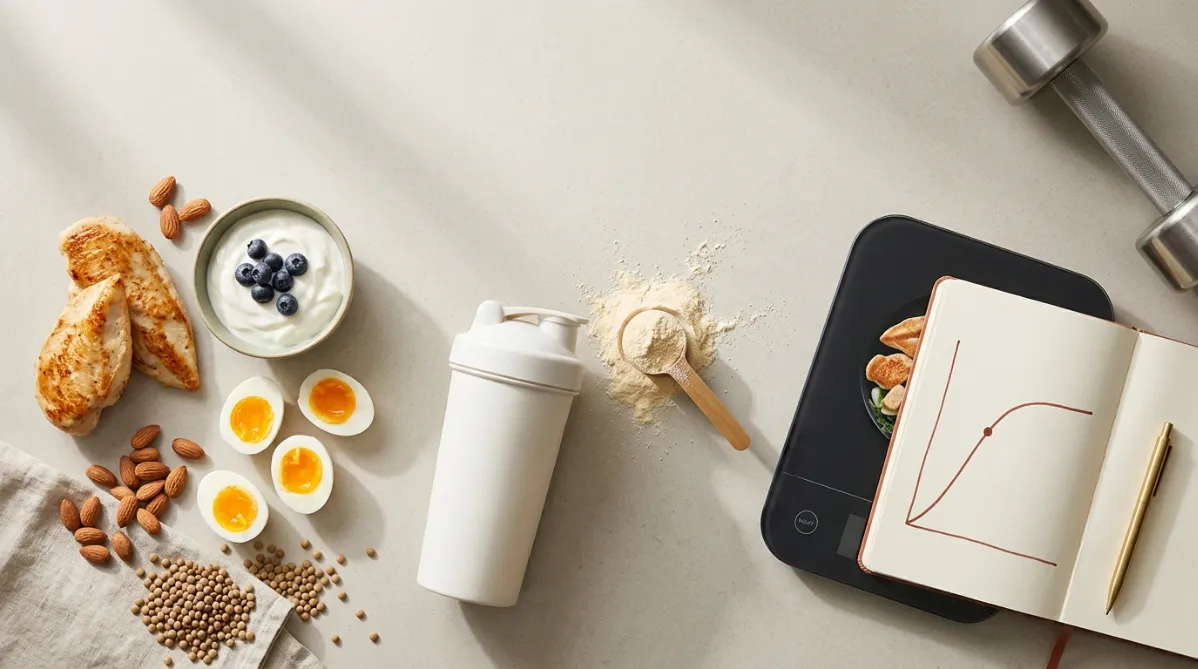
A wide, editorial flat-lay photograph shot from directly above on a pale warm-gray stone countertop, lit by soft natural morning window light with gentle diagonal shadows. On the left, a neatly arranged cluster of whole-food protein sources: two seared chicken breast slices with a golden crust, a small ceramic bowl of creamy Greek yogurt topped with blueberries, three halved soft-boiled eggs with jammy orange yolks, a handful of raw almonds, and a small pile of dried lentils scattered on a linen napkin. At the center, a matte white shaker bottle and a wooden scoop resting in a pile of fine vanilla-colored protein powder, a few grains dusted artfully across the surface. On the right, a minimalist kitchen scale in matte black displaying a portion of food, next to an open notebook with a hand-drawn curve that rises steeply and then flattens into a plateau, drawn in a deep terracotta ink pen, with a small dot marking the bend. A brass pen lies beside the notebook. A single dumbbell with a brushed steel finish sits partially in frame at the upper right corner, grounding the fitness theme without feeling gym-like. Color palette: warm cream, sage green, terracotta, soft charcoal, and butter yellow accents, with generous negative space along the top edge for title overlay. Shallow depth of field, crisp textures, subtle film grain, modern lifestyle magazine aesthetic, clean and calm composition, 16:9 landscape.
nutrition

Quanto proteína realmente maximiza o músculo? O platô de 1,6 g/kg explicado

BY DR. GYMBRO ·

Acha que precisa de mais de 2 g de proteína por quilograma para ganhar músculo? Uma meta‑análise de 49 ensaios com 1.863 adultos mostrou que o benefício estabiliza por volta de 1,6 g/kg/dia, com o limite superior da confiança em torno de 2,2 g/kg. Levantadores experientes obtiveram os maiores ganhos com a suplementação, enquanto o efeito diminuía com a idade. Veja como esses números se traduzem no seu prato, no seu copo de shake e no seu bolso.

A wide, softly lit editorial still life on a pale warm-gray concrete surface, shot from a slightly elevated three-quarter angle. In the center-left, two matte ceramic scoops sit side by side. One holds fine ivory whey powder, the other holds slightly coarser, pale golden collagen peptide powder. A small, elegant dusting of both powders spills between them and blends into a soft swirl. Behind them, three minimalist cream and sage-green supplement tubs with no legible text stand in a staggered row, with a frosted glass shaker bottle of creamy liquid beside them.

On the right, a brushed-steel barbell plate and a compact chalk-dusted kettlebell rest slightly out of focus, suggesting resistance training. Pale wisps of chalk hang in the air. A folded charcoal gym towel and a pair of worn leather lifting straps lie in the foreground. A single cross-section of a clean white bone model, a stylized vertebra, rests on a small oak block at the far right. It subtly signals the bone-density theme without looking clinical.

Natural window light enters from the left, casting long, gentle shadows and a warm highlight on the powders. The palette is muted and modern: oatmeal, bone white, sage green, soft charcoal, and touches of warm amber. Shallow depth of field keeps the scoops tack-sharp and melts the background into creamy blur. Leave generous negative space in the upper right for headline overlay. The overall feel is a premium health and science journal cover: clean, tactile, minimalist, with fine film-like grain and a calm, editorial mood.
nutrition

Whey + colágeno supera qualquer outro suplemento em levantadores — mas há uma pegadinha

BY DR. GYMBRO ·

Misturar 30 g de whey com 10 g de colágeno superou whey sozinho, colágeno sozinho e placebo em todos os desfechos em um novo estudo de 8 semanas com homens treinados em resistência. A combinação acrescentou 2,66 kg de músculo (por BIA), elevou a DMO da coluna lombar e melhorou agachamento, supino e marcadores de turnover ósseo. O colágeno sozinho movimentou o osso, o whey sozinho o músculo. Porém, com apenas 40 participantes, totais de proteína desiguais e um salto inesperadamente grande na DMO, há uma pegadinha. Veja o que a combinação ganhou, para quem pode ser adequada e quem deve evitá‑la.

A wide, softly lit bedroom scene at dusk, styled like a modern editorial photograph. In the foreground, a rumpled bed with textured oatmeal linen sheets and a single dented pillow sits beside a light oak nightstand. On the nightstand is a tall glass of creamy, milky white protein shake, a small wooden scoop and a matte ceramic tub with no readable label, beside a minimalist analog alarm clock. The clock's hands show a late hour, and it casts a faint shadow on the wall. A pair of clean white running shoes rests on the floor by the bed. A folded gray athletic hoodie lies at the foot of the bed, suggesting an athlete's lifestyle.

Warm amber light from a bedside lamp mixes with cool blue-gray twilight from a tall window with sheer curtains. The glow lands on the glass and gives the milky surface a soft sheen. Through the window, a muted city skyline fades into evening haze.

The palette is calm and sophisticated: warm cream, soft sage green, dusty blue, and a touch of terracotta from a small ceramic vase holding dried pampas grass. The composition follows the rule of thirds, with the glass and clock in the right third and open negative space on the left for headline text. Shallow depth of field keeps the glass and clock crisp while the background blurs gently.

The mood is quiet, slightly restless, and thoughtful, hinting at a night that does not go as planned. A subtle detail, a half-drawn curtain letting in a thin stripe of light across the rumpled sheets, suggests interrupted sleep. The look is clean, contemporary, and magazine-quality, with fine film grain, natural tones, and soft shadows, like a lifestyle wellness journal cover. No people, no text, no futuristic elements.
recovery

A “Proteína do Sono” que Fez os Que Dormem Mal Acordarem Mais Frequentemente

BY DR. GYMBRO ·

A alfa‑lactalbumina, vendida como a “proteína do sono”, tem sido apontada como potencial aliada de atletas que têm dificuldade para dormir. Um ensaio clínico cruzado, randomizado e duplo‑cego avaliou o suplemento em 24 atletas com sono ruim. Após uma semana consumindo 40 g duas horas antes de deitar, não houve melhora no sono; os despertares aumentaram ligeiramente (11,01 vs 10,25) e a altura do salto diminuiu (27,68 vs 28,58 cm). O único benefício observado foi a redução do humor negativo à noite. Confira o que foi testado, os resultados e quem deve evitar esse suplemento.

This page is available in