Dr. Gymbro
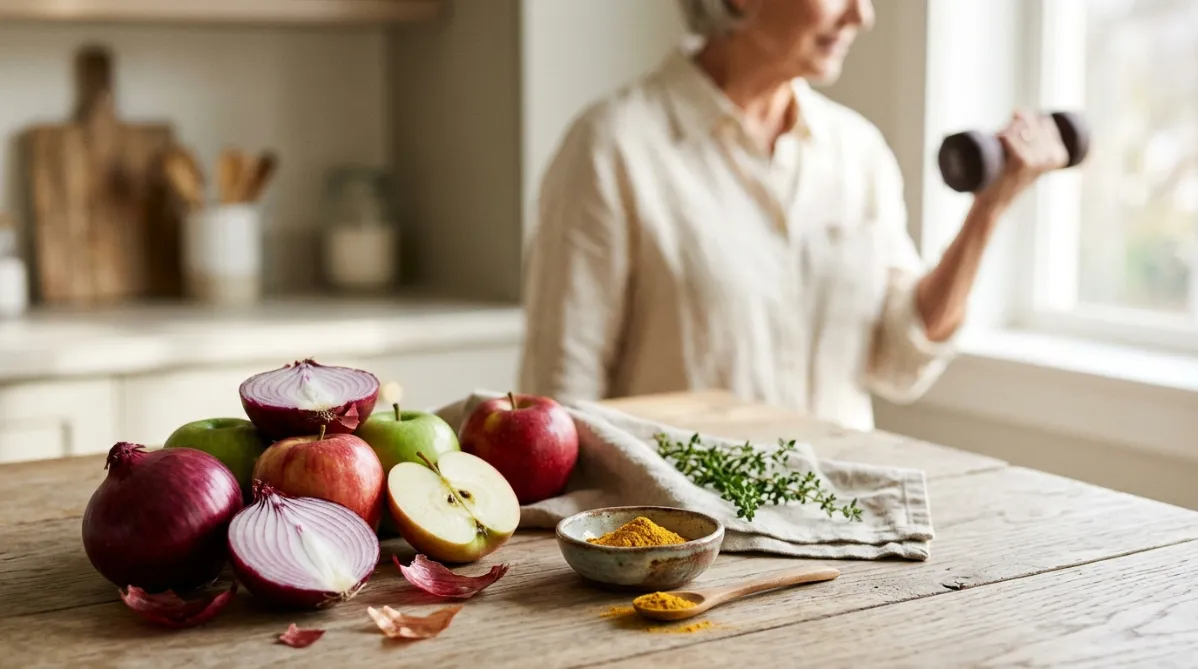
A landscape editorial photograph of a rustic kitchen table in soft morning window light. On a weathered light oak surface, a loose arrangement of fresh red onions, a few halved to show their purple-white rings, and crisp red and green apples, one sliced open to reveal pale flesh. A small ceramic bowl holds a pinch of golden-yellow quercetin powder, with a wooden spoon resting beside it. In the softly blurred background, an older woman in a cream linen shirt lifts a modest dumbbell near a sunlit window, her posture strong and relaxed. Her silhouette is out of focus, which keeps the produce as the main subject.

The palette is warm and natural: deep magenta onion skins, glossy apple reds, buttery yellow accents, and creamy neutrals. A gentle shallow depth of field gives creamy bokeh in the background. The light is diffused and golden, with delicate shadows and a few dried onion skin flakes scattered across the wood for texture. A folded linen napkin and a small sprig of thyme add a curated, modern lifestyle-magazine feel.

The composition follows the rule of thirds, with the produce at lower left and negative space on the right, where the blurred lifter and window glow provide balance. The overall look is clean, calm, and contemporary, like a premium health and wellness journal cover: natural, tactile, and optimistic, with fine film-like grain and true-to-life color.
Nutrition

Quercetina Triplicou o Ganho de Força em Levantadores Mais Velhos — Sem Aumento de Massa Muscular

Dr. Gymbro · · 4 min read

O Aumento de Força que Não Apareceu na Balança

Imagine um composto vegetal barato que praticamente triplica seus ganhos de força ao treinar, sem que você ganhe um grama a mais de músculo. É isso que um novo ensaio randomizado e duplo‑cego publicado no European Journal of Nutrition relata sobre a quercetina, o flavonoide presente em cebolas e maçãs. Após seis semanas de treinamento resistido, adultos mais velhos que consumiram glicósidos de quercetina aumentaram a força de extensão do joelho em cerca de 15 %. O grupo placebo melhorou em cerca de 5 %. A diferença veio do sistema nervoso, e não de músculos maiores.

O Que os Pesquisadores Realmente Fizeram

Uma equipe japonesa liderada por Nishikawa e Watanabe, da Chukyo University, atribuiu aleatoriamente 26 adultos saudáveis e mais velhos a um dos dois grupos. Ambos os grupos completaram o mesmo programa de treinamento resistido de seis semanas. Um grupo recebeu placebo e o outro recebeu 200 mg por dia de glicósidos de quercetina.

Antes e depois da intervenção, a equipe mediu três variáveis:

  • Força voluntária máxima (MVF) durante uma extensão isométrica do joelho;
  • Massa muscular;
  • Comportamento de disparo das unidades motoras durante uma contração em rampa até 70 % do MVF.

O ensaio foi registrado (UMIN000053019) e os autores declararam não haver conflitos de interesse.

Os Números de Destaque: +15 % vs. +5 %

Ambos os grupos ficaram significativamente mais fortes (p < 0.001), o que se espera de um treinamento. Contudo, a força pós‑intervenção atingiu 115,1 ± 11,0 % do ponto de partida no grupo quercetina contra 105,3 ± 4,8 % no grupo placebo, diferença estatisticamente significativa (p < 0.001, teste de Mann‑Whitney). Em termos simples, o grupo quercetina ganhou aproximadamente três vezes mais força que o grupo placebo com o mesmo treinamento.

A massa muscular não mudou de forma significativa em nenhum dos grupos (p > 0.05). Portanto, a força extra não provém de tecido adicional.

A História Real: Unidades Motoras Disparando Mais Rápido

Uma unidade motora é um neurônio motor mais as fibras musculares que ele controla. Unidades motoras de limiar mais alto são recrutadas para esforços mais intensos e são responsáveis pela maior parte da produção de força.

Após o treinamento, unidades motoras com limiares de recrutamento moderados e altos dispararam em taxas mais rápidas no grupo quercetina do que no grupo placebo (p < 0.05). Os autores também encontraram correlação significativa (r = 0.642, p = 0.018) entre a variação percentual da força e a variação percentual das taxas de disparo das unidades motoras de limiar alto. Pessoas cujas unidades de alto limiar aumentaram mais a velocidade tendiam a ganhar mais força.

Os autores concluíram que as adaptações nessas unidades motoras de limiar mais alto explicam a maior melhora de força com a quercetina. Os dados mostram apenas uma associação, portanto trata‑se de um mecanismo plausível, não de prova definitiva. Ainda assim, isso está de acordo com a premissa inicial do estudo: a quercetina pode melhorar a atividade das unidades motoras de alto limiar durante o treinamento resistido em adultos mais velhos.

Por Que Isso Importa para Levantadores Mais Velhos

A perda de força relacionada à idade não se deve apenas ao encolhimento muscular. O impulso neural também diminui, e as unidades motoras de alto limiar são especialmente vulneráveis. Um suplemento que ajude o sistema nervoso a “acelerar” essas unidades pode ser um complemento útil ao treinamento, principalmente quando o crescimento muscular é lento ou difícil de alcançar.

É por isso que a força pode aumentar sem qualquer mudança no tamanho do músculo. Nos iniciantes, os ganhos iniciais são frequentemente de natureza neural, o que provavelmente explica por que os participantes do estudo observaram melhorias significativas em apenas seis semanas.

Dicas Práticas

Dose: O estudo utilizou 200 mg por dia de glicósidos de quercetina, ingeridos diariamente junto ao treinamento resistido.

Forma: Foi usada quercetina na forma de glicósido (glucosídeo), que costuma ser mais bem absorvida que a aglicona pura. Se for comprar, procure um produto de glicósido, como a isoquercitrina modificada enzimaticamente. O resumo não menciona um produto comercial específico.

Timing: O estudo não especificou o horário da ingestão, portanto não há “truque” de timing baseado em evidências. O que foi testado foi a consistência diária durante o treinamento.

Para quem pode ser adequado: Adultos saudáveis e mais velhos que estejam iniciando ou retornando ao treinamento resistido. Iniciantes podem ser o público‑alvo mais responsivo, já que as adaptações neurais predominam nos estágios iniciais.

Não deixe de treinar: Ambos os grupos fizeram treinamento de força. A quercetina foi testada como um complemento, não como substituto.

O Fio da Navalha: Não Exagere

  • Amostra pequena: Apenas 26 participantes; os achados precisam ser confirmados em estudos maiores.
  • Duração curta: Seis semanas não revelam se a vantagem persiste, aumenta ou desaparece a longo prazo.
  • Um único teste de força: A medida foi extensão isométrica do joelho. Não sabemos se o benefício se traduz em agachamentos, subir escadas, força de preensão ou nas atividades do dia a dia.
  • Apenas participantes saudáveis: Os resultados não se aplicam a idosos frágeis ou a pessoas com condições médicas.
  • Mecanismo correlacional: A relação entre taxa de disparo e ganho de força é uma correlação, não prova de causalidade.
  • Não para levantadores mais jovens: O estudo avaliou apenas adultos mais velhos.

Se você toma medicamentos ou tem alguma condição de saúde, consulte um profissional antes de iniciar qualquer suplemento.

Conclusão

Em um ensaio pequeno, porém bem‑desenhado, 200 mg/dia de glicósidos de quercetina combinados a seis semanas de treinamento geraram cerca de 15 % de ganho de força em adultos mais velhos, contra aproximadamente 5 % no grupo placebo. O tamanho muscular não mudou, e a explicação mais provável é o disparo mais rápido das unidades motoras que mais contribuem para a força. É um composto barato com um mecanismo neural intrigante, mas um estudo com 26 pessoas não é a palavra final. Considere‑o um indício promissor a ser acompanhado, e continue treinando.

Original study

Read the original research on pubmed.ncbi.nlm.nih.gov →

This article summarizes published research for general information. It is not medical advice.

DG

Written by

Dr. Gymbro

Dr. Gymbro writes for Dr. Gymbro: science-backed fitness, nutrition & performance.

Related Articles

A wide, editorial-style still life photographed in soft natural window light on a pale oak gym bench. In the foreground, a small rustic ceramic bowl in warm sand tones holds a mound of fine golden-beige ashwagandha root powder, with a few dried gnarled ashwagandha roots and a sprig of green leaves with tiny orange-red berries resting beside it. A wooden scoop dusted with powder lies at an angle. Just behind, a matte black barbell with a single chalk-dusted steel plate sits slightly out of focus, a light haze of white chalk hanging in the air and catching the sunlight.

On the left side, a neat stack of printed research papers with a sharp black pen and a few muted sage-green sticky tabs. One page shows a simple, abstract forest-plot-style line graph with small squares and horizontal lines, subtly out of focus, hinting at statistics without legible text. A pair of minimal round reading glasses rests on the pages. A small linen gym towel is folded near the edge of the bench.

The palette is restrained and modern: warm cream, soft sage green, muted terracotta, charcoal black, and brushed steel highlights. The background is a softly blurred minimalist studio space with a pale plaster wall and a long soft shadow cast by a window frame, giving a calm, contemplative mood. Shallow depth of field, crisp detail on the powder and roots, gentle film-like grain, and generous negative space on the right third of the frame for a headline overlay. The overall look is a clean, trendy health-and-science journal cover, thoughtful and skeptical rather than promotional, balancing the natural herbal element against the discipline of strength training.
nutrition

Ashwagandha para Levantadores: Impulso de Força ou Miragem Estatística?

BY DR. GYMBRO ·

Ashwagandha é promovida como potenciador de força e volume para quem levanta pesos. Uma nova meta‑análise de ensaios clínicos de treinamento de resistência mostrou ganhos de 1RM em supino e agachamento que parecem impressionantes no papel. Contudo, apenas três estudos com 161 participantes puderam ser combinados e os efeitos perderam significância em testes mais rigorosos. A classificação GRADE apontou evidência de baixa a muito baixa, sem efeito confiável sobre a gordura corporal. Veja o que realmente os dados demonstram e quem ainda pode se interessar em experimentar.

A soft-lit editorial still life on a pale warm-gray concrete surface, shot from a slightly elevated three-quarter angle in a wide landscape frame. On the left, a single amber glass supplement bottle with a minimalist cream label, its lid set beside it. A few golden-yellow softgel capsules are scattered in a loose arc across the surface, catching the light like small drops of honey. At the center-right, a matte sage-green yoga mat is partly unrolled, with a polished chrome dumbbell resting on it. Next to the dumbbell sits a worn canvas hand gripper, a nod to the handgrip finding. Behind them, a wooden gym bench is slightly out of focus, and a folded linen towel sits on top of it.

Warm morning sunlight enters from the upper left through a large window. It casts long, gentle diagonal shadows and a faint golden glow across the scene, a quiet reference to vitamin D and sunshine. A sprig of dried eucalyptus or a small potted succulent adds an organic touch near the bottom right. A small, neatly stacked pile of two or three matte pastel-toned weight plates in butter yellow and dusty terracotta adds color blocking.

The palette is muted and modern: butter yellow, sage, warm sand, soft terracotta, and off-white, with a single strong amber accent from the bottle. The depth of field is shallow, with crisp focus on the capsules and bottle and a creamy blur falling off toward the background. The negative space on the upper right is clean and uncluttered, which leaves room for a headline overlay. The overall feel is calm, minimalist, and contemporary, like a premium health and wellness magazine or a trendy online journal. The grain is subtle, the contrast gentle, and the textures tactile: brushed metal, frosted glass, linen, and concrete. There are no people, no text, and no futuristic elements.
science research

Vitamina D não vai definir seu corpo nem construir músculos, exceto em um caso

BY DR. GYMBRO ·

Uma meta‑análise de dose‑resposta com 28 ensaios randomizados e 1.675 adultos avaliou se a suplementação de vitamina D potencializa os efeitos do exercício. Os níveis sanguíneos de 25(OH)D subiram cerca de 34 nmol/L, mas peso, IMC, massa gorda, percentual de gordura e massa magra não melhoraram além do treinamento isolado. A força no leg press também não teve benefício. A única exceção foi um ganho modesto na extensão do joelho (+4,36 kg) e melhorias na preensão manual em idosos que receberam doses mais altas. Veja quem realmente pode se beneficiar e o que fazer antes de comprar outro frasco.

A wide landscape editorial photograph of a bright, airy sunlit living room with pale oak floors and a large window with sheer linen curtains. In the center, a woman in her late 50s with silver-streaked hair, wearing soft sage-green athletic wear, rises from a simple wooden chair, caught mid-motion with a calm, determined expression. Her hands are lightly extended forward for balance. Beside her on a small round oak side table sits a ceramic mug of tea, a glass of water, and a small matte white jar with a wooden scoop resting beside it, a few fine white crystalline grains scattered on the tabletop. In the soft-focus foreground, a pair of light-gray dumbbells and a rolled terracotta-colored yoga mat rest on the floor. A trailing green pothos plant spills from a shelf in the background, with a stack of books and a small analog kitchen timer nearby.

The color palette is warm and muted: cream, sage green, soft terracotta, natural wood, and gentle morning-gold light. Light streams diagonally across the scene, creating long soft shadows and a subtle glow on the woman's shoulders. Shallow depth of field blurs the background gently, while the woman and the table remain crisp. The composition follows the rule of thirds, with the woman on the right and generous negative space on the left, suited for headline overlay. The mood is hopeful, grounded, and modern, like a high-end wellness magazine or a trendy health journal. Natural film-like grain, soft contrast, and a slight matte finish give it a contemporary lifestyle photography feel. There are no futuristic elements, no digital overlays, and no text.
science research

Creatina ajuda mulheres com joelho comprometido a levantar‑se melhor – mas não da forma que você imagina

BY DR. GYMBRO ·

A creatina costuma ser associada a jovens levantadores, mas um ensaio randomizado, duplo‑cego, avaliou seu efeito em mulheres pós‑menopáusicas com osteoartrite de joelho. Após 12 semanas de treino de pernas, o escore do teste de ficar em pé cronometrado do grupo que recebeu creatina subiu de 15,7 para 18,1, enquanto o placebo praticamente não mudou (15,0 para 15,2). A creatina também melhorou rigidez, massa magra e qualidade de vida, mas alívio da dor e força máxima no leg press não foram superiores ao placebo. Veja o que os números realmente indicam e quem pode se beneficiar.

A wide, softly lit editorial photograph of a rustic light-oak table by a sunny window. On it, a handful of dried brown kelp and wakame seaweed fronds spill from a handmade matte ceramic bowl in warm sand tones, their glossy, ruffled edges catching the light. Beside the bowl sits a small wooden scoop holding fine golden-beige powder, with a little of it dusted across the table. In the middle ground, an older adult's weathered but strong hand grips a smooth, rounded river stone, with the knuckles and tendons subtly emphasized to suggest strength and vitality. Only the hand and part of a forearm in a soft oatmeal linen sleeve are visible.

In the background, slightly out of focus, a pair of worn leather walking shoes rests on a windowsill next to a trailing green plant. Beyond the window, a blurred coastal path winds through dune grass toward a pale blue sea, hinting at walking and an active daily life. A simple analog wristwatch lies on the table's edge, a quiet nod to the twelve-week timeline.

The palette is muted and natural: sage green, warm sand, soft ocean teal, and creamy off-white, with deep olive-brown accents from the seaweed. Morning light streams in from the left, casting long, gentle shadows and a faint golden glow. The depth of field is shallow, with crisp focus on the hand and seaweed and a creamy bokeh background. The composition follows the rule of thirds, with the hand and bowl on the left and generous negative space on the right for headline text. The mood is calm and hopeful, with a clean, contemporary wellness-magazine feel. The image is shot as if on a 50mm lens with subtle film grain and a natural, uncluttered, tactile look.
science research

Fucoidana de Alga Marinha Aumenta a Força de Preensão em Pessoas com Mais de 60 Anos em 12 Semanas

BY DR. GYMBRO ·

Perder força com a idade é uma mudança comum e pouco discutida, e o treinamento de resistência nem sempre é viável. Um ensaio randomizado de 12 semanas mostrou que fucoidana de alga marinha de baixo peso molecular, consumida a 1 650 mg/dia, aumentou significativamente a força de preensão e o desempenho na caminhada de seis minutos em adultos com mais de 60 anos. Surpreendentemente, a massa muscular não mudou e a combinação com BCAAs e vitamina D não trouxe benefício adicional. O estudo é pequeno e testou um único produto de marca, sendo um indício promissor, mas não uma conclusão definitiva. Veja o que a pesquisa revelou e o que isso significa na prática.

This page is available in