Dr. Gymbro
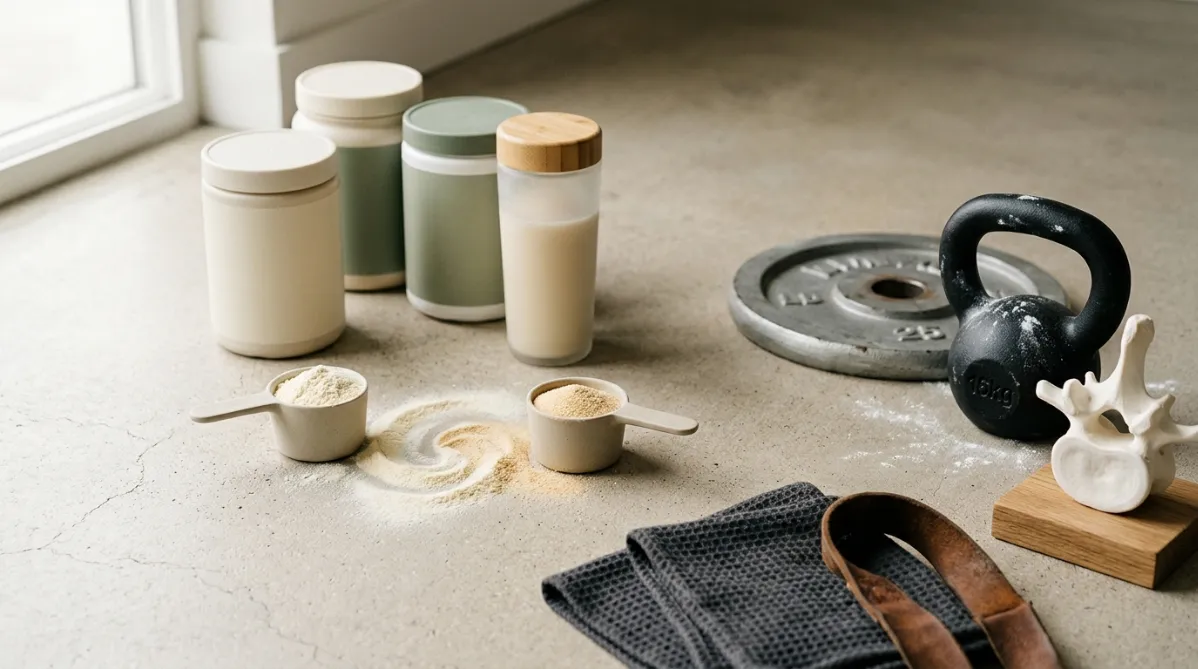
A wide, softly lit editorial still life on a pale warm-gray concrete surface, shot from a slightly elevated three-quarter angle. In the center-left, two matte ceramic scoops sit side by side. One holds fine ivory whey powder, the other holds slightly coarser, pale golden collagen peptide powder. A small, elegant dusting of both powders spills between them and blends into a soft swirl. Behind them, three minimalist cream and sage-green supplement tubs with no legible text stand in a staggered row, with a frosted glass shaker bottle of creamy liquid beside them.

On the right, a brushed-steel barbell plate and a compact chalk-dusted kettlebell rest slightly out of focus, suggesting resistance training. Pale wisps of chalk hang in the air. A folded charcoal gym towel and a pair of worn leather lifting straps lie in the foreground. A single cross-section of a clean white bone model, a stylized vertebra, rests on a small oak block at the far right. It subtly signals the bone-density theme without looking clinical.

Natural window light enters from the left, casting long, gentle shadows and a warm highlight on the powders. The palette is muted and modern: oatmeal, bone white, sage green, soft charcoal, and touches of warm amber. Shallow depth of field keeps the scoops tack-sharp and melts the background into creamy blur. Leave generous negative space in the upper right for headline overlay. The overall feel is a premium health and science journal cover: clean, tactile, minimalist, with fine film-like grain and a calm, editorial mood.
Nutrition

Whey + colágeno supera qualquer outro suplemento em levantadores — mas há uma pegadinha

Dr. Gymbro · · 4 min read

A pilha que dominou todos os rankings (no papel)

Um ensaio randomizado recente, publicado na BMC Sports Science, Medicine and Rehabilitation, fez uma pergunta simples a homens treinados em resistência: será que acrescentar colágeno ao whey supera whey sozinho, colágeno sozinho ou um placebo? No estudo, a combinação whey + colágeno ficou em primeiro lugar em todos os desfechos avaliados: massa muscular, densidade mineral óssea (DMO) da coluna lombar, força no agachamento e no supino, e marcadores de turnover ósseo. Antes de reorganizar sua “pilha” de suplementos, vale entender como o estudo foi conduzido.

O estudo em resumo

  • Desenho: ensaio duplo‑cego, randomizado e controlado por placebo
  • Amostra: 40 homens treinados em resistência (dos 52 triados, todos concluíram o protocolo)
  • Grupos:
    • whey + colágeno (30 g de whey + 10 g de colágeno ao dia)
    • whey sozinho (30 g/dia)
    • colágeno sozinho (10 g/dia)
    • placebo (10 g/dia de maltodextrina)
  • Treinamento: 8 semanas de resistência supervisionada, 3 sessões por semana
  • Desfecho primário: massa muscular medida por bioimpedância elétrica (BIA)
  • Desfechos secundários: DMO da coluna lombar por DXA, 1RM no agachamento e no supino, e marcadores de turnover ósseo P1NP (formação) e CTX‑I (reabsorção)

Quais desfechos a pilha venceu

Massa muscular. A combinação gerou ganho de 2,66 ± 0,25 kg. Whey sozinho trouxe 1,59 ± 0,18 kg, colágeno sozinho 0,46 ± 0,13 kg e placebo 0,10 ± 0,12 kg. As diferenças entre os grupos foram significativas (p < 0,001).

DMO da coluna lombar. A pilha aumentou 0,108 ± 0,027 g/cm². O colágeno sozinho subiu 0,023 ± 0,018 g/cm², mudança também significativa. Whey sozinho e placebo não apresentaram alteração relevante. Diferenças entre grupos: p < 0,001.

Força. A combinação acrescentou 15,22 ± 1,04 kg ao agachamento e 10,63 ± 1,25 kg ao supino. Whey e colágeno isolados ficaram em segundo, enquanto o placebo praticamente não progrediu.

Turnover ósseo. O grupo whey + colágeno mostrou aumentos marcantes em P1NP e quedas em CTX‑I. O colágeno sozinho trouxe melhorias menores, porém significativas. Whey e placebo não apresentaram mudanças relevantes.

O padrão observado foi claro: o whey impulsionou o ganho muscular, enquanto o colágeno foi o único ingrediente que afetou o tecido ósseo. A combinação uniu ambos os efeitos; whey sozinho não alterou DMO nem marcadores ósseos neste ensaio.

Por que o resultado faz sentido

Os autores descrevem o whey como o motor anabólico para o músculo e o colágeno como fornecedor de blocos de construção para tecido conjuntivo e osso. Essa complementaridade é plausível e o estudo está alinhado com a hipótese, embora não prove o mecanismo subjacente, já que apenas os resultados finais foram medidos.

A letra pequena: limitações que você deve considerar

  • Amostra pequena. Apenas 40 homens divididos em quatro braços deixam poucos participantes por grupo, o que pode inflar os efeitos.
  • Duração curta. Oito semanas não permitem avaliar se os ganhos se mantêm ou continuam a crescer.
  • Massa muscular medida por BIA. A bioimpedância é prática, mas sensível ao estado de hidratação e não é o padrão‑ouro para tecido magro.
  • Aumento inesperado de DMO. Um salto de 0,108 g/cm² em 8 semanas é bastante expressivo. Essa observação vem da minha interpretação dos dados, não foi destacada pelos autores, e sugere necessidade de replicação.
  • Totais de proteína desiguais. A combinação forneceu 40 g de proteína suplementar por dia, contra 30 g para whey, 10 g para colágeno e nada para o placebo. O desenho, portanto, não separa claramente um efeito sinérgico de um simples benefício de “mais proteína”. O resumo não informa se a ingestão dietética total foi controlada.
  • População restrita. Apenas homens treinados em resistência participaram. Os autores recomendam estudos mais longos e com amostras mais diversificadas. O resumo também não detalha quais comparações pareadas foram significativas (por exemplo, pilha vs whey na força). Consulte o artigo completo para esses detalhes.

Conclusões práticas

  • Dose utilizada no ensaio: 30 g/dia de whey + 10 g/dia de colágeno, associado a 3 sessões supervisionadas de resistência por semana. O estudo não especifica o timing da ingestão (pré‑treino, pós‑treino ou dividido ao longo do dia).
  • Para quem pode ser adequado: homens saudáveis, treinados em resistência e com perfil semelhante ao dos participantes, que desejam apoiar simultaneamente músculo e osso enquanto treinam de forma consistente. O suplemento não substitui o treinamento; todos os grupos treinaram, e o grupo placebo teve ganho mínimo.
  • Quem deve ser cauteloso ou evitar:
    • Mulheres, idosos, iniciantes e pessoas com doenças ósseas, pois nenhum desses grupos foi estudado.
    • Quem tem alergia a laticínios ou sensibilidade ao colágeno de origem animal.
    • Pessoas com problemas renais ou outras condições que exigem controle de ingestão proteica (cautela geral, não baseada neste estudo); consulte um profissional de saúde antes.
    • Quem busca tratamento para osteoporose, já que o ensaio avaliou apenas levantadores saudáveis, não pacientes.

Conclusão final

Este ensaio randomizado, duplo‑cego, conferiu à combinação whey + colágeno uma vitória completa em homens treinados em resistência ao longo de 8 semanas. O colágeno sozinho mostrou sinal ósseo, o whey solo sinal muscular, e a combinação mostrou ambos. Considere-o um indício promissor, não um veredicto definitivo. As limitações — amostra pequena, medida de massa muscular por BIA, ingestão proteica desigual e aumento incomumente grande na DMO — apontam para a necessidade de replicação antes de declarar esta combinação como um “stack” comprovado para construção óssea.
Original study

Read the original research on pubmed.ncbi.nlm.nih.gov →

This article summarizes published research for general information. It is not medical advice.

DG

Written by

Dr. Gymbro

Dr. Gymbro writes for Dr. Gymbro: science-backed fitness, nutrition & performance.

Related Articles

A bright, minimalist editorial still life on a pale oak table, shot from a slightly elevated three-quarter angle in soft natural window light. On the left sits a rustic ceramic bowl of uncooked short-grain white rice, with a few grains scattered across the wood. Beside it is a matte cream-colored shaker bottle. On the right is a small glass bowl of fine ivory whey powder with a wooden scoop resting in it, and a small pitcher of milk behind it. Two identical tall glasses of creamy, lightly frothed shake stand side by side in the center, one a touch warmer beige and the other a soft white. They suggest equal outcomes without any text or labels. A pair of worn black neoprene-coated dumbbells and a folded sage-green gym towel sit slightly out of focus in the background. A sprig of green rice stalks in a slim vase adds a fresh, natural accent.

The palette is warm neutrals: cream, oatmeal, soft sage, and muted terracotta, with gentle shadows and a shallow depth of field. The surface has subtle grain, and fine powder dust is caught in the light. The composition is clean and balanced, with generous negative space on the upper right for a headline overlay. The mood is calm, modern, and health-forward, like a contemporary nutrition magazine or wellness journal. Photorealistic, crisp detail, creamy bokeh, and a gentle matte film-like finish.
nutrition

48 g de proteína de arroz equivalem ao whey em massa muscular e força em 8 semanas

BY DR. GYMBRO ·

A proteína vegetal costuma ser vista como inferior ao whey, mas um estudo de 2013 com homens treinados mostrou o contrário quando a dose é alta. Em 24 atletas de musculação, 48 g de isolado de proteína de arroz consumidos após o treino geraram os mesmos ganhos em massa magra, espessura muscular, força e potência que 48 g de whey ao longo de oito semanas. Por que o arroz conseguiu acompanhar? A alta dose provavelmente supriu a diferença de leucina. A seguir, veja o que a pesquisa revelou, suas limitações e como veganos e intolerantes à lactose podem aplicá‑la.

A bright, airy editorial flat-lay shot from slightly above, on a soft warm-white linen surface with gentle natural window light and long, soft shadows. Two small ceramic dishes sit side by side at the center. The left dish holds a single small capsule in muted terracotta. The right dish holds one small capsule in the same color, with a noticeable empty space beside it to suggest rhythm and spacing. Between them lies a minimalist wooden calendar block or a row of seven small round ceramic discs in alternating tones, dusty rose and cream, evoking an every-other-day pattern. Around the dishes are fresh, iron-rich foods arranged with restraint: a halved blood orange, a few deep green spinach leaves, a small scattering of pumpkin seeds, and a sprig of parsley. A folded sage-green athletic towel and a slim, modern water bottle sit at the upper edge, hinting at women who train. A matte ceramic mug of herbal tea sits at the right with a faint curl of steam. A small notebook with a pen lies open at the lower left, its pages blank, suggesting lab results and tracking without any legible text. The palette is soft and cohesive: warm cream, dusty rose, terracotta, sage green, with small accents of deep coral. The mood is calm, clean, and wellness-oriented, like a contemporary health and science journal feature. Shallow depth of field keeps the capsules sharp and softly blurs the edges of the frame. The composition leaves generous negative space on the left third for title overlay. The look is a high-end lifestyle photograph with subtle film grain, natural textures, and refined minimalism, with no people, no text, and no futuristic or laboratory elements.
nutrition

Menos Ferro em Dias Alternados: Ganhos de Ferritina Iguais em Mulheres

BY DR. GYMBRO ·

A hepcidina pode reduzir a absorção de ferro após uma dose única, o que explica por que a suplementação diária costuma ser pouco eficaz e irritar o estômago. Um ensaio randomizado de 2026 com 66 mulheres com deficiência de ferro comparou 21 mg de ferro a cada 48 h com 30 mg diários durante 42 dias. A ferritina aumentou significativamente em ambos os grupos, sem diferença relevante entre eles, enquanto a hemoglobina permaneceu estável e os efeitos gastrointestinais foram leves. O estudo usou ferro ativo como controle e formulações diferentes, demonstrando comparabilidade, não superioridade. Veja o que isso significa para as mulheres que treinam e por que é essencial medir a ferritina antes de suplementar.

A wide landscape editorial photograph of a bright, airy sunlit living room with pale oak floors and a large window with sheer linen curtains. In the center, a woman in her late 50s with silver-streaked hair, wearing soft sage-green athletic wear, rises from a simple wooden chair, caught mid-motion with a calm, determined expression. Her hands are lightly extended forward for balance. Beside her on a small round oak side table sits a ceramic mug of tea, a glass of water, and a small matte white jar with a wooden scoop resting beside it, a few fine white crystalline grains scattered on the tabletop. In the soft-focus foreground, a pair of light-gray dumbbells and a rolled terracotta-colored yoga mat rest on the floor. A trailing green pothos plant spills from a shelf in the background, with a stack of books and a small analog kitchen timer nearby.

The color palette is warm and muted: cream, sage green, soft terracotta, natural wood, and gentle morning-gold light. Light streams diagonally across the scene, creating long soft shadows and a subtle glow on the woman's shoulders. Shallow depth of field blurs the background gently, while the woman and the table remain crisp. The composition follows the rule of thirds, with the woman on the right and generous negative space on the left, suited for headline overlay. The mood is hopeful, grounded, and modern, like a high-end wellness magazine or a trendy health journal. Natural film-like grain, soft contrast, and a slight matte finish give it a contemporary lifestyle photography feel. There are no futuristic elements, no digital overlays, and no text.
science research

Creatina ajuda mulheres com joelho comprometido a levantar‑se melhor – mas não da forma que você imagina

BY DR. GYMBRO ·

A creatina costuma ser associada a jovens levantadores, mas um ensaio randomizado, duplo‑cego, avaliou seu efeito em mulheres pós‑menopáusicas com osteoartrite de joelho. Após 12 semanas de treino de pernas, o escore do teste de ficar em pé cronometrado do grupo que recebeu creatina subiu de 15,7 para 18,1, enquanto o placebo praticamente não mudou (15,0 para 15,2). A creatina também melhorou rigidez, massa magra e qualidade de vida, mas alívio da dor e força máxima no leg press não foram superiores ao placebo. Veja o que os números realmente indicam e quem pode se beneficiar.

A wide, softly lit bedroom scene at dusk, styled like a modern editorial photograph. In the foreground, a rumpled bed with textured oatmeal linen sheets and a single dented pillow sits beside a light oak nightstand. On the nightstand is a tall glass of creamy, milky white protein shake, a small wooden scoop and a matte ceramic tub with no readable label, beside a minimalist analog alarm clock. The clock's hands show a late hour, and it casts a faint shadow on the wall. A pair of clean white running shoes rests on the floor by the bed. A folded gray athletic hoodie lies at the foot of the bed, suggesting an athlete's lifestyle.

Warm amber light from a bedside lamp mixes with cool blue-gray twilight from a tall window with sheer curtains. The glow lands on the glass and gives the milky surface a soft sheen. Through the window, a muted city skyline fades into evening haze.

The palette is calm and sophisticated: warm cream, soft sage green, dusty blue, and a touch of terracotta from a small ceramic vase holding dried pampas grass. The composition follows the rule of thirds, with the glass and clock in the right third and open negative space on the left for headline text. Shallow depth of field keeps the glass and clock crisp while the background blurs gently.

The mood is quiet, slightly restless, and thoughtful, hinting at a night that does not go as planned. A subtle detail, a half-drawn curtain letting in a thin stripe of light across the rumpled sheets, suggests interrupted sleep. The look is clean, contemporary, and magazine-quality, with fine film grain, natural tones, and soft shadows, like a lifestyle wellness journal cover. No people, no text, no futuristic elements.
recovery

A “Proteína do Sono” que Fez os Que Dormem Mal Acordarem Mais Frequentemente

BY DR. GYMBRO ·

A alfa‑lactalbumina, vendida como a “proteína do sono”, tem sido apontada como potencial aliada de atletas que têm dificuldade para dormir. Um ensaio clínico cruzado, randomizado e duplo‑cego avaliou o suplemento em 24 atletas com sono ruim. Após uma semana consumindo 40 g duas horas antes de deitar, não houve melhora no sono; os despertares aumentaram ligeiramente (11,01 vs 10,25) e a altura do salto diminuiu (27,68 vs 28,58 cm). O único benefício observado foi a redução do humor negativo à noite. Confira o que foi testado, os resultados e quem deve evitar esse suplemento.

This page is available in