Dr. Gymbro
←

#curcumin

1 article
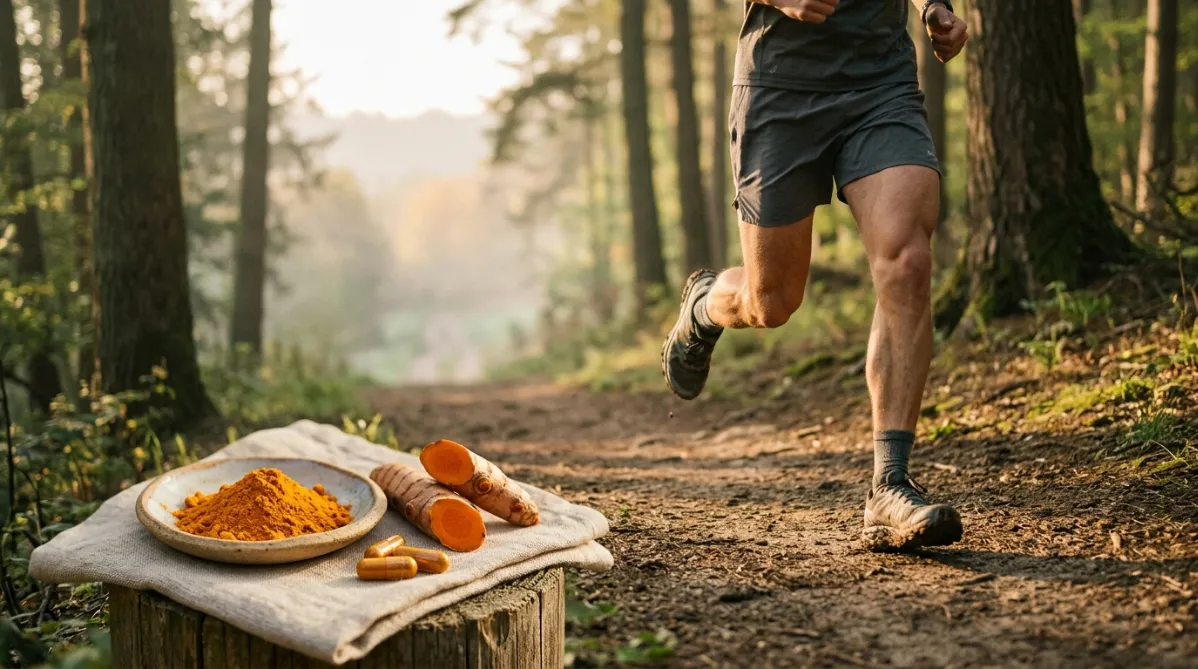
A wide, editorial-style photograph of a male runner mid-stride on a gently sloping forest trail at early morning, shot from a low three-quarter angle. Soft golden light filters through tall trees and casts long dappled shadows across the packed dirt path. The runner is captured from the waist down and slightly from the side, wearing charcoal running shorts and worn trail shoes, with the quadriceps and thigh muscles defined and naturally lit. A fine mist hangs in the background, and the slope descends toward a blurred, softly glowing horizon.

In the foreground, slightly out of focus on a weathered wooden post or flat mossy stone at the trail's edge, rests a small ceramic dish holding a pile of vivid golden-orange turmeric powder. Beside it sit two fresh turmeric roots, one cut open to show a deep saffron interior, and a few amber capsules. A thin linen cloth is draped beneath them. The saturated yellow-orange of the turmeric contrasts with the cool green and muted brown tones of the forest, creating a strong color anchor on the left third of the frame.

The composition follows the rule of thirds, with the turmeric in the lower left foreground and the runner in the right two-thirds, leaving open negative space in the upper left for headline text. Shallow depth of field, creamy bokeh, and natural film-like grain give it a refined, modern health-and-science magazine feel. The palette is warm and earthy: golden amber, moss green, soft cream, and deep umber. The lighting is natural and gentle, with subtle rim light on the runner's calves and hamstrings. No text, no logos, no graphics, and no futuristic elements. The result should feel clean, calm, and aspirational, like a cover image for a premium wellness and sports-nutrition journal.
recovery

Curcumina Meriva Reduz Danos Musculares Visíveis por RM após Corrida em Descida

BY DR. GYMBRO ·

Um pequeno ensaio randomizado de 2014 mostrou que a curcumina Meriva – forma baseada em lecitina produzida pela Indena – reduziu lesões musculares de coxa visíveis por RM após uma corrida em descida. Vinte homens tomaram 1 g duas vezes ao dia, começando 48 h antes do teste e continuando 24 h depois. A diferença nas imagens foi marcante, embora o benefício na dor tenha sido significativo apenas nas partes anteriores das coxas. Marcadores de estresse oxidativo e histologia muscular não apresentaram diferenças. A seguir, a dose, o timing, os cuidados com a indústria e o que os dados podem – e não podem – nos dizer.

This page is available in