Dr. Gymbro
←

#pms

1 article
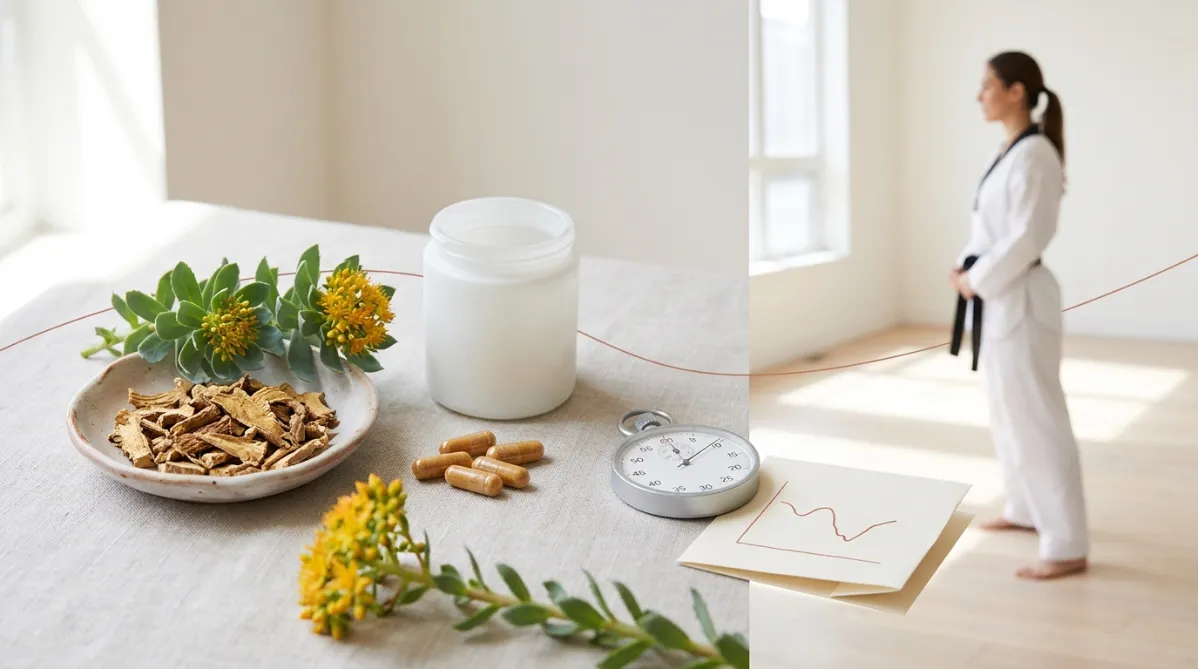
A wide, softly lit editorial still life on a pale warm-gray linen surface. On the left, a small ceramic dish holds dried golden-brown Rhodiola rosea root pieces, with a few fresh sprigs of the plant beside it. The sprigs have thick succulent blue-green leaves and tight clusters of small yellow-orange flowers. Next to the dish sit a handful of amber capsules and a matte white glass jar with no label. A sprig of the yellow blooms lies diagonally across the foreground, slightly out of focus.

On the right, in the middle distance, a woman in athletic wear is seen from the side and slightly blurred. She wears a crisp white taekwondo dobok with a black belt and stands in a calm ready stance in a bright, minimalist studio with pale wood floors and large windows. Soft morning light spills across the floor. Her form is a secondary element, and the shallow depth of field keeps the botanical objects sharp.

A thin, elegant detail ties the two halves together: a modern minimalist stopwatch with a clean white face rests on the linen near the capsules, its hand frozen mid-sweep. Beside it lies a small folded sheet of cream paper with a delicate hand-drawn line chart in muted terracotta ink, showing a small dip. A single fine terracotta line curves across the composition, loosely connecting the root, the stopwatch, and the athlete.

The palette is sophisticated and earthy: warm cream, sage green, dusty blush pink, terracotta, and a touch of marigold yellow from the flowers. The mood is calm, trustworthy, and wellness-forward, like a contemporary health and science journal. Light comes from the left, with soft shadows and gentle highlights on the ceramic and glass. There is generous negative space in the upper portion of the frame for title overlay. The image has a fine-grain, high-end editorial photography look, shot on a medium-format camera with a 50mm lens, shallow depth of field, and natural color grading.
nutrition

Rhodiola reduz o tempo de reação em 60 ms em atletas com TPM — mas há um detalhe

BY DR. GYMBRO ·

Um novo estudo duplo‑cego mostrou que 10 dias de Rhodiola rosea diminuíram o tempo de reação visual em 60 ms em atletas femininas de taekwondo que sofrem de TPM. O suplemento também aliviou uma série de sintomas — de irritabilidade e ansiedade a desejos alimentares e cólicas — e ainda fez o exercício parecer mais fácil. Contudo, a pesquisa contou apenas com 24 participantes e a planta não melhorou nem o tempo até a exaustão nem o VO₂máx estimado. Veja a dose, o período de uso, quem pode se beneficiar, quem deve evitar e as limitações por trás do hype.

This page is available in