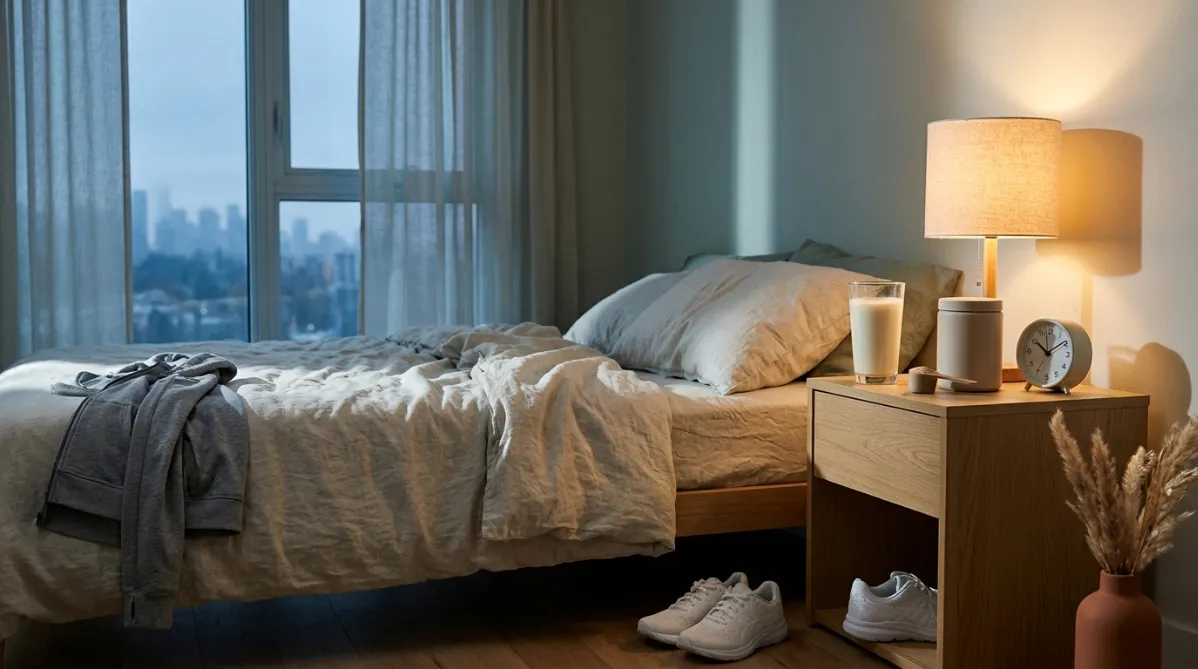
You've seen the pitch: a tryptophan-rich whey fraction, taken before bed, supposedly helps you fall asleep, sleep deeper and wake up ready to perform. It's called alpha-lactalbumin (ALAC), and it's marketed as the "sleep protein." A 2025 randomized controlled trial in Nutrients tested it in the people who should benefit most, athletes who sleep badly. The result was not what the marketing promises.
What the Study Actually Did
Researchers led by Barnard, with Roberts, Lastella, Aisbett and Condo, ran a double-blind, randomized, crossover trial. Every participant tried both ALAC and a control, so each person served as their own comparison.
- Who: 24 athletically trained people with genuine sleep problems. Their average Athlete Sleep Screening Questionnaire score was 8.6 and their Pittsburgh Sleep Quality Index was 10.0. A PSQI above 5 is the usual cutoff for poor sleep, so these were not casual "I could sleep better" volunteers.
- Dose and timing: 40 g of ALAC or control, taken 2 hours before sleep for 7 consecutive nights.
- Setting: Participants slept at home, not in a lab, and sleep was tracked with actigraphy (a wrist-worn movement sensor).
- Performance tests: After the week of supplementation, participants did a 30-second countermovement jump test, the Yo-Yo Intermittent Recovery Test Level 1, and reaction time testing, all in a standardized sequence under controlled conditions.
The design matters because earlier work in this area suggested that acute ALAC supplementation might improve sleep and performance in athletes. This trial asked whether a week of nightly use in everyday conditions would do the same.
What It Found: The Numbers
The headline result is that the "sleep protein" did not improve sleep or performance. On a few measures it looked slightly worse.
- More awakenings: Objectively measured awakenings rose from 10.25 ± 5.28 on control to 11.01 ± 5.79 on ALAC (p = 0.031). That is roughly three-quarters of an extra awakening per night.
- Lower jump height: Average countermovement jump height fell from 28.58 ± 5.53 cm to 27.68 ± 5.14 cm (p = 0.037), about 0.9 cm lower.
- Worse evening self-ratings: Subjective physical and mental performance capabilities declined in the evening (p < 0.001).
- One bright spot: Evening negative emotional states were reduced (p = 0.001).
The authors concluded that seven days of ALAC may not improve the sleep or physical performance of athletically trained people with mild-to-moderate sleep difficulties. The abstract highlights jump height as the performance measure that changed, and it does not report differences in the other performance outcomes.
Why This Busts the "Sleep Protein" Myth
The tryptophan story is neat. Tryptophan is a precursor to serotonin and melatonin, ALAC is a rich source, and so more ALAC should mean better sleep. Plausible biochemistry is not the same as a result in real people.
The contrast with earlier acute findings is the interesting part. Short-term studies hinted at benefits, but when ALAC was taken nightly at home for a week by people who really struggled with sleep, the benefit didn't show up. The measurable changes went the wrong way: more awakenings, lower jumps, and lower self-rated capability in the evening.
Some caution is needed here. These were small differences, and "slightly worse" is not the same as "harmful." But a product sold on improving sleep should at least not fragment it.
The Catch: Limitations
Before writing off ALAC entirely, consider what this study can't tell us.
- Small sample. With 24 participants, subtle effects in either direction are hard to pin down. The significant p-values are modest, and the abstract doesn't say whether corrections were made for testing many outcomes.
- Mild-to-moderate sleep problems. The authors say future work should recruit people with more severe difficulties, who might respond differently.
- Short duration. Seven nights may not be long enough to see a benefit that builds over time.
- No sleep architecture data. Actigraphy estimates sleep from movement. It can't show sleep stages, so any effect on deep or REM sleep went unmeasured.
- A large dose. At 40 g, this was a substantial serving. The results apply to that dose and timing, not necessarily to smaller amounts.
- Mood vs. sleep. The reduction in evening negative emotion is a real finding, but it did not come with better sleep or performance.
The same research area has since produced a follow-up in Nutrition Journal (2026) on pre-sleep ALAC and dietary protein interactions in athletes with sleep difficulties. That suggests the question of when and with what ALAC might work is still being explored.
How to Use This Information
Dose and timing tested: 40 g, 2 hours before bed, for 7 nights. That protocol did not improve sleep or performance in this group.
Form: ALAC, the tryptophan-rich whey fraction, supplied as a supplement rather than regular whey or food.
Who might still experiment: Athletes who are curious and have no safety concerns could treat it as a low-stakes personal trial. If you do, track your own sleep and morning performance rather than trusting the label.
Who should probably skip it:
- Athletes with sleep difficulties hoping it will fix them. This trial found no sleep benefit in exactly that group.
- Anyone with a key performance session the next day, given the small drop in jump height.
- Anyone who already wakes frequently at night, given the slight rise in awakenings.
The broader lesson is general. Persistent sleep trouble is more likely to respond to the basics, such as consistent schedules, a good sleep environment and sensible training and caffeine habits, or to professional assessment, than to a single supplement. Don't rely on a powder to do that work.
The Bottom Line
In athletes with sleep problems, a week of 40 g pre-sleep ALAC did not improve sleep or performance. It slightly increased awakenings and reduced jump height, and it lowered evening self-rated capability. Its one upside was less negative mood in the evening. The "sleep protein" may still have a role in other populations or protocols, but for poor-sleeping athletes this trial gives little reason to buy the hype.