Dr. Gymbro
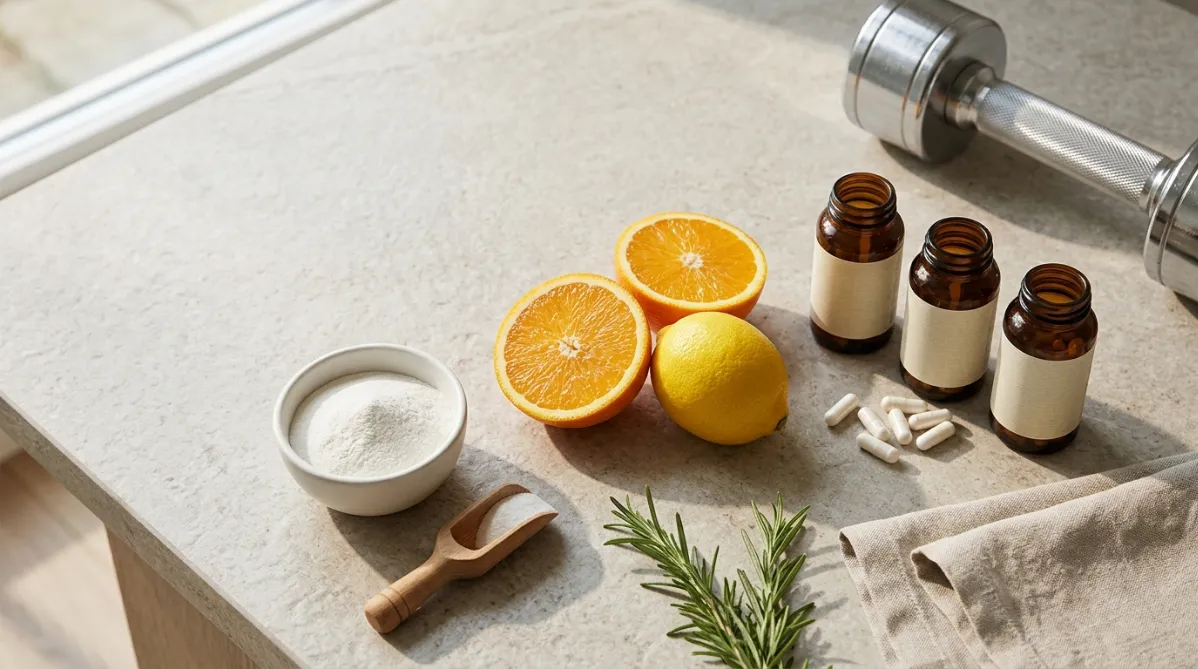
A wide, editorial-style flat lay photographed from above on a pale warm-gray stone countertop in soft morning window light. On the left, a small matte white ceramic bowl holds fine white arginine powder, with a wooden scoop resting beside it. At the center, two halved oranges and one whole lemon in saturated citrus tones, with a few glossy droplets of water on the cut surfaces, to suggest vitamin C. On the right, three slim amber glass capsule bottles with minimal cream labels and no legible text stand in a loose row, with a few white capsules spilling out. A single chrome dumbbell handle enters the frame from the upper right corner, partly cropped, its cool metallic sheen contrasting with the warm fruit. A sprig of green rosemary and a folded linen napkin in oatmeal beige add texture. Long soft shadows fall to the left. The palette is warm cream, sunny orange, soft yellow, and muted sage, with a few crisp accents of steel gray. The composition is airy and uncluttered, with generous negative space in the upper left for a title overlay. It has a shallow depth of field, a crisp foreground, and a faintly blurred background. The look is clean, contemporary, and wellness-magazine, like a premium health and fitness journal cover, with natural grain, high-end product photography quality, and a calm, fresh, trustworthy mood.
Science & Research

3 g Arginine + 500 mg Vitamin C: Testosterone Up 26% in Lifters

Dr. Gymbro · · 4 min read

Arginine has a bad reputation in the gym. For years it was sold as a nitric oxide booster for bigger pumps and better performance, and most controlled studies in trained people never delivered. A new randomized trial gives the amino acid a twist: pair it with a cheap dose of vitamin C and run it alongside a structured training program. In 50 male bodybuilders, that combination was linked to higher testosterone and higher VO2max.

The result is interesting, but it comes from one small trial. Here is what it found, what it didn't, and how much weight to put on it.

The Stack and the Dose

The trial, by Athar and colleagues, was published in 2026 in the Journal of Diabetes and Metabolic Disorders. It was randomized, double-blind and placebo-controlled. Fifty male bodybuilders, averaging about 24 years old, were split into two groups of 25.

The intervention group took 3,000 mg of L-arginine per day, split into three 1,000 mg doses, plus 500 mg of vitamin C per day. The control group took a starch placebo. Both groups ran for 45 days on the same standardized program of resistance training plus aerobic work. According to the Ergo-log write-up that flagged the study, that meant resistance sessions with 20 minutes of cardio, three times a week.

Both ingredients are cheap, widely available and easy to dose.

The Results

Compared with placebo, the supplement group showed significant improvements in two headline measures:

  • VO2max rose significantly (p < 0.001). Ergo-log put the increase at roughly 10%.
  • Serum testosterone rose significantly (p < 0.001). Ergo-log put the increase at roughly 26%.

The supplement group also had significant reductions in body weight (p < 0.001), BMI (p = 0.004) and body fat (p < 0.001). The abstract does not give the percentage changes, so the 10% and 26% figures come from Ergo-log's reading of the paper. Check the full text before quoting them as exact.

The weight loss deserves a note. Bodybuilders chasing size may not want a lower scale weight. The abstract reports a fall in fat mass and body weight, but not lean mass, so it can't tell us whether muscle was gained, held or lost.

Why Vitamin C Might Matter

The rationale is about nitric oxide. Arginine is a precursor for nitric oxide, a signaling molecule that helps regulate blood vessel tone and blood flow. Nitric oxide is also fragile and easily neutralized by free radicals.

The proposed idea is that vitamin C, an antioxidant, protects nitric oxide from that damage, so arginine works better as an NO donor. That could explain why the pairing worked here when arginine alone has often disappointed. It is a plausible mechanism, not something this trial demonstrated. The study did not test whether vitamin C was necessary, because there was no arginine-only arm.

What Didn't Change

Several markers stayed put, and they matter for interpretation.

  • Growth hormone showed no significant difference between groups. Arginine is often marketed as a GH secretagogue, and that effect did not show up here.
  • Cortisol also did not differ significantly, so there was no clear shift in the catabolic hormone.
  • Nitrogen balance: urinary urea nitrogen fell significantly, but the change in nitrogen balance did not reach significance between groups after adjusting for confounders. The study did not show a measurable improvement in protein economy.

The researchers also measured glucose and lipid profiles. The abstract does not report those results, so nothing can be said about them here.

Caveats

Treat this as a promising lead rather than a verdict.

  1. One trial. This is a single study from Iran, with no independent replication yet.
  2. Small and short. Fifty young men for 45 days says little about long-term effects, other populations, women or elite athletes.
  3. Hormones aren't hypertrophy. Higher testosterone does not automatically mean more muscle. The abstract reports no strength or lean-mass gains, and the decline in body weight points the other way for anyone bulking.
  4. No arm to isolate the vitamin C effect. Without an arginine-only or vitamin-C-only group, we can't say the combination beats either part.
  5. Training was standardized. The effects were seen alongside a structured program, and the authors frame the conclusion that way.

Practical Takeaways

If you want to experiment, the protocol is simple: 1,000 mg of L-arginine three times a day (3 g total) plus 500 mg of vitamin C daily, on top of consistent resistance and cardio training. Spreading the arginine across the day is how the trial dosed it.

The most plausible fits are recreational lifters who also care about conditioning, since VO2max and body fat moved in the right direction, and people cutting who want to keep training quality high. It is a weaker fit for anyone who needs the scale to go up. Anyone with a medical condition or on medication, especially for blood pressure or blood sugar, should check with a doctor first, since arginine acts on vascular function.

The cost is low, so a trial of your own is cheap. Just don't expect it to replace training, protein and sleep, and track your own numbers rather than trusting one study.

Source

Athar et al. The combined effect of L-arginine and Vitamin C supplementation on nitrogen balance, body composition, maximal oxygen uptake, and anabolic-catabolic hormones in male bodybuilders: A randomized double-blind clinical trial. Journal of Diabetes and Metabolic Disorders, 2026. DOI: 10.1007/s40200-026-01987-4 | PubMed
Original study

Read the original research on pubmed.ncbi.nlm.nih.gov →

This article summarizes published research for general information. It is not medical advice.

DG

Written by

Dr. Gymbro

Dr. Gymbro writes for Dr. Gymbro: science-backed fitness, nutrition & performance.

Related Articles

A landscape editorial still life on a soft, warm oat-colored linen surface, lit by diffused natural window light from the left. In the center sits a shallow matte ceramic bowl in muted sage green holding a small mound of fine white arginine powder. Beside it rests a wooden scoop dusted with powder. To the left, a loose arrangement of dried Astragalus root slices, pale golden and delicate, fans out in a graceful curve. To the right, a few whole Panax notoginseng roots, knobbly and earthy brown, sit next to a small pile of finely ground tan powder on a folded cream paper. A single sprig of fresh green leaf adds a gentle accent in the background.

In the foreground, a minimalist glass beaker with clear water and a thin linen-wrapped glass dropper sit slightly out of focus. Behind the objects, a softly blurred backdrop in pale blush and sand tones carries a faint, abstract pattern of soft circular shapes, like ripples or molecular dots drawn in subtle terracotta ink. A thin hand-drawn line graph in dusty coral rises gently across the upper right of the background, as if sketched on textured paper, with no readable text.

The composition uses generous negative space on the upper left, which leaves room for a headline overlay. The palette is earthy and calm: sage, cream, terracotta, honey gold, and soft blush. The shallow depth of field gives creamy bokeh. Gentle shadows fall to the right. The overall feel is clean and contemporary, like a wellness and science journal cover, with subtle film grain, high-end editorial photography, and tactile natural textures.
nutrition

The Add-On That Boosted Arginine Absorption 17% in a Small Trial

BY DR. GYMBRO ·

A 2023 crossover trial found that pairing 5 g of arginine with Astragalus and Panax notoginseng saponins raised arginine absorption by 17.3% and lifted the arginine-to-ADMA ratio by 167.1%. Urinary nitrate and cGMP, two nitric oxide markers, also rose. But only 24 people were analysed after six were excluded for large individual differences, and nobody measured workout performance. Here's what the data show, what they don't, and who should think twice.

A wide, editorial-style flat lay photographed from above on a pale warm-gray linen surface in soft natural window light. At the center, a small open amber glass jar tips gently onto its side, spilling a few cream-colored capsules across the fabric. Next to the jar sits a loose arrangement of fresh mushrooms: a cluster of golden-tan reishi with glossy, lacquered caps, a few slender white enoki stems, a halved shiitake showing its pale gills, and a curl of turkey tail with concentric bands of rust, cream, and charcoal. A small wooden scoop holds a pile of fine beige mushroom powder.

On the left third of the frame, a matte black sports watch with a minimal face lies beside a folded sage-green running shirt and a pair of lightweight off-white running shoes, hinting at athletic training without showing a person. A slim white notebook with a single pencil rests nearby, open to a blank page with a faint hand-drawn line graph trending upward, in thin graphite strokes.

On the right side, a pair of clear glass beakers and a single small petri dish with a soft amber-tinted liquid add a subtle laboratory note, kept calm and organic. A single sprig of dried herbs and a few scattered oat-colored grains add texture.

The palette is earthy and refined: oatmeal, soft sage, terracotta, warm amber, and charcoal accents against the muted neutral background. Shadows are soft and diffused, with a gentle highlight on the glass and the glossy reishi cap. The composition leaves generous negative space in the upper right for a headline overlay. Shallow depth of field blurs the edges slightly, while the central mushrooms and capsules stay crisp. The overall feel is modern, clean, and trendy, like a wellness and science magazine cover, with tactile natural textures, minimal styling, and a quiet sense of curiosity and skepticism.
science research

A Mushroom Capsule Lifted VO2max 14.8%—But There's a Big Catch

BY DR. GYMBRO ·

A mushroom capsule, 40 days, and a 14.8% rise in VO2max sounds almost too good to be true. In this new Antioxidants paper, 50 young male athletes taking 320 mg/day of a beta-glucan-rich multi-mushroom extract improved from 46.26 to 53.12 mL/kg/min. The big catch is that there was no placebo group, no randomization and no blinding, and the athletes kept training throughout. Cell experiments on rat heart cells add a hypoxia-related hint, but they tested single compounds, not the capsule. Here's what the study found, what it can't tell us, and who should think twice.

A wide, editorial-style photograph of a lone cyclist's legs and torso mid-sprint on a stationary indoor bike in a bright, minimalist performance studio. The scene is shot from a low three-quarter angle with shallow depth of field. The cyclist wears matte charcoal shorts and a fitted sage-green top, with a subtle sheen of sweat catching soft window light. Their hands grip the handlebars and the pedals are caught in a slight motion blur, which conveys explosive effort.

In the foreground, slightly out of focus on a pale oak side table, sit a small matte white scoop and a clear glass of water. Next to them is a little ceramic dish holding a few off-white capsules and a pinch of fine white powder. A folded linen towel and a slim stopwatch rest nearby. The stopwatch face is softly legible, hinting at timed sprint intervals.

The background is warm cream concrete and pale wood, with tall windows casting long diagonal shafts of golden morning light across the floor. Faint dust motes drift in the light. On the wall behind, a clean, abstract line graph is painted in muted terracotta and deep teal. It shows one line rising in steps like five sprint bouts and another line gently falling, a subtle visual nod to power up and lactate down. The graph is minimal and stylized, with no readable numbers or text.

The color palette is earthy and modern: sage green, terracotta, warm cream, soft charcoal, and touches of natural wood. The lighting is soft and directional with gentle highlights and natural shadows. The overall look is calm, refined, and contemporary, like a premium wellness and sports science magazine cover. The composition follows the rule of thirds, with the cyclist on the right and open negative space on the left for a headline. The image is crisp, grainy in a subtle film-like way, and free of any futuristic or sci-fi elements.
science research

This Carnitine Form Lifted Sprint Power Up to 15% and Cut Lactate

BY DR. GYMBRO ·

A 2009 crossover study found that a single 4.5 g dose of glycine propionyl-L-carnitine (GPLC) lifted peak and mean sprint power by 2.6% to 15% across five all-out cycling bouts. Blood lactate was also 16.2% lower 14 minutes after exercise. But the "15%" is the top of a range, not an average, and the study involved just 24 men in one lab. This article breaks down how GPLC differs from regular L-carnitine and ALCAR, where the nitric oxide theory fits, and who might actually benefit. It also covers dose, timing and the limits of the evidence.

A wide, landscape editorial photograph with a modern wellness-journal feel. In the foreground, a clear glass vial of pale amber liquid sits on a matte white stone surface, with a small dropper beside it and a few droplets catching soft light. A slim brushed-steel measuring spoon and a minimalist notebook with handwritten dose calculations in pencil rest nearby. The numbers are blurred and unreadable.

In the softly blurred background, a bright, airy modern gym with large windows and morning light. A fit man in his thirties, in a charcoal athletic shirt, is mid-stride on a treadmill in profile, with a gentle sheen of sweat and a focused expression. Behind him, a wooden plyo box, a kettlebell, and a rope are arranged neatly, suggesting functional training.

The palette is calm and refined: warm cream, soft sage green, muted terracotta, and touches of deep navy. Natural golden side-light makes long, gentle shadows. Shallow depth of field with a crisp foreground and creamy bokeh. Clean composition with negative space on the left third for a title overlay. Premium magazine photography, subtle film grain, realistic textures, no text or logos, and no futuristic or digital elements.
nutrition

HMB Boosted Cardio Fitness, Not Strength, in New 2026 Trial

BY DR. GYMBRO ·

HMB is usually sold as a way to hold onto muscle and build strength, but a new triple-blind trial found something different. In 90 men, a high personalized dose of liquid HMB free acid (90 mg per kg of fat-free mass daily) plus high-intensity functional training raised VO2max and threshold markers more than placebo. The effect was clearest in trained men, and isometric leg strength did not budge. Here is the dose math, how it compares with the standard 3 g, and who might actually benefit.

This page is available in