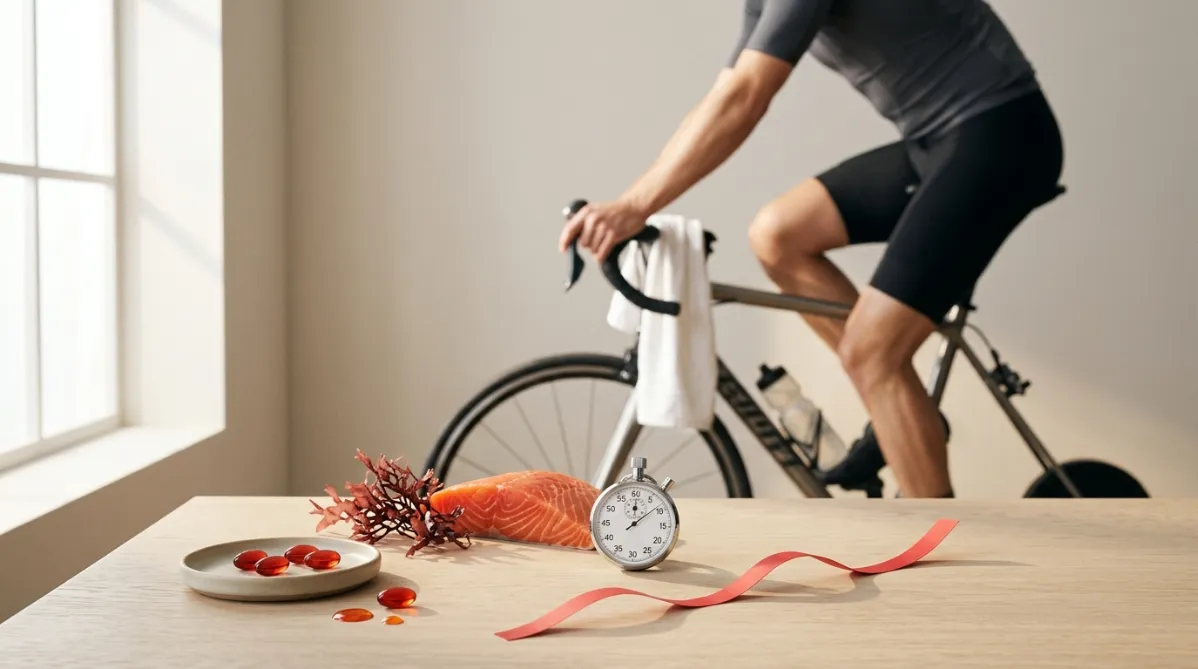
Astaxanthin, the red carotenoid that gives salmon and krill their color, has been marketed to endurance athletes for years. A new randomized trial in Nutrition Journal (Shu et al., 2026) asks whether it does anything for a different group: young male taekwondo athletes, who face repeated high-intensity bouts, heavy impact, and plenty of mental strain. The answer is promising but needs careful reading.
What the researchers did
The team ran a 28-day randomized, double-masked, placebo-controlled trial. Young male taekwondo athletes took either 12 mg of astaxanthin per day or a placebo. Researchers tracked three things over the month: oxidative stress markers, a muscle-damage marker, and psychological status using the Athlete Burnout Questionnaire (ABQ).
The measures were creatine kinase (CK) for muscle damage, superoxide dismutase (SOD) as an antioxidant enzyme, malondialdehyde (MDA) as a marker of lipid peroxidation, and the ABQ subscales for burnout. Data were analyzed with mixed-design ANOVA, which tests whether the two groups changed differently over time, the group × time interaction.
The headline result: creatine kinase
The most robust finding was for CK. The analysis showed a significant group × time interaction, meaning the astaxanthin and placebo groups followed different trajectories over the four weeks. CK is a common, if imperfect, indicator of exercise-induced muscle damage, because it leaks into the blood when muscle fibers are stressed. A different trajectory suggests astaxanthin may have blunted some of that damage during training.
This is the result that most deserves attention, because it came from the pre-specified interaction test, the statistically strongest way to read a trial like this.
Antioxidant markers: SOD up, MDA exploratory
SOD showed significant main effects of both group and time. Exploratory between-group comparisons suggested higher SOD activity in the astaxanthin group at Weeks 2 and 4. That fits astaxanthin's reputation as a potent free-radical scavenger and a modulator of the body's own antioxidant defenses.
MDA is trickier. There was no significant group × time interaction. Only in exploratory comparisons did the astaxanthin group show lower MDA concentrations at Week 4. That is a hint, not a confirmation, and it should be treated that way.
Burnout: a narrow, exploratory signal
The psychological findings are where caution matters most. Among the ABQ subscales, only emotional and physical exhaustion (ABQa) differed between groups at Week 4, and only in exploratory analysis. No burnout subscale showed a significant group × time interaction.
The authors themselves conclude that effects on other dimensions of burnout appear limited. Read plainly, astaxanthin did not clearly change burnout overall. It may have nudged the exhaustion component, but the evidence isn't strong enough to claim it as a mental-recovery tool.
Limitations to keep in mind
- Small trial. Modest sample sizes limit statistical power and make exploratory findings fragile.
- Biomarkers, not performance. The study measured blood markers and questionnaires, not competition results, power output, injury rates, or recovery speed in the gym.
- Narrow population. Only young males in one sport were studied, so results may not carry over to women, older athletes, or other disciplines.
- Short duration. Four weeks says little about long-term benefits or safety.
- Exploratory comparisons. Several of the more attractive results (MDA, ABQa, SOD at specific weeks) come from tests without a significant interaction, which raises the risk of false positives.
Practical takeaways
If you're curious about astaxanthin, here is how the trial translates into practice:
- Dose: 12 mg per day, the amount used in the study.
- Duration: 28 days. Benefits at this dose haven't been shown beyond that window.
- Take it with food: Astaxanthin is fat-soluble, so taking it with a meal containing fat is the sensible way to support absorption. The trial abstract doesn't specify this, so it is general carotenoid guidance rather than a study finding.
- Who might care: Combat sport athletes and others in high-volume, high-impact training, where muscle damage and cumulative fatigue are persistent concerns.
- Who shouldn't expect miracles: Anyone hoping for a clear fix for burnout. Sleep, load management, and psychological support remain the primary tools.
Bottom line
This trial offers reasonable, early evidence that 12 mg of astaxanthin daily for four weeks changes muscle-damage patterns in taekwondo athletes, with supportive but softer signals for antioxidant status and emotional exhaustion. It does not show better performance, and it does not show reduced burnout across the board. Larger, longer trials that include performance outcomes and more diverse athletes would be needed to move astaxanthin from "interesting" to "recommended." Until then, treat it as a low-stakes experiment to discuss with a sports dietitian or physician, not a replacement for good training and recovery fundamentals.