Dr. Gymbro
←

#astaxanthin

2 articles
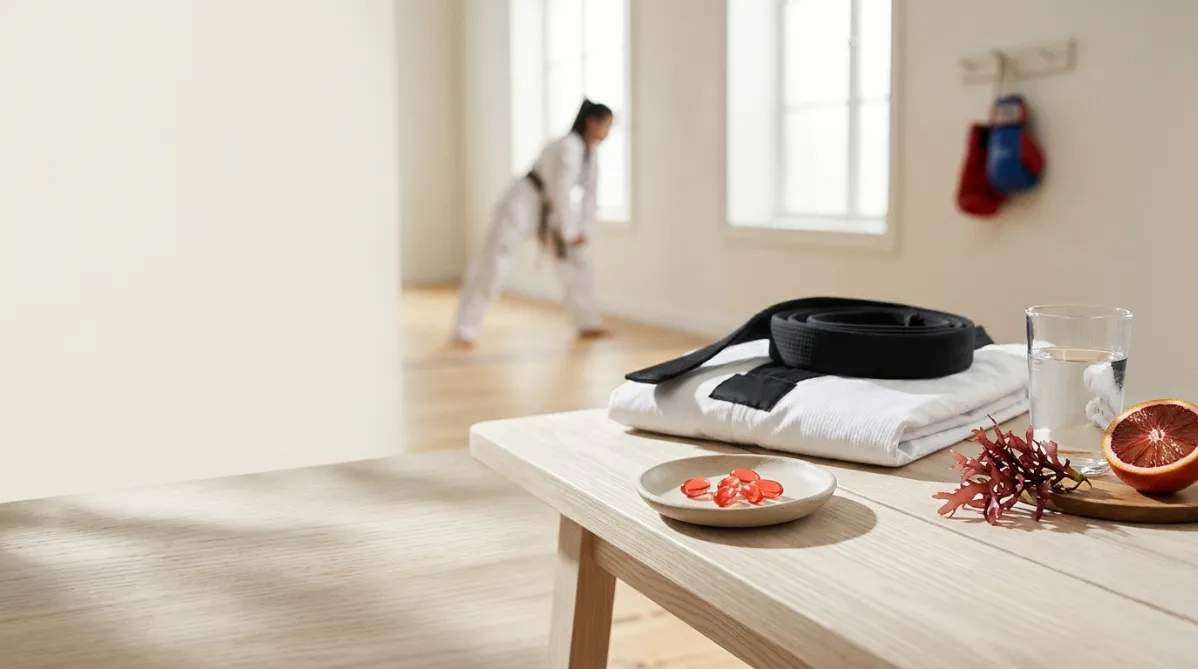
A wide editorial still life shot from a slightly elevated angle on a pale ash-wood bench in a bright, airy training hall. In the center sits a small matte ceramic dish holding a few translucent coral-red softgel capsules, their glossy surfaces catching soft window light. Beside the dish rests a folded white taekwondo dobok with a black belt loosely coiled on top. A sprig of fresh red microalgae-toned seaweed and a halved blood orange add natural color accents. A clean glass of water with subtle condensation stands to one side.

In the softly blurred background, the silhouette of a martial artist in a white uniform stretches near tall windows, with diffused morning light streaming across a sprung wooden floor. A pair of red and blue sparring gloves hangs on a minimal wall hook. Thin, elegant shadows stretch across the bench.

The palette is restrained and modern: warm off-white, soft sand, muted charcoal, with a vivid coral-red accent pulled from the capsules. Shallow depth of field, crisp focus on the capsules and dish, creamy bokeh behind. Natural, gentle lighting with a subtle film-like grain, reminiscent of a contemporary wellness and science magazine cover. Generous negative space on the left third of the frame for headline text. Calm, precise, and quietly athletic in mood, with no text, logos, or futuristic elements.
science research

12 mg Astaxanthin for 28 Days: Muscle Damage and Burnout in Fighters

BY DR. GYMBRO ·

A new randomized trial put 12 mg of daily astaxanthin to the test in young male taekwondo athletes. After 28 days, the supplement group showed a significantly different creatine kinase trajectory than placebo, plus higher SOD and exploratory signs of lower MDA and less emotional and physical exhaustion. But the burnout findings were exploratory, with no group × time interaction on any subscale. The trial was small and measured biomarkers, not performance. Here's what the data show, what they don't, and who might want to pay attention.
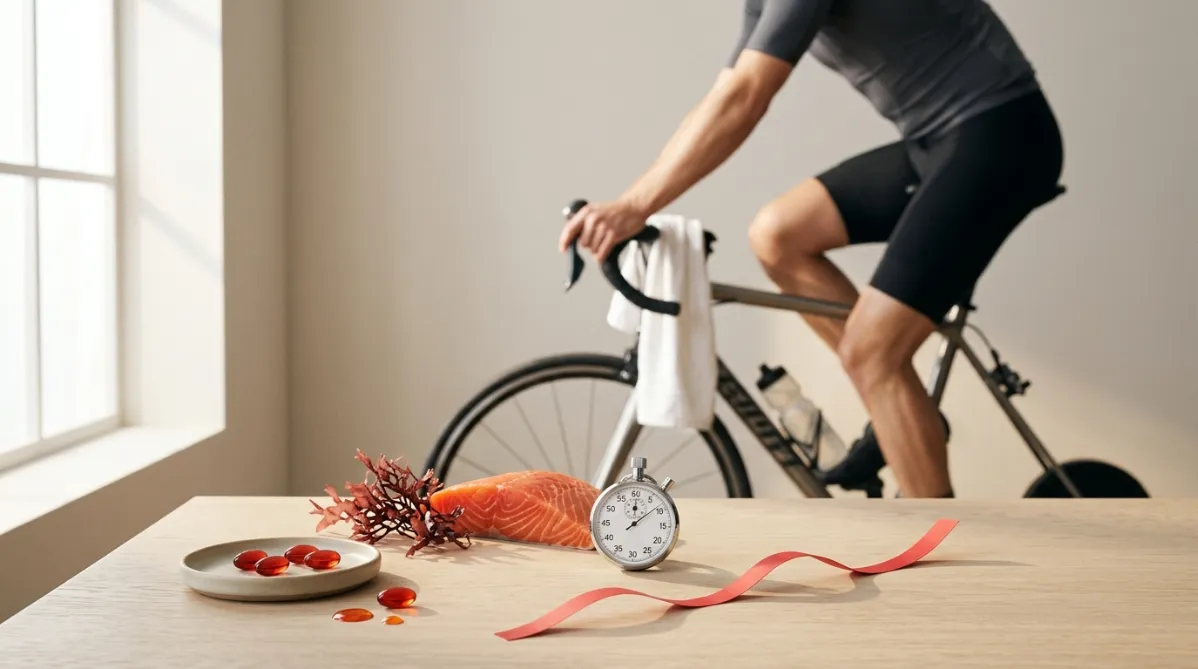
A cyclist's legs mid-pedal on a stationary road bike, shot in a bright, airy, minimalist studio with a soft warm-grey backdrop. In the foreground on a pale oak table sits a small ceramic dish holding four deep coral-red softgel capsules, with a few translucent droplets of red-orange oil glistening beside them. Beside the dish is a sprig of dried red microalgae-toned seaweed and a halved wild salmon fillet, its coral flesh echoing the capsule color. Behind the table, slightly out of focus, a cyclist in a fitted charcoal jersey and matte black shorts rides a bike on an indoor trainer. Only the torso and legs are visible, with no face. A white towel hangs over the handlebars and a clear water bottle catches the light.

Soft diffused morning light streams from a large window on the left, creating long gentle shadows and a subtle golden-hour glow on the skin and the glossy capsules. The palette is restrained and editorial: warm cream, sand, soft grey and charcoal, with vivid coral-red as the single accent color. A minimalist analog stopwatch with a clean white face sits on the table, its hands near the 85-minute mark. A thin, elegant line-graph shape is subtly suggested by a curved strip of red ribbon lying on the table, rising from left to right to hint at the performance gain without any text.

The composition follows the rule of thirds, with the capsules and stopwatch in the lower left and the cyclist's motion-blurred legs sweeping across the right. Shallow depth of field, crisp macro detail on the capsules, and a fine film-like grain. The overall feel is a modern health and science magazine cover: clean, calm, sophisticated, and natural, with negative space in the upper area for a headline. There are no futuristic elements, no glowing effects, no laboratory equipment, and no text or logos. Landscape 16:9 format.
nutrition

Astaxanthin for 4 Days Boosted Cycling Time-to-Exhaustion From 72 to 85 Minutes in a Small Trial

BY DR. GYMBRO ·

Four days of astaxanthin at 28 mg/day lengthened cycling time to exhaustion from about 72 to 85 minutes in a small randomized trial, a gain of roughly 18%. The same protocol blunted rises in muscle damage markers (CK and LDH) and lipid peroxidation (MDA) after a hard ride at 75% VO2max. Inflammation markers and fuel use did not change, so the mechanism is still unclear. The dose is also well above what many softgels provide, and the study had just ten young men. Here is what the numbers show and where the evidence stops.

This page is available in