Dr. Gymbro
A landscape editorial still life on a soft, warm oat-colored linen surface, lit by diffused natural window light from the left. In the center sits a shallow matte ceramic bowl in muted sage green holding a small mound of fine white arginine powder. Beside it rests a wooden scoop dusted with powder. To the left, a loose arrangement of dried Astragalus root slices, pale golden and delicate, fans out in a graceful curve. To the right, a few whole Panax notoginseng roots, knobbly and earthy brown, sit next to a small pile of finely ground tan powder on a folded cream paper. A single sprig of fresh green leaf adds a gentle accent in the background.

In the foreground, a minimalist glass beaker with clear water and a thin linen-wrapped glass dropper sit slightly out of focus. Behind the objects, a softly blurred backdrop in pale blush and sand tones carries a faint, abstract pattern of soft circular shapes, like ripples or molecular dots drawn in subtle terracotta ink. A thin hand-drawn line graph in dusty coral rises gently across the upper right of the background, as if sketched on textured paper, with no readable text.

The composition uses generous negative space on the upper left, which leaves room for a headline overlay. The palette is earthy and calm: sage, cream, terracotta, honey gold, and soft blush. The shallow depth of field gives creamy bokeh. Gentle shadows fall to the right. The overall feel is clean and contemporary, like a wellness and science journal cover, with subtle film grain, high-end editorial photography, and tactile natural textures.
Nutrition

The Add-On That Boosted Arginine Absorption 17% in a Small Trial

Dr. Gymbro · · 4 min read

Your arginine pre-workout might be leaving something on the table. A 2023 crossover trial found that pairing 5 g of arginine with a capsule of Astragalus and Panax notoginseng saponins (APS) raised arginine absorption and shifted several nitric oxide (NO) markers. One number jumped far more than the rest: the arginine-to-ADMA ratio rose 167.1%.

Before you add anything to your shaker, here is what the study did and didn't show.

What the Study Actually Was

The paper, published in Functional Foods in Health and Disease (2023;13(6):307-19, registered as NCT05024123), is a randomized, double-blind, placebo-controlled crossover pharmacokinetic study. Healthy adults aged 20 to 80 took 5 g of arginine powder with either one capsule of APS or a placebo. Each participant did both conditions, with a washout period in between. Researchers collected plasma and urine to track arginine levels and NO-related markers.

The authors say they know of no earlier human trials of Astragalus and ginseng extracts on NO levels. So this is early-stage work.

The Headline Numbers

Compared with arginine plus placebo, arginine plus APS produced:

  • Arginine AUC +17.3% (p = 0.041). AUC is a measure of total exposure, so this is the "absorbed more arginine" result.
  • Arginine Cmax +11.1%. This is the peak blood concentration. The abstract gives no p-value for it.
  • Arg/ADMA ratio +167.1% (p = 0.007). ADMA (asymmetric dimethylarginine) works against the enzyme that makes NO, so a higher ratio points toward a friendlier environment for NO production.
  • Urinary nitrate +20.8% and urinary cGMP +18.9%. Both are downstream NO markers. The abstract gives no significance values for these.

The authors conclude that APS improved arginine absorption, lowered ADMA, and enhanced NO production.

Why Lifters Should Care (and Why They Shouldn't Overreact)

Arginine is a staple of pre-workout formulas because it is a precursor to NO, which is tied to vasodilation. The usual complaint is that oral arginine doesn't reliably translate into meaningful NO changes. A compound that nudges absorption up and ADMA down is an appealing idea. The authors suggest APS could be useful for pre-workout and cardiovascular health.

That suggestion goes beyond the data, though. This study measured blood and urine markers. It did not measure workout performance, pump, strength, endurance, or blood flow during exercise. Nobody lifted anything. A higher NO marker is not the same as a better session.

The Caveats You Need to Know

1. Six people were thrown out. Thirty participants were evidently enrolled, since 24 were analysed after six were excluded for "great individual differences." That is 20% of the sample. Excluding people because their responses varied widely can make an effect look cleaner than it would be in the real world. The abstract does not say how this criterion was defined. Whether these six would have weakened the result is unknown.

2. Small sample. Twenty-four analysed participants is modest, and the p-value for the AUC result (0.041) is close to the usual cutoff.

3. Healthy people only. The results say nothing about people with cardiovascular disease, high blood pressure, or those taking medications.

4. Single-dose design. The abstract describes one arginine dose with one APS capsule. It reports nothing on long-term use or on repeated dosing.

5. Surrogate markers. Urinary nitrate and cGMP are indirect readouts of NO activity, not direct measures of vascular function.

6. Details I couldn't verify. I worked from the abstract and publication record. The APS dose per capsule, product composition, funding, and any conflicts of interest are in the full text, so check it yourself before drawing conclusions.

Practical Takeaways

Dose tested: 5 g of arginine powder with one APS capsule. The abstract doesn't state the saponin content of the capsule, so you can't replicate it from this information alone. Matching a retail product to the trial's standardized extract is not possible from the abstract.

Timing: The abstract doesn't specify how long before exercise the doses were taken, and no exercise was involved. Don't treat any specific pre-workout window as validated by this paper.

Who it might be relevant to: Healthy adults who already use arginine and are curious about absorption. The trial included ages 20 to 80, but only healthy volunteers.

Who should skip it or ask first:

  • Anyone with a heart condition, blood pressure problems, or on cardiovascular medication
  • Anyone taking blood thinners or other prescription drugs, since interactions weren't assessed in this trial
  • Pregnant or breastfeeding people and anyone with a chronic illness
  • Anyone expecting a proven performance boost, because this study didn't test performance

The abstract also says nothing on cost, so the "cheap add-on" label would be an assumption.

The Bottom Line

This small, tightly controlled crossover trial gives a credible early signal that APS may improve how the body handles an arginine dose and shift NO-related markers in the right direction. The 167% jump in the Arg/ADMA ratio is the standout finding. The exclusion of six participants, the small sample, the lack of significance values for some markers, and the absence of any performance outcome mean it is a hypothesis-builder, not a reason to overhaul your stack. The next step is a larger trial that tests exercise outcomes and reports on everyone enrolled.
Original study

Read the original research on doi.org →

This article summarizes published research for general information. It is not medical advice.

DG

Written by

Dr. Gymbro

Dr. Gymbro writes for Dr. Gymbro: science-backed fitness, nutrition & performance.

Related Articles

A wide, editorial-style flat lay photographed from above on a pale warm-gray stone countertop in soft morning window light. On the left, a small matte white ceramic bowl holds fine white arginine powder, with a wooden scoop resting beside it. At the center, two halved oranges and one whole lemon in saturated citrus tones, with a few glossy droplets of water on the cut surfaces, to suggest vitamin C. On the right, three slim amber glass capsule bottles with minimal cream labels and no legible text stand in a loose row, with a few white capsules spilling out. A single chrome dumbbell handle enters the frame from the upper right corner, partly cropped, its cool metallic sheen contrasting with the warm fruit. A sprig of green rosemary and a folded linen napkin in oatmeal beige add texture. Long soft shadows fall to the left. The palette is warm cream, sunny orange, soft yellow, and muted sage, with a few crisp accents of steel gray. The composition is airy and uncluttered, with generous negative space in the upper left for a title overlay. It has a shallow depth of field, a crisp foreground, and a faintly blurred background. The look is clean, contemporary, and wellness-magazine, like a premium health and fitness journal cover, with natural grain, high-end product photography quality, and a calm, fresh, trustworthy mood.
science research

3 g Arginine + 500 mg Vitamin C: Testosterone Up 26% in Lifters

BY DR. GYMBRO ·

Arginine has long been written off as an overhyped nitric oxide booster, but a new randomized trial adds a twist: pair it with vitamin C. In 50 male bodybuilders, 3 g of arginine (split into three doses) plus 500 mg of vitamin C for 45 days significantly raised testosterone and VO2max versus placebo, and body fat dropped. Growth hormone, cortisol and nitrogen balance did not significantly differ between groups. It's a cheap stack worth watching, but it comes from one small trial, and higher testosterone doesn't guarantee more muscle.

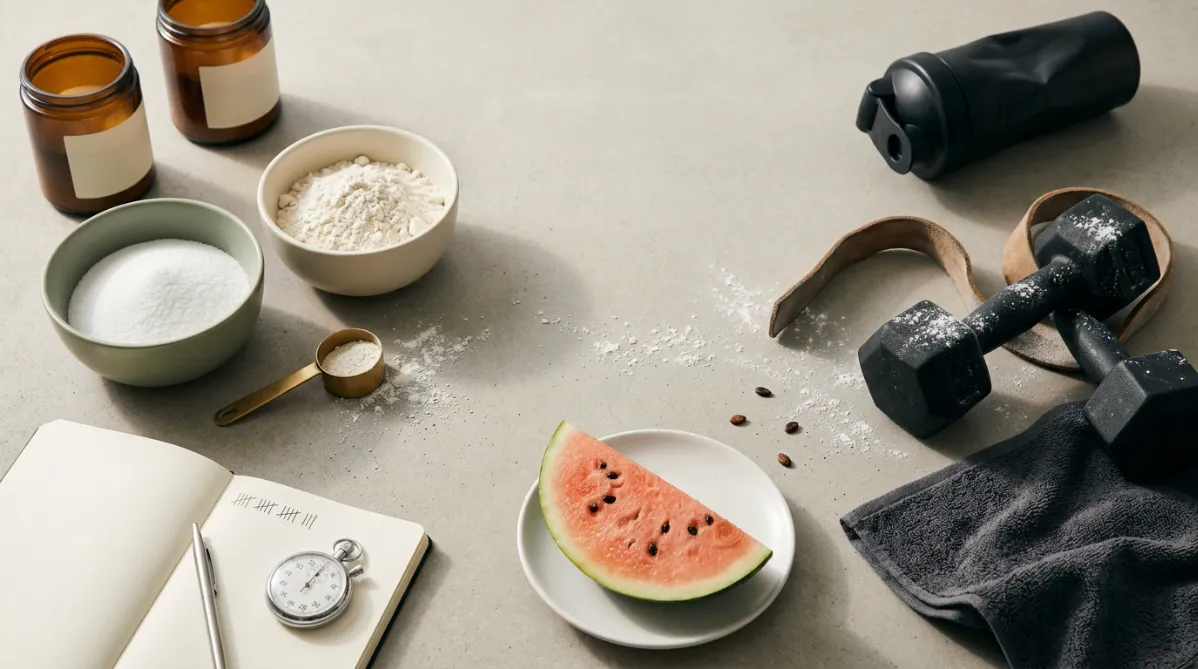
A wide, editorial-style flat lay photographed from above on a pale warm-gray concrete surface, lit by soft natural window light with gentle long shadows. On the left, two matte ceramic bowls in muted sage green and cream sit side by side. One holds fine white crystalline powder, the other holds slightly coarser off-white powder. Between them, a small brass measuring scoop rests on the surface, dusted with powder. Behind the bowls, two simple amber glass jars with minimal cream labels and no legible text stand slightly out of focus.

On the right side, a pair of chalk-dusted black hex dumbbells and a worn leather lifting strap curve across the frame. A folded charcoal gym towel sits beneath them. A rumpled matte-black shaker bottle lies on its side near the top edge. A slice of watermelon, the natural source of citrulline, sits on a small white ceramic plate in the lower center. Its vivid coral-pink flesh and dark seeds add a saturated pop of color against the neutral palette. A few loose watermelon seeds and a scattering of white powder dust trail across the surface toward the dumbbells, tying the composition together.

In the lower left corner, an open notebook with blank cream pages holds a slim silver pen and a minimalist analog stopwatch. A thin line of hand-drawn tally marks suggests counted reps, with no readable words or numbers.

The palette is restrained and contemporary: warm grays, sage, cream, charcoal, and amber, with the watermelon's coral-pink as the single bright accent. The mood is calm, clean, and precise, like a modern wellness or science-journal feature. Shallow depth of field keeps the powder bowls and watermelon crisp while the background items soften slightly. Generous negative space across the upper center leaves room for a headline overlay. The photograph looks high-end and tactile, with a subtle film-grain finish.
nutrition

L-Citrulline vs Citrulline Malate: The Upper-Body Endurance Twist

BY DR. GYMBRO ·

Everyone argues over whether plain L-citrulline or citrulline malate is the better buy, but a new six-week trial found something more interesting. Both forms beat placebo for upper-body reps to failure, and both raised nitric oxide metabolite responses. The catch: neither form improved 1RM strength, and the leg results were only a trend. With just 33 trained men in the study, this is a promising signal rather than a verdict. Here's what the doses, timing questions, and fine print mean for your training.

A landscape editorial photograph with a modern, clean magazine feel, shot on a pale warm-gray concrete surface in soft natural window light from the left. In the foreground, two matte white ceramic espresso cups sit side by side. The left cup holds a small amount of dark espresso with golden crema. The right cup is filled twice as high. Beside them, two small stainless steel scoops hold fine coffee-colored powder, one half full and one heaped, suggesting a dose comparison without any text or labels. A pair of worn red leather boxing gloves rests slightly out of focus behind the cups, laces loosely draped, with a white hand wrap rolled neatly beside them. A minimalist digital kitchen scale in matte black sits at the edge of the frame, with a few roasted coffee beans scattered across the surface. In the soft-focus background, a boxing gym corner appears: a hanging heavy bag in muted charcoal, pale wood plank flooring, and a tall window with diffused morning light. The palette is warm cream, espresso brown, brick red, and soft slate gray, with gentle shadows and a shallow depth of field. The composition follows the rule of thirds, with the cups and scoops in the lower left third and open negative space on the right for headline overlay. The look is tactile and refined, like a high-end health and performance journal. It has natural grain, subtle contrast, and a calm, confident mood. There are no people, no text, no logos, and no futuristic elements.
nutrition

Doubling Your Caffeine Barely Helped Boxers—Here's What Did

BY DR. GYMBRO ·

Think a double scoop of pre-workout means double the performance? A new crossover trial in 15 competitive boxers compared 3 mg/kg and 6 mg/kg of caffeine, and the bigger dose was not consistently better. Both doses raised jump height and power at 60 minutes, while 6 mg/kg only pulled ahead on a few outcomes like ballistic push-up power and knee torque. Here is the mg-per-kg conversion for common body weights, the timing the data supports, and the honest caveats, including that punching itself was never tested.

A sunlit, minimalist kitchen counter in a modern home, photographed from a slightly elevated three-quarter angle with soft natural morning light spilling in from a window on the left. In the center sits a matte white ceramic mug of black coffee with a thin curl of steam, beside a small glass jar of deep magenta beetroot powder with a wooden scoop resting on the lid. A scattering of fine crimson powder dusts the pale oak surface in an artful, casual swirl. Nearby, a halved raw beetroot reveals vivid concentric rings of purple and pink, next to a few roasted coffee beans and a neatly folded charcoal gym towel. In the soft-focus background, a pair of clean white running shoes and a stainless steel water bottle sit on a floating shelf, hinting at a pre-workout routine. A single sprig of green beet leaves adds a fresh accent.

The color palette is warm and editorial: creamy neutrals, espresso browns, and rich beet magenta, with gentle highlights and long soft shadows. The composition has generous negative space on the right side for headline text, shallow depth of field, and a crisp, tactile texture on the ceramic, powder, and wood grain. The mood is calm, health-conscious, and contemporary, like a lifestyle feature in a premium wellness magazine or a trendy nutrition journal. Clean, balanced, natural, with subtle film-like grain and a slightly muted, high-end finish.
science research

Pre-Workout Caffeine Stiffens Arteries. Beetroot Powder Offset It

BY DR. GYMBRO ·

A new randomized crossover trial found that a pre-workout-sized dose of caffeine (6 mg/kg) raised markers of arterial stiffness within 2.5 hours. Adding a beetroot powder with 400 mg of nitrate brought those markers back to placebo levels. Blood pressure and endothelial function did not change, so this is a subtle effect rather than a red flag. The study involved just 24 healthy young adults and a single dose, leaving big questions about long-term use and older or hypertensive people. Here is what the data show, what they do not, and how to think about it if you rely on caffeine before training.

This page is available in