Dr. Gymbro
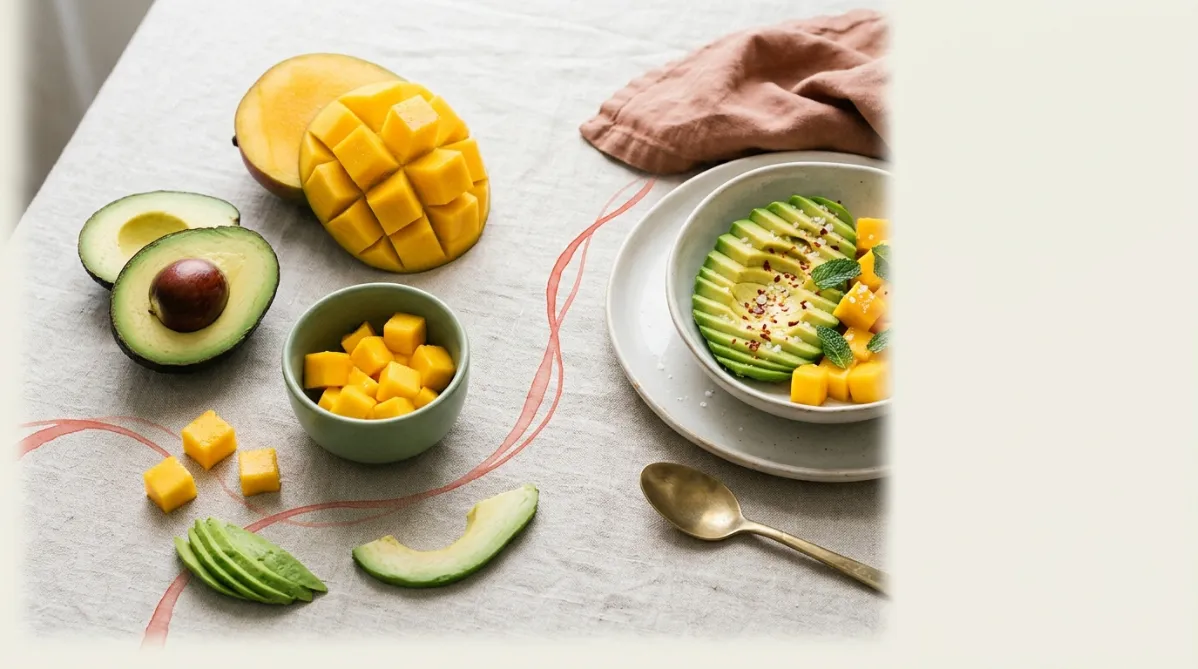
A wide, softly lit editorial still life photographed from slightly above on a pale oat-colored linen surface. On the left, a halved ripe Hass avocado with its glossy pit still nestled in one half, the flesh a buttery gradient from deep green at the skin to creamy yellow at the center. Beside it, a ripe mango is sliced into thick cheeks with a neat crosshatch pattern, the golden-orange flesh catching the light. A small ceramic bowl in matte sage green holds a cup of diced mango cubes. A few scattered mango cubes and a thin avocado slice fan out across the surface.

On the right, a minimalist ceramic plate holds a simple composed bowl: sliced avocado fanned over mango, with a sprinkle of flaky sea salt, a pinch of chili flakes, and a few torn mint leaves. A linen napkin in muted terracotta is draped casually at the edge of the frame. A single brushed-brass spoon rests nearby.

A subtle graphic touch ties in the artery theme: a thin, elegant line of warm coral red, like a hand-drawn ribbon or gentle wave, curves through the negative space on the surface, suggesting a blood vessel and flow without looking clinical. It passes softly beneath the fruit as if painted on the table in watercolor.

Natural morning window light enters from the upper left, creating soft long shadows and gentle highlights on the fruit's surface. The palette is warm and fresh: avocado greens, mango golds and oranges, cream, sage, and a hint of coral. Shallow depth of field blurs the background edges into creamy neutrals, leaving generous clean empty space on the right third for title text. Modern wellness magazine aesthetic, crisp but organic, high-end food photography, with a subtle film-like grain and calm, balanced composition.
Nutrition

Avocado + Mango Daily: What Changed in Arteries (and What Didn't)

Dr. Gymbro · · 4 min read

Eight weeks. One avocado. One cup of mango. Every day. The blood vessels of people with prediabetes responded. Blood sugar, inflammation and most other markers did not.

That split is the whole story of a new randomized trial in the Journal of the American Heart Association. It is a useful result, but only if you read it for what it shows.

What the researchers actually did

A team at the Illinois Institute of Technology, led by Britt Burton-Freeman, randomized 82 adults with prediabetes. Average age was about 45 and average BMI about 30. Everyone ate a partially controlled diet, with food provided weekly: 1,500 kcal/day for women and 1,750 kcal/day for men.

One group got a whole avocado and one cup of mango every day for 8 weeks. The control group got energy-matched, low-fat, low-fiber foods in their place. Calories were equal, so the comparison is about food quality and composition, not eating more or less.

The primary endpoint was flow-mediated dilation (FMD). This is an ultrasound test of how well an artery widens when blood flow increases, and it is a standard readout of endothelial function.

The headline result: FMD moved

FMD rose by roughly 1 percentage point on the avocado-mango diet and fell on the control diet. The between-group difference was about 2.1 percentage points (effect -2.11 ± 0.77%, P = 0.008), with the sign reflecting the control-versus-fruit comparison.

The control group's decline matters as much as the fruit group's gain. A diet low in fiber and fruit may have nudged vessel function the wrong way over two months, while the fruit diet reversed that direction. Total fruit, fiber, vitamin C and monounsaturated fat intake all rose significantly on the avocado-mango diet.

Blood pressure: a men-only signal

Diastolic blood pressure also differed between diets, and the effect showed up mainly in men. Brachial diastolic pressure reached P = 0.03. Central diastolic pressure came in at P = 0.07, which is a trend rather than a clear result.

Treat the sex-specific finding as a lead for future work. Subgroup effects in a trial of 82 people are easy to overread, and the study wasn't built to settle why men responded more.

What didn't change

Most of the other secondary endpoints showed no meaningful difference (P > 0.05). That covers glucose-related markers, inflammatory markers and most of the metabolic panel. Some lipid and kidney markers were marginal (P < 0.1), but that is not enough to claim an effect.

So this is not a blood-sugar-lowering trick or an anti-inflammatory fix. It is evidence that two whole fruits can improve one important vascular measure in a high-risk group, even without a visible change in glucose.

Read the fine print

The trial was funded in part by the Hass Avocado Board and the National Mango Board, and the authors disclosed that funding. Industry funding doesn't invalidate the data, but it is a reason to wait for independent replication.

The design also can't separate avocado from mango. The study tested the combination, so we don't know which fruit, or which nutrient (fiber, vitamin C, monounsaturated fat, polyphenols), drove the vessel effect. FMD is a surrogate marker, not heart attacks or strokes, and eight weeks is short.

How to fit it into your diet

The calorie math is the practical question. A medium avocado runs roughly 240-320 kcal depending on size, and a cup of mango chunks is around 100 kcal. Expect about 350-420 kcal for the pair. In this trial that was a large share of a 1,500-1,750 kcal day, and it was offset by the other foods provided.

  • Cutting: Treat the pair as a calorie-dense block and budget for it. Swap out other fats (oils, cheese, nuts) and refined carbs instead of stacking it on top. A half avocado with a half cup of mango gets you partway for about 175-210 kcal.
  • Maintenance: The full dose is easy to fit. Replace a processed snack or dessert with it and the day barely changes.
  • Bulking: Add it on top, since you probably have the room.

Who might benefit most: People with prediabetes or excess weight, and anyone whose diet is low in fruit and fiber. If you already eat plenty of produce, the gain may be smaller, and the study doesn't tell us.

Simple meal ideas

  • Avocado toast on whole-grain bread, with a cup of mango on the side.
  • A smoothie with half an avocado, mango, spinach and Greek yogurt for protein.
  • Chicken or shrimp bowl with diced mango, sliced avocado, black beans and lime.
  • Mango-avocado salsa over grilled fish.
  • Frozen mango chunks as an evening snack, with the avocado used at lunch or dinner.

The bottom line

In adults with prediabetes, adding one avocado and one cup of mango daily for 8 weeks improved flow-mediated dilation relative to a low-fiber, low-fat control diet, and diastolic pressure improved in men. Glucose and most other markers didn't budge. Food is not a drug, and this result is modest. Still, swapping low-fiber filler for whole fruit and healthy fats is a cheap, low-risk change, and your arteries may respond even when the lab numbers don't.
Original study

Read the original research on pubmed.ncbi.nlm.nih.gov →

This article summarizes published research for general information. It is not medical advice.

DG

Written by

Dr. Gymbro

Dr. Gymbro writes for Dr. Gymbro: science-backed fitness, nutrition & performance.

Related Articles

A wide, softly lit editorial still life on a pale warm-gray stone surface. In the center, three small clear glass vials of differing liquid heights stand in a staggered row, filled with luminous citrus-orange liquid. The shortest vial holds a thin layer of liquid, the middle one is about half full, and the tallest is nearly full, subtly suggesting rising levels without any charts or text. Beside the vials, a halved blood orange and a halved lemon sit with glistening, dewy pulp, and a few loose orange segments scatter across the surface. In the foreground, a shallow ceramic dish holds a few translucent golden softgel capsules catching the light, and a single droplet of orange liquid rests on the stone with a delicate glossy highlight.

Behind the vials, a large, out-of-focus backdrop in muted peach and cream tones fades into a gentle gradient. Soft morning window light enters from the left and casts long, elegant shadows to the right. Thin sprigs of green citrus leaves add a fresh contrast in the upper corner. A few macro-scale glossy spheres, resembling tiny bubbles of oil or water, float on the surface near the vials, their rounded, shimmering skins hinting at encapsulation in a natural, organic way.

The palette is warm and restrained: apricot, tangerine, cream, soft sage, and pale stone gray. The composition follows the rule of thirds, with the vials slightly right of center and generous negative space on the left for a headline overlay. Shallow depth of field, crisp focus on the middle vial, fine film-like grain, and a clean, minimalist styling reminiscent of contemporary wellness and science magazine photography. No people, no text, no lab equipment, no futuristic elements. A calm, modern, trustworthy, editorial mood.
nutrition

Liposomal Vitamin C Hit 6x Higher Blood Levels. A New Form Doubled It

BY DR. GYMBRO ·

A new crossover trial found that conventional liposomal vitamin C produced about 6 times the blood exposure of plain vitamin C, while a new dual-encapsulated form reached about 11 times. That is a striking gap, but the study had only 12 people, one 350 mg dose, and an 8-hour window. It was also funded by the maker of the new form, which has a patent filed. Here is what the numbers actually show, why encapsulation changes absorption, and who might (or might not) benefit.

A calm, editorial-style still life shot from a slightly elevated angle, in a bright minimalist kitchen with soft natural window light coming from the left. On a pale oak wooden table sit two small glass cruets side by side: one filled with clear, pale golden MCT oil, the other with deeper green-gold extra virgin olive oil. Between and in front of them, two shallow ceramic spoons in matte off-white, each holding a glistening pour of its respective oil, with a few droplets catching the light on the table surface. A sprig of fresh olive branch with silvery-green leaves rests to the right, and a halved coconut with white flesh sits softly out of focus at the left edge, hinting at the source of MCTs. In the background, a blurred linen cloth in warm beige and a small bowl of mixed greens and cherry tomatoes suggest a healthy diet. A simple analog kitchen scale in brushed white metal sits subtly in the soft-focus background, a quiet nod to weight loss without being literal. Color palette: creamy whites, warm sand, soft sage green, and glowing golden amber highlights. Shallow depth of field, gentle shadows, delicate specular highlights on the oil, subtle film grain, clean negative space on the right third for headline overlay. Modern wellness magazine aesthetic, tactile, airy, and sophisticated, shot as if with an 85mm lens, 16:9 landscape composition.
nutrition

MCT Oil vs Olive Oil on a Diet: One Group Ended 1.7 kg Lighter

BY DR. GYMBRO ·

A 16-week diet trial pitted MCT oil against olive oil, and the MCT group ended about 1.7 kg lighter. Their endpoint belly fat was lower too. But the fat-loss differences were only trends, over a third of participants dropped out, and the study dates to 2008. Here's what the research really showed, why MCTs might work, how to dose them without stomach trouble, and who should skip them.

A bright, minimalist editorial still life on a soft warm-white surface, shot from a slightly elevated angle in natural morning light. In the center-left, a small matte ceramic dish holds a handful of pale cream capsules and tablets, a few spilling casually onto the surface. Beside it sits a sleek analog blood pressure cuff, softly coiled, in muted sage green fabric. Fresh potassium-rich foods are arranged in a loose, balanced composition around the pills: a halved ripe avocado with its pit, a peeled banana, a cut sweet potato with glowing orange flesh, a few leafy spinach stems, and a small cluster of white beans in a wooden bowl. A single slim pair of chrome dumbbell handles or a small chalked kettlebell rests discreetly at the right edge, hinting at the lifter audience without dominating the frame.

The palette is soft and modern: warm cream, sage green, terracotta orange, and buttery yellow, with subtle blush-pink shadows. The background is a smooth, out-of-focus pale oatmeal wall with a gentle diagonal shadow from a window, creating a calm, airy mood. The right third of the frame has generous negative space for headline text. A faint, delicate line of hand-drawn-style red accent, such as a small red ribbon or a thin red pencil resting near the pills, adds a quiet "caution" note without feeling alarming.

The overall look is clean, contemporary health-journal photography with shallow depth of field, crisp focus on the pills and produce, soft diffused highlights, and fine natural texture in the ceramic, linen, and food surfaces. Subtle film-like grain, editorial styling, and a calm, trustworthy, slightly cautionary tone. 16:9 landscape composition.
science research

Potassium Pills Cut BP 5 Points in 4 Weeks, But There's a Catch

BY DR. GYMBRO ·

A new meta-analysis of 19 randomized trials found that oral potassium cut clinic systolic blood pressure by about 5 mmHg in roughly four weeks. But the story isn't that simple: 24-hour readings improved less, and side effects showed up in 12.8% of people versus 3.2% in comparison groups. The findings apply to untreated primary hypertension, and potassium supplements can be dangerous for people with kidney disease or those on ACE inhibitors, ARBs, or potassium-sparing diuretics. Here's what the data show, what they don't, and how lifters with low-produce diets should think about it.

A bright, airy editorial still life photographed from slightly above on a pale oat-colored linen surface, in soft natural window light with gentle long shadows. In the foreground, a rustic ceramic bowl holds halved and whole oranges, glossy red bell pepper slices, and a few kiwi halves with emerald flesh. Beside it sit loose strawberries and a small pile of bright yellow lemon wedges. Their colors pop against the muted neutral palette. A single clear glass of water with a slice of orange rests nearby, catching the light.

On the right side of the frame, a pair of well-worn but clean walking sneakers in sage green and cream sits casually on the surface, with one lace loosely trailing. Behind them, a simple wooden chair with a light ash finish is partly visible and slightly out of focus, a quiet nod to the sit-to-stand test. A small stainless-steel stopwatch lies next to the shoes, with a subtle reflective glint.

A minimalist ceramic dish holds a few small, round, pale-yellow vitamin capsules, kept understated. A sprig of green leaves and a folded cotton napkin in soft terracotta add a warm accent. A small open notebook with a pencil rests in the upper left, its page blank except for faint, abstract pencil lines suggesting a simple rising graph, with no legible text.

The composition leaves generous negative space on the left third for title overlay, with a soft cream-to-peach gradient background. The mood is fresh, healthy, and contemplative, like a modern wellness magazine or a trendy online journal. The color palette is warm citrus orange, sunny yellow, sage green, and soft cream, with gentle terracotta accents. The depth of field is shallow, with crisp focus on the fruit and shoes and a creamy blur in the background. The overall look is clean, natural, and editorial, with fine film-like grain, true-to-life color, and a calm, optimistic tone. Landscape 16:9 framing.
nutrition

The Cheap Vitamin Linked to Stronger Legs as You Age

BY DR. GYMBRO ·

A large British study of more than 5,000 adults aged 48 to 92 found that people with optimal blood vitamin C (50 µmol/L or higher) walked faster and stood from a chair more quickly than those with low levels. Women also had stronger height-adjusted grip, while men showed no grip link. Food-based vitamin C showed associations only in women, and not in a tidy pattern. The design is cross-sectional, so it can't prove vitamin C causes better function. Here's what the numbers show, what they don't, and why your blood level may be worth checking.

This page is available in