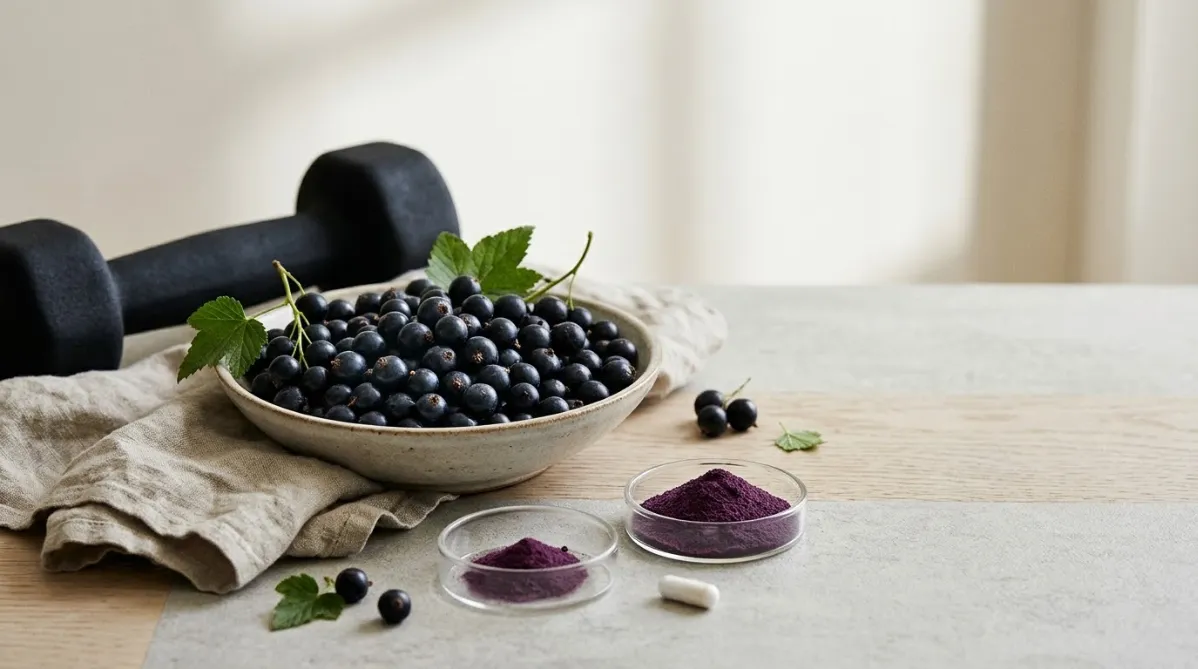
A berry extract made your bench press go up in one week, and the smaller dose often looked as good as the bigger one. That is the headline from a new trial of New Zealand blackcurrant (NZBC) in resistance-trained adults. The full picture is messier, and the messy part is the most useful part for anyone thinking of buying it.
What the researchers actually did
The paper, published in Nutrients, was a randomized, double-blind, placebo-controlled crossover study. Twenty resistance-trained adults went through four seven-day conditions:
- No-capsule control (CON)
- Placebo (PL)
- Low-dose blackcurrant (LDBC): 250 mg per day
- High-dose blackcurrant (HDBC): 600 mg per day
NZBC is rich in anthocyanins and has been reported to have ergogenic effects in endurance exercise. Its effects in strength-trained people were largely unexplored. The team measured bench press and leg press 1RM, total lifting volume, bench press power on a Tendo unit, 30-second Wingate performance, Stroop Color-Word Test scores, readiness, perceived exertion, blood pressure and other hemodynamic responses, and adverse events.
The bench press result
Both doses raised bench press 1RM versus control and versus placebo. Against the no-capsule control, the gains were +3.33 kg for the low dose (effect size 0.72, p = 0.005) and +2.34 kg for the high dose (effect size 0.49, p = 0.041). A couple of kilograms on a max bench is modest, but it is the kind of change lifters notice, and it held up against placebo. Bench press total volume showed no significant overall treatment effect.
Power: the high dose's moment
The high dose had its best result in bar speed. On the Tendo-derived bench press measures, HDBC beat placebo for peak power by 79.5 W (p = 0.006) and for mean power by 46.2 W (p = 0.026). The abstract doesn't report a matching power win for the low dose. So "more is better" doesn't hold across the board, but neither does "less is better." The outcomes behaved differently.
The brain bonus
The Stroop test measures attention and cognitive interference. The low dose beat placebo on the Color, Color-Word and total scores. The high dose beat placebo on Color-Word only. Here the lower dose looked at least as good as the higher one.
The catch: placebo did something too
The leg press numbers look spectacular. Leg press 1RM was higher than control by 37.2 kg with the low dose and 25.8 kg with the high dose. Leg press volume was up by 2,627 kg and 1,025 kg respectively. But the placebo also beat the no-capsule control on leg press.
The authors say this suggests non-specific effects may have contributed to some of the lower-body gains. These could include taking a capsule at all, expectation, repeated testing, or period effects. Their conclusion is that placebo-controlled contrasts should carry the most weight when judging what blackcurrant itself does. That is why the bench press 1RM, Tendo power and Stroop findings are the more credible ones: they were measured against placebo, not just against doing nothing. Treat the big leg press numbers against CON with caution.
What didn't change
- Wingate performance: no differences across any condition, so there was no sign of a boost in 30-second all-out cycling.
- Hemodynamic responses and adverse events: comparable across all conditions, and both doses were well tolerated over the short term.
Limitations to keep in mind
- Small sample: 20 participants, in a crossover design. Results may not generalize widely.
- Short duration: only seven days per condition. Nothing is known here about longer use.
- Mixed signals: the placebo-versus-control gap shows how easily testing effects and expectation can inflate results.
- Dose pattern: the low dose did as well as or better than the high dose on several outcomes, except for bench press power. The abstract doesn't explain why, and a trial this size can't settle it.
- Conflicts of interest: the authors declare none. The abstract doesn't mention funding, so check the full paper for that.
Practical takeaways
Dose studied: 250 mg per day or 600 mg per day for seven days. If you try it, the lower dose is the more economical place to start, since it matched or beat the higher dose on bench 1RM and Stroop outcomes. The abstract doesn't specify timing relative to training, so no timing advice can be drawn from it.
Who it might suit: experienced lifters who want to experiment with a low-risk supplement and who can judge changes against a fair baseline. The participants were resistance-trained adults, so the findings apply to that group.
Who should skip it or be cautious: beginners, who weren't studied. Anyone expecting a Wingate-style sprint boost should skip it, since that didn't change. People with medical conditions, those on medication, or those who are pregnant should talk to a clinician first, as the study doesn't cover those groups. Anyone who wants proof of a long-term benefit should also wait for more research.
Bottom line
This is an interesting, tidy early signal, not a verdict. A week of blackcurrant extract was linked to a few kilograms more on the bench, better bar power at the higher dose, and better Stroop scores, all against placebo. The leg press gains are muddied by a placebo effect. Until larger and longer trials replicate it, treat NZBC as a promising experiment rather than a proven strength aid.