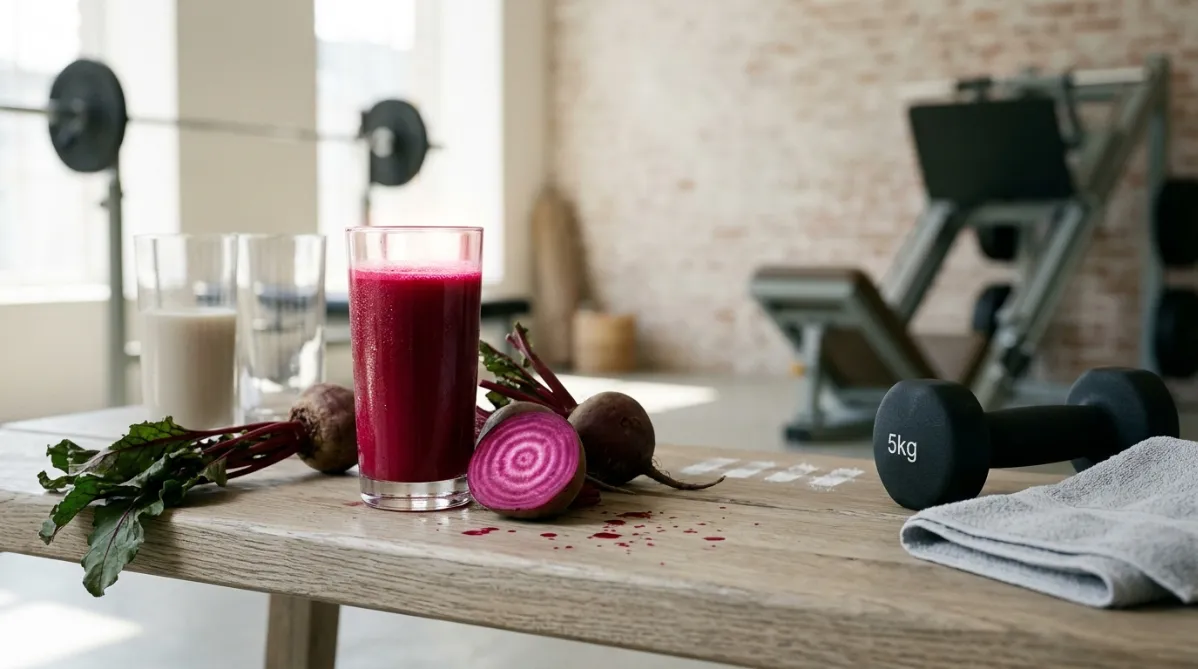
A new head-to-head trial puts two popular supplements against each other over a very short window. The study, by Ammar and colleagues in the International Journal of Food Sciences and Nutrition (2026), compared creatine (CR) with beetroot juice (BJ) and a placebo (PLA). It looked at resistance training capacity, performance and physiological responses over roughly 72 hours of supplementation. The answer to "which one wins" depends on what you measure.
How the study was run
This was a randomized controlled crossover trial. Eleven novice resistance-trained men completed bench press and back squat sets at 60-80% of their one-rep max (1RM) under all three conditions: creatine, beetroot juice and placebo. Because every participant acted as his own control, differences between conditions are less likely to reflect differences between people.
The researchers tracked several outcomes:
- Repetition performance
- Movement velocity
- Intramuscular oxygen saturation (SmO2)
- Peak heart rate
- Heart rate variability (HRV), a window into autonomic recovery
- The prevalence of meaningful individual responses ("modulation")
Where creatine won
Creatine's clear win was in the mechanical output most lifters care about. It significantly improved repetition performance at 80% 1RM in the bench press compared with placebo (d = 1.33, a large effect). The abstract reports this repetition benefit only for creatine. The authors conclude that creatine "preferentially enhanced mechanical performance."
That fits the established role of creatine in supporting phosphocreatine-based energy production for short, high-intensity efforts. Heavy sets near failure are where that system is most stressed.
Where beetroot juice won
Beetroot juice took most of the remaining categories, according to the abstract:
- Velocity: Both supplements produced moderate-to-very large effects on movement velocity, but BJ had the superior effect (d = 1.40-2.82 vs. placebo).
- Muscle oxygenation: BJ gave higher SmO2 (d = 1.74-2.9) than both placebo and creatine.
- Cardiovascular strain: BJ gave lower peak heart rate (d = 0.83-2.74) than both placebo and creatine.
- Autonomic recovery: BJ produced more favourable HRV-based recovery, for example RMSSD (d = 0.91-2.99), compared with both placebo and creatine.
- Individual responses: The modulation analysis found a greater proportion of meaningful individual adaptations with BJ than with CR.
The authors summarise this as BJ providing "broader cardiometabolic and autonomic benefits." That is consistent with beetroot's nitrate content, which is generally linked to nitric oxide pathways, blood flow and oxygen use. The abstract doesn't test that mechanism directly, so treat it as context rather than a finding.
Scorecard
| Outcome | Result per abstract |
|---|---|
| Bench press reps at 80% 1RM | Creatine beat placebo (d = 1.33) |
| Velocity | Both beat placebo; beetroot stronger |
| Muscle oxygen saturation | Beetroot beat placebo and creatine |
| Peak heart rate | Beetroot lower than placebo and creatine |
| HRV / autonomic recovery | Beetroot better than placebo and creatine |
| Meaningful individual responses | Beetroot beat creatine |
Beetroot juice did not "lose" any of these categories to creatine. But creatine was the only one credited with the repetition gain, and rep capacity is the most direct measure of lifting volume.
Doses and timing: what we can and can't say
The abstract confirms a supplementation period of about 72 hours and testing at 60-80% 1RM in bench press and back squat. It does not report doses, the number of daily servings, or how close to the session each was taken. Check the full text before copying a protocol.
For general context only, and not drawn from this study, the wider literature often uses 3-5 g of creatine monohydrate daily. Beetroot protocols often provide several millimoles of nitrate, taken a few hours before exercise. Product nitrate content varies widely, so labels matter.
Who should pick which?
- Chasing heavy-set rep performance: Creatine has the more direct evidence here, since it was the one that improved bench press reps at 80% 1RM.
- Wanting faster bar speed, lower cardiovascular strain or better recovery markers: Beetroot juice looked stronger on velocity, SmO2, peak HR and HRV.
- High-volume or metabolically demanding sessions: BJ's oxygenation and heart-rate profile may suit these, though the abstract doesn't test this directly.
- Can't decide: The study compared the supplements separately, not stacked, so it can't say whether combining them adds anything.
Limitations
The sample was only 11 novice trained men, so results may not transfer to women, advanced lifters or older adults. Effect sizes in small crossover trials can look very large and tend to shrink in bigger samples. The 72-hour window also says little about long-term strength or hypertrophy. Creatine is usually studied over weeks and is best known for building a muscle stores base, so a three-day snapshot may not capture its full effect.
Bottom line
In this short trial, creatine won on the number that fills a training log, bench press reps at 80% 1RM. Beetroot juice won on movement speed and the physiological markers around the lift. Pick based on your goal, and confirm the dosing details in the full paper before putting either into practice.