Dr. Gymbro
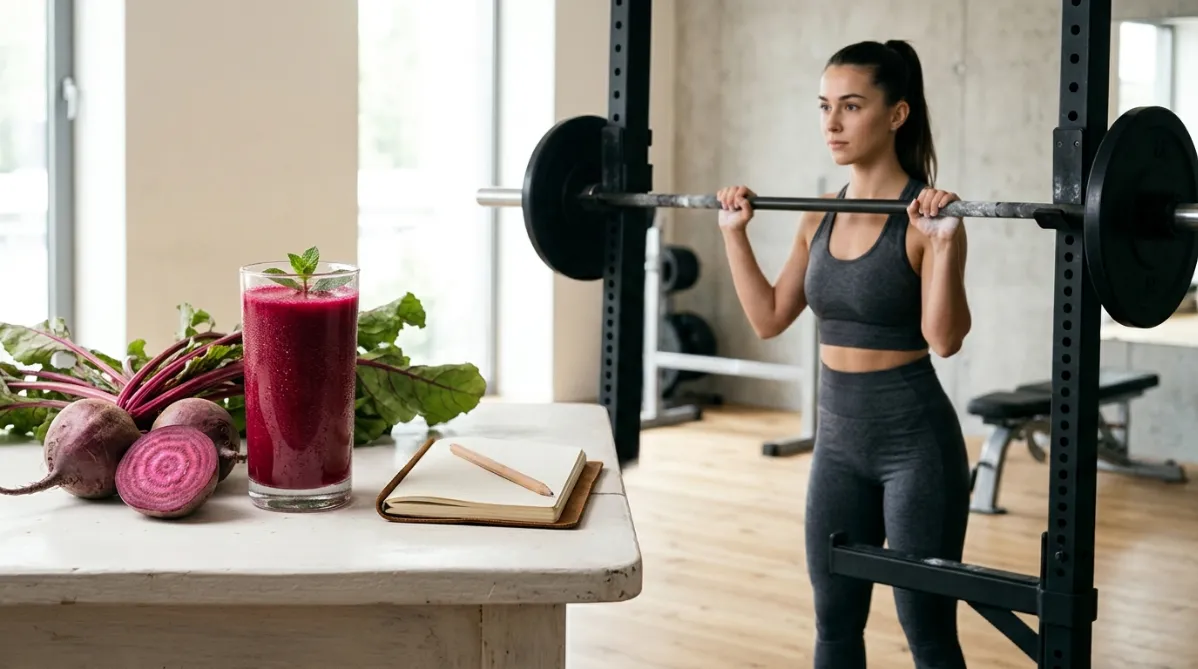
A wide, editorial-style still life photographed in soft natural window light, set on a pale oak gym bench or a light concrete surface. In the center foreground, a tall clear glass of deep magenta-crimson beetroot juice catches the light, with a faint luminous glow along its rim and condensation beading on the outside. Two other glasses sit slightly behind it, one holding a pale, neutral-colored liquid and one empty. They suggest the placebo and no-treatment conditions without any labels. Beside the glasses, a halved raw beetroot shows concentric rings of vivid fuchsia and violet. A few whole beets with their leafy stems and dark green and burgundy leaves are scattered casually nearby.

On the right side of the frame, slightly out of focus, a matte black women's-size dumbbell and a neatly folded light gray towel rest on the bench. Behind them, the soft blur of a minimalist, airy training space includes a barbell rack and a leg press machine in muted tones. The background is bright and neutral, in warm off-white, soft sand, and light gray, so the magenta of the juice is the dominant accent color.

A small, restrained motif of four evenly spaced chalk marks or four small round weight plates arranged in a neat row on the bench hints at the "four sets" of the trial. A few drops of beet juice have splashed onto the surface, forming a tasteful organic pattern.

The composition follows the rule of thirds, with the glass of juice on the left third and open negative space on the right for headline text. Shallow depth of field, crisp focus on the glass and beet, subtle film-like grain, and a calm, modern, trendy magazine aesthetic. The palette is magenta, deep burgundy, sage green, cream, and soft gray. The mood is quiet, skeptical, and scientific without any laboratory imagery, with clean lines and an elegant, minimal feel.
supplements

Beetroot Juice Didn't Add a Single Rep for Resistance-Trained Women

Dr. Gymbro · · 4 min read

Beetroot juice has a reputation as a natural performance booster, with endurance athletes drinking it before racing and lifters wondering if it can squeeze out extra reps. A new randomized, double-blind, crossover trial suggests that for resistance-trained women, the payoff may be zero. The result isn't a small or ambiguous effect. It's a clean null.

The Study: Putting Nitrate to the Test in Women

The paper, by Teodoro, Guimarães and Manoel, was published in Nutrition and Health in 2026. It targets a gap in the research. Most nitrate studies in resistance exercise have used male participants, so how women respond has been mostly guesswork.

Sixteen recreationally trained women took part (average age 27 ± 4.7 years). Their average one-repetition maximum was about 31 kg on the bench press and about 199 kg on the 45° leg press. Each woman completed three separate sessions in a randomized order:

  • Nitrate-rich beetroot juice: BEET It Sport, providing 12.8 mmol of nitrate (NO3-)
  • Placebo drink: containing just 0.92 mmol of nitrate
  • Control: nothing at all

The drink, when given, was consumed 2.5 hours before training. That timing is in line with common practice, since nitrate-related effects are usually thought to peak a few hours after ingestion.

The Workout: Four Sets to Failure

In each session the women performed four sets of bench press and four sets of leg press, each taken to concentric failure at 60% of their 1RM with two-minute rest intervals. That's a demanding muscular endurance test, and total repetitions across all sets served as the primary performance measure. If nitrate improved blood flow, oxygen economy or muscle contractility enough to matter, this protocol should have shown it.

The Results: A Flat Line Across the Board

It didn't. In the bench press, total repetitions were 55.6 ± 9.7 for control, 58.9 ± 13.0 for placebo and 56.0 ± 14.0 for nitrate (p = 0.785). In the leg press, the numbers were 82.6 ± 36.0, 80.4 ± 37.0 and 79.3 ± 30.0 reps respectively (p = 0.945).

The effect sizes were essentially nonexistent (ηp² of 0.003 for bench and 0.001 for leg press). If anything, the placebo condition posted the highest bench total, a reminder of how noisy rep-to-failure data can be and how easily expectation effects can creep in.

The secondary measures told the same story. Compared with placebo, nitrate had no significant effect on:

  • Rating of perceived exertion
  • Heart rate
  • Blood pressure
  • Blood lactate

So the juice didn't improve performance, and it didn't visibly change the body's acute physiological response to the workout either.

Why Might Nitrate Have Fallen Flat Here?

The study can't say why, but there are plausible directions for future work. Nitrate is converted to nitric oxide, which may improve blood flow and muscle efficiency. Some research suggests these benefits are strongest in type II muscle fibers and under conditions of low oxygen availability. Whether the effect differs between sexes, training status or exercise type is still unsettled, and this trial wasn't designed to untangle those variables.

The leg press data also show large variability. Standard deviations of 30 to 37 reps around means of roughly 80 mean individual differences were big. With only 16 participants, a small real effect could be hidden in that noise, though the near-identical group averages make a large effect unlikely under this protocol.

Limitations Worth Keeping in Mind

This is not a verdict that beetroot juice is useless for everyone. The study tested a single acute dose in a small group of recreationally trained women using one specific protocol: moderate load, high repetitions, short-ish rest. Results could differ for:

  • Higher-load strength work, such as sets of 1 to 5 reps
  • Chronic supplementation over several days or weeks
  • Elite or highly trained athletes
  • Different nitrate doses or dosing windows

The researchers also didn't claim otherwise. Their conclusion is measured: the ergogenic potential of nitrate may be limited in this population.

The Practical Takeaway

If you're a resistance-trained woman hoping a shot of beetroot juice will add reps to your high-rep sets, this study gives you little reason to expect it. The group-level data showed no measurable benefit in either the upper or lower body, so the money and the stained shaker may be better spent elsewhere. Training consistency, progressive overload, sleep, adequate protein and total energy intake have far stronger evidence behind them.

That said, beetroot juice isn't harmful in this context, and it remains a source of dietary nitrate for those who like it or who have other reasons to consume it. Just don't count on it to turn a stalled set into a personal best.

The bigger win from this study may be methodological. By including both a placebo and a no-supplement control, the researchers show how much variation can occur with no active ingredient at all. As more research on women accumulates, we'll get a clearer picture of which supplement claims actually hold up, and which ones were built on male-only data.

Original study

Read the original research on pubmed.ncbi.nlm.nih.gov →

This article summarizes published research for general information. It is not medical advice.

DG

Written by

Dr. Gymbro

Dr. Gymbro writes for Dr. Gymbro: science-backed fitness, nutrition & performance.

Related Articles

A wide editorial still life on a clean, pale oatmeal-colored linen surface, lit by soft natural window light from the left. In the center-left, a small clear glass shot glass filled with deep magenta-crimson beetroot juice catches a glowing highlight, with a few droplets beaded on the surface beside it. Behind it sit two whole beetroots with their leafy stems, the skins a dusty burgundy and the stems a vivid pink-red, and one beetroot sliced in half to reveal concentric rings of magenta and soft pink. To the right, a vintage-style brass stopwatch rests at an angle on the linen, its white face crisp and its hands frozen, slightly out of focus in the foreground edge. A faint curve of a sprinting track lane, in muted terracotta with thin white lines, sweeps diagonally across the blurred background, hinting at a running track without showing any people. Scattered across the surface are a few small, delicate beet-colored splashes and a light dusting of coarse sea salt. The palette is restrained and modern: warm cream, terracotta, dusty rose, deep magenta, and touches of sage green from the leaves. Shallow depth of field and a gentle film-like grain give it a contemporary lifestyle-magazine feel. The composition leaves generous negative space on the upper right for title overlay. Minimalist, tactile, calm, and sophisticated, in the style of a high-end health and science journal's editorial photography, 16:9 landscape.
nutrition

Beetroot Juice Boosted Nitrite 35x, But Sprinters Got No Faster

BY DR. GYMBRO ·

Beetroot juice sent salivary nitrite soaring about 35-fold in trained sprinters, which sounds like the start of a performance miracle. Then the stopwatch came out. In a randomized, double-blind, placebo-controlled study of 12 male sprinters, a 70 mL shot of beetroot juice didn't improve 60 m or 100 m times, jump height, or most measures of muscle function. Here is what was tested, what the study can't tell us, and who should save their money.

A wide, editorial-style still life photographed on a pale warm-gray concrete surface in soft, diffused morning window light. On the left side, a tall clear glass filled with deep magenta-crimson beetroot juice sits beside two halved raw beetroots, their concentric rings of vivid fuchsia and purple clearly visible, with a few small green-and-red-veined leaves draped casually nearby. On the right side, a matching clear glass of cloudy white creatine solution rests next to a small matte ceramic bowl heaped with fine white powder and a minimal wooden scoop, a light dusting of powder scattered across the surface. In the center, between the two sides, a simple matte black barbell grip and a single chalk-dusted weight plate edge rise into the frame at a low angle, hinting at lifting without showing a person. The composition is split in a balanced, symmetrical way, with a subtle vertical shadow line dividing the saturated magenta tones on the left from cool, neutral whites and creams on the right. The background is softly blurred with a muted sage-green and oatmeal-toned wall, with plenty of negative space at the top for a headline overlay. Shallow depth of field, crisp focus on the glasses' condensation droplets and the textured beetroot flesh. The color palette is limited and refined: magenta, cream, charcoal, and soft sage. The mood is clean, modern, and health-journal chic, like a contemporary wellness magazine cover, with natural shadows, a tactile matte finish, and subtle film-like grain. No text, no logos, no futuristic elements.
nutrition

Beetroot Juice vs Creatine: Who Wins for Lifting in 72 Hours?

BY DR. GYMBRO ·

A new randomized crossover trial pitted beetroot juice against creatine over about 72 hours of supplementation in novice lifters. Creatine was the one credited with more bench press reps at 80% 1RM, while beetroot juice led on bar velocity, muscle oxygenation, peak heart rate and HRV recovery. The abstract doesn't report doses or timing, so we flag what's missing. Here's the full scorecard and who might choose which supplement.

A wide, editorial-style photograph of a bright, modern gym corner softened by morning window light. In the foreground, a rustic matte-white ceramic table holds a tall clear glass of deep magenta beetroot juice, beads of condensation on the glass, a few fresh whole beetroots with leafy crimson-veined stems beside it, and one beetroot sliced in half to reveal its vivid concentric purple-pink rings. Next to the glass sits a small, neat notebook with a pencil, suggesting a research note, with no legible text. Behind the table, slightly out of focus, a young woman lifter with a tidy ponytail and a fitted charcoal training set stands at a barbell resting on a squat rack, chalk-dusted hands gripping the bar, calm and focused expression. A loaded bench with a bar is visible further back, with matte black plates and a light wooden floor. The palette is restrained and trendy: warm off-white, soft concrete gray, muted sage green accents from the beet leaves, and a bold beetroot magenta as the focal color. Shallow depth of field with a creamy bokeh background, natural side lighting casting long gentle shadows, subtle film grain. Composition follows the rule of thirds, with the juice and beets on the left third and the lifter on the right, leaving clean negative space in the upper area for a headline overlay. Mood is thoughtful, clean, and slightly skeptical, like a contemporary health and science journal cover. Realistic photography style, high-end magazine look, no text, no logos, no futuristic elements.
nutrition

Beetroot Juice Failed Women Lifters—and Even Slowed the Bench

BY DR. GYMBRO ·

Beetroot juice has a reputation as a natural performance booster, but a new crossover trial in 18 resistance-trained women found no squat benefit at all. Even stranger, bench press power and velocity dipped slightly at one load (60% 1RM) after a ~6.7 mmol nitrate dose taken 2.5 hours before training. The drop was only about 5 W and 0.02 m/s, with borderline P values, so it's far from a verdict. Here's what the study tested, what it can't tell us, and who might still want to experiment with nitrate.

A softly lit, minimalist gym interior photographed in a modern editorial style. In the foreground, a muscular lifter in a fitted charcoal tank top is mid-set at a cable station, forearm and shoulder muscles defined, a light dusting of chalk on their hands. The frame is shot at a slight low angle with shallow depth of field, so the background gym equipment melts into creamy blur. On a matte concrete-textured bench beside them sits a clean, unbranded matte-white scoop container of white powder, a stainless steel shaker bottle, and a small analog stopwatch, arranged with careful, magazine-style composure. A few loose grains of white powder catch the light on the bench surface.

Warm golden late-afternoon sunlight pours through tall industrial windows on the left, creating long diagonal light streaks, gentle lens flare, and a subtle haze of floating chalk dust that glows in the beams. The palette is restrained and sophisticated: warm sand, soft cream, muted terracotta, deep charcoal, and a single accent of sage green from a potted plant on a shelf. Rows of neatly racked dumbbells in dark metal repeat in the mid-ground, adding rhythm and depth.

The composition follows the rule of thirds: the lifter and supplement still life occupy the right two-thirds, while the left third remains calm, with a smooth, softly blurred wall and window light, leaving generous negative space for headline text. Subtle film grain, natural color grading, and a slightly desaturated, high-end lifestyle photography look evoke a contemporary health and science journal. No text, logos, or graphics. Clean, aspirational, grounded, and tactile, with a sense of focused effort and quiet intensity.
nutrition

Beta-Alanine Finally Works for Lifters—If You Train Like This

BY DR. GYMBRO ·

Beta-alanine has long had a murky track record for lifting, but a new randomized controlled trial may explain why. When trained lifters took 6.4 g per day for four weeks, their total reps rose 17.3% on drop sets and 18.2% on bi-sets, while placebo showed no significant gains. Perceived exertion, motivation, and affect did not differ between groups, so the boost was physical rather than psychological. Here is the dose, the loading period, who the data applies to, and who should stay skeptical.

This page is available in