Dr. Gymbro
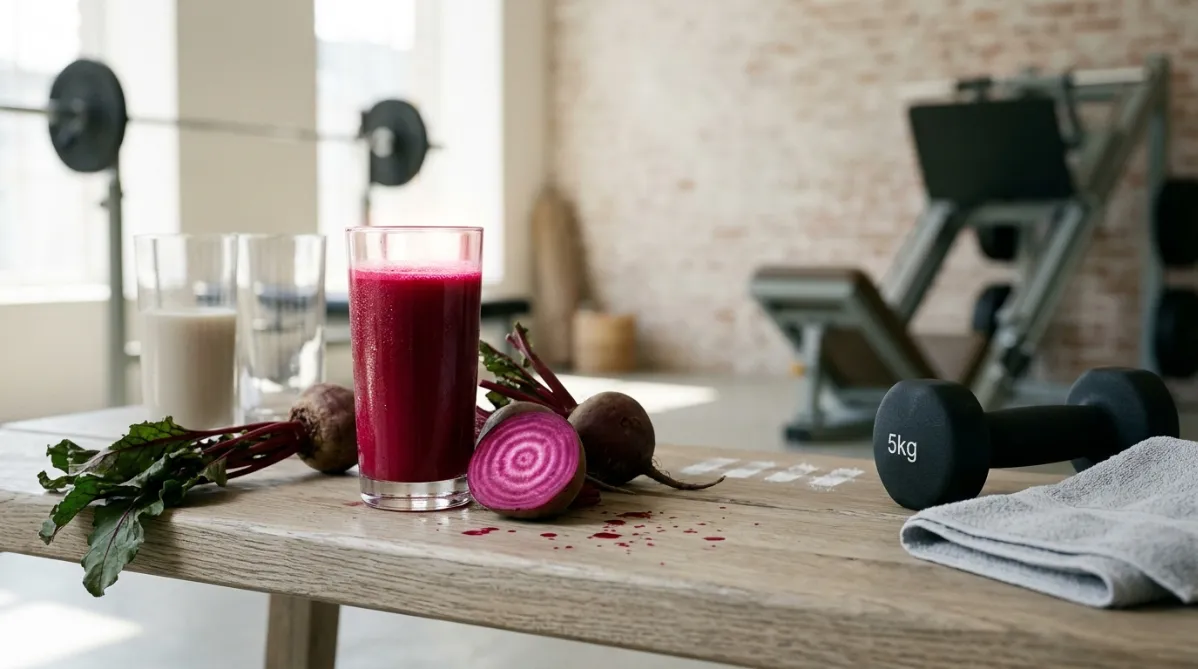
A wide, editorial-style still life photographed in soft natural window light, set on a pale oak gym bench or a light concrete surface. In the center foreground, a tall clear glass of deep magenta-crimson beetroot juice catches the light, with a faint luminous glow along its rim and condensation beading on the outside. Two other glasses sit slightly behind it, one holding a pale, neutral-colored liquid and one empty. They suggest the placebo and no-treatment conditions without any labels. Beside the glasses, a halved raw beetroot shows concentric rings of vivid fuchsia and violet. A few whole beets with their leafy stems and dark green and burgundy leaves are scattered casually nearby.

On the right side of the frame, slightly out of focus, a matte black women's-size dumbbell and a neatly folded light gray towel rest on the bench. Behind them, the soft blur of a minimalist, airy training space includes a barbell rack and a leg press machine in muted tones. The background is bright and neutral, in warm off-white, soft sand, and light gray, so the magenta of the juice is the dominant accent color.

A small, restrained motif of four evenly spaced chalk marks or four small round weight plates arranged in a neat row on the bench hints at the "four sets" of the trial. A few drops of beet juice have splashed onto the surface, forming a tasteful organic pattern.

The composition follows the rule of thirds, with the glass of juice on the left third and open negative space on the right for headline text. Shallow depth of field, crisp focus on the glass and beet, subtle film-like grain, and a calm, modern, trendy magazine aesthetic. The palette is magenta, deep burgundy, sage green, cream, and soft gray. The mood is quiet, skeptical, and scientific without any laboratory imagery, with clean lines and an elegant, minimal feel.
supplements

El jugo de remolacha no sumó ni una sola repetición en mujeres entrenadas en resistencia

Dr. Gymbro · · 4 min read

El jugo de remolacha goza de reputación como potenciador natural del rendimiento; atletas de resistencia lo beben antes de competir y levantadores se preguntan si puede proporcionar repeticiones extra. Un nuevo ensayo aleatorizado, doble ciego y cruzado indica que, en mujeres entrenadas en resistencia, la ventaja es nula. No se trata de un efecto pequeño o ambiguo, sino de una ausencia total de efecto.

El estudio: poniendo a prueba el nitrato en mujeres

El artículo, de Teodoro, Guimarães y Manoel, se publicó en Nutrition and Health en 2026. Pretende cubrir un vacío en la investigación, ya que la mayor parte de los estudios sobre nitrato y ejercicios de fuerza se han realizado con hombres, dejando la respuesta femenina en gran medida como una suposición.

Participaron dieciséis mujeres entrenadas de forma recreativa (edad media 27 ± 4,7 años). Su una repetición máxima (1RM) promedio era de aproximadamente 31 kg en press de banca y 199 kg en la prensa de piernas a 45°.

Cada mujer completó tres sesiones distintas en orden aleatorio:

  • Jugo de remolacha rico en nitrato: BEET It Sport, que aporta 12,8 mmol de nitrato (NO₃⁻)
  • Bebida placebo, que contiene solo 0,92 mmol de nitrato
  • Control: nada en absoluto

Cuando se administró, la bebida se consumió 2,5 horas antes del entrenamiento, intervalo que coincide con la práctica habitual, pues se cree que los efectos del nitrato alcanzan su pico a las pocas horas de la ingesta.

El entrenamiento: cuatro series hasta el fallo

En cada sesión, las participantes realizaron cuatro series de press de banca y cuatro series de prensa de piernas, cada una llevada al fallo concéntrico con una carga del 60 % de su 1RM y descansos de dos minutos. Es una prueba exigente de resistencia muscular, y el total de repeticiones acumuladas en todas las series se utilizó como medida primaria de rendimiento. Si el nitrato mejorara el flujo sanguíneo, la economía de oxígeno o la contractilidad muscular lo suficiente como para marcar la diferencia, este protocolo lo habría revelado.

Los resultados: línea plana en todo

No lo hizo. En el press de banca, el total de repeticiones fue 55,6 ± 9,7 para el control, 58,9 ± 13,0 para el placebo y 56,0 ± 14,0 para el nitrato (p = 0,785). En la prensa de piernas, los valores fueron 82,6 ± 36,0, 80,4 ± 37,0 y 79,3 ± 30,0 repeticiones, respectivamente (p = 0,945).

Los tamaños del efecto fueron esencialmente nulos (ηp² = 0,003 para el press y ηp² = 0,001 para la prensa). De hecho, la condición placebo mostró el mayor total en press de banca, lo que recuerda lo ruidosos que pueden ser los datos de repeticiones hasta el fallo y lo fácil que resulta que la expectativa influya en los resultados.

Las medidas secundarias contaron la misma historia. En comparación con el placebo, el nitrato no tuvo efecto significativo en:

  • Valoración de la percepción del esfuerzo (RPE)
  • Frecuencia cardiaca
  • Presión arterial
  • Lactato sanguíneo

Así que el jugo no mejoró el rendimiento ni alteró visiblemente la respuesta fisiológica aguda del cuerpo al entrenamiento.

¿Por qué el nitrato pudo haber quedado plano?

El estudio no puede afirmar la causa, pero abre varias direcciones plausibles para futuras investigaciones. El nitrato se convierte en óxido nítrico, lo que puede favorecer el flujo sanguíneo y la eficiencia muscular. Algunas investigaciones sugieren que estos beneficios son más pronunciados en fibras musculares tipo II y bajo condiciones de baja disponibilidad de oxígeno. Si el efecto difiere entre sexos, nivel de entrenamiento o tipo de ejercicio, aún está por determinarse, y este ensayo no fue diseñado para desenredar esas variables.

Los datos de la prensa de piernas también muestran una gran variabilidad. Desviaciones estándar de 30 a 37 repeticiones alrededor de medias de aproximadamente 80 indican diferencias individuales sustanciales. Con solo 16 participantes, un efecto real pequeño podría ocultarse entre el ruido, aunque los promedios casi idénticos hacen improbable un efecto grande bajo este protocolo.

Limitaciones a tener en cuenta

Esto no es un veredicto de que el jugo de remolacha sea inútil para todos. El estudio probó una única dosis aguda en un grupo reducido de mujeres recreativamente entrenadas, usando un protocolo específico: carga moderada, altas repeticiones y descansos relativamente cortos. Los resultados podrían variar para:

  • Trabajo de fuerza con cargas altas, como series de 1 a 5 repeticiones
  • Suplementación crónica durante varios días o semanas
  • Atletas de élite o muy entrenados
  • Dosis de nitrato diferentes o ventanas de ingesta distintas

Los investigadores tampoco afirmaron lo contrario. Su conclusión es medida: el potencial ergogénico del nitrato podría ser limitado en esta población.

La conclusión práctica

Si eres una mujer entrenada en resistencia y esperas que una dosis de jugo de remolacha añada repeticiones a tus series de alta repetición, este estudio te brinda pocas razones para contar con ello. Los datos a nivel grupal no mostraron ningún beneficio mensurable ni en la parte superior ni en la inferior del cuerpo, por lo que el dinero y el batidor manchado podrían destinarse a otras cosas. La constancia del entrenamiento, la sobrecarga progresiva, el sueño, una ingesta adecuada de proteína y de energía total tienen evidencias mucho más sólidas.

Dicho esto, el jugo de remolacha no es perjudicial en este contexto y sigue siendo una fuente de nitrato dietético para quienes lo disfrutan o tienen otras razones para consumirlo. Simplemente, no cuentes con que convierta una serie estancada en un nuevo récord personal.

El mayor aporte de este estudio quizá sea metodológico. Al incluir tanto un placebo como un control sin suplemento, los investigadores demuestran cuánta variación puede aparecer sin ningún ingrediente activo. Conforme se acumule más investigación con mujeres, obtendremos una visión más clara de qué afirmaciones de suplementos realmente se sostienen y cuáles se construyeron sobre datos exclusivamente masculinos.

Original study

Read the original research on pubmed.ncbi.nlm.nih.gov →

This article summarizes published research for general information. It is not medical advice.

DG

Written by

Dr. Gymbro

Dr. Gymbro writes for Dr. Gymbro: science-backed fitness, nutrition & performance.

Related Articles

A wide editorial still life on a clean, pale oatmeal-colored linen surface, lit by soft natural window light from the left. In the center-left, a small clear glass shot glass filled with deep magenta-crimson beetroot juice catches a glowing highlight, with a few droplets beaded on the surface beside it. Behind it sit two whole beetroots with their leafy stems, the skins a dusty burgundy and the stems a vivid pink-red, and one beetroot sliced in half to reveal concentric rings of magenta and soft pink. To the right, a vintage-style brass stopwatch rests at an angle on the linen, its white face crisp and its hands frozen, slightly out of focus in the foreground edge. A faint curve of a sprinting track lane, in muted terracotta with thin white lines, sweeps diagonally across the blurred background, hinting at a running track without showing any people. Scattered across the surface are a few small, delicate beet-colored splashes and a light dusting of coarse sea salt. The palette is restrained and modern: warm cream, terracotta, dusty rose, deep magenta, and touches of sage green from the leaves. Shallow depth of field and a gentle film-like grain give it a contemporary lifestyle-magazine feel. The composition leaves generous negative space on the upper right for title overlay. Minimalist, tactile, calm, and sophisticated, in the style of a high-end health and science journal's editorial photography, 16:9 landscape.
nutrition

El jugo de remolacha elevó el nitrito 35 veces, pero los velocistas no fueron más rápidos

BY DR. GYMBRO ·

Un estudio con 12 velocistas entrenados mostró que 70 mL de jugo de remolacha aumentaron el nitrito salival unas 35 veces, pero no mejoraron ni el sprint de 60 m ni el de 100 m, ni la altura del salto ni la mayoría de los parámetros musculares. Aquí analizamos qué se hizo, qué no se pudo demostrar y a quién conviene (o no) invertir en este suplemento.

A wide, editorial-style still life photographed on a pale warm-gray concrete surface in soft, diffused morning window light. On the left side, a tall clear glass filled with deep magenta-crimson beetroot juice sits beside two halved raw beetroots, their concentric rings of vivid fuchsia and purple clearly visible, with a few small green-and-red-veined leaves draped casually nearby. On the right side, a matching clear glass of cloudy white creatine solution rests next to a small matte ceramic bowl heaped with fine white powder and a minimal wooden scoop, a light dusting of powder scattered across the surface. In the center, between the two sides, a simple matte black barbell grip and a single chalk-dusted weight plate edge rise into the frame at a low angle, hinting at lifting without showing a person. The composition is split in a balanced, symmetrical way, with a subtle vertical shadow line dividing the saturated magenta tones on the left from cool, neutral whites and creams on the right. The background is softly blurred with a muted sage-green and oatmeal-toned wall, with plenty of negative space at the top for a headline overlay. Shallow depth of field, crisp focus on the glasses' condensation droplets and the textured beetroot flesh. The color palette is limited and refined: magenta, cream, charcoal, and soft sage. The mood is clean, modern, and health-journal chic, like a contemporary wellness magazine cover, with natural shadows, a tactile matte finish, and subtle film-like grain. No text, no logos, no futuristic elements.
nutrition

Jugo de remolacha vs creatina: ¿Quién gana en el levantamiento en 72 horas?

BY DR. GYMBRO ·

Un nuevo ensayo aleatorizado cruzado comparó jugo de remolacha con creatina durante unas 72 horas en levantadores novatos. La creatina mejoró el número de repeticiones en press de banca al 80 % de 1RM, mientras que el jugo de remolacha sobresalió en velocidad de barra, oxigenación muscular, frecuencia cardíaca máxima y recuperación medida por HRV. El resumen no indica dosis ni horarios de ingesta, por lo que señalamos lo que falta. Aquí tienes la tabla de resultados y quién podría elegir cada suplemento.

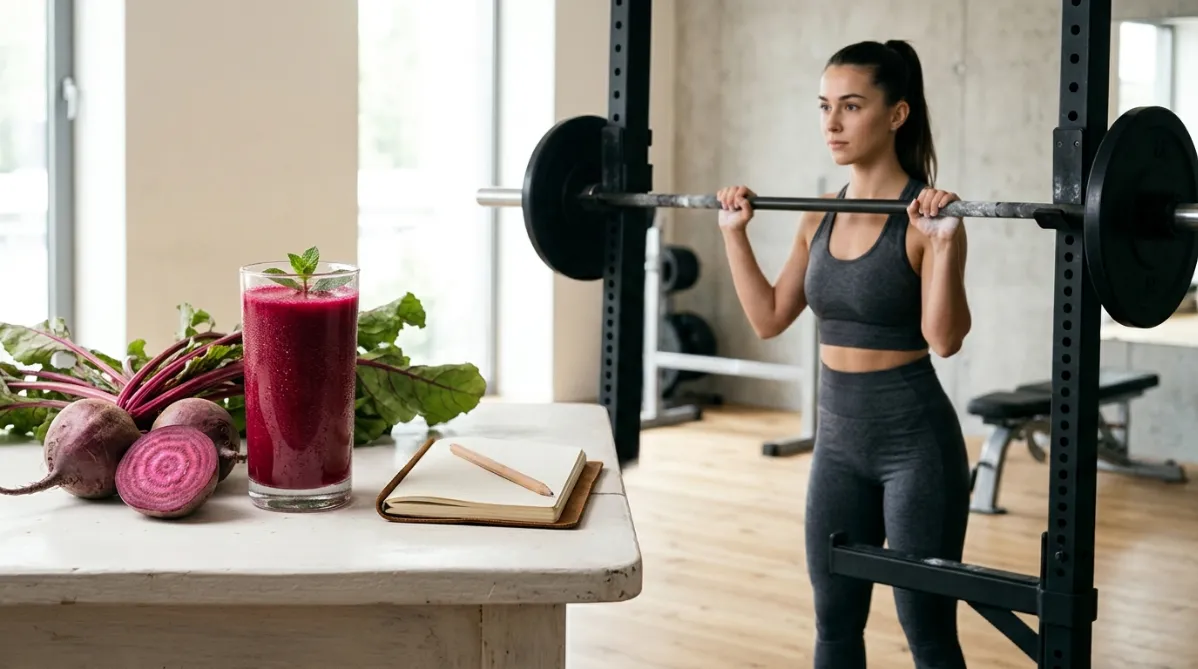
A wide, editorial-style photograph of a bright, modern gym corner softened by morning window light. In the foreground, a rustic matte-white ceramic table holds a tall clear glass of deep magenta beetroot juice, beads of condensation on the glass, a few fresh whole beetroots with leafy crimson-veined stems beside it, and one beetroot sliced in half to reveal its vivid concentric purple-pink rings. Next to the glass sits a small, neat notebook with a pencil, suggesting a research note, with no legible text. Behind the table, slightly out of focus, a young woman lifter with a tidy ponytail and a fitted charcoal training set stands at a barbell resting on a squat rack, chalk-dusted hands gripping the bar, calm and focused expression. A loaded bench with a bar is visible further back, with matte black plates and a light wooden floor. The palette is restrained and trendy: warm off-white, soft concrete gray, muted sage green accents from the beet leaves, and a bold beetroot magenta as the focal color. Shallow depth of field with a creamy bokeh background, natural side lighting casting long gentle shadows, subtle film grain. Composition follows the rule of thirds, with the juice and beets on the left third and the lifter on the right, leaving clean negative space in the upper area for a headline overlay. Mood is thoughtful, clean, and slightly skeptical, like a contemporary health and science journal cover. Realistic photography style, high-end magazine look, no text, no logos, no futuristic elements.
nutrition

El jugo de remolacha decepcionó a las levantadoras, e incluso ralentizó el press de banca

BY DR. GYMBRO ·

El jugo de remolacha es famoso por ser un potenciador natural del rendimiento, pero un ensayo cruzado con 18 mujeres entrenadas en resistencia no encontró mejoras en la sentadilla. Curiosamente, la potencia y la velocidad del press de banca disminuyeron ligeramente en una carga (60 % de 1RM) tras ingerir ~6,7 mmol de nitrato 2,5 h antes del entrenamiento. La caída fue de apenas 5 W y 0,02 m/s, con valores p marginales, por lo que lejos de constituir una conclusión definitiva. A continuación se explica qué probó el estudio, qué no puede decirnos y quién podría seguir experimentando con nitrato.

A softly lit, minimalist gym interior photographed in a modern editorial style. In the foreground, a muscular lifter in a fitted charcoal tank top is mid-set at a cable station, forearm and shoulder muscles defined, a light dusting of chalk on their hands. The frame is shot at a slight low angle with shallow depth of field, so the background gym equipment melts into creamy blur. On a matte concrete-textured bench beside them sits a clean, unbranded matte-white scoop container of white powder, a stainless steel shaker bottle, and a small analog stopwatch, arranged with careful, magazine-style composure. A few loose grains of white powder catch the light on the bench surface.

Warm golden late-afternoon sunlight pours through tall industrial windows on the left, creating long diagonal light streaks, gentle lens flare, and a subtle haze of floating chalk dust that glows in the beams. The palette is restrained and sophisticated: warm sand, soft cream, muted terracotta, deep charcoal, and a single accent of sage green from a potted plant on a shelf. Rows of neatly racked dumbbells in dark metal repeat in the mid-ground, adding rhythm and depth.

The composition follows the rule of thirds: the lifter and supplement still life occupy the right two-thirds, while the left third remains calm, with a smooth, softly blurred wall and window light, leaving generous negative space for headline text. Subtle film grain, natural color grading, and a slightly desaturated, high-end lifestyle photography look evoke a contemporary health and science journal. No text, logos, or graphics. Clean, aspirational, grounded, and tactile, with a sense of focused effort and quiet intensity.
nutrition

Beta‑alanina funciona para levantadores: si entrenas así

BY DR. GYMBRO ·

La beta‑alanina ha tenido una reputación ambivalente en el entrenamiento con pesas, pero un nuevo ensayo aleatorizado controlado ayuda a aclarar el panorama. Cuando levantadores experimentados tomaron 6,4 g al día durante cuatro semanas, sus repeticiones totales aumentaron un 17,3 % en series descendentes y un 18,2 % en bi‑series, mientras que el grupo placebo no mostró mejoras significativas. La percepción de esfuerzo, la motivación y el ánimo no cambiaron entre los grupos, de modo que el beneficio es puramente físico y no psicológico. Aquí tienes la dosis, el periodo de carga, a quiénes aplican los datos y quién debería seguir escéptico.

This page is available in