Dr. Gymbro
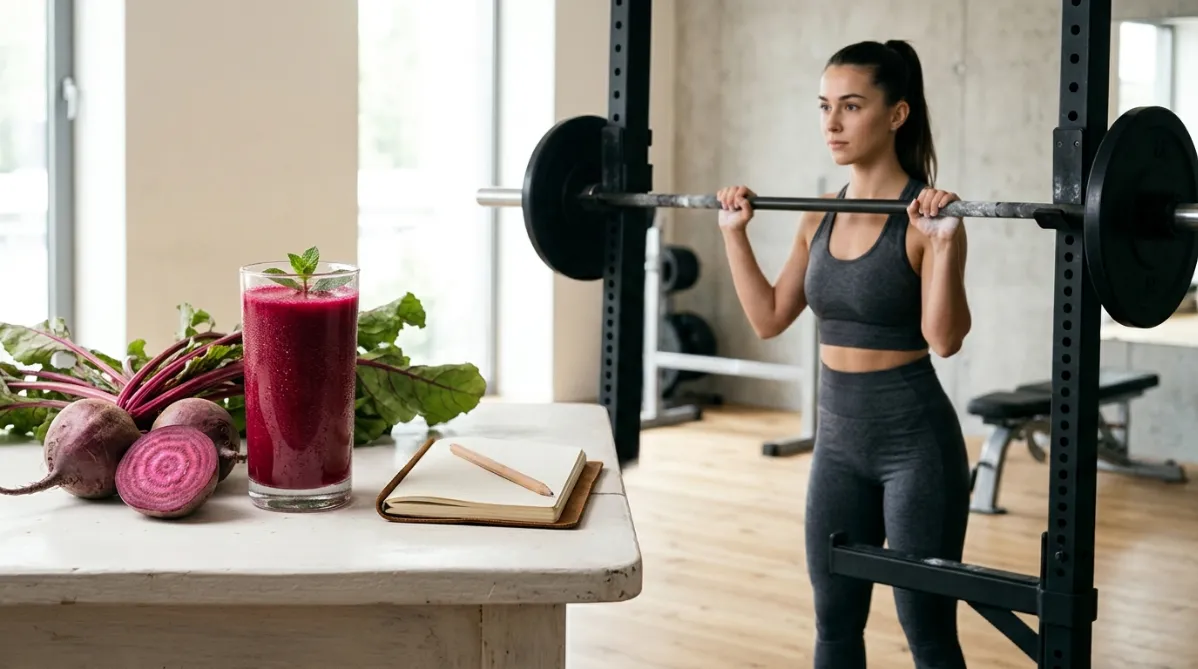
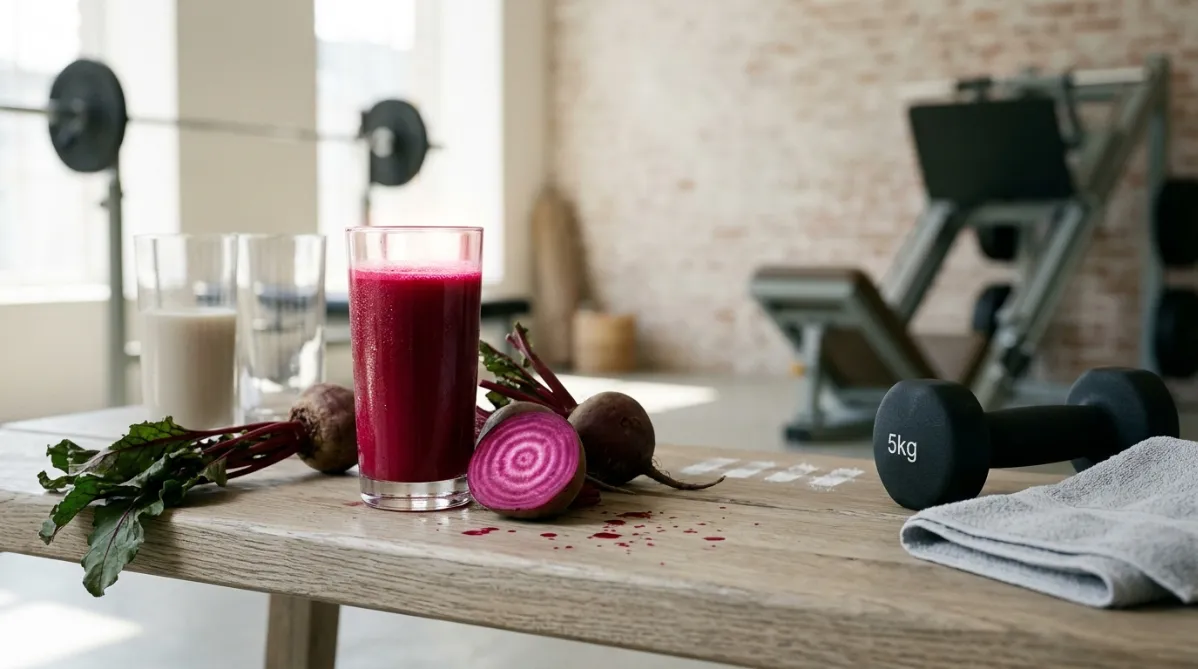
A wide, editorial-style still life photographed in soft natural window light, set on a pale oak gym bench or a light concrete surface. In the center foreground, a tall clear glass of deep magenta-crimson beetroot juice catches the light, with a faint luminous glow along its rim and condensation beading on the outside. Two other glasses sit slightly behind it, one holding a pale, neutral-colored liquid and one empty. They suggest the placebo and no-treatment conditions without any labels. Beside the glasses, a halved raw beetroot shows concentric rings of vivid fuchsia and violet. A few whole beets with their leafy stems and dark green and burgundy leaves are scattered casually nearby.

On the right side of the frame, slightly out of focus, a matte black women's-size dumbbell and a neatly folded light gray towel rest on the bench. Behind them, the soft blur of a minimalist, airy training space includes a barbell rack and a leg press machine in muted tones. The background is bright and neutral, in warm off-white, soft sand, and light gray, so the magenta of the juice is the dominant accent color.

A small, restrained motif of four evenly spaced chalk marks or four small round weight plates arranged in a neat row on the bench hints at the "four sets" of the trial. A few drops of beet juice have splashed onto the surface, forming a tasteful organic pattern.

The composition follows the rule of thirds, with the glass of juice on the left third and open negative space on the right for headline text. Shallow depth of field, crisp focus on the glass and beet, subtle film-like grain, and a calm, modern, trendy magazine aesthetic. The palette is magenta, deep burgundy, sage green, cream, and soft gray. The mood is quiet, skeptical, and scientific without any laboratory imagery, with clean lines and an elegant, minimal feel.
supplements

Bietensap leverde geen extra herhalingen bij weerstands‑getrainde vrouwen

Dr. Gymbro · · 3 min read

Bietensap staat bekend als een natuurlijke prestatie‑booster; duursporters drinken het voor een race en krachtsporters vragen zich af of het extra herhalingen oplevert. Een nieuwe gerandomiseerde, dubbelblinde crossover‑studie suggereert dat voor weerstands‑getrainde vrouwen de winst nihil is. Het resultaat is dus geen klein of dubbelzinnig effect, maar een duidelijk nulresultaat.

De studie: Nitraten testen bij vrouwen

Het artikel van Teodoro, Guimarães en Manoel verscheen in Nutrition and Health in 2026. Het richt zich op een leemte in het onderzoek. De meeste nitrate‑studies bij weerstandstraining gebruikten mannelijke deelnemers, waardoor de reactie van vrouwen grotendeels speculatief bleef.

Zestien recreatief getrainde vrouwen namen deel (gemiddelde leeftijd 27 ± 4,7 jaar). Hun gemiddelde één‑repetitie‑maximum was ongeveer 31 kg voor de bankdruk en circa 199 kg voor de 45° leg press. Elke vrouw voltooide drie afzonderlijke sessies in een gerandomiseerde volgorde:

  • Nitrate‑rijk bietensap: BEET It Sport, levert 12,8 mmol nitrate (NO₃⁻)
  • Placebo‑drank: bevat slechts 0,92 mmol nitrate
  • Controle: niets

De drank, wanneer gegeven, werd 2,5 uur vóór de training ingenomen. Deze timing sluit aan bij de gangbare praktijk, aangezien de nitrate‑gerelateerde effecten doorgaans enkele uren na inname pieken.

De training: Vier sets tot falen

In elke sessie voerden de vrouwen vier sets bankdrukken en vier sets leg press uit, elk tot concentrisch falen bij 60 % van hun 1RM met twee‑minuten rustintervallen. Dat is een veeleisende test van spieruithoudingsvermogen, en het totale aantal herhalingen over alle sets diende als primaire prestatiemeting. Als nitrate de bloedstroom, zuurstof‑efficiëntie of spiercontractiliteit voldoende verbeterde, zou dit protocol dat moeten laten zien.

De resultaten: Een vlakke lijn overal

Dat deed het niet. Bij de bankdruk waren de totale herhalingen 55,6 ± 9,7 voor controle, 58,9 ± 13,0 voor placebo en 56,0 ± 14,0 voor nitrate (p = 0,785). Bij de leg press waren de cijfers respectievelijk 82,6 ± 36,0, 80,4 ± 37,0 en 79,3 ± 30,0 (p = 0,945).

De effectgroottes waren praktisch niet‑bestaand (ηp² = 0,003 voor de bankdruk en ηp² = 0,001 voor de leg press). Indien iets, behaalde de placebo‑conditie het hoogste bench‑totaal, een herinnering aan hoe ruisgevoelig data van herhalingen tot falen zijn en hoe gemakkelijk verwachtingseffecten kunnen binnensluipen.

De secundaire uitkomsten vertelden hetzelfde verhaal. Vergeleken met placebo had nitrate geen significant effect op:

  • Rating of Perceived Exertion (RPE)
  • Hartslag
  • Bloeddruk
  • Bloedlactaat

Dus het sap verbeterde de prestatie niet, en het veranderde ook geen acute fysiologische respons op de training.

Waarom nitrate hier mogelijk mislukte

De studie kan de reden niet vaststellen, maar er zijn plausibele richtingen voor vervolgonderzoek. Nitrate wordt omgezet in stikstofoxide, wat de bloedstroom en spier‑efficiëntie kan verbeteren. Sommige onderzoeken suggereren dat deze voordelen het sterkst zijn in type‑II spiervezels en onder omstandigheden met beperkte zuurstof. Of het effect verschilt tussen geslachten, trainingsstatus of type oefening, is nog onduidelijk; deze trial was niet opgezet om die variabelen te ontleden.

De leg press‑data laten ook grote variabiliteit zien. Standaarddeviaties van 30‑37 herhalingen rond gemiddelden van circa 80 duiden op grote individuele verschillen. Met slechts 16 deelnemers zou een klein werkelijk effect in die ruis kunnen verdwijnen, hoewel de vrijwel identieke groepsgemiddelden een groot effect onder dit protocol onwaarschijnlijk maken.

Beperkingen om in gedachten te houden

Dit is geen definitief oordeel dat bietensap voor niemand nuttig is. De studie testte een enkele acute dosis in een kleine groep recreatief getrainde vrouwen met één specifiek protocol: matige belasting, hoge herhalingen, relatief korte rust. Resultaten kunnen anders uitvallen voor:

  • Zwaardere krachttraining, zoals sets van 1‑5 herhalingen
  • Chronische suppletie over dagen of weken
  • Elite‑ of hooggekwalificeerde atleten
  • Andere nitrate‑doses of -tijdstippen

De onderzoekers deden geen sterkere claims; hun conclusie is gematigd: het ergogene potentieel van nitrate kan beperkt zijn in deze populatie.

Praktische conclusie

Als je een weerstands‑getrainde vrouw bent die hoopt dat een shot bietensap extra reps toevoegt aan je hoge‑rep sets, geeft deze studie weinig reden om dat te verwachten. De groepsdata toonden geen meetbaar voordeel in de boven‑ of onderlichaamsprestaties, dus het geld en de bevlekte shaker kun je beter ergens anders aan besteden. Consistent trainen, progressieve overload, voldoende slaap, eiwitten en totale energie‑inname hebben veel sterkere wetenschappelijke onderbouwing.

Dat gezegd hebbende, bietensap is in deze context niet schadelijk en blijft een bron van voedings‑nitrate voor wie het lekker vindt of om andere redenen consumeert. Vertrouw er echter niet op dat het een vastgelopen set in een personal best verandert.

De grotere winst van deze studie ligt in de methodologie. Door zowel een placebo‑ als een geen‑suppletie‑controle op te nemen, laten de onderzoekers zien hoeveel variatie kan optreden zonder enige actieve stof. Naarmate meer onderzoek bij vrouwen zich ophoopt, krijgen we een duidelijker beeld van welke supplementclaims echt standhouden en welke gebaseerd waren op uitsluitend mannelijke data.

Original study

Read the original research on pubmed.ncbi.nlm.nih.gov →

This article summarizes published research for general information. It is not medical advice.

DG

Written by

Dr. Gymbro

Dr. Gymbro writes for Dr. Gymbro: science-backed fitness, nutrition & performance.

Related Articles

A wide editorial still life on a clean, pale oatmeal-colored linen surface, lit by soft natural window light from the left. In the center-left, a small clear glass shot glass filled with deep magenta-crimson beetroot juice catches a glowing highlight, with a few droplets beaded on the surface beside it. Behind it sit two whole beetroots with their leafy stems, the skins a dusty burgundy and the stems a vivid pink-red, and one beetroot sliced in half to reveal concentric rings of magenta and soft pink. To the right, a vintage-style brass stopwatch rests at an angle on the linen, its white face crisp and its hands frozen, slightly out of focus in the foreground edge. A faint curve of a sprinting track lane, in muted terracotta with thin white lines, sweeps diagonally across the blurred background, hinting at a running track without showing any people. Scattered across the surface are a few small, delicate beet-colored splashes and a light dusting of coarse sea salt. The palette is restrained and modern: warm cream, terracotta, dusty rose, deep magenta, and touches of sage green from the leaves. Shallow depth of field and a gentle film-like grain give it a contemporary lifestyle-magazine feel. The composition leaves generous negative space on the upper right for title overlay. Minimalist, tactile, calm, and sophisticated, in the style of a high-end health and science journal's editorial photography, 16:9 landscape.
nutrition

Bietensap Verhoogde Nitriet 35‑maal, Maar Sprinters Werden Niet Sneller

BY DR. GYMBRO ·

Een enkele shot van 70 ml bietensap verhoogde de speekselconcentratie van nitriet bij getrainde sprinters ongeveer 35‑maal, maar de 60‑ en 100‑meter tijden, spronghoogte en spierfunctie‑metingen bleven onveranderd. In deze samenvatting lees je wat er precies getest werd, welke conclusies de studie wel en niet kan ondersteunen, en voor wie het geld beter kan worden bespaard.

A wide, editorial-style still life photographed on a pale warm-gray concrete surface in soft, diffused morning window light. On the left side, a tall clear glass filled with deep magenta-crimson beetroot juice sits beside two halved raw beetroots, their concentric rings of vivid fuchsia and purple clearly visible, with a few small green-and-red-veined leaves draped casually nearby. On the right side, a matching clear glass of cloudy white creatine solution rests next to a small matte ceramic bowl heaped with fine white powder and a minimal wooden scoop, a light dusting of powder scattered across the surface. In the center, between the two sides, a simple matte black barbell grip and a single chalk-dusted weight plate edge rise into the frame at a low angle, hinting at lifting without showing a person. The composition is split in a balanced, symmetrical way, with a subtle vertical shadow line dividing the saturated magenta tones on the left from cool, neutral whites and creams on the right. The background is softly blurred with a muted sage-green and oatmeal-toned wall, with plenty of negative space at the top for a headline overlay. Shallow depth of field, crisp focus on the glasses' condensation droplets and the textured beetroot flesh. The color palette is limited and refined: magenta, cream, charcoal, and soft sage. The mood is clean, modern, and health-journal chic, like a contemporary wellness magazine cover, with natural shadows, a tactile matte finish, and subtle film-like grain. No text, no logos, no futuristic elements.
nutrition

Bietensap vs Creatine: Wie wint bij krachttraining in 72 uur?

BY DR. GYMBRO ·

Een nieuwe gerandomiseerde crossover‑studie zette bietensap tegenover creatine gedurende ongeveer 72 uur bij beginnende lifters. Creatine scoorde beter met meer bench‑press‑herhalingen op 80 % van 1RM, terwijl bietensap beter scoorde op barsnelheid, spierzuurstof, maximale hartslag en HRV‑herstel. De samenvatting vermeldt geen dosering of timing, een belangrijk gemis. Hieronder de volledige scorekaart en welk supplement bij welke doelstelling past.

A wide, editorial-style photograph of a bright, modern gym corner softened by morning window light. In the foreground, a rustic matte-white ceramic table holds a tall clear glass of deep magenta beetroot juice, beads of condensation on the glass, a few fresh whole beetroots with leafy crimson-veined stems beside it, and one beetroot sliced in half to reveal its vivid concentric purple-pink rings. Next to the glass sits a small, neat notebook with a pencil, suggesting a research note, with no legible text. Behind the table, slightly out of focus, a young woman lifter with a tidy ponytail and a fitted charcoal training set stands at a barbell resting on a squat rack, chalk-dusted hands gripping the bar, calm and focused expression. A loaded bench with a bar is visible further back, with matte black plates and a light wooden floor. The palette is restrained and trendy: warm off-white, soft concrete gray, muted sage green accents from the beet leaves, and a bold beetroot magenta as the focal color. Shallow depth of field with a creamy bokeh background, natural side lighting casting long gentle shadows, subtle film grain. Composition follows the rule of thirds, with the juice and beets on the left third and the lifter on the right, leaving clean negative space in the upper area for a headline overlay. Mood is thoughtful, clean, and slightly skeptical, like a contemporary health and science journal cover. Realistic photography style, high-end magazine look, no text, no logos, no futuristic elements.
nutrition

Bietensap faalt bij vrouwelijke lifters — en vertraagt zelfs de bench‑press

BY DR. GYMBRO ·

Bietensap staat bekend als een natuurlijke prestatieverbeteraar, maar een nieuwe crossover‑studie met 18 vrouwen die krachttraining doen, vond helemaal geen voordeel voor de squat. Nog merkwaardiger daalde de bench‑press‑power en -snelheid iets bij één belasting (60 % 1RM) na een dosis van ongeveer 6,7 mmol nitraat, ingenomen 2,5 uur voor de training. Het verschil was slechts circa 5 W en 0,02 m/s, met grenzende p‑waarden, dus verre van definitief. Hier lees je wat de studie testte, wat ze niet kan aantonen, en wie wellicht toch met nitraat wil experimenteren.

A softly lit, minimalist gym interior photographed in a modern editorial style. In the foreground, a muscular lifter in a fitted charcoal tank top is mid-set at a cable station, forearm and shoulder muscles defined, a light dusting of chalk on their hands. The frame is shot at a slight low angle with shallow depth of field, so the background gym equipment melts into creamy blur. On a matte concrete-textured bench beside them sits a clean, unbranded matte-white scoop container of white powder, a stainless steel shaker bottle, and a small analog stopwatch, arranged with careful, magazine-style composure. A few loose grains of white powder catch the light on the bench surface.

Warm golden late-afternoon sunlight pours through tall industrial windows on the left, creating long diagonal light streaks, gentle lens flare, and a subtle haze of floating chalk dust that glows in the beams. The palette is restrained and sophisticated: warm sand, soft cream, muted terracotta, deep charcoal, and a single accent of sage green from a potted plant on a shelf. Rows of neatly racked dumbbells in dark metal repeat in the mid-ground, adding rhythm and depth.

The composition follows the rule of thirds: the lifter and supplement still life occupy the right two-thirds, while the left third remains calm, with a smooth, softly blurred wall and window light, leaving generous negative space for headline text. Subtle film grain, natural color grading, and a slightly desaturated, high-end lifestyle photography look evoke a contemporary health and science journal. No text, logos, or graphics. Clean, aspirational, grounded, and tactile, with a sense of focused effort and quiet intensity.
nutrition

Beta‑alanine werkt eindelijk voor lifters — als je zo traint

BY DR. GYMBRO ·

Beta‑alanine heeft een twijfelachtig verleden in de sportschool, maar een nieuwe gerandomiseerde gecontroleerde proef kan verhelderen waarom. Toen getrainde lifters 6,4 g per dag vier weken innamen, steeg hun totale aantal herhalingen met 17,3 % bij dropsets en 18,2 % bij bisets, terwijl het placebo geen significante winst liet zien. De waargenomen inspanning, motivatie en gemoedstoestand verschilden niet tussen de groepen, dus de boost was fysiek en niet psychologisch. Hieronder vind je het doseringsschema, de laadperiode, voor wie de data geldt en voor wie je sceptisch moet blijven.

This page is available in