You took the caffeine. You did the drop jumps. So did the coffee make you jump higher? In a new trial on elite basketball players, the answer was a surprising no, at least not beyond what a well-built jump warm-up already delivered.
The Study: Caffeine vs. Placebo in High-Level Hoopers
Researchers publishing in Frontiers in Physiology (Li et al., 2026) ran a randomized, double-blind, placebo-controlled crossover trial. The participants were 21 male basketball players at National Athlete Grade I level, classed as highly trained or national level. Each player completed two sessions. In one they took caffeine at 3 mg per kg of body mass, and in the other a placebo.
In both sessions they performed the same individualized drop-jump conditioning routine. Countermovement jump (CMJ) height was measured after the warm-up and again at 15 seconds, 3, 6, 9, and 12 minutes after conditioning. PAPE was defined as the change in CMJ height relative to the post-warm-up baseline. The crossover design matters because every athlete served as his own control, which makes the comparison cleaner.
What the Drop-Jump Warm-Up Actually Did
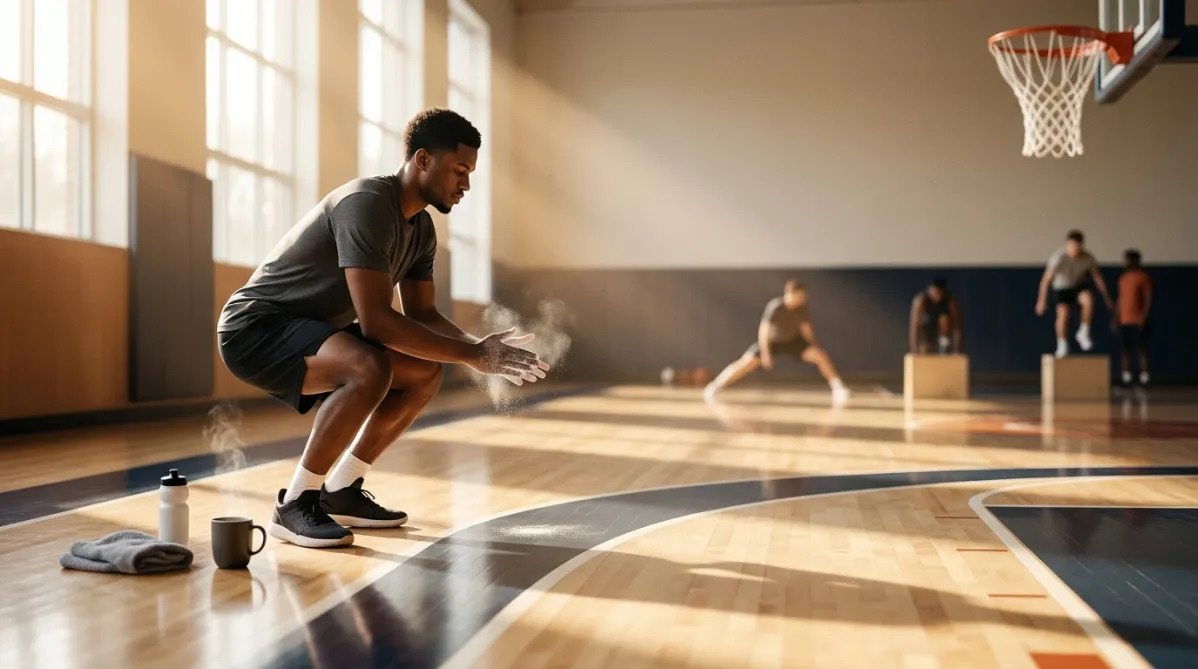
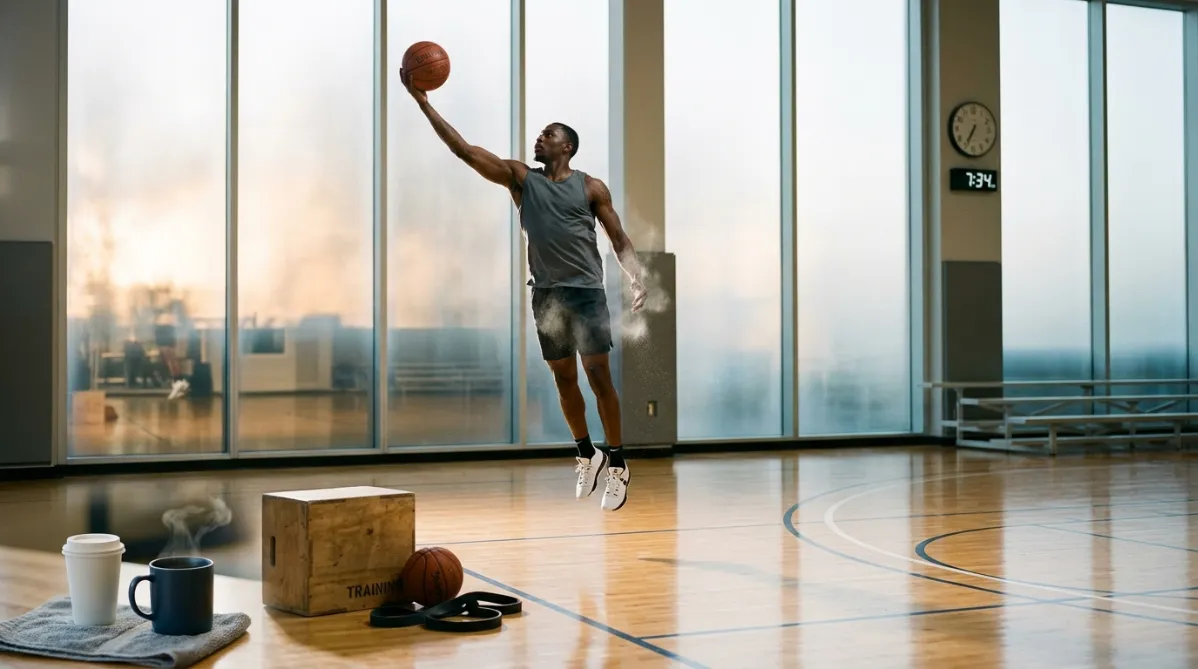
Post-activation performance enhancement (PAPE) is the short-lived boost in explosive output that can follow a well-chosen high-intensity "primer." Here the primer was a drop-jump protocol guided by each athlete's reactive strength index (RSI). RSI links jump output to ground contact time, so it captures how well someone absorbs and redirects force quickly. Tailoring the conditioning to that profile is the "individualized" part.
It worked. CMJ performance changed significantly over time after conditioning (time effect, p < 0.001), which is the signature of a transient PAPE response. The enhancement was real but temporary, and it moved across the 12-minute window instead of staying flat. That is the main positive finding: a tailored plyometric primer produced a measurable change in jump performance in athletes who are already very good.
Why Caffeine Didn't Add On Top
The caffeine group did not differ from placebo on any main outcome. The condition × time interaction was not significant (p > 0.05), so caffeine did not change the shape of the PAPE curve. Peak CMJ height, peak enhancement magnitude, time to peak performance, and cumulative PAPE were also all non-significant (all p > 0.05).
The authors suggest that individualized conditioning may already optimize the PAPE response, leaving little room for caffeine to add more. This is a hypothesis, not something the trial proves. Other plausible factors include a ceiling effect in highly trained jumpers, the moderate dose, or measurement noise in a 21-person sample. Treat these as open questions.
The result is also narrow. It does not show that caffeine fails to improve performance generally. It says that, in this population and with this protocol, caffeine on top of an individualized drop-jump warm-up produced no average extra jump benefit.
The Individual Responders Twist
An average of "nothing" can hide a lot. The researchers' individual response analysis found substantial variability in caffeine-related changes. Some athletes likely jumped a bit better on caffeine, others no better or slightly worse. These swings cancel out in group statistics.
The crossover data cannot tell us whether this variability reflects true individual responses or just day-to-day fluctuation in jump performance. Sensitivity analysis did confirm that the overall time pattern of the PAPE response was stable. So the warm-up effect was consistent, while the caffeine effect was unpredictable. An athlete who swears by caffeine may be a genuine responder, but this study can't confirm it.
Practical Takeaways for Jump and Sprint Athletes
Who this applies to: athletes in jump- and sprint-dependent sports, such as basketball, volleyball, and track and field, especially those already at a high training level.
- Prioritize the warm-up first. The evidence in this study favors a structured, individualized drop-jump primer over a stimulant as the reliable lever for a short-term jump boost.
- Individualize the drop height. The study guided conditioning by RSI. In practice, that means testing a few drop heights and choosing the one that gives the best balance of jump height and short ground contact. The abstract does not give the exact jump volume, so work with a coach to dose it conservatively and avoid fatiguing yourself.
- Use the window. The study tracked CMJ from 15 seconds to 12 minutes after conditioning, and the enhancement was transient. Test your own response in practice, because the best rest interval varies between people. Many athletes find the benefit comes after the first few minutes of recovery rather than immediately, but check this individually.
- Dose and timing if you use caffeine. The trial used 3 mg per kg of body mass, which is about 210 mg for a 70 kg athlete. Caffeine is commonly taken roughly 60 minutes before exercise to match peak blood levels, though the abstract does not detail the trial's timing. Do not assume more is better.
- Test it yourself. Because responses varied, run a blinded or at least repeated comparison in training before trusting caffeine on game day.
The Bottom Line
The headline is not that caffeine is useless. Caffeine has other evidence behind it in other contexts. In this trial, the individualized drop-jump warm-up did the work, and 3 mg/kg of caffeine added nothing measurable on average. For athletes and coaches, that is a reminder to perfect the process before reaching for a supplement. Limits still apply: 21 male basketball players, one dose, one jump test, and one conditioning protocol. Women, other sports, and other doses remain unanswered.