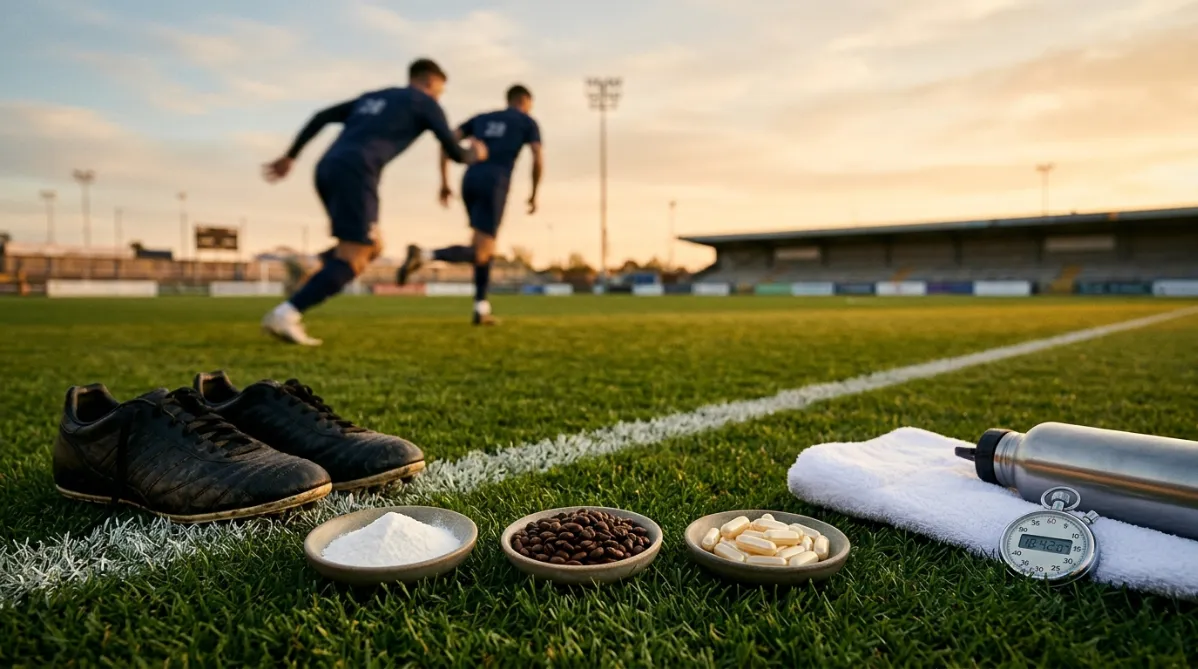
300 mg of Caffeine Made Soccer Players Faster. It Didn't Make Them Better at Reacting.
You take caffeine before a match expecting to feel sharper, quicker and more switched on. A new double-blind crossover trial suggests that only part of that is true. Sixteen amateur soccer players took 300 mg of caffeine, and they changed direction faster on a planned course and jumped higher. They did not get meaningfully better at reacting to a light or to a human opponent.
The Study in 60 Seconds
Researchers from Comenius University in Bratislava and the University of Ss. Cyril and Methodius in Trnava published the trial in Sports (2026). Sixteen male amateur soccer players, average age 23.5 years, took part. Each one completed two conditions in randomized order: 300 mg of caffeine (about 3.7 mg per kg of body weight) and a placebo. Neither the players nor the testers knew which was which.
Thirty to 45 minutes after ingestion, the players performed a countermovement jump (CMJ), a drop jump (DJ) and three Y-shaped agility tests. The agility tests were planned agility, reactive agility to a light stimulus, and reactive agility to a human stimulus. The conditions were compared with paired t-tests and Hedges' g effect sizes.
What Caffeine Improved
Three outcomes reached statistical significance, all at p = 0.02:
- Planned agility time: effect size 0.62, the largest effect in the study and a moderate-to-large improvement.
- Countermovement jump height: effect size 0.30, a small gain.
- Reactive strength index in the drop jump: effect size 0.35, also small. This measure reflects how well an athlete uses the stretch-shortening cycle, which is the quick "bounce" in explosive movement.
These are all motor-dominant tasks. The athlete already knows what to do and the question is how forcefully and quickly the body can do it. Caffeine seems to help with that kind of execution.
What Caffeine Didn't Clearly Improve
The two reactive agility tests are where the story changes. When players had to respond to a light, the effect was negligible (p = 0.32, ES = 0.10). When they had to respond to a human stimulus, which is the closest test to a real opponent, the result was p = 0.06 with an effect size of 0.35. That falls just short of the conventional significance threshold.
The human-stimulus result should not be read as proof of a benefit, and it should not be dismissed as proof of nothing either. With only 16 participants, a modest real effect could easily go undetected. The authors' conclusion is that caffeine offers limited benefit for reactive agility. In this sample, the faster legs did not clearly carry over into faster decisions.
Why the Split Makes Sense
Planned agility relies mainly on physical output: how quickly you accelerate, brake and push off. Reactive agility adds a perceptual-cognitive layer, because you must read a cue, decide and then move. Caffeine can plausibly boost the muscular and neural drive behind the movement, which would explain the jump and planned-agility gains. The perception and decision-making stages may be less sensitive to a single dose, or the added complexity may simply produce more variability in the data.
The paper's title frames this as the "limits of perceptual-cognitive enhancement." Caffeine's reputation as a mental sharpener does not automatically carry over to sport-specific decision speed.
Practical Takeaways
- Dose: The study used 300 mg, or roughly 3.7 mg/kg. That is in the range commonly used in sports research, but it is a lot of caffeine for some people. Check your own body weight and tolerance rather than copying the number.
- Timing: Testing began 30 to 45 minutes after ingestion, so that is the window the results apply to. Peak effects can vary between individuals.
- Best use case: Motor-dominant efforts such as jumping, sprint-and-cut drills and pre-planned change-of-direction work.
- Don't expect: A guaranteed improvement in reading the play or reacting to an opponent.
- Who it's for: Healthy adult amateur soccer players who already tolerate caffeine. The study used young, amateur, male participants, so the findings may not apply to women, elite players, adolescents or people sensitive to stimulants.
Caveats Worth Keeping in Mind
This was a small trial using a single dose and a single testing session per condition. The tests were done in a lab-style setting, not during a 90-minute match, so fatigue, game context and repeated sprints were not part of the picture. Conclusions about "match performance" would go beyond the data. The authors declared no conflicts of interest, and the crossover, double-blind design is a strength. Even so, larger samples and different doses would be needed to confirm and refine the findings.
Bottom Line
If you want a performance edge on jumping and planned agility, 300 mg of caffeine looks like a reasonable bet for an amateur soccer player, with the effect shown 30 to 45 minutes after taking it. If you were hoping it would sharpen your reactions to an opponent, this study gives you little reason to expect that. Treat caffeine as a tool for physical output and keep training the perceptual side the old-fashioned way, with game-like drills that force you to read and react.