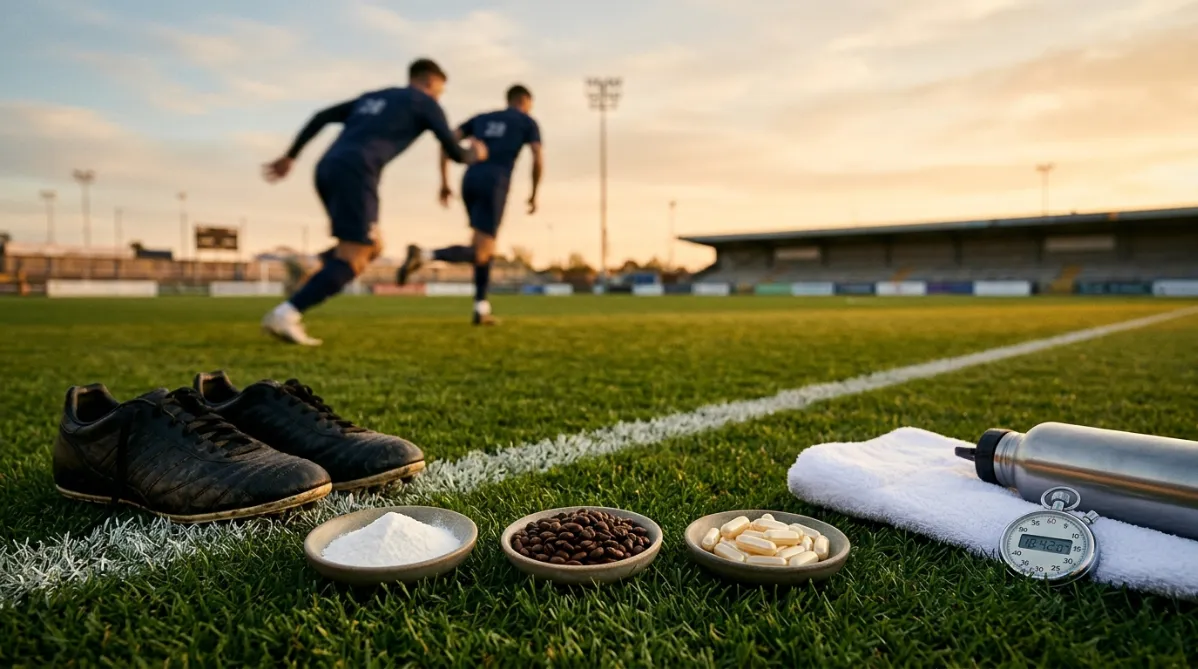
Everyone knows caffeine works. But what happens when you pair it with an adaptogen that has a reputation for fighting fatigue and blunting stress? A new crossover trial in soccer players put that question to the test, and the only condition that beat placebo on maximum Wingate power was the combo. Before you reorder your pre-workout, though, read the fine print. It matters a lot here.
The Study at a Glance
Researchers from Türkiye (Yelken, Hepsert and Küçüksayan) published the work in Frontiers in Physiology in 2026. They recruited 10 trained male soccer players, around 20 years old, and ran a randomized, placebo-controlled crossover design. Every athlete went through all four conditions in random order, so each player acted as his own control.
The goal was to see how caffeine, Rhodiola rosea (RR), and the two together affected anaerobic performance and salivary stress markers.
What They Took, and When
The four conditions were:
- Placebo (P)
- Caffeine (C): 3 mg/kg
- Rhodiola rosea (RR): 3 mg/kg
- Caffeine + Rhodiola (CRR): 3 mg/kg of each
Timing was simple: supplements went in 60 minutes before the Wingate Anaerobic Test, the 30-second all-out cycling sprint that is the standard lab measure of peak and mean anaerobic power. For a 75 kg player, 3 mg/kg works out to roughly 225 mg of each compound. That is a moderate caffeine dose, not a mega-dose.
The Wingate Results: Where the Combo Won
Here is what the analysis found:
- Maximum power: CRR was higher than placebo (p<0.05).
- Average power: CRR was higher than RR alone (p<0.05).
Notice what the abstract does not report. Caffeine alone and Rhodiola alone are not described as significantly beating placebo on power. CRR is also not reported as significantly better than caffeine alone. So the headline is that the combination separated from placebo on peak power, and from Rhodiola on mean power. It does not show that the stack beats caffeine by itself.
That gap matters if you are asking whether you need the extra capsule. This study cannot answer that.
The Stress Biomarkers: Cortisol, α-Amylase and IgA
The team measured three saliva markers by ELISA, each telling a different story about physiological stress:
- Cortisol: differed significantly between CRR and placebo (p<0.05). Cortisol is the classic hormonal stress marker, and this fits the idea that the stack changes the stress response. The abstract, however, does not spell out the interpretation, so avoid overreading it.
- α-Amylase: significantly lower with caffeine than with placebo (p<0.05). This enzyme is commonly used as a window into sympathetic nervous system activity.
- IgA: differed significantly between RR and placebo (p<0.05). Salivary IgA is a common marker of mucosal immune function.
So each supplement left a different fingerprint. Caffeine showed up in α-amylase, Rhodiola in IgA, and the combination in cortisol. That is interesting, but it is a pattern of differences, not proof of a benefit. The authors describe the findings as "associated with differences" in performance and biomarkers, and they chose that wording deliberately.
Practical Takeaways for Athletes
If you are tempted to experiment, here is how to read this sensibly:
- The dose is realistic. 3 mg/kg of caffeine is well within the range most athletes already use. The same dose of Rhodiola was layered on top.
- Timing is practical. Taking both an hour before a sprint-heavy session or match mirrors a normal pre-competition routine.
- Trial it in training first. Never debut a new stack on game day. Individual responses to caffeine vary widely, and Rhodiola products differ in quality and standardization.
- Don't expect miracles. The effect was detected under controlled lab conditions in a single 30-second test.
Who This Might Be For
The evidence applies most directly to young, trained male team-sport athletes whose game demands repeated high-power efforts. Soccer players, with their sprints, accelerations and jumps, are a logical fit. If you are a masters athlete, a female athlete, or a strength-focused lifter, this paper tells you very little about your response.
The Caveats You Can't Skip
This is where the clickbait ends and the honesty begins:
- n = 10. That is a very small sample. Crossover designs add statistical power, but results from ten people can easily fail to replicate.
- Acute only. This was a single dose before a single test. There is no information on repeated use, tolerance, or long-term effects.
- One population. Trained male soccer players aged about 20.
- No interaction analysis. The authors themselves call for "appropriate interaction analyses" to separate the independent and combined effects. In other words, we do not know whether the two compounds work together or whether the combo simply added up two small effects.
- Multiple comparisons. With several outcomes and condition pairs, some p<0.05 results can appear by chance.
- Cautious conclusions. The authors state the findings should be interpreted carefully and that larger studies are needed.
Bottom Line
Caffeine plus Rhodiola rosea at 3 mg/kg each, taken 60 minutes pre-test, produced higher peak Wingate power than placebo in ten trained soccer players, along with shifts in salivary stress and immune markers. That is a promising early signal and a good reason for bigger, better-controlled trials. It is not yet a proven performance stack. Treat it as a hypothesis worth testing, not a new rule of supplementation.