Dr. Gymbro
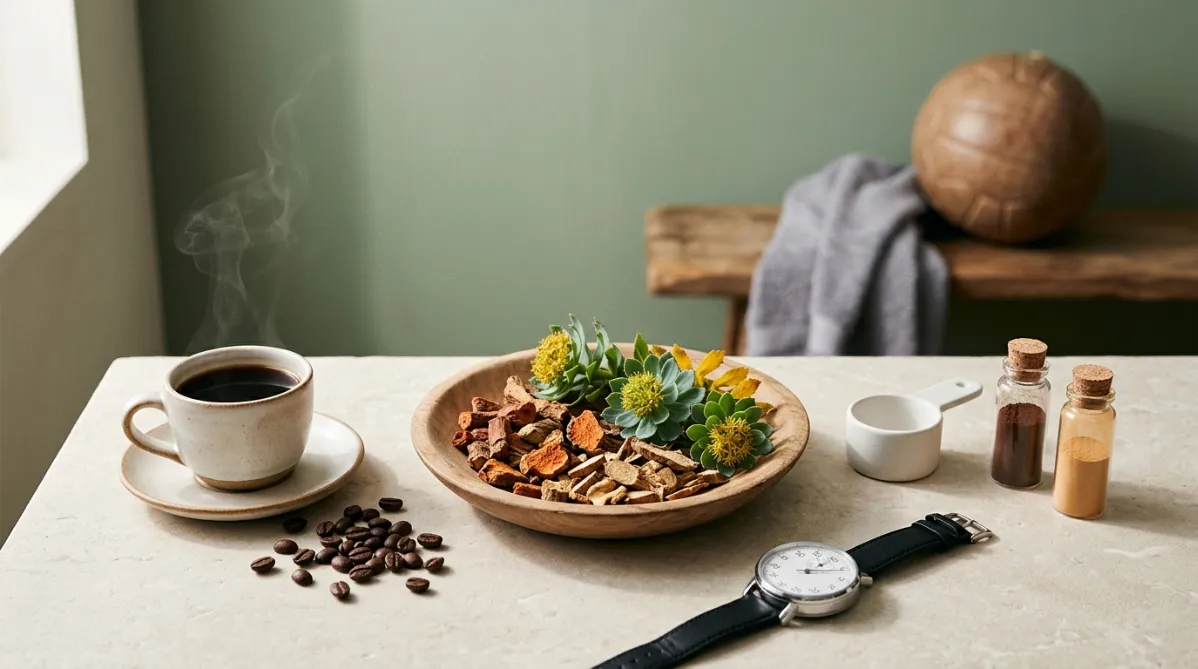
A wide, editorial-style still life photographed on a pale, matte stone countertop in soft morning window light. On the left, a small ceramic cup of black coffee sits beside a scattering of whole roasted coffee beans, with a thin wisp of steam rising. At the center, a shallow wooden bowl holds dried Rhodiola rosea root pieces, rust-orange and tan, with a few fresh succulent-like Rhodiola rosette stems with blue-green leaves and yellow-gold flowers laid across the surface. On the right, a minimalist matte white scoop and two small glass vials of fine powder, one dark brown and one soft amber, are lined up neatly like a measured dose. Behind them, softly out of focus, a blurred athletic setting suggests a training space: a muted sage-green wall, a folded gray towel, and a worn soccer ball resting on a low bench. A stopwatch with a clean white face lies in the foreground, slightly angled, hinting at timing and performance. The palette is warm and earthy: cream, terracotta, deep espresso brown, moss green, and a touch of marigold yellow. Shadows are long and gentle, with a shallow depth of field and fine natural texture in the stone, wood, and plant material. The composition is balanced and uncluttered, with generous negative space on the upper left for headline text. The overall look is modern, calm, and trendy, like a contemporary wellness and science journal cover, with crisp detail, subtle film grain, and a natural, tactile feel.
supplements

Rhodiola + Koffein: Das Stack, das Placebo beim Wingate‑Test übertraf

Dr. Gymbro · · 4 min read

Everyone knows caffeine works. But what happens when you pair it with an adaptogen that has a reputation for fighting fatigue and blunting stress? A new crossover trial in soccer players put that question to the test, and the only condition that beat placebo on maximum Wingate power was the combo. Before you reorder your pre-workout, though, read the fine print. It matters a lot here.

The Study at a Glance

Researchers from Türkiye (Yelken, Hepsert and Küçüksayan) published the work in Frontiers in Physiology in 2026. They recruited 10 trained male soccer players, around 20 years old, and ran a randomized, placebo-controlled crossover design. Every athlete went through all four conditions in random order, so each player acted as his own control.

The goal was to see how caffeine, Rhodiola rosea (RR), and the two together affected anaerobic performance and salivary stress markers.

What They Took, and When

The four conditions were:

  • Placebo (P)
  • Caffeine (C): 3 mg/kg
  • Rhodiola rosea (RR): 3 mg/kg
  • Caffeine + Rhodiola (CRR): 3 mg/kg of each

Timing was simple: supplements went in 60 minutes before the Wingate Anaerobic Test, the 30-second all-out cycling sprint that is the standard lab measure of peak and mean anaerobic power. For a 75 kg player, 3 mg/kg works out to roughly 225 mg of each compound. That is a moderate caffeine dose, not a mega-dose.

The Wingate Results: Where the Combo Won

Here is what the analysis found:

  • Maximum power: CRR was higher than placebo (p<0.05).
  • Average power: CRR was higher than RR alone (p<0.05).

Notice what the abstract does not report. Caffeine alone and Rhodiola alone are not described as significantly beating placebo on power. CRR is also not reported as significantly better than caffeine alone. So the headline is that the combination separated from placebo on peak power, and from Rhodiola on mean power. It does not show that the stack beats caffeine by itself.

That gap matters if you are asking whether you need the extra capsule. This study cannot answer that.

The Stress Biomarkers: Cortisol, α-Amylase and IgA

The team measured three saliva markers by ELISA, each telling a different story about physiological stress:

  • Cortisol: differed significantly between CRR and placebo (p<0.05). Cortisol is the classic hormonal stress marker, and this fits the idea that the stack changes the stress response. The abstract, however, does not spell out the interpretation, so avoid overreading it.
  • α-Amylase: significantly lower with caffeine than with placebo (p<0.05). This enzyme is commonly used as a window into sympathetic nervous system activity.
  • IgA: differed significantly between RR and placebo (p<0.05). Salivary IgA is a common marker of mucosal immune function.

So each supplement left a different fingerprint. Caffeine showed up in α-amylase, Rhodiola in IgA, and the combination in cortisol. That is interesting, but it is a pattern of differences, not proof of a benefit. The authors describe the findings as "associated with differences" in performance and biomarkers, and they chose that wording deliberately.

Practical Takeaways for Athletes

If you are tempted to experiment, here is how to read this sensibly:

  1. The dose is realistic. 3 mg/kg of caffeine is well within the range most athletes already use. The same dose of Rhodiola was layered on top.
  2. Timing is practical. Taking both an hour before a sprint‑heavy session or match mirrors a normal pre‑competition routine.
  3. Trial it in training first. Never debut a new stack on game day. Individual responses to caffeine vary widely, and Rhodiola products differ in quality and standardization.
  4. Don't expect miracles. The effect was detected under controlled lab conditions in a single 30‑second test.

Who This Might be For

The evidence applies most directly to young, trained male team‑sport athletes whose game demands repeated high‑power efforts. Soccer players, with their sprints, accelerations and jumps, are a logical fit. If you are a masters athlete, a female athlete, or a strength‑focused lifter, this paper tells you very little about your response.

The Caveats You Can't Skip

This is where the clickbait ends and the honesty begins:

  • n = 10. That is a very small sample. Crossover designs add statistical power, but results from ten people can easily fail to replicate.
  • Acute only. This was a single dose before a single test. There is no information on repeated use, tolerance, or long‑term effects.
  • One population. Trained male soccer players aged about 20.
  • No interaction analysis. The authors themselves call for "appropriate interaction analyses" to separate the independent and combined effects. In other words, we do not know whether the two compounds work together or whether the combo simply added up two small effects.
  • Multiple comparisons. With several outcomes and condition pairs, some p<0.05 results can appear by chance.
  • Cautious conclusions. The authors state the findings should be interpreted carefully and that larger studies are needed.

Bottom Line

Caffeine plus Rhodiola rosea at 3 mg/kg each, taken 60 minutes pre‑test, produced higher peak Wingate power than placebo in ten trained soccer players, along with shifts in salivary stress and immune markers. That is a promising early signal and a good reason for bigger, better‑controlled trials. It is not yet a proven performance stack. Treat it as a hypothesis worth testing, not a new rule of supplementation.
Original study

Read the original research on pubmed.ncbi.nlm.nih.gov →

This article summarizes published research for general information. It is not medical advice.

DG

Written by

Dr. Gymbro

Dr. Gymbro writes for Dr. Gymbro: science-backed fitness, nutrition & performance.

Related Articles

nutrition

Koffein lässt Fußballspieler schneller werden, aber nicht reaktionsfähiger

BY DR. GYMBRO ·

Die gängige Annahme, Koffein schärfe Sportler in allen Bereichen, wird durch eine neue doppelblinde Studie mit Amateur‑Fußballern relativiert. Eine Einzeldosis von 300 mg (ca. 3,7 mg/kg) verbesserte die geplante Agilität (Effektstärke 0,62) und die Sprungleistung, während die Reaktionszeit auf Lichtsignale oder menschliche Gegner kaum beeinflusst wurde. Der Beitrag fasst die Ergebnisse zusammen, erklärt ihre Bedeutung und zeigt, für wen sie relevant sind.

A wide, editorial-style photograph of a professional soccer pitch at golden hour, shot from a low angle at the edge of the grass. In the foreground, slightly off-center to the left, a pair of worn leather cleats sits beside a scatter of three small matte ceramic dishes. One holds fine white taurine powder, one holds dark roasted coffee beans, and one holds pale cream-colored softgel capsules. Soft warm light catches the textures: the grain of the beans, the powder's fine crystalline sheen, the glossy curve of the capsules. A clean white sports towel and a brushed-steel water bottle rest nearby, with a small stopwatch lying on the turf, its face softly glowing.

Behind them, the field stretches into a gentle blur. A lone player in a muted navy training kit mid-sprint leaves a faint streak of motion across the frame, with painterly bokeh from stadium floodlights and distant stands. The grass is a rich, deep green with crisp white line markings curving across the midground and leading the eye toward the athlete. Long amber shadows stretch across the pitch, and a hazy peach and pale blue sky fills the upper right, leaving open negative space for a title overlay.

The palette is restrained and modern: deep green, warm cream, soft amber, charcoal, and a touch of muted coral. The depth of field is shallow, with sharp detail on the supplements and cleats. The mood is calm, premium, and scientific without feeling clinical, like a contemporary sports-science magazine or wellness journal cover. The lighting is natural and cinematic, with gentle film grain and a subtle vignette. The composition follows the rule of thirds, with clean lines and no text, logos, or clutter.
nutrition

Taurin‑Koffein‑PS‑Stack verschafft Profifußballern Vorteile – der Haken?

BY DR. GYMBRO ·

Profifußballer, die 14 Tage lang Taurin, Koffein und Phosphatidylserin einnahmen, erzielten in einer randomisierten Studie mit 97 Teilnehmenden bessere 30‑m‑Sprintzeiten, schnellere Reaktionszeiten und geringere mentale Ermüdungswerte als das Placebo. Eine Verdopplung der PS‑Dosis von 300 mg auf 600 mg brachte jedoch nur einen geringen, inkonsistenten Unterschied. Die Autoren betonen zudem, dass die Daten keinen Nachweis für eine höhere Ermüdungsresistenz liefern und PS nie allein getestet wurde. Im Folgenden erfahren Sie, welche Bestandteile der Stack hatte, welche Effekte er zeigte und welche Fragen offen bleiben.

A wide, editorial-style photograph of an indoor basketball court at early morning, shot from a low angle near the baseline. In the foreground, a male collegiate basketball player in a charcoal athletic tee and black shorts is captured mid-crouch, just before a plyometric jump, with chalk dust lifting off his hands and fingers. His expression is focused and calm. Beside him on the polished maple floor sits a matte ceramic cup of black coffee with a thin curl of steam, next to a small white water bottle and a folded gray towel, placed slightly out of focus as a quiet visual hint at the caffeine theme.

Soft golden sunlight pours through tall high windows on the left, casting long, warm diagonal beams across the hardwood and creating subtle reflections on the glossy surface. The painted court lines in deep navy and cream curve gracefully through the frame, leading the eye toward the background, where a few teammates blur softly, stretching and doing box jumps over low plyometric boxes. A basketball hoop with a clean white net is visible in the upper right, gently out of focus.

The color palette is warm and refined: honey-toned wood, espresso brown, cream, muted navy, and touches of terracotta orange. Use shallow depth of field with a creamy bokeh, fine film-like grain, and gentle contrast, giving the image the feel of a modern lifestyle and science journal cover, like a contemporary wellness or sports magazine. Composition follows the rule of thirds, with the athlete on the left third and generous negative space on the right, filled with soft light and blurred court, which is ideal for overlaid headline text. No text, logos, or graphics appear in the image. The mood is energized, intentional, and quietly scientific, evoking preparation, rhythm, and peak performance, with natural realism and no futuristic elements.
science research

Koffein + dieser Aufwärmtrick steigert die Wingate‑Leistung bei Basketballspielern

BY DR. GYMBRO ·

Was wäre, wenn dein Aufwärmen und dein Koffein heimlich besser zusammenwirken würden? Eine randomisierte Crossover‑Studie mit 24 männlichen College‑Basketballspielern zeigte, dass ein plyometrisches PAPE‑Aufwärmen ein Standard‑Aufwärmen übertraf und die Zugabe von 5 mg/kg Koffein die Spitzenleistung, die durchschnittliche Leistung und das Gesamtarbeitsvolumen weiter steigerte. Auch die subjektive Anstrengung nahm ab, der Fatigue‑Index änderte sich jedoch nicht eindeutig. Hier erfährst du die Dosierung, das Protokoll, für wen es geeignet ist und welche Einschränkungen du kennen solltest.

supplements

Rhodiola steigerte Spitzen‑Sprintleistung und senkte Laktat – aber nicht alles

BY DR. GYMBRO ·

Ein dreitägiges Rhodiola‑rosea‑Ladeprotokoll steigerte die Spitzenleistung bei einem maximalen Wingate‑Sprint und senkte das Blutlaktat nach 3, 10 und 20 Minuten. Der Haken: Mittelwertleistung und Gesamtarbeit blieben unverändert. In der Crossover‑Studie nahmen 23 junge, trainierte Männer teil, mit einer fünftägigen Wash‑out‑Phase. Die Forscher geben zu, dass der Mechanismus hinter dem Laktat‑Effekt noch unklar ist. Im Folgenden finden Sie das genaue Protokoll, mögliche Zielgruppen und was die Evidenz nicht aussagt.

This page is available in