A pill that shrinks your waist and adds 2.3 kg of lean mass sounds like supplement-aisle fantasy. A new meta-analysis of 27 randomized controlled trials says carotenoid supplements did move both numbers. But the fine print matters, and it changes who should care.
The Headline Numbers
Researchers pooled data from 27 RCTs published up to October 2025. The trials tested carotenoid supplements such as astaxanthin, crocin, lutein and fucoxanthin at 2 to 100 mg per day. Compared with control groups, carotenoid supplementation was linked to:
- Body weight: -1.00 kg (95% CI: -1.87 to -0.13)
- Waist circumference: -1.78 cm (95% CI: -3.02 to -0.54)
- Fat-free mass: +2.32 kg (95% CI: +0.49 to +4.14)
- Leptin: -1.42 ng/mL (95% CI: -2.35 to -0.49)
Leptin is the hormone that signals body-fat stores. A drop can hint at improved metabolic signaling, though this analysis can't say what it means for any one person.
The Reality Check
The authors themselves call the effects "modest but favorable," and that wording is fair. Here is what the data did not show:
- Weight loss was small. One kilogram is not a transformation, and the lower end of the confidence interval sits close to zero.
- Body fat percentage did not change significantly. If carotenoids melted fat, you'd expect this number to move. It didn't.
- BMI, hip circumference and adiponectin were unchanged. Adiponectin is another fat-derived hormone, and it stayed flat.
- The lean-mass result rests on only 4 trials. The interval is wide (+0.49 to +4.14 kg), so the true effect could be much smaller than 2.3 kg. Treat it as a hypothesis to test, not a muscle-building promise.
There's also a puzzle. Waist size and body weight fell, but fat percentage didn't budge, while fat-free mass rose. The pooled data can't explain that on their own. Body-composition methods vary between trials, and only a few trials reported fat-free mass. That is why the lean-mass claim needs caution.
Who Seemed to Benefit Most
Subgroup analyses pointed to two patterns:
- Longer interventions (more than 8 weeks) showed stronger effects than shorter ones.
- Participants under 50 responded better than older participants.
These are subgroup findings, so they suggest where to look next rather than proving anything. Still, they fit a common-sense picture. Slow-acting antioxidant compounds probably need weeks to show up in body composition, and younger people may simply respond differently. The authors found no substantial publication bias, which adds some confidence to the overall pattern.
Why Would an Antioxidant Affect Body Composition?
The proposed mechanisms are oxidative stress, inflammation and adipokine secretion. Chronic low-grade inflammation and oxidative stress are tied to excess adiposity and poorer metabolic regulation. Carotenoids may dampen both. The leptin reduction fits with that idea. This meta-analysis measured outcomes, not mechanisms, so the "why" remains a plausible theory.
Practical Takeaways
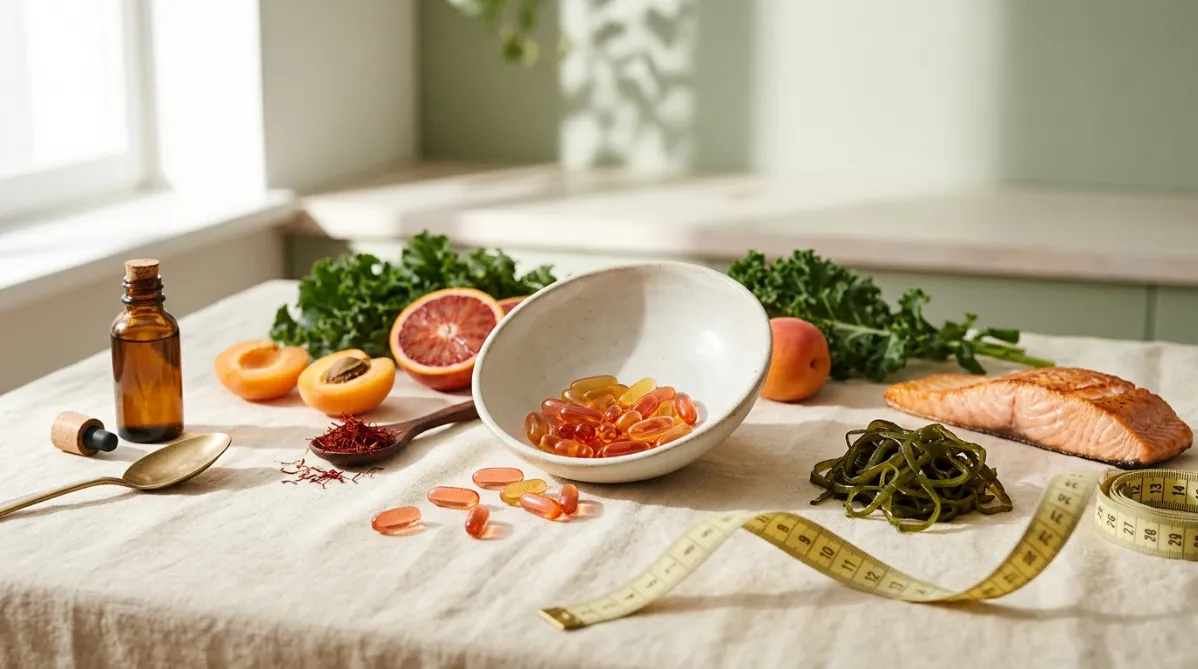
Which carotenoids? The trials covered astaxanthin, crocin (the main pigment in saffron), lutein and fucoxanthin (found in brown seaweed). The pooled analysis doesn't tell us which one drives the effects.
What dose? The trials used 2 to 100 mg per day, a 50-fold range. The authors say dose-response relationships remain unclear, so no optimal dose can be named. Following the label of a reputable product, or a dose used in a specific trial, is more sensible than guessing.
Timing? The paper offers no timing guidance. As general background (not from this study), carotenoids are fat-soluble, so taking them with a meal that contains some fat is a common practice.
How long? Given the subgroup results, think in terms of more than 8 weeks, not a two-week experiment.
Food first? Whole foods are a lower-risk way to raise carotenoid intake: tomatoes, saffron, seaweed, and colorful vegetables generally. Note that this meta-analysis tested supplements, not foods. Food intake is a reasonable habit, but it isn't proven to replicate these results.
Who It Might Help, and Who Should Skip It
Possibly worth considering: adults under 50 who already have training and nutrition dialed in and want a low-key add-on for waist and metabolic health, and who are willing to wait two months or more to judge it.
Probably skip or ask a professional first: anyone expecting significant fat loss, since body fat percentage didn't change. Also check with a doctor if you're pregnant or breastfeeding, take medications, or have a medical condition. Supplement doses at the high end of the range (up to 100 mg) deserve particular caution. Smokers should be especially careful with carotenoid supplements in general, since high-dose beta-carotene has raised lung cancer risk in past trials. That finding is outside this paper but worth knowing.
The Bottom Line
Carotenoid supplements show a small, statistically significant effect on weight, waist size and leptin, and a possible but shaky boost in lean mass. They are an adjunct, not a replacement for training, protein and a calorie plan. The authors call for longer, high-quality RCTs to confirm these findings and map out dose-response. Until then, the honest verdict is "promising, modest, unproven."
Source: Jun Z, Jianmin Z, Jiawen W, et al. Impact of carotenoids on body composition and adipokine hormones: a systematic review and meta-analysis of randomized controlled trials. Nutrition & Diabetes. 2026;16(1):51. doi:10.1038/s41387-026-00459-1. PubMed.