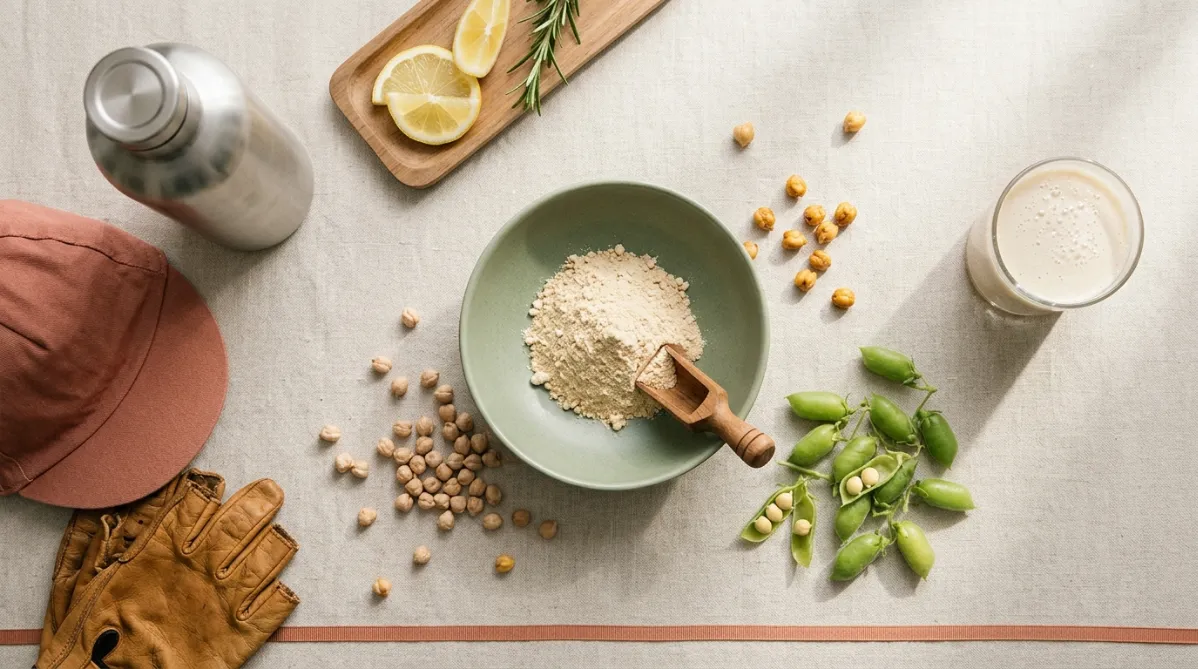
A small scoop of chickpea-derived powder, taken after training for two weeks, was linked to lower levels of a key inflammation marker and a muscle-damage marker in competitive cyclists. That is the headline from a new randomized controlled trial in the Journal of the International Society of Sports Nutrition. It is also a finding that needs a lot of context before anyone rebuilds their supplement stack around it.
What the Researchers Actually Did
The team, led by García-Durán, recruited 24 federated male road cyclists. These were registered competitive riders, not casual weekend pedalers. In a randomized, double-blind, placebo-controlled design, participants took either 12 g/day of a chickpea protein hydrolysate (CPH) or a placebo after their training sessions for 14 days.
The researchers tracked nutritional intake and training, and measured body composition and blood markers of muscle damage and inflammation before and after the intervention. Groups did not differ in body composition, training load or dietary intake. That matters, because it makes it harder to explain the biomarker differences by one group simply training less or eating differently.
The Striking Results: CRP and LDH
The between-group comparison of change scores showed two statistically significant differences favoring the chickpea group:
- C-reactive protein (CRP), p = 0.02: CRP decreased in the CPH group and increased in the placebo group. CRP is a widely used general marker of inflammation.
- Lactate dehydrogenase (LDH), p = 0.04: LDH decreased with CPH and rose slightly with placebo. Elevated LDH is often read as a sign of cellular stress or muscle tissue strain after hard exercise.
Two other markers leaned the same way but did not clear the bar. Creatine kinase (CK), a classic muscle-damage marker, showed a favorable pattern with CPH, but the between-group result was p = 0.062, just short of significance. Myoglobin followed a similar downward trend. Those two should be treated as hints, not findings.
Hydrolysate vs. Regular Chickpea or Pea Protein
A hydrolysate is not the same thing as a standard protein isolate. Regular pea or chickpea protein powder is the intact protein, extracted and concentrated. A hydrolysate has been enzymatically pre-digested into shorter peptide fragments.
That is relevant here because the researchers did not pick 12 g to hit a muscle-building protein target. They chose the dose based on earlier studies pointing to antioxidant and immunomodulatory bioactive properties of the hydrolysate. In other words, the hypothesis is about specific peptides acting on inflammatory and oxidative pathways, not about delivering more amino acids. Twelve grams is well below a typical 20-30 g protein serving, which supports that reading.
It also means you should not assume that your regular chickpea or pea protein will do the same thing. This study tested one specific hydrolysate, and the results cannot be generalized to every plant protein on the shelf.
Why the Context Matters: Cyclists Already Ate Plenty of Protein
The participants' habitual protein intake exceeded 2 g/kg/day, which is high. The authors suggest this, along with the short duration, may be why body composition did not change. It is also a reminder that this supplement was not filling a protein gap. Any effect seen was on top of an already generous intake.
That cuts both ways. It makes the biomarker changes more interesting, since they were not simply a result of more total protein. But it also means we do not know whether athletes with lower protein intakes would respond the same way.
The Honest Caveats
This is where the clickbait-friendly headline needs a reality check:
- Small sample: 24 riders is a modest number, and small trials are prone to unstable results.
- Short duration: Two weeks tells us nothing about months of training adaptation.
- Biomarkers only: The study did not measure performance, recovery speed or muscle soreness. A lower CRP does not automatically mean you ride faster or feel better.
- Not all markers moved: CK missed significance, and the two significant results were modest in statistical strength (p = 0.02 and 0.04).
- Men only: All participants were male road cyclists.
- Inflammation is not always bad: Some post-exercise inflammatory signaling is part of how the body adapts. Whether dampening it is helpful, neutral or counterproductive over time is an open question.
The authors say as much, describing the results as short-term biochemical responses and calling for further studies to determine whether they translate into better recovery, training adaptation or performance.
Practical Takeaways
- The dose studied: 12 g/day of chickpea protein hydrolysate, taken after training sessions, for 14 days.
- Who might care most: Plant-based athletes and endurance athletes looking for non-dairy recovery options. Note that the study did not specifically recruit vegans or vegetarians, so this is an extrapolation of interest, not a finding.
- What not to expect: Do not count on it to replace your main protein sources, build extra muscle, or improve race times. None of that was shown.
- Check the product: If you consider trying a chickpea hydrolysate, look for one that matches the form and dose used in research, and be skeptical of generic claims.
- Wait for replication: One small trial is a promising signal, not a recommendation. Larger, longer studies measuring performance and perceived recovery would change the picture.
The Bottom Line
This trial offers an intriguing, plausible lead: a low-dose plant-derived hydrolysate may nudge inflammation and cell-stress markers in a favorable direction in trained cyclists. It is a well-designed experiment with proper blinding and controls, but it answers a narrow question. Until follow-up research links these biomarker shifts to actual recovery or performance gains, chickpea protein hydrolysate sits in the "interesting, unproven" category rather than the "must-buy" one.