Dr. Gymbro
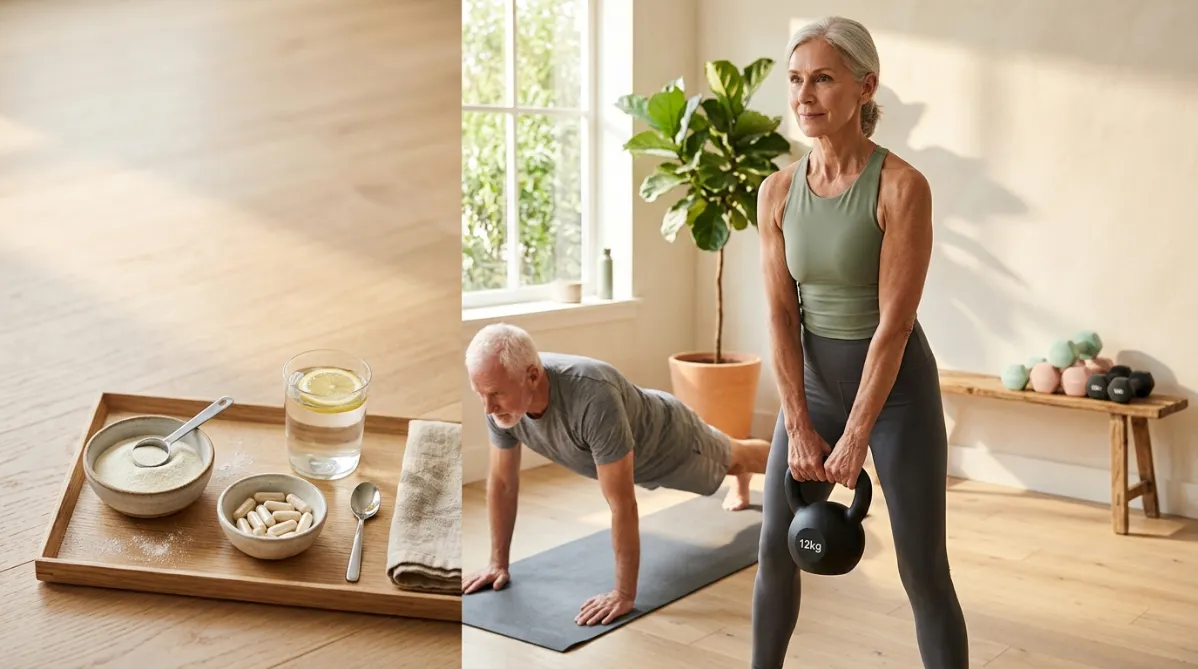
A warm, softly lit modern home gym or sunlit studio, photographed in a clean editorial style. In the center-right of the frame, a silver-haired woman in her mid-60s with a calm, confident expression grips a matte black kettlebell at hip height. She wears a fitted sage-green athletic top and charcoal leggings. Her forearms and shoulders show lean, defined strength rather than bulk. Beside her, slightly out of focus, a man in his late 60s with short white hair and a trim beard performs a controlled bodyweight plank on a pale oak floor.

In the foreground on the left, a minimalist wooden tray holds two small ceramic bowls. One contains fine white powder and the other holds a few cream-colored capsules. Next to them sit a glass of water with a lemon slice and a folded linen towel. A subtle scatter of powder dusts the tray. The foreground is shot with shallow depth of field and a creamy bokeh falloff.

Behind them, tall windows pour in golden morning light, with long soft shadows across the floor. A potted fiddle-leaf fig and a stacked set of pastel-toned dumbbells on a low wooden shelf add texture. The wall is warm off-white plaster with a hint of terracotta in the corner.

The palette is muted and modern: sage green, warm cream, soft terracotta, natural oak, and charcoal, with gentle highlights. The mood is quietly optimistic, focused, and grounded, suggesting strength, vitality, and measured scientific curiosity. The composition leaves clean negative space in the upper-left for a headline overlay. The look is a high-end wellness magazine cover with natural film-like grain, soft contrast, and crisp detail on the hands and kettlebell. There is no text, no logos, and no futuristic elements, only authentic, aspirational realism.
Nutrition

Creatine + HMB Made Over-60s Stronger in 6 Weeks, Not Bigger

Dr. Gymbro · · 4 min read

Here is the part that surprised researchers: a group of active adults over 60 got measurably stronger in just six weeks on a creatine + HMB stack, and the scale and the muscle readings barely moved. If you assumed strength after 60 is all about adding size, this randomized crossover trial suggests the story is more interesting.

The Stack: Creatine Monohydrate + HMB

The study, published in Geroscience by a team from the University of Burgos and collaborators in Spain, tested two supplements together:

  • Creatine monohydrate (CRE): one of the most studied performance supplements in existence, tied to energy availability during short, hard efforts.
  • β-hydroxy-β-methylbutyrate (HMB): a leucine metabolite often discussed for its role in limiting muscle breakdown.

The pitch is simple. Sarcopenia, the age-related loss of muscle and function, drives frailty and loss of independence. Pairing exercise with targeted nutrition might help people hold on to both strength and autonomy.

The Study: Small, Tight, and Well Controlled

The design is what makes this worth reading. It was a randomized, double-blind, placebo-controlled crossover trial, so every participant did both conditions.

  • 30 older adults (20 men, 10 women), all aged 60 or over and physically active
  • Two 6-week periods: CRE + HMB or placebo, separated by a 3-week washout
  • Training in both conditions: an integral physical conditioning program, with four supervised sessions per week
  • Session content: strength, power, multicomponent circuits, high-intensity intervals and moderate continuous work, at roughly 40-100% of training heart rate and 20-90% of 1RM

Because everyone trained identically and swapped conditions, the comparison is cleaner than in many supplement studies. Each person served as their own control. The trial was registered (NCT05951439) and approved by an ethics committee, and the authors declared no competing interests.

The Results: Strength and Endurance Went Up

The CRE + HMB condition significantly improved multiple functional strength outcomes:

  • Leg and back strength
  • Arm flexion strength
  • Upper-body endurance (dumbbell flexion, push-ups, isometric hold)
  • Core endurance (crunches)

These are practical measures: pushing, pulling, holding and bracing. They are the movements that matter when you are getting out of a chair or carrying shopping, which is why this kind of result resonates beyond the gym.

The Plot Twist: Body Composition Barely Budged

The body composition findings are easy to overstate, so precision matters here.

The analysis found significant time × group interactions for fat mass, fat-free mass, total muscle mass, skeletal muscle mass, appendicular skeletal muscle mass, and related indices. The CRE + HMB group showed reductions in fat mass and body fat percentage, with slight numerical increases in muscle parameters. The placebo group trended the opposite way.

But the within-group changes were not statistically significant. In plain terms, the groups diverged in direction, yet nobody can claim the stack "built" a meaningful amount of muscle in six weeks. The honest headline is that strength rose while muscle changes were small.

The "Strength Without Size" Angle

This is where the neuromuscular story comes in. The authors ran regression analyses and found the strength improvements were largely independent of changes in muscle mass. They suggest a potential neuromuscular mechanism.

What might that mean? Strength is not just about how much tissue you carry. It also depends on how effectively the nervous system recruits muscle, how quickly you can generate force, and how well you sustain repeated effort. Early strength gains in new or restructured training are often driven by this kind of neural efficiency, and the abstract points that way. Note that the study did not directly measure neural drive, so the mechanism remains a hypothesis rather than a proven pathway.

For older lifters, that is encouraging. Function can improve even when the muscle-mass needle is slow to move.

Limitations: Read Before You Buy

This is a promising result, not a final verdict.

  • Short duration: six weeks is brief. We cannot say whether the benefits persist, grow, or plateau.
  • Small sample: 30 participants limits precision and how far results generalize.
  • Body composition method: the study used bioelectrical impedance analysis (BIA), which is convenient but sensitive to hydration. That matters because creatine can shift body water.
  • Active participants: these were physically active older adults on a supervised, varied program. Results may differ for sedentary or frail people.
  • Combined intervention: the trial tested the stack together, so it cannot tell you how much each ingredient contributed.

Practical Takeaways

The abstract does not list doses or timing, so check the full text for the exact protocol. The figures below are general, evidence-based guidance, not the study's protocol:

  • Creatine monohydrate: commonly 3-5 g per day, taken consistently.
  • HMB: commonly 3 g per day, often split into smaller servings.
  • Timing: consistency matters more than the clock. Taking creatine with a meal or around training is a common, convenient habit.
  • Training comes first: the supplements were layered onto a supervised program with four sessions a week. They are not a substitute for it.

Who Is This For?

  • Older lifters who already train and want an edge in functional strength
  • Parents and active midlifers thinking ahead about healthy ageing
  • Anyone concerned about sarcopenia who is already combining resistance work with good protein intake

If you have kidney disease, take medications, or have other health conditions, talk to your doctor before starting any supplement.

The Bottom Line

In this crossover trial, creatine plus HMB, layered onto a varied training program, improved strength and muscular endurance in active adults over 60 within six weeks, and those gains appeared largely independent of muscle mass. It is an early, small, short study, but it fits a useful idea: for healthy ageing, getting functionally stronger may matter more than looking bigger.
Original study

Read the original research on pubmed.ncbi.nlm.nih.gov →

This article summarizes published research for general information. It is not medical advice.

DG

Written by

Dr. Gymbro

Dr. Gymbro writes for Dr. Gymbro: science-backed fitness, nutrition & performance.

Related Articles

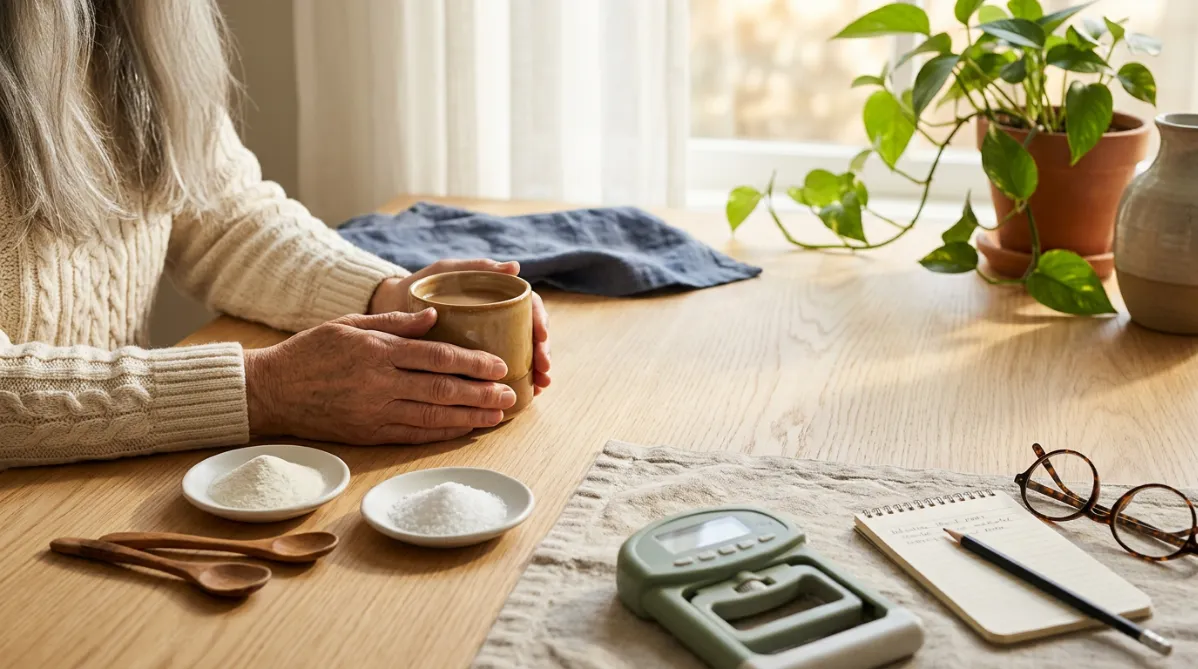
A landscape editorial photograph of a sunlit kitchen table in soft morning light. An older adult's hands, with silver hair and a cream knit sleeve just visible, rest around a ceramic mug. Beside the mug are two small matte white ceramic dishes. One holds a mound of fine white powder, and the other holds a slightly different crystalline white powder. Two wooden spoons lie next to them. A handheld hand-grip dynamometer in muted sage green sits on a linen placemat in the foreground, slightly out of focus. A small open notebook with a pencil and a pair of round tortoiseshell reading glasses sit nearby, with no legible text.

The tabletop is pale oak with a visible grain. Behind it, a window with sheer curtains lets in warm golden light, and the blurred shapes of a trailing green pothos plant and a pale terracotta vase show in the background. The color palette is warm cream, sage green, soft terracotta, and pale wood, with a touch of muted navy from a folded napkin. The mood is calm, thoughtful, and quietly scientific without any laboratory feel.

The composition follows the rule of thirds. The hands and dishes sit in the left-center, and generous negative space on the right is suitable for a title overlay. Shallow depth of field, 50mm lens look, gentle film grain, and soft shadows. Modern lifestyle-magazine and health-journal aesthetic, natural and unstaged, high-end editorial photography.
nutrition

Creatine's Precursor Beat Creatine for Grip Strength in Over-65s

BY DR. GYMBRO ·

A small trial in adults over 65 found that guanidinoacetic acid (GAA), the direct precursor of creatine, improved grip strength more than creatine monohydrate. The catch is that it was an 8-week pilot with just 21 completers, no exercise program, and a confidence interval that barely cleared zero. GAA also showed greater myostatin suppression and BIA-measured gains in muscle-related indices, though those readings may partly reflect hydration. Homocysteine is the safety question to watch, since GAA consumes methyl groups and has raised it in other studies. Here is what the study found, what it can't tell us, and why creatine monohydrate is still the proven default.

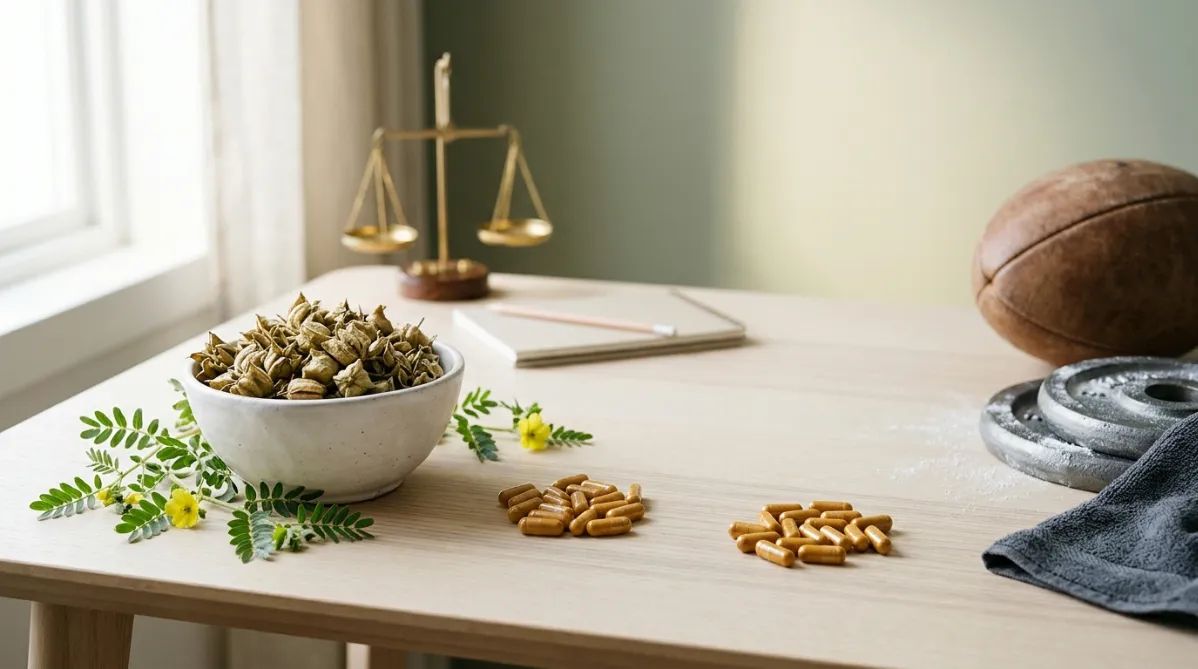
A wide, landscape editorial photograph shot from slightly above, showing a rustic matte-white ceramic bowl of dried tribulus terrestris, spiky star-shaped seed pods in warm tan and khaki tones, with a few fresh green trailing vines and tiny yellow flowers draped beside it. The bowl sits at the left third of the frame on a pale ash-wood table. Scattered nearby are two identical sets of plain, unlabeled amber supplement capsules, one pile slightly apart from the other, hinting at a placebo comparison. To the right, slightly out of focus, a worn leather rugby ball rests next to a chalk-dusted steel barbell plate and a folded charcoal-gray athletic towel.

Soft diffused natural light streams in from a window on the left, creating gentle long shadows and a calm, clean atmosphere. The background is a muted sage-green and cream gradient with a shallow depth of field, leaving generous negative space on the right side for title overlay. A small, minimal notebook with a pencil and a simple balance scale made of brushed brass sits subtly in the midground, suggesting scientific scrutiny without any laboratory clutter.

The color palette is earthy and refined: sage green, sand, warm amber, charcoal, and off-white. The style is modern lifestyle-magazine photography, crisp textures, subtle film grain, and a high-end wellness journal feel. The composition is balanced, uncluttered, and minimalist, with a quiet, thoughtful mood that conveys skepticism and evidence-based inquiry. No text, no logos, no people, no futuristic or sci-fi elements.
science research

Tribulus Terrestris Flopped in Elite Rugby Players: 5-Week Trial

BY DR. GYMBRO ·

Tribulus terrestris is marketed as a natural testosterone booster that builds muscle in under a month. So researchers tested it on elite rugby league players in a double-blind trial. Everyone got stronger and gained fat-free mass, but the placebo group did just as well. The supplement also didn't change the urinary T/E ratio. Here's what the study found, its limits, and where your money is better spent.

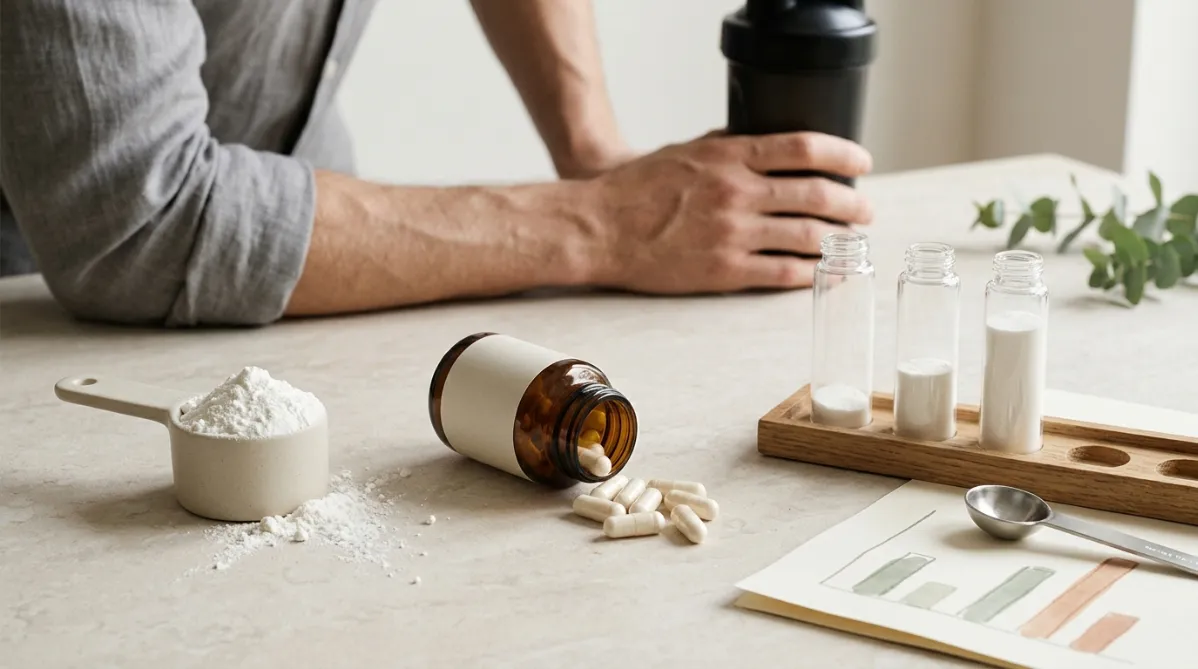
A modern editorial still life photographed from a slightly elevated angle on a pale, matte stone surface in soft natural window light. On the left, a heaping mound of fine white creatine monohydrate powder spills from a matte ceramic scoop, with a few crisp grains scattered across the surface. In the center, a small, minimalist amber glass capsule bottle sits tipped on its side, with a handful of off-white capsules spilling out. The label is blank and clean. On the right, a neat row of three clear glass lab-style vials rests on a slim oak tray. The vials hold different amounts of white powder: the first nearly empty, the second slightly fuller, the third filled almost to the brim. This quietly suggests the difference in dose and result. Beside the tray lies a simple stainless steel measuring spoon and a folded sheet of cream paper with soft, abstract bar-chart lines in muted sage green and terracotta. The lines are hand-drawn and unlabeled.

Behind the objects, slightly out of focus, a lean athletic forearm in a gray linen sleeve rests on the edge of the surface, one hand loosely holding a matte shaker bottle. This hints at a training context without showing a face. A single sprig of eucalyptus in the corner adds a soft organic touch.

The palette is warm neutral: bone white, oatmeal, soft sage, muted terracotta, and touches of amber. Shadows are gentle and long, with a shallow depth of field that gives creamy bokeh in the background. The mood is calm, clean, and trustworthy, like a premium health and science journal's feature spread, with generous negative space at the top and right for headline overlay. The composition is wide, balanced, and uncluttered, with subtle film-like grain and a natural, true-to-life color grade. No text, no logos, no futuristic elements.
nutrition

Kre-Alkalyn's Label Dose Didn't Lift Muscle Creatine, Biopsies Show

BY DR. GYMBRO ·

Buffered creatine like Kre-Alkalyn promises better absorption, lower doses and less bloating. A double-blind Texas A&M trial put that to the test with actual muscle biopsies in 36 trained lifters over 28 days. At the label dose of 1.5 g/day, muscle creatine barely moved, while monohydrate raised it clearly more. Strength, body composition and side effects showed no advantage for the buffered product. Here is what the numbers show and how to dose creatine instead.

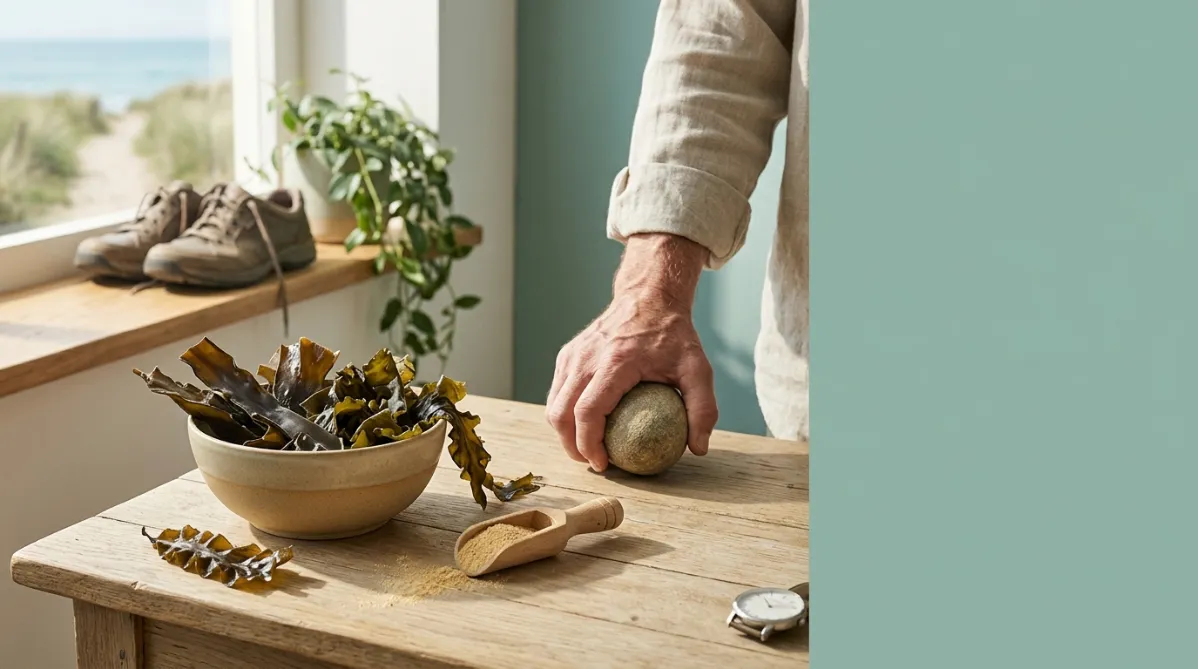
A wide, softly lit editorial photograph of a rustic light-oak table by a sunny window. On it, a handful of dried brown kelp and wakame seaweed fronds spill from a handmade matte ceramic bowl in warm sand tones, their glossy, ruffled edges catching the light. Beside the bowl sits a small wooden scoop holding fine golden-beige powder, with a little of it dusted across the table. In the middle ground, an older adult's weathered but strong hand grips a smooth, rounded river stone, with the knuckles and tendons subtly emphasized to suggest strength and vitality. Only the hand and part of a forearm in a soft oatmeal linen sleeve are visible.

In the background, slightly out of focus, a pair of worn leather walking shoes rests on a windowsill next to a trailing green plant. Beyond the window, a blurred coastal path winds through dune grass toward a pale blue sea, hinting at walking and an active daily life. A simple analog wristwatch lies on the table's edge, a quiet nod to the twelve-week timeline.

The palette is muted and natural: sage green, warm sand, soft ocean teal, and creamy off-white, with deep olive-brown accents from the seaweed. Morning light streams in from the left, casting long, gentle shadows and a faint golden glow. The depth of field is shallow, with crisp focus on the hand and seaweed and a creamy bokeh background. The composition follows the rule of thirds, with the hand and bowl on the left and generous negative space on the right for headline text. The mood is calm and hopeful, with a clean, contemporary wellness-magazine feel. The image is shot as if on a 50mm lens with subtle film grain and a natural, uncluttered, tactile look.
science research

Seaweed Fucoidan Boosted Grip Strength in Over-60s in 12 Weeks

BY DR. GYMBRO ·

Losing strength with age is one of the most common and least discussed parts of getting older, and resistance training isn't an option for everyone. A new 12-week randomized trial found that a low-molecular-weight seaweed fucoidan, taken at 1,650 mg per day, significantly improved grip strength and six-minute walk performance in adults over 60. Surprisingly, muscle mass didn't change, and adding BCAAs and vitamin D offered no extra benefit. The trial was small and tested a single branded product, so it's a promising lead rather than a verdict. Here's what the study found and what it means in practice.

This page is available in