Dr. Gymbro
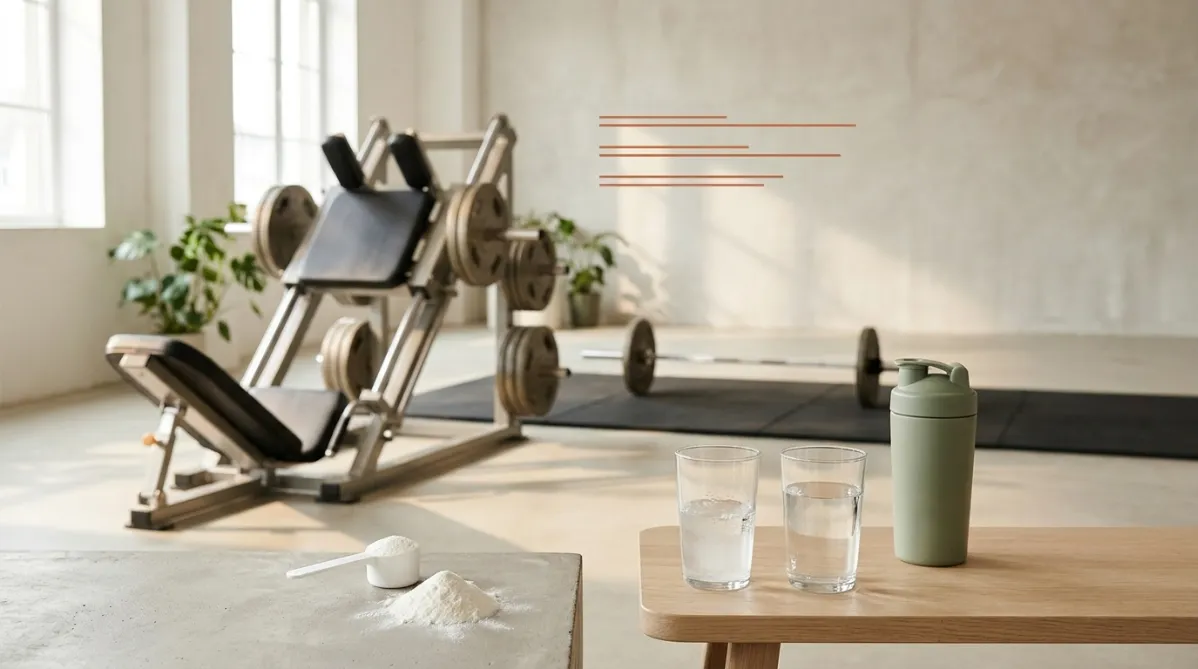
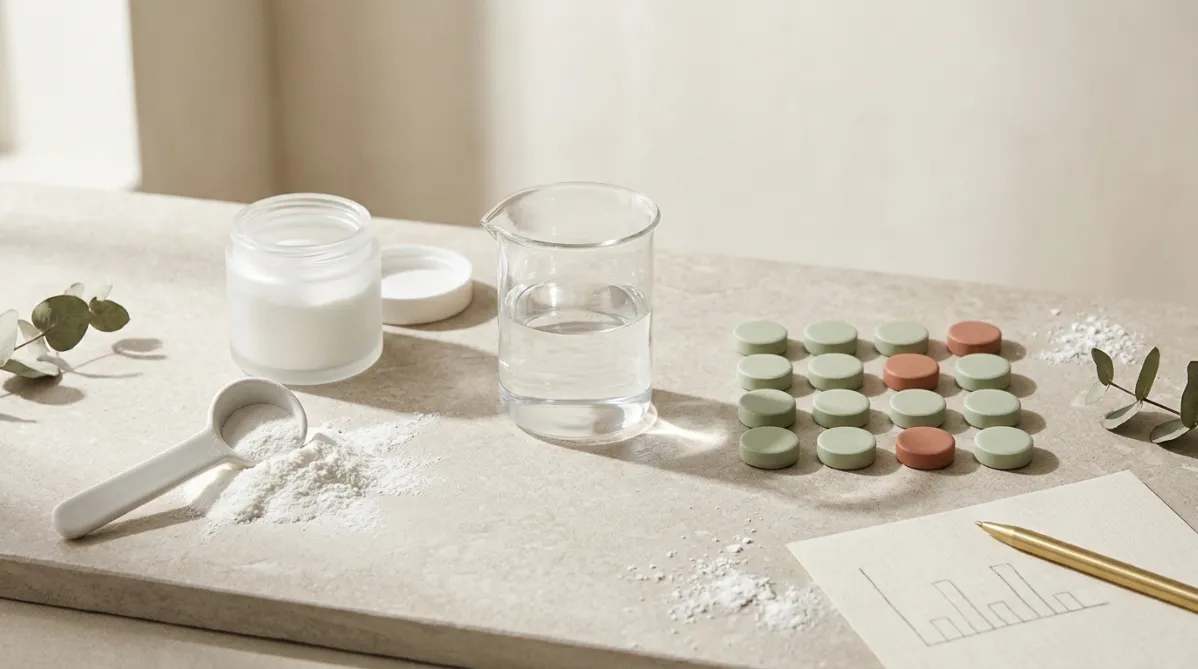
A wide, editorial still-life photographed from slightly above on a pale warm-gray stone surface, lit by soft natural window light with gentle long shadows. On the left, a matte white ceramic scoop rests in a small mound of fine white creatine powder. Beside it sits a minimalist frosted glass jar with its lid off. In the center, a clear glass beaker with a few ounces of water catches the light, with soft caustic reflections across the stone. On the right, a neat row of fifteen small, identical pale sage-green ceramic tokens sits in a precise grid of three rows of five. Twelve are sage green and three are a muted terracotta, hinting at sample size and the "catch" without any text. Scattered at the edge of the frame are a few loose powder grains, a sprig of dried eucalyptus, and a slim brushed-brass pen lying across a blank cream notecard with faint, abstract pencil-drawn bar graph lines, unreadable and softly out of focus.

The palette is calm and modern: bone white, warm stone, sage, dusty terracotta, and subtle brass accents. The background fades into a creamy, softly blurred neutral tone with shallow depth of field, so the foreground tokens and powder are crisp. The composition follows the rule of thirds, with generous negative space on the upper right for a headline overlay. The mood is clean, thoughtful, and scientific without being clinical, like a contemporary health and science journal feature. The image is high-resolution and has subtle film-like grain, with no people, no text, no lab equipment clichés, and no futuristic elements.
Science & Research

Creatine and Sperm Count: First Human Trial Has 15 Men and a Catch

Dr. Gymbro · · 4 min read

Creatine is the most studied supplement in the gym bag, and it may now be headed somewhere unexpected: male fertility. A new pilot trial reports that more men improved their sperm concentration on creatine than on placebo. Before anyone adds a scoop to their shake for this reason, the details matter. The trial is tiny, the headline average change was not statistically significant, and the senior author has financial ties to the creatine industry.

What the Researchers Did

The paper, published in Nutrition and Health (online October 2025, listed in the September 2026 issue), calls itself the first to test whether dietary creatine changes the physical-chemical and microscopic characteristics of human semen. The team, based mainly at the University of Novi Sad in Serbia, ran a randomized, placebo-controlled exploratory pilot trial. The trial is registered at ClinicalTrials.gov (NCT06202469).

The numbers are small. A total of 15 men (mean age 25.0 ± 6.1 years, BMI 25.1 ± 2.0 kg/m²) were randomized, and five of them were oligospermic, meaning they had low sperm concentration. Participants took creatine alone, creatine plus ubiquinol (the reduced form of coenzyme Q10), or a control for 8 weeks. The researchers measured semen parameters, sperm biochemical markers, well-being on the WHO-5 questionnaire, and side effects.

The Headline Numbers

The results were mixed, and the way they are framed matters.

  • Average sperm concentration: In the creatine-plus-ubiquinol group, concentration rose by an average of 7.4 million per milliliter. That change was non-significant (P = 0.22), so it could easily be noise.
  • Responder rates: Six of ten men taking creatine, with or without ubiquinol (60%), had higher sperm concentration at 8 weeks, versus 20% of the control group (P ≤ 0.05).
  • Oligospermic men: All oligospermic men who received creatine or creatine plus ubiquinol improved. In the oligospermic controls, concentration stayed the same or fell (P ≤ 0.05).
  • Sperm creatine content: In the creatine-plus-ubiquinol group, sperm creatine concentration rose by an average of 125.4 µmol/L (35.8%) (P = 0.03).

The last result is the most solid, but it only shows that supplemental creatine reached sperm. It does not show that fertility improved.

Why This Is Not Proof

The study design limits what can be concluded. With 15 participants split across several arms, one or two men can swing a percentage. The "60% vs 20%" comparison rests on a handful of individuals. The group average, which is the more conventional measure, did not reach significance. Sperm concentration also varies naturally from sample to sample and week to week, which is a real problem in a study this small.

The authors themselves describe the findings as "preliminary" and say they need validation in well-designed longitudinal trials with larger samples. Nothing in the abstract shows that creatine improves fertility outcomes such as motility, pregnancy rates, or live births. The abstract also does not report the WHO-5 or side-effect results, so this summary cannot say how well tolerated the regimen was.

The Conflict-of-Interest Flag

The disclosure statement deserves attention. Senior author Sergej Ostojic (listed as SMO) serves on the Scientific Advisory Board on Creatine in Health and Medicine for AlzChem LLC. He co-owns a European patent on liquid creatine supplements and a U.S. patent application on a creatine composition for telomere lengthening. He also reports research support related to creatine in the past 36 months from AlzChem GmbH, ThermoLife International, and Hueston Hennigan LLP, as well as Serbian government bodies. He reports owning no stocks or shares in any organization. The other authors declared no competing interests.

These ties do not invalidate the data, and the disclosure is commendable. But they are a good reason to wait for independent replication, especially with a sample this small.

Practical Takeaways: Dose, Timing, Who It's For

Dose: The abstract does not state the creatine or ubiquinol doses, and this article will not guess. Anyone curious should read the full paper's methods section rather than rely on numbers from social media.

Timing: The only timeframe in the abstract is 8 weeks of supplementation, with outcomes measured at follow-up. There is no data here on long-term use, on stopping, or on the best time of day.

Who it might be relevant for: The signal was strongest in the five oligospermic men, but that group is far too small to support advice. Men with low sperm counts or trouble conceiving should see a physician or fertility specialist and get a proper semen analysis. A supplement is not a replacement for a workup.

Who should not read this as a green light: Healthy men in the gym without fertility concerns have no evidence here that creatine will raise their sperm count. The study also gives no basis for claiming creatine is harmful to fertility, which is consistent with the paper's cautious framing.

The Bottom Line

This is a first, hypothesis-generating signal and not a fertility protocol. Creatine got into sperm, more creatine-treated men saw increases in concentration, and the small group of oligospermic men looked promising. The average change in the creatine-plus-ubiquinol group was not significant, the numbers are very small, and the senior author has ties to the creatine industry. The next step is a larger, independent, preregistered trial that measures outcomes beyond sperm concentration.

Original study

Read the original research on pubmed.ncbi.nlm.nih.gov →

This article summarizes published research for general information. It is not medical advice.

DG

Written by

Dr. Gymbro

Dr. Gymbro writes for Dr. Gymbro: science-backed fitness, nutrition & performance.

Related Articles

A wide, softly lit editorial still life photographed on a pale oak desk at the blue hour just before dawn. In the center-left foreground, a clear glass of water sits beside a small ceramic dish holding a mound of fine white powder, with a matte wooden scoop resting beside it, a light dusting of powder scattered across the wood grain. Behind them, a minimalist analog alarm clock in muted sage green reads close to 4:00. Next to it is an open linen-bound notebook with a pencil and a few abstract handwritten lines, plus a ceramic mug of black coffee with a thin trail of steam. To the right, a slim laptop is open to a blurred, softly glowing screen with no legible text. A window in the background shows a deep indigo sky turning peach at the horizon, with soft city silhouettes out of focus. Warm light from a small brass desk lamp creates a gentle pool of amber on the desk, contrasting with the cool blue ambient light from the window. The palette is muted and modern: dusty blue, warm cream, soft sage, and a touch of apricot. Shallow depth of field, fine film grain, and generous negative space on the right third for title overlay. The mood is calm, focused, and slightly weary but hopeful, like a contemporary health and science magazine cover. Clean composition, natural textures, subtle shadows, and a high-end lifestyle photography aesthetic.
nutrition

Creatine Before an All-Nighter? A Lower Dose Still Cut the Brain Crash

BY DR. GYMBRO ·

What if one big scoop of creatine could soften the brain fog of an all-nighter? A new study in Nutrients found that a single 0.2 g/kg dose, roughly 14-16 g for most adults, reduced the decline in logic, numerical, language-speed and vigilance tasks during 21 hours awake, with improvements of up to 12%. Women appeared to benefit more. But only 29 people took part, the dose is several times the normal daily amount, and the effect was smaller than with the same group's earlier 0.35 g/kg trial. Here's what the data show, and what they don't.

A wide, editorial-style still life shot from a slightly elevated angle on a pale oak laboratory-meets-kitchen countertop, bathed in soft, diffused morning window light. In the center, two small matte ceramic bowls sit side by side: one holds fine white creatine powder, the other holds slightly coarser off-white L-arginine crystals. A brushed steel scoop rests beside each. Between and slightly behind them stands a clear glass shaker bottle filled with a cloudy, pale liquid, catching a gentle highlight. In the foreground, a minimalist analog stopwatch lies on the wood surface, its face crisp and legible, next to a folded sheet of off-white paper with a hand-drawn simple bar chart in charcoal pencil, with one tall bar and a few shorter ones, no text or numbers. In the soft-focus background, a blurred gym-style window view shows a pale running track and a muted sage-green hedge, suggesting sprinting and athletic testing without any people. Eighteen small smooth stones or white pills are arranged in a neat loose arc across the lower edge of the frame, a subtle nod to the small sample size, with one stone set slightly apart. The color palette is calm and modern: warm cream, bone white, soft sage, muted terracotta accents from a small clay dish, and thin touches of brushed metal. Shadows are long and gentle, the depth of field shallow, with a fine film-like grain. The composition leaves generous negative space on the left third for a title overlay. The mood is clean, thoughtful, and trustworthy, like a contemporary health and science journal cover, with no futuristic elements, no glowing effects, and no text.
nutrition

Creatine Plus L-Arginine Added ~99 W Peak Power. Here's the Catch

BY DR. GYMBRO ·

A new crossover trial found that taking creatine and L-arginine together an hour before testing raised peak sprint power by about 99 W over placebo. The stack also beat each supplement alone on peak power and countermovement jump height. But the researchers couldn't prove the two work synergistically, and the study had only 18 men. Here's what the numbers show, how the doses worked, and who should be cautious.

A bright, modern gym scene shot in soft natural daylight from large windows, with a wide landscape composition. In the foreground, slightly off-center to the left, sits a clean white ceramic scoop resting on a matte surface beside a small pile of fine white powder. Next to it are two clear glass tumblers on a pale oak bench. One is filled a third of the way with cloudy water and the other two-thirds of the way, a quiet visual nod to different doses. A minimalist matte shaker bottle in sage green stands behind them, slightly out of focus.

The middle ground shows a polished leg press machine with a black padded seat and brushed steel frame. Several weight plates are loaded on its pegs, and the machine catches warm highlights. Beyond it, a bent-over barbell rests on a rubber floor, deliberately softer in focus to suggest contrast between the two exercises.

The background is an airy, uncluttered studio-style gym with pale concrete walls, a few green potted plants, and long soft shadows across the floor. The color palette is muted and editorial: warm off-white, sand, sage green, charcoal, and a subtle accent of terracotta orange. A shallow depth of field gives it a magazine-like, premium wellness-journal look.

Add a subtle graphic touch: three thin horizontal lines of different lengths in terracotta, painted or projected on the wall, hinting at a bar chart comparing three results without any text or numbers. The overall mood is calm, focused, and scientific yet approachable, like a contemporary health and fitness publication cover. Clean lines, generous negative space on the right side for title overlay, and crisp, high-resolution photographic quality.
nutrition

Is 8 g Citrulline Malate Too Low? Only 12 g Boosted Leg Press Reps

BY DR. GYMBRO ·

Most citrulline malate pre-workouts lean on a moderate dose, but a new double-blind pilot trial suggests that may not be enough to move the needle. In 12 resistance-trained adults, only a 12 g dose significantly increased total reps, while 8 g did not reach significance. The boost showed up on leg press, with estimated reps of 17 on placebo, 19 on 8 g and 20 on 12 g, but not on bent-over rows. Taken one hour before training, the higher dose looks promising, yet the tiny sample means this is a hypothesis, not a verdict.

A bright, modern editorial still life shot from a slightly elevated angle on a pale warm-gray stone countertop, bathed in soft natural window light with gentle diffused shadows. In the center, a small glass bowl holds a scatter of translucent golden-amber fish oil softgel capsules, a few spilled casually onto the surface and catching the light like tiny glowing beads. Beside the bowl sits a single chrome dumbbell with a matte finish, slightly out of focus, and a neatly folded charcoal gym towel. To the left, a clean arrangement of alternative "better spent" items: a ceramic dish of raw eggs, a wedge of salmon fillet on a wooden board with a sprig of dill, and a small bowl of Greek yogurt with a spoon, all styled with restraint. A minimalist notebook with a thin pen lies at the right edge, with faint, abstract pencil-drawn bar charts and a flat horizontal line suggesting "no effect," legible only as soft shapes with no readable text. The color palette is muted and sophisticated: warm cream, soft sage green, sandy beige, and pops of golden amber from the capsules, with a single accent of coral from the salmon. Shallow depth of field keeps the capsules crisp while the background melts into a creamy blur of a sunlit kitchen with a hint of green plant leaves. The composition leaves generous negative space on the right third for title overlay, in a 16:9 landscape format. The mood is calm, thoughtful, and quietly skeptical, in the style of a contemporary health and science magazine, with a crisp editorial photography look, fine grain, and natural color grading. No people, no futuristic elements, and no text.
science research

Fish Oil for Gains? 8 Trials Say Don't Count on It

BY DR. GYMBRO ·

Fish oil has long been sold as a recovery and muscle-building booster, but a new meta-analysis in Nutrition says the evidence isn't there. Pooling four trials for fat-free mass and eight trials (22 effects) for strength in healthy non-obese adults, researchers found no clear benefit for either. The strength result was essentially zero, while the fat-free mass estimate was too imprecise to say anything. Certainty of evidence was very low, so this isn't proof of no effect, but it's no reason to buy fish oil for gains. Here's what the numbers mean and where your money is better spent.

This page is available in