Dr. Gymbro
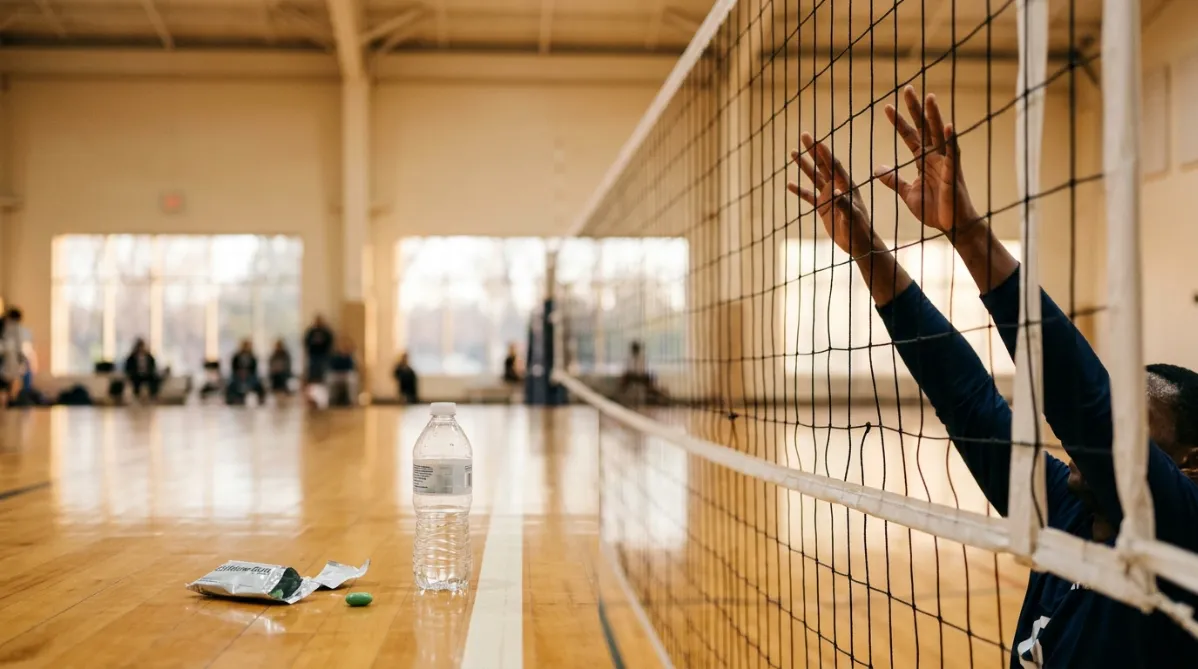
A landscape editorial photograph of a volleyball net in a softly lit indoor gym, shot from a low angle on the court. In the foreground, a pair of athletic hands in mid-block reach above the net, fingers spread, caught in crisp focus. The athlete's face is out of frame, so the attention stays on the hands and the net. In the lower left foreground, a small open foil pack of caffeine chewing gum sits on the polished maple floor, with two mint-green gum pieces beside it and a clear water bottle. The pack is unbranded and minimal.

The background is a warm blur of honey-toned hardwood, pale gym walls, and tall windows with diffused late-afternoon light streaming in. Dust motes glow in the light shafts. The palette is muted and modern: warm wood amber, soft cream, sage green, and a touch of deep navy from the athlete's jersey. Shallow depth of field and gentle film grain give the image a refined, magazine-like feel. The composition follows the rule of thirds, with the hands and net on the right and open negative space on the left, where headline text could sit.

The mood is calm, focused, and slightly cinematic, like a feature in a contemporary sports science journal. The lighting is soft and natural, with long gentle shadows across the court lines. No futuristic or digital elements, no charts, no text. The overall look is clean, tactile, and editorial.
Nutrition

Fatigue Slowed Reactions 18%. Caffeine Gum Held It to 3%

Dr. Gymbro · · 4 min read

Fatigue Slowed Reactions 18%. Caffeine Gum Held It to 3%

Picture the fifth set. Your legs are heavy, and the hitter across the net is already committing. The block you needed to read and jump on is a fraction late. A new randomized trial suggests caffeinated chewing gum may blunt that late-game slowdown, though the details matter more than the headline number.

The Number That Stops the Scroll

Researchers at Capital University of Physical Education and Sports in Beijing tested 15 elite female volleyball players. Each athlete went through a volleyball-specific repeated blocking fatigue protocol, with testing before and immediately after. On placebo gum, the overall reactive blocking sequence time got 18.4% slower after fatigue. With caffeine gum at a nominal 3 mg/kg, the slowdown was 6.4%. At 6 mg/kg, it was only 3.0%.

The sequence time is an integrated measure of the whole blocking timing chain, from stationary response through movement. It is a closer proxy for what actually happens at the net than a simple lab reaction test. The 6 mg/kg dose showed the smallest deterioration in this measure and a reduction in mean stationary response time.

It Wasn't Just Reaction Speed

Block-jump peak power, one of the primary outcomes, fell 13.9% on placebo but only 6.9% with 6 mg/kg. Those are descriptive differences, and the authors are careful here. The adjusted post-fatigue comparison did not establish that 6 mg/kg was superior to 3 mg/kg.

Secondary measures leaned the same way. Caffeine produced more favorable post-fatigue responses in selected jump measures, including countermovement jump mean propulsive power and drop-jump contact time. The 6 mg/kg dose also better preserved drop-jump height and drop-jump vertical stiffness than placebo. Those are stretch-shortening cycle qualities, the spring-like behavior that fatigue tends to erode.

Not everything lined up. The countermovement jump mRSI showed a divergent pattern, and the authors explicitly did not treat it as evidence that caffeine reduced fatigue-related decline. Exploratory muscle-activity data (surface EMG) showed smaller post-fatigue changes under 6 mg/kg, particularly in extensor-muscle measures, but these were labeled exploratory.

Why 3 mg/kg Isn't Dead

The 3 mg/kg dose showed little change in the mean stationary and movement component times. So the picture is outcome-specific. The 6 mg/kg dose looked best on the integrated sequence time and on block-jump power decline, while the lower dose held up well on some individual timing components. The authors conclude the findings do not establish a generally preferable dose, or a timing-stability advantage for 3 mg/kg.

What the Doses Mean in Real Milligrams

These are simple weight-based calculations from the nominal target doses:

Body mass 3 mg/kg 6 mg/kg
60 kg athlete 180 mg 360 mg
80 kg athlete 240 mg 480 mg

The jump from 3 to 6 mg/kg doubles the caffeine, and the 480 mg figure is large in absolute terms. Check the label of any product to see how much caffeine each piece contains. The abstract does not say how many pieces of gum were used.

Why Gum at All?

This study did not compare gum with capsules or pills, so it cannot say gum is better. The general rationale is that caffeine in gum can be absorbed partly through the lining of the mouth, which may speed its arrival compared with swallowed capsules that must pass through the gut first. For an athlete who needs caffeine on board by a certain point in a match, that faster onset is the appeal. Treat it as background reasoning, not a finding from this trial.

The Trade-Off at 6 mg/kg

Higher dose, more side effects. Adverse effects were more frequent in the 6 mg/kg condition. The abstract does not itemize which ones, so there is no basis here for guessing at specifics. But the pattern is a practical warning: the dose with the strongest descriptive timing result also carried the greatest cost in tolerability. An athlete who feels jittery or uncomfortable may give back what caffeine gives.

Caveats You Should Not Skip

  • Small sample: Just 15 athletes, all elite female volleyball players. Results may not carry over to other sports, sexes, or levels.
  • Incomplete blinding: No one guessed caffeine on placebo, but participants reported perceiving caffeine in 53.3% of 3 mg/kg visits and 80.0% of 6 mg/kg visits. Expectation could have contributed to the differences, and the authors say this limits attributing them solely to dose.
  • No winner declared: The adjusted comparison did not establish 6 mg/kg over 3 mg/kg.
  • Mixed signals: Some measures, like CMJ mRSI, did not follow the caffeine-friendly pattern, and the EMG data were exploratory.

Practical Takeaways

  1. Who it may suit: Team-sport and jump athletes whose performance depends on fast reads and repeated explosive efforts late in matches. This is an extrapolation, since the study tested volleyball blockers.
  2. Start lower: 3 mg/kg (about 180 mg for 60 kg, 240 mg for 80 kg) still limited the sequence-time slowdown to 6.4% versus 18.4% on placebo, with presumably less side-effect risk.
  3. Test 6 mg/kg in training only: If you try the higher dose (360 mg or 480 mg for those body weights), do it in practice, not on match day, and watch how you feel.
  4. Don't expect a miracle: Caffeine reduced the decline; it did not eliminate fatigue.
  5. Mind the placebo effect: If you feel caffeine kick in, part of the benefit may be expectation. That is not a reason to skip it, but it is a reason to stay realistic.

The Bottom Line

In a small, well-controlled crossover trial, caffeinated gum meaningfully softened the late-fatigue hit to blocking reaction timing and jump power, with 6 mg/kg showing the smallest descriptive slowdown. But with 15 athletes, leaky blinding, more side effects at the higher dose, and no dose crowned best, this is a promising signal rather than a prescription.
Original study

Read the original research on pubmed.ncbi.nlm.nih.gov →

This article summarizes published research for general information. It is not medical advice.

DG

Written by

Dr. Gymbro

Dr. Gymbro writes for Dr. Gymbro: science-backed fitness, nutrition & performance.

Related Articles

A landscape editorial still life on a pale warm-gray concrete surface, shot from a slightly elevated three-quarter angle in soft diffused morning window light. In the foreground left, a small open foil blister pack of mint-green caffeine gum sits beside two neatly arranged piles of gum pieces, one with three pieces and one with six, each on a small matte ceramic dish in oat and sage tones. The pieces are slightly glossy, rounded rectangles with crisp shadows. In the center-right, a worn leather basketball rests on the surface with deep amber-orange tones and visible pebbled texture. Next to it is a loosely chalked barbell collar and a single steel weight plate edge, partly out of focus. A minimalist analog stopwatch with a matte white face and a thin black hand lies at the lower right, and a slim notebook with a pencil rests nearby. The page shows a simple hand-drawn bar graph of two equal bars, with no legible text. In the soft-focus background, a blurred indoor basketball court with warm honey-colored hardwood and distant hoop lines fades into creamy bokeh. A narrow band of sunlight crosses the scene diagonally and picks out chalk dust particles in the air. The palette is muted and modern: sage green, warm oat, terracotta orange, charcoal, and cream. The composition leaves open negative space on the upper left for title overlay. Shallow depth of field, fine film grain, and a calm, clean magazine aesthetic like a contemporary health and science journal. No people, no text, no futuristic elements.
science research

Caffeine Gum and Same-Day Performance: Why 3 mg/kg Matched 6

BY DR. GYMBRO ·

A new crossover trial in basketball players found that caffeine gum at 3 mg/kg improved same-day strength, power, sprint speed, and reactive agility about as much as a 6 mg/kg dose. Both doses also raised barbell velocity during heavy squat priming. By 24 and 48 hours, though, the benefit was gone. The study had no baseline testing and no caffeine-only arm, so the results need careful reading. Here is what it means for dose, timing, and who might benefit.

nutrition

Caffeine Made Soccer Players Faster, But Not at Reacting

BY DR. GYMBRO ·

Everyone assumes caffeine makes athletes sharper all around, but a new double-blind trial in amateur soccer players tells a more nuanced story. A 300 mg dose (about 3.7 mg/kg) improved planned agility with an effect size of 0.62 and also boosted jump performance. But when players had to react to a light or a human opponent, the benefits were small or not statistically significant. Here is what the study found, how to read the results, and who might actually benefit.

A wide, editorial-style photograph of a sprinter crouched in starting blocks on a deep terracotta-red running track, shot from a low angle at the side as the first morning light rakes across the lanes. The athlete is mid-set, hips lifted, hands poised behind crisp white lane lines, with a soft focus on their muscular calves and spiked shoes in the foreground. Warm golden sunlight creates long, elegant shadows and subtle lens flare, while the distant lanes fade into a creamy bokeh.

In the lower right foreground, slightly out of focus, sits a minimalist still life on a matte concrete ledge beside the track: a small ceramic cup of black coffee with a thin wisp of steam, two loose roasted coffee beans, and a simple stopwatch with a clean white face. The ceramic is a muted sand color, adding a refined, modern lifestyle touch.

The color palette is restrained and trendy: terracotta, warm cream, soft charcoal, and a hint of sage green from trees blurred in the far background. The composition uses generous negative space across the upper left, ideal for headline text overlay. The look is similar to a contemporary health and sports science magazine: natural film-like grain, gentle contrast, shallow depth of field, and a calm, focused mood. No text, no logos, no graphics, and no futuristic elements, just a realistic, tactile, sunlit scene that suggests precision, preparation, and explosive speed.
science research

Double the Caffeine, Faster Sprints? What 6 mg/kg Really Added

BY DR. GYMBRO ·

A new randomized, double-blind crossover trial pitted 3 mg/kg against 6 mg/kg of caffeine in 21 trained male sprinters. Both doses beat placebo, but the higher dose added extra speed only over the first 30 and 60 m, not at 10 m. It also gave extra benefit for jump height and block force development, yet nothing more for reaction time or Wingate peak power. Here is what the doses mean in milligrams for a 70 to 80 kg athlete, when to take them, who the evidence applies to, and what the study does not tell us about side effects.

A landscape editorial photograph in a bright, modern gym studio with soft natural light pouring through tall windows. In the foreground, a matte ceramic cup and a small glass jar of plain white powder sit on a light oak bench, with a wooden scoop resting beside them and a few loose grains dusted across the wood. The jar has no label, which hints at mystery without being heavy-handed. Slightly out of focus behind them, a female athlete in a sage green athletic set stands at a barbell, chalked hands gripping the bar, her expression calm and focused. A male cyclist on a stationary bike is blurred in the far background. The palette is warm neutrals: cream, soft sand, pale oak, muted sage, and a touch of terracotta, with gentle golden-hour highlights and soft shadows. The composition follows the rule of thirds, with the cup and jar in the lower left, the athlete on the right, and open negative space in the upper area for headline text. The depth of field is shallow, with a creamy bokeh background. The mood is contemplative, curious, and trendy, like a contemporary health and science magazine cover. Fine film grain, subtle matte finish, clean minimalist styling, and no text or logos.
science research

Fake Caffeine Still Made Athletes Stronger and Faster

BY DR. GYMBRO ·

What if part of your pre-workout kick is coming from your head and not the scoop? A 2026 meta-analysis of 17 studies found that a placebo athletes believed was caffeine still improved sport performance (d = 0.49), across bench press, cycling time-trials and repeated sprints. Effects were larger when researchers were blinded and in studies with more females, though the evidence is low certainty with high risk of bias. This is no reason to skip real caffeine at 3-6 mg/kg, but it is a reminder that expectation is a performance variable. Here's what the data say, and who should be cautious.

This page is available in
