Dr. Gymbro
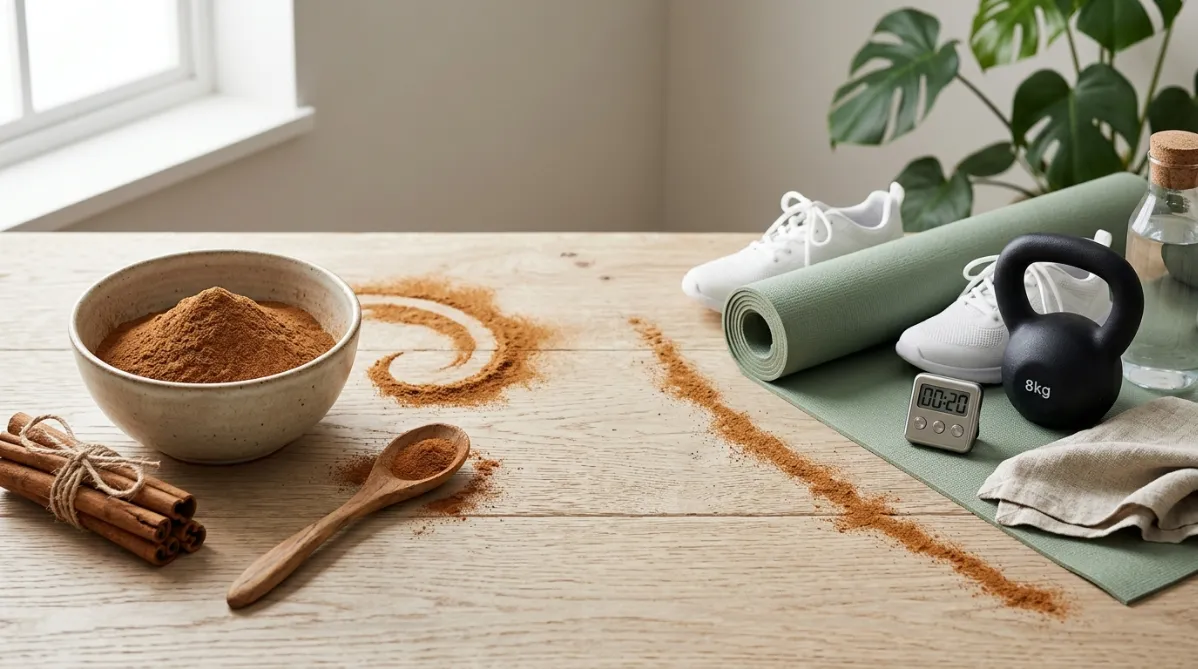
A wide, editorial-style flat lay photographed from above on a pale, warm-toned marble surface with soft natural window light coming from the left. At the center sits a shallow ceramic bowl filled with glistening golden-amber fish oil capsules, a few spilled casually onto the marble. Beside the bowl, a sleek minimalist bathroom scale in matte white sits at the right edge, its digital display blurred so it appears static. To the left, a neatly folded heather-gray athletic towel rests beside a small cluster of fresh ingredients: a halved lemon, a sprig of dill, and a fillet of raw salmon on a slate board, its coral-pink flesh with delicate white marbling catching the light. Near the top of the frame, a pair of brushed-steel dumbbells in a light finish and a soft tape measure curl loosely across the surface, suggesting body composition tracking without being clinical. A small glass of water with condensation and a linen napkin add quiet lifestyle detail. The color palette is calm and modern: cream, soft sage green, warm gold, coral, and muted gray. Shadows are soft and diffused, with gentle highlights on the capsules making them glow like tiny amber beads. The composition has generous negative space on the upper left for headline text, with a shallow depth of field that keeps the capsules and salmon crisp while the edges fall softly out of focus. The overall mood is clean, health-conscious, and contemporary, like a high-end wellness magazine or science journal cover, with a subtle film-like grain and natural, true-to-life tones. No people, no text, no futuristic elements.
Nutrition

Fish Oil Swapped Fat for Muscle in 6 Weeks. Scale Didn't Budge.

Dr. Gymbro · · 4 min read

Imagine stepping on the scale after six weeks of a supplement and seeing... nothing. Same number. Yet your body has quietly traded about half a kilo of fat for about half a kilo of lean tissue. That is roughly what a double-blind trial in healthy adults reported for fish oil, and a stress hormone may be part of the story. The numbers are modest and the study is small, so here is what the data show and where the hype should stop.

The Study: What Was Actually Done

Researchers at Gettysburg College, led by Eric Noreen, published the trial in the Journal of the International Society of Sports Nutrition in 2010. It was a randomized, double-blind, placebo-controlled study of 44 healthy men and women with an average age of 34 (±13) years.

After baseline testing, participants were split into two groups for 6 weeks:

  • Fish oil group: 4 g/day of fish oil, supplying 1,600 mg EPA and 800 mg DHA (about 2.4 g combined omega-3s).
  • Control group: 4 g/day of safflower oil.

All testing happened first thing in the morning after an overnight fast. Resting metabolic rate (RMR) was measured by indirect calorimetry with a facemask. Body composition was measured by air displacement plethysmography (the Bod Pod method). Saliva was collected by passive drool and analyzed for cortisol.

The Headline Result: Fat Down, Lean Mass Up

Compared with safflower oil, fish oil produced these changes:

  • Fat-free mass: +0.5 ± 0.5 kg with fish oil vs. -0.1 ± 1.2 kg with safflower (p = 0.03)
  • Fat mass: -0.5 ± 1.3 kg vs. +0.2 ± 1.2 kg (p = 0.04)
  • Body fat percentage: -0.4 ± 1.3% vs. +0.3 ± 1.5%, a tendency that did not reach significance (p = 0.08)
  • Body mass: 0.0 ± 0.9 kg vs. +0.2 ± 0.8 kg, no significant difference

That is the curiosity gap. The scale was flat in the fish oil group, but the composition underneath shifted slightly. Anyone who judges progress only by body weight would have missed it.

The Cortisol Twist

The researchers also tracked salivary cortisol, a hormone tied to stress and, at chronically high levels, to fat storage and muscle breakdown. Cortisol tended to fall in the fish oil group (-0.064 ± 0.142 μg/dL) and was roughly flat in the control group (+0.016 ± 0.272 μg/dL). That difference was not statistically significant (p = 0.11).

The link showed up inside the fish oil group. Within it, the change in cortisol correlated with the change in fat-free mass (r = -0.504, p = 0.02) and with the change in fat mass (r = 0.661, p = 0.001). People whose cortisol dropped more tended to gain more lean mass and lose more fat.

Reality Check: What This Doesn't Show

This is where an accurate read matters more than a flashy one.

  • The effects are small. About 0.5 kg each way, with large individual variation. The standard deviation on fat mass change (±1.3 kg) is bigger than the average change, so some people likely saw little or nothing.
  • The sample is small. 44 adults over 6 weeks is a pilot-sized dataset. It needs replication.
  • Cortisol is correlational. The between-group cortisol difference was not significant, and a correlation inside one group cannot prove cortisol caused the body composition shifts.
  • Metabolism didn't explain it. RMR did not differ significantly (+17 ± 260 kcal with fish oil vs. -62 ± 184 kcal with safflower). Respiratory exchange ratio didn't either. So this was not a proven "metabolic boost."
  • Measurement matters. Air displacement plethysmography is a well-regarded method, but changes of half a kilo sit close to the noise of any body composition test, and hydration shifts can influence readings.
  • Who was studied. Healthy adults, not a clinical or elite-athlete population. The results say nothing about people with obesity or competitive lifters.

What This Means for You

Dose tested: 4 g/day of fish oil providing about 2.4 g combined EPA + DHA (1.6 g EPA, 0.8 g DHA). That is the only dose this trial evaluated, so it is the number to anchor on.

Read the label carefully. "1,000 mg fish oil" does not mean 1,000 mg of EPA and DHA. Many capsules contain only about 300 mg combined omega-3s per gram of oil. Check the supplement facts panel for the EPA and DHA amounts, then do the math. Hitting 2.4 g could take around 8 standard capsules, or far fewer with a concentrated product.

Timing: The paper does not test timing. A practical approach is to take it with meals, since dietary fat generally helps absorption and may ease fishy burps. Splitting the dose across meals is a reasonable way to tolerate it.

Duration: The study ran 6 weeks. Whether benefits continue, plateau, or fade is unknown from this paper.

Who it might suit:

  • Healthy adults who rarely eat fatty fish and want to cover omega-3 intake
  • People curious about recomposition who understand the expected effect is small

Who should skip it or talk to a doctor first:

  • Anyone on blood thinners or anticoagulants, or with a bleeding disorder
  • People with a fish or shellfish allergy (check the product source)
  • Anyone with heart rhythm issues, or who is pregnant or has a medical condition, and wants to take omega-3s at high doses
  • Anyone expecting a fat-loss shortcut. This is not one

The Bottom Line

In this double-blind trial, 6 weeks of about 2.4 g/day of EPA+DHA was linked to roughly 0.5 kg more fat-free mass and 0.5 kg less fat mass than safflower oil, with body weight unchanged. A drop in cortisol tracked with those changes, but the evidence there is correlational. Metabolic rate did not change. Treat fish oil as a low-risk, small-effect tool that supports a good diet and training, not a replacement for either.
Original study

Read the original research on pubmed.ncbi.nlm.nih.gov →

This article summarizes published research for general information. It is not medical advice.

DG

Written by

Dr. Gymbro

Dr. Gymbro writes for Dr. Gymbro: science-backed fitness, nutrition & performance.

Related Articles

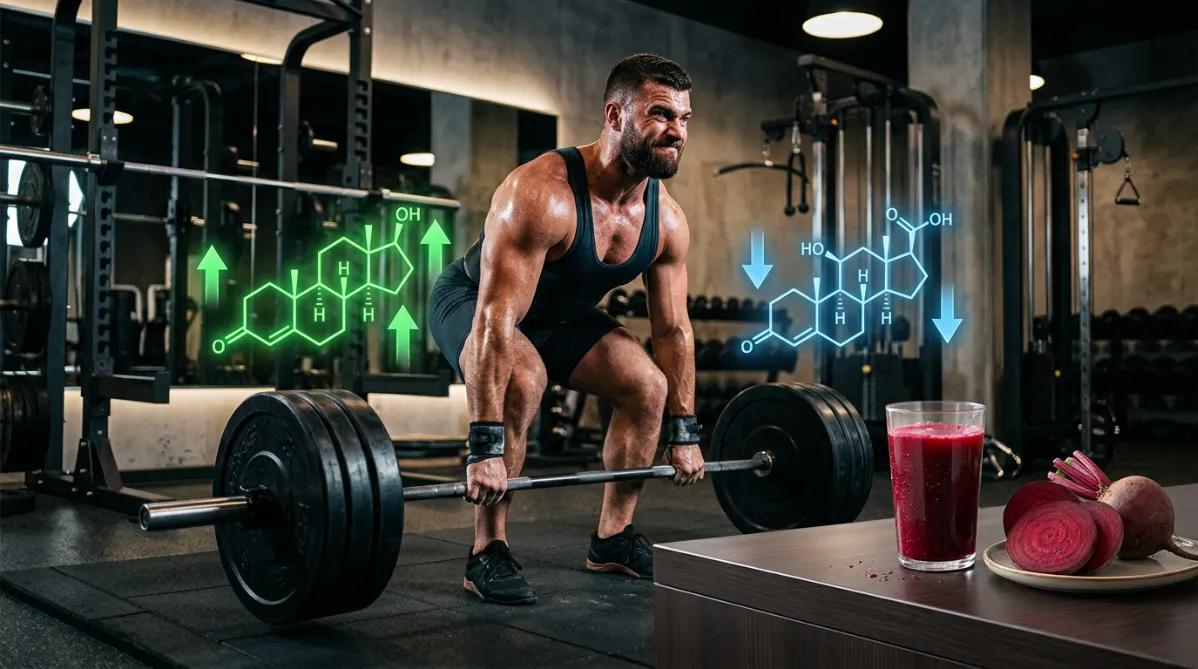
A softly lit editorial still life on a pale oatmeal-colored linen surface, shot from a slightly elevated three-quarter angle with a shallow depth of field. In the left foreground, a small ceramic dish holds several translucent golden-amber fish oil softgel capsules, glowing as if lit from within by warm morning window light. A few capsules are scattered casually beside it, catching crisp highlights. Just behind them, a sliced fresh salmon fillet with vivid coral-orange flesh rests on a matte slate board next to a sprig of dill, a halved lemon, and a small glass dropper bottle of golden oil.

In the soft-focus midground, a pair of weathered, capable older adult hands rests on the edge of the table, gently holding a pale sage-green resistance band, a hint of an active lifestyle. Beside them sits a modest set of brushed-steel dumbbells and a folded heather-gray towel. Subtle natural details add warmth: a glass of water, a small ceramic mug, and a sprig of eucalyptus in a bud vase.

On the right side, a tidy stack of printed research papers with a few pastel sticky tabs and a pair of thin tortoiseshell reading glasses sits on top, suggesting scholarly review. A fountain pen lies across the pages, with a few abstract handwritten notes and a simple hand-drawn bar chart visible but unreadable.

The palette is warm and calming: cream, soft sage, terracotta, honey gold, and coral accents against muted neutral tones. Window light enters from the left, producing long gentle shadows and a faint dappled leaf-shadow pattern across the linen. The background fades into a creamy blur of pale wall and a hint of a wooden shelf.

The composition leaves clean negative space across the upper right third for headline text overlay. The mood is trustworthy, health-forward, and modern, reminiscent of a contemporary wellness and science journal's photography. Fine film-like grain, natural color grading, high-resolution editorial photography, 16:9 landscape format.
nutrition

Fish Oil for Aging Muscles: What 14 Studies Actually Show

BY DR. GYMBRO ·

Fish oil is being pitched as armor for aging muscles, but what does the evidence actually say? A 2026 umbrella review pooled seven RCTs and seven meta-analyses in adults 55 and older. It found modest but measurable strength gains, with the clearest signal for lower-body strength and function. Grip strength, walking speed, and upper-body strength were far less certain, and heavy overlap among the studies means the evidence is shakier than it looks. Here is what it means, who it may help, and who should check with a doctor first.

A bright, minimalist editorial still life on a soft warm-white linen surface, shot from a slightly elevated angle in natural morning window light. In the center, a small shallow ceramic bowl in matte oatmeal tones holds several glossy, translucent coral-red softgel capsules, with a few spilled onto the surface in a gentle arc. Beside the bowl, a single ripe peach-pink shrimp-like krill shape is absent; instead a delicate scatter of tiny coral-orange dried krill-pink petals and a sprig of pale green seaweed hint at the marine origin. To the left, an empty clear glass of water and a folded cream napkin suggest fasting. To the right, a simple matte white plate sits bare with a silver fork resting across it. In the soft-focus background, a pair of sage green hand weights and a neatly rolled yoga mat in dusty blue add a quiet nod to muscle and strength. Soft shadows fall diagonally across the scene, giving gentle depth. The palette is calm and modern: warm ivory, coral red, sage green, dusty blue, and soft beige. Shallow depth of field with crisp focus on the capsules, which catch small bright highlights. Clean negative space on the left third of the frame for headline text. The overall feel is a contemporary wellness magazine or health journal cover, airy, refined, and editorial, with subtle film-like grain and natural color grading. Landscape 16:9 composition.
nutrition

Krill Oil Cut Muscle Loss on a Fasting Diet by Up to 6x in a Trial

BY DR. GYMBRO ·

Dieting hard often means losing muscle along with fat, but a new randomized trial suggests one supplement may change that. In 41 adults doing 8 weeks of alternate-day fasting, krill oil and placebo groups lost the same body weight (about 4.6 vs 4.5 kg). Yet the krill group lost just 0.2 kg of fat-free mass versus 1.2 kg for placebo, and held onto handgrip strength too. Before you stock up, there are catches: the sample was small and the capsule also contained astaxanthin and choline. Here are the numbers, the dose and who should skip it.

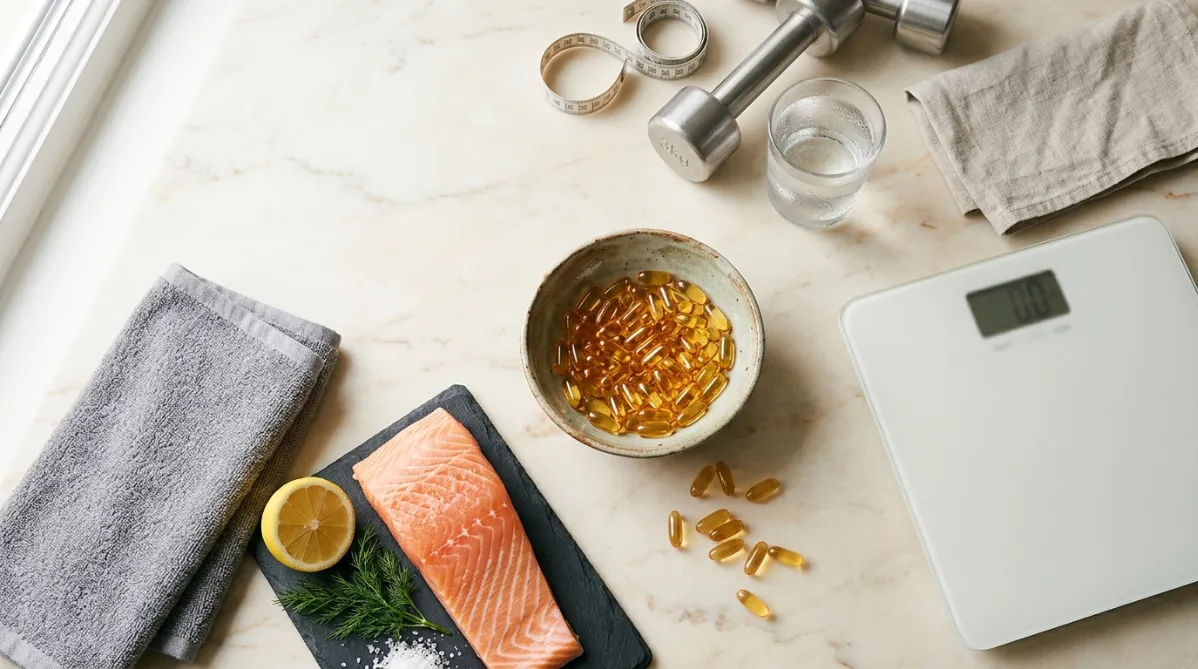
A wide, landscape editorial photograph shot from slightly above on a pale oak wooden surface, styled like a modern wellness magazine cover. On the left, a rustic ceramic bowl in matte oatmeal glaze holds ground cinnamon in a soft mound. Beside it sit several whole cinnamon sticks tied with natural twine, and a small wooden spoon dusted with warm reddish-brown powder. A loose cinnamon swirl spills across the surface in a graceful, organic arc. On the right, a minimalist fitness scene flows into the frame: a matte sage-green yoga mat partly unrolled, a stainless steel interval timer reading 00:20, a pair of clean white training sneakers, and a compact black kettlebell. A folded linen towel and a glass bottle of water add quiet, lifestyle-oriented detail. The two halves are linked by a thin line of scattered cinnamon powder that runs across the table like a brushstroke, joining the kitchen and the workout.

Soft morning window light enters from the upper left. It casts gentle, long diffused shadows and highlights the texture of the spice, the grain of the wood, and the curled bark of the sticks. The palette is warm and earthy: cinnamon brown, terracotta, cream, sage green, and soft charcoal, with one small accent of burnt orange. The background is a softly blurred neutral wall with a hint of a leafy plant in the top corner, giving shallow depth of field. The composition leaves generous negative space at the top and center-right for headline text. The mood is calm, fresh, health-forward, and trustworthy, with a subtle scientific-journal sophistication. Crisp focus on the cinnamon, creamy bokeh in the background, and a fine film-like grain. The image is realistic, tactile, and uncluttered, with no people, no text, no logos, and nothing futuristic.
nutrition

Cinnamon + Tabata Beat Training Alone for Fat Loss in 8-Week Trial

BY DR. GYMBRO ·

A humble kitchen spice may have given Tabata trainers an extra edge in an 8-week trial. Men who took 1.5 g of cinnamon daily alongside high-intensity circuits lost 7.86% body fat, significantly more than those who trained alone (p = 0.013). Inflammation dropped and irisin rose most in the combination group, while insulin changes appeared across all training groups. But with only about ten men per group, and cinnamon alone failing to match the combo, this is promising rather than proven. Here's the circuit, the dose and the coumarin catch you need to know.

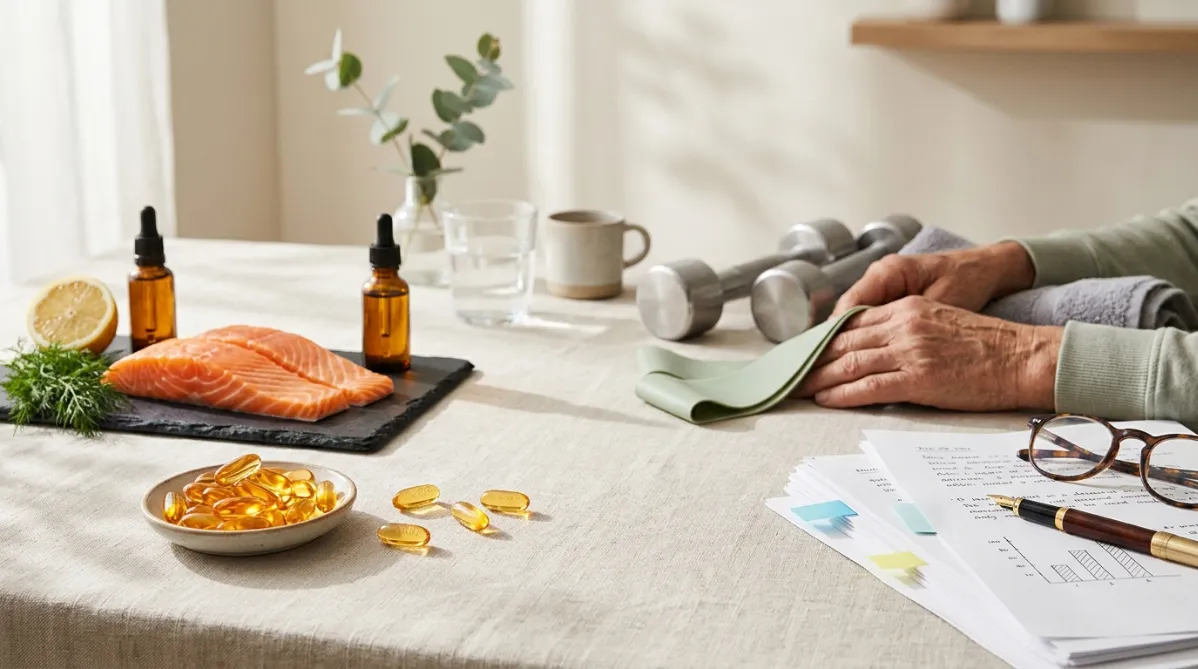
A muscular athlete in a modern gym performing a powerful deadlift, with intense focus and determination on their face. Sweat glistens on their skin as they grip a loaded barbell. In the foreground, a glass of deep red beet juice sits on a sleek counter, with fresh beetroot slices arranged nearby. The background features state-of-the-art gym equipment with soft lighting creating dramatic shadows. Overlaid translucent graphics show testosterone and cortisol molecular structures floating in the air, with upward arrows for testosterone (in vibrant green) and downward arrows for cortisol (in calming blue). The overall color palette combines deep reds from the beets, metallic grays from the gym equipment, and energetic greens and blues from the hormone visualizations, creating a scientific yet powerful atmosphere that represents the intersection of nutrition science and athletic performance.
general

The Science-Backed Secret to Maximizing Testosterone and Crushing Cortisol: How Betaine Transforms Your Training Hormones

BY DR. GYMBRO ·

Recent research reveals that betaine supplementation can significantly boost testosterone levels while reducing cortisol response in strength athletes, creating an optimal hormonal environment for muscle growth and recovery. This naturally occurring compound, found in beets and other foods, works through multiple pathways to enhance the anabolic hormone profile that drives training adaptations. With just 2.5 grams daily, athletes are experiencing measurable improvements in strength, body composition, and recovery that stem from betaine's unique ability to simultaneously elevate testosterone and moderate cortisol elevation following intense training sessions.

This page is available in