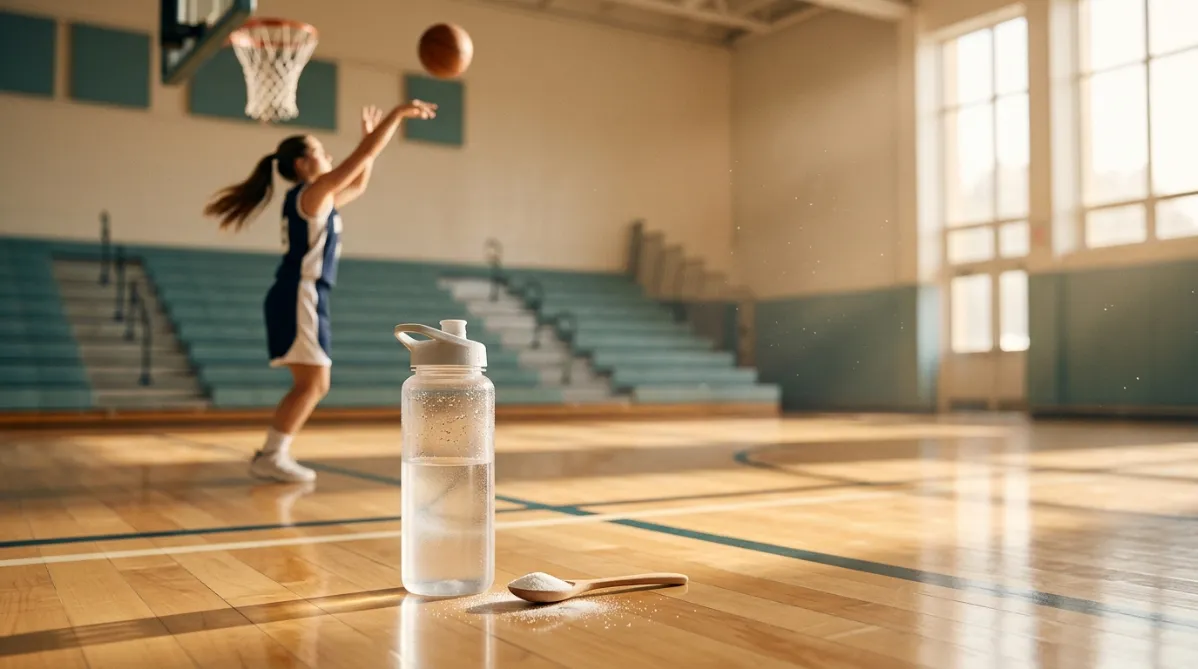
Everyone tells athletes to drink water. But in a small basketball study, plain water didn't protect shooting accuracy as well as water with a little L-alanyl-L-glutamine (AG) stirred in. The surprise is that the lower dose beat the higher one.
The Study at a Glance
The paper, published in the Journal of the International Society of Sports Nutrition in 2012, came from a team led by Jay Hoffman at the University of Central Florida. Here is the design:
- Design: crossover, with every player completing all four trials
- Participants: 10 women, all scholarship NCAA Division I basketball players (age 21.2 ± 1.6 years, body mass 73.5 ± 8.0 kg)
- Format: four 40-minute basketball games with controlled time-outs for rehydration
- Conditions: no rehydration (DHY), water only (W), low-dose AG (1 g per 500 ml, called AG1), and high-dose AG (2 g per 500 ml, called AG2)
- Analysis: pre-to-post change scores, compared with a one-way repeated measures ANOVA
What Is L-Alanyl-L-Glutamine?
AG is a dipeptide, meaning glutamine bonded to alanine. It is a form of glutamine that dissolves readily in water, which is why it can be mixed into a sports drink. The study tested whether adding it to rehydration fluid changed skill and physical performance late in a game, compared with water alone.
How They Set the Fluid Levels
The first trial was the dehydration game. Players could not drink, and the weight they lost set how much fluid they got in the next three trials. They lost 1.72 ± 0.42 kg, or 2.3% of body mass. In the three rehydration games, intake averaged 1.55 ± 0.43 L, with no differences between the water and AG trials. So any performance gap can't be blamed on one condition delivering more fluid.
The Headline Finding: Shooting
Shooting performance is where the results stood out:
- AG1 vs. no rehydration: a 12.5% difference in shooting performance (p = 0.016)
- AG1 vs. water only: an 11.1% difference (p = 0.029)
Water alone did not significantly separate itself from the dehydrated game on shooting in the abstract's reported comparisons. The low-dose AG trial separated from both. In other words, replacing the fluid wasn't enough to hold shooting accuracy. Adding the dipeptide appeared to matter.
Reaction Time and Fatigue
Visual reaction time was significantly different after AG1 compared with no rehydration (p = 0.014). The authors concluded that AG rehydration maintained skill performance and visual reaction time to a greater extent than water only.
Fatigue, measured by player load, was less clear-cut. A difference (p = 0.045) appeared only between the high-dose AG2 trial and the dehydrated trial. So the high dose showed up on fatigue, while the low dose showed up on shooting and reaction time.
Jump power did not budge. Peak and mean vertical jump power showed no differences in any trial. If you were hoping for a leaping boost, this study doesn't offer one. The signal was in skill and reaction, not explosive power.
Why Did Less Beat More?
The paper's abstract doesn't explain why the low dose outperformed the high dose on shooting, and with 10 players it would be reckless to guess. A plain reading is that more was not better here, and that the dose-response pattern wasn't a simple upward line. Any mechanism is speculation until larger studies test it.
What This Means for You
Dose: The effective dose in this study was 1 g of AG per 500 ml of fluid. With players drinking about 1.55 L on average, that works out to roughly 3 g total over a game. That is my arithmetic, not a figure reported in the abstract. The 2 g per 500 ml dose did not improve shooting more than the low dose.
Timing: Players drank during the controlled time-outs of a 40-minute game, with total fluid matched to their measured weight loss. The practical version is to mix AG into the fluid you sip during long games or sessions, rather than taking it once beforehand.
Who it may suit:
- Basketball or similar stop-start court sport athletes in long games where late-game accuracy matters
- Players who sweat enough to lose a couple of percent of body mass
- Coaches or athletes who already have a hydration plan and want to experiment with it
Who should skip it or hold off:
- Anyone hoping for better jump or power output, since the study found no effect there
- Casual exercisers on short sessions, a group the study didn't test
- People with kidney or liver conditions, or on medication, should talk to a doctor before taking any amino acid supplement
- Anyone expecting a guaranteed result, because the evidence is thin
The Caveats You Need to Know
- Tiny sample. Only 10 players took part, so the results are fragile.
- Women only, elite only. All were Division I women's basketball players. The findings may not transfer to men, recreational players, or other sports.
- The dehydrated game came first. Its weight loss set the fluid for later trials. The abstract does not describe randomizing the order of the other conditions, so order or familiarity effects can't be ruled out from the abstract alone.
- Funding and conflicts. The abstract doesn't mention funding or industry involvement. Check the full text (PMC3316133) for the funding and competing-interests statements before drawing conclusions.
- Single study. It hasn't been treated here as settled science, and replication would be needed.
Bottom Line
In this small crossover trial, adding 1 g of AG per 500 ml to rehydration fluid kept shooting performance about 11% above water-only and about 12.5% above no rehydration, and it helped visual reaction time versus dehydration. Jump power was unchanged, and the higher dose did not beat the lower one on shooting. It's an interesting lead for hydration strategy in long games, but it is a lead, not a proven protocol.