Dr. Gymbro
←

#hydration

2 articles
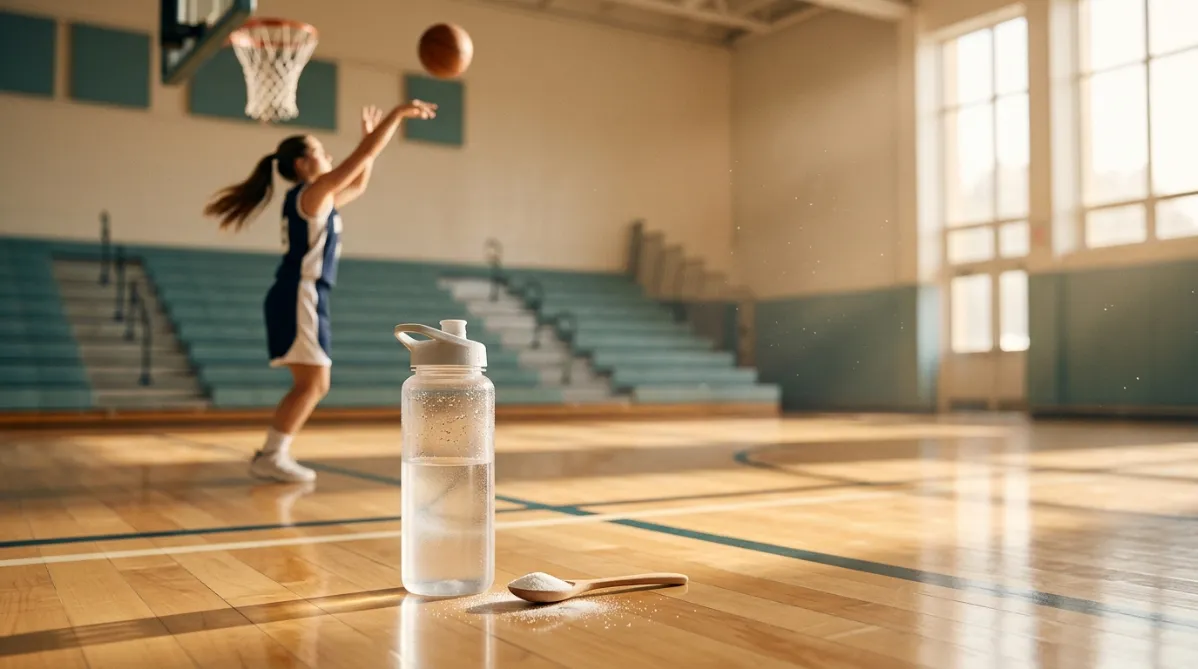
A wide, editorial-style photograph of a hardwood basketball court at golden hour, seen from a low angle near the baseline. In the foreground, slightly off-center to the left, sits a clear sports water bottle on a polished maple floor. It is half full, with tiny beads of condensation on the surface and a faint cloudy shimmer in the liquid. Beside it rests a small wooden spoon dusted with fine white powder, and a few loose grains are scattered on the wood. Warm amber light streams through tall gym windows on the right and casts long soft shadows across the court's painted lines.

In the mid-ground, slightly out of focus, a female basketball player in a navy and white uniform is caught mid-shot. Her arm is extended in a clean follow-through, her wrist relaxed, and the ball is just leaving her fingertips. Her ponytail swings behind her. Behind her, the net hangs crisp against a softly blurred bleacher background in muted teal and cream.

The palette is calm and modern: honey-toned wood, warm cream, deep navy, and soft teal accents. A shallow depth of field gives creamy bokeh in the background, with subtle dust motes floating in the light beams. The composition leaves generous negative space on the upper right for title text. The mood is fresh, athletic, and clean, like a contemporary health and performance journal. The photographic style is natural and film-like, with fine grain, soft contrast, and gentle highlights.
nutrition

The Glutamine Dipeptide That Kept Shooters Accurate When Water Didn't

BY DR. GYMBRO ·

Water is the default hydration advice, but a small study of Division I basketball players suggests it may not protect shooting accuracy as well as water with a little L-alanyl-L-glutamine. Ten women played four 40-minute games, and the low dose of 1 g per 500 ml beat water by 11.1% on shooting. The higher dose did not do better on shooting, and jump power didn't change at all. Here are the numbers, the practical takeaways, and the caveats you should weigh before stirring any of it into your bottle.
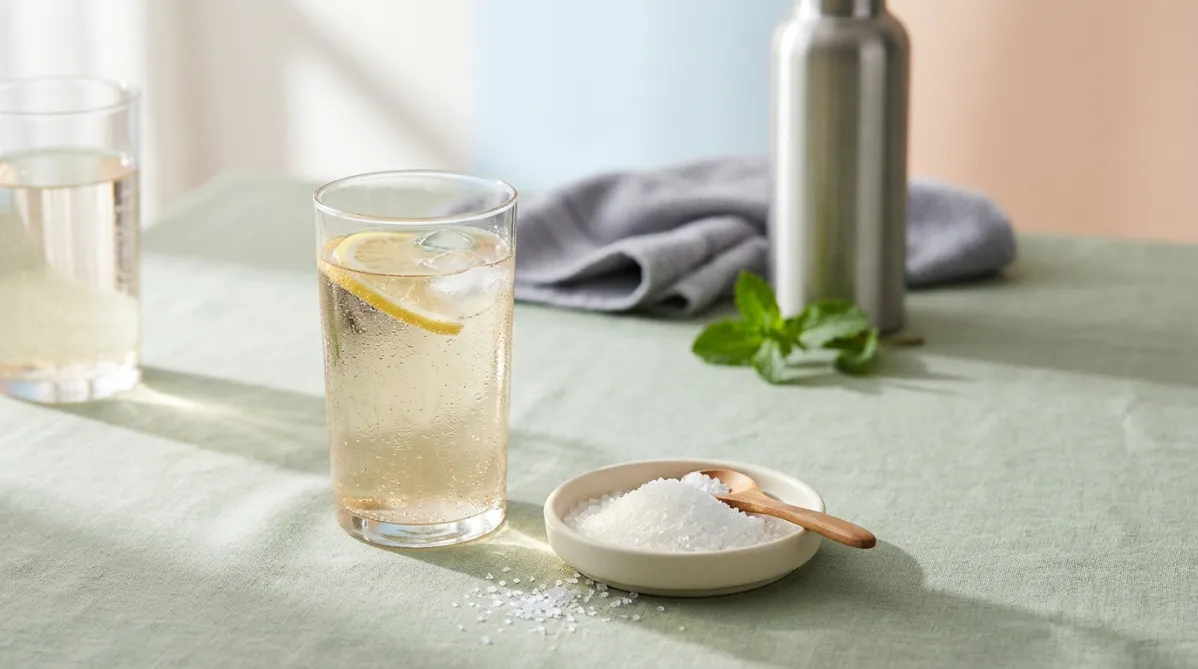
A wide, airy editorial still life photographed on a pale sage-green linen surface in soft morning window light. At the center sits a tall, clear glass of lightly sparkling water with a faint golden tint, beaded with condensation, a thin slice of lemon and a few ice cubes floating inside. Beside it, a small shallow ceramic dish in matte cream holds a mound of fine, translucent white crystals of rare sugar, with a tiny wooden spoon resting at its edge and a few crystals scattered across the linen, catching the light like frosted sea salt. To the left, a second glass of the same size stands slightly out of focus, suggesting a comparison without any branding or labels. In the soft background, a folded gray athletic towel, a minimalist stainless steel water bottle with no logo, and a sprig of fresh mint sit gently blurred. Long diagonal shadows from the window fall across the surface, adding depth and a calm, clean mood. The color palette is muted and modern: sage green, warm cream, soft blush peach, pale sky blue highlights in the glass and a touch of citrus yellow from the lemon. The composition follows the rule of thirds, leaving generous negative space on the right side for a headline overlay. Shallow depth of field, crisp focus on the glass and crystals, subtle film grain, high-end wellness magazine aesthetic, natural, fresh, and understated. No people, no text, no futuristic elements, no laboratory equipment.
nutrition

This Zero-Calorie Rare Sugar Beat a Diet Drink at Rehydration

BY DR. GYMBRO ·

A zero-calorie rare sugar called allulose just outperformed a sucralose-sweetened electrolyte drink in a randomized, double-blind crossover trial. In 15 healthy men, plasma volume recovery was 28.16% versus 4.13%, and fluid retention reached 91.54% versus 80.55%. Participants also reported a bigger drop in thirst, with no glycemic or temperature downside. But the study is small, funded by an allulose maker, and never tested a regular sugary sports drink. Here is what the numbers show, who might benefit, and who should wait for better evidence.

This page is available in