Dr. Gymbro
←

#hydration

2 articles
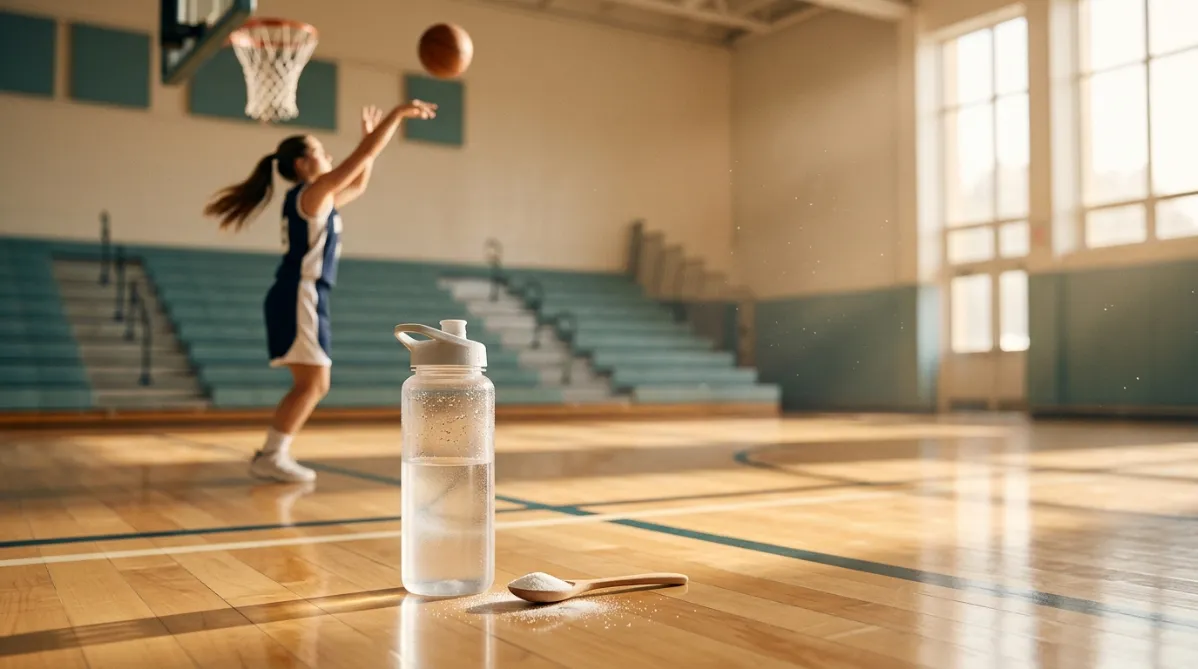
A wide, editorial-style photograph of a hardwood basketball court at golden hour, seen from a low angle near the baseline. In the foreground, slightly off-center to the left, sits a clear sports water bottle on a polished maple floor. It is half full, with tiny beads of condensation on the surface and a faint cloudy shimmer in the liquid. Beside it rests a small wooden spoon dusted with fine white powder, and a few loose grains are scattered on the wood. Warm amber light streams through tall gym windows on the right and casts long soft shadows across the court's painted lines.

In the mid-ground, slightly out of focus, a female basketball player in a navy and white uniform is caught mid-shot. Her arm is extended in a clean follow-through, her wrist relaxed, and the ball is just leaving her fingertips. Her ponytail swings behind her. Behind her, the net hangs crisp against a softly blurred bleacher background in muted teal and cream.

The palette is calm and modern: honey-toned wood, warm cream, deep navy, and soft teal accents. A shallow depth of field gives creamy bokeh in the background, with subtle dust motes floating in the light beams. The composition leaves generous negative space on the upper right for title text. The mood is fresh, athletic, and clean, like a contemporary health and performance journal. The photographic style is natural and film-like, with fine grain, soft contrast, and gentle highlights.
nutrition

El dipéptido de glutamina que mantuvo la precisión de los tiradores cuando el agua no lo logró

BY DR. GYMBRO ·

El agua es la recomendación de hidratación por defecto, pero un pequeño estudio con jugadoras de baloncesto de la División I sugiere que no protege la precisión en el tiro tan bien como el agua mezclada con una pequeña cantidad de L‑alanyl‑L‑glutamine. Diez mujeres disputaron cuatro partidos de 40 minutos, y la dosis baja (1 g por 500 ml) superó al agua en un 11,1 % en los tiros. La dosis alta no mejoró los tiros, y la potencia de salto no cambió en absoluto. A continuación, los datos, las conclusiones prácticas y las advertencias que deberías considerar antes de añadirlo a tu botella.
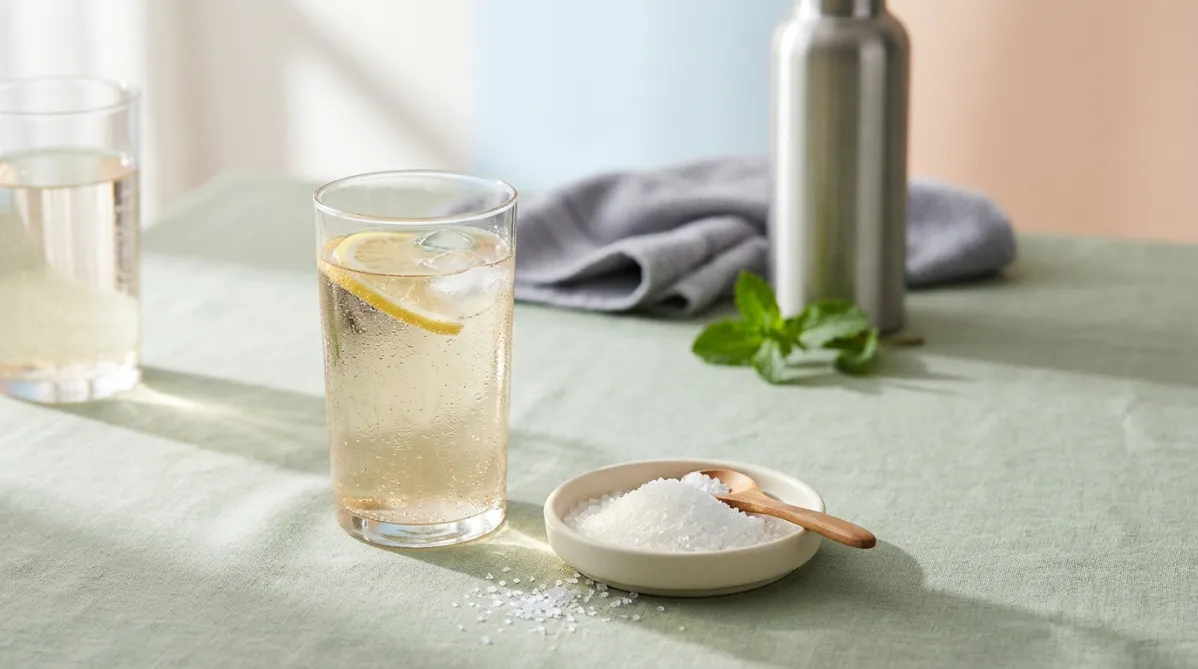
A wide, airy editorial still life photographed on a pale sage-green linen surface in soft morning window light. At the center sits a tall, clear glass of lightly sparkling water with a faint golden tint, beaded with condensation, a thin slice of lemon and a few ice cubes floating inside. Beside it, a small shallow ceramic dish in matte cream holds a mound of fine, translucent white crystals of rare sugar, with a tiny wooden spoon resting at its edge and a few crystals scattered across the linen, catching the light like frosted sea salt. To the left, a second glass of the same size stands slightly out of focus, suggesting a comparison without any branding or labels. In the soft background, a folded gray athletic towel, a minimalist stainless steel water bottle with no logo, and a sprig of fresh mint sit gently blurred. Long diagonal shadows from the window fall across the surface, adding depth and a calm, clean mood. The color palette is muted and modern: sage green, warm cream, soft blush peach, pale sky blue highlights in the glass and a touch of citrus yellow from the lemon. The composition follows the rule of thirds, leaving generous negative space on the right side for a headline overlay. Shallow depth of field, crisp focus on the glass and crystals, subtle film grain, high-end wellness magazine aesthetic, natural, fresh, and understated. No people, no text, no futuristic elements, no laboratory equipment.
nutrition

Este azúcar rara sin calorías supera a una bebida dietética en rehidratación

BY DR. GYMBRO ·

Un azúcar rara sin calorías llamado alulosa superó a una bebida electrolítica endulzada con sucralosa en un ensayo aleatorizado, doble ciego y cruzado. En 15 hombres sanos, la recuperación del volumen plasmático fue del 28,16 % frente al 4,13 %, y la retención de líquido alcanzó el 91,54 % contra el 80,55 %. Los participantes también reportaron una mayor disminución de la sed, sin efectos negativos en la glucemia ni en la temperatura corporal. Sin embargo, el estudio es pequeño, está financiado por el fabricante de alulosa y no comparó la bebida con un isotónico tradicional con azúcar. Aquí desglosamos los datos, quién podría beneficiarse y quién debería esperar a pruebas más robustas.

This page is available in