Your bench press might have a microbial component. A new study in Gut links one specific gut bacterium, Roseburia inulinivorans, to stronger handgrip, leg press and bench press in people. When researchers gave it to mice, grip strength went up. Before you start shopping for a supplement, there are caveats: the proof that it causes strength gains comes from mice only, and no product exists yet.
What the researchers actually found
The team ran metagenomic analyses, meaning they sequenced the gut microbes, in cohorts of younger and older adults who had been extensively tested for muscle strength. They then asked which bacterial species tracked with performance.
The answer was unusually specific. The relative abundance of R. inulinivorans was positively associated with multiple strength measures, including handgrip, leg press and bench press. Other Roseburia species did not show the same pattern. Even within one bacterial genus, only one member stood out.
The study also found that R. inulinivorans was lower in older adults than in young adults. That fits the idea that gut changes and age-related muscle loss might be connected, though the data can't say which drives which.
The mouse experiment: where causality enters
An association in humans can't tell you whether the bacterium builds strength or whether strong, active people simply host more of it. To probe causality, the researchers gave candidate species orally to antibiotic-treated mice, which have depleted native gut microbes.
Mice given R. inulinivorans showed significantly better forelimb grip strength. Mice given other Roseburia species did not. That species-level specificity makes the result more interesting, because it argues against a generic "any gut bacteria helps" explanation.
Important flag: the strength-boosting effect was demonstrated in mice, not people. The human part of the study is correlational.
How might a gut bug change muscle?
The authors ran metabolomic profiling and muscle phenotyping to look for mechanisms. In mice receiving R. inulinivorans:
- Amino acid concentrations were lower in the caecum and in plasma.
- The purine and pentose phosphate pathways were activated in muscle.
- Muscle fibre size increased.
- Muscle shifted from type I fibres toward type II fibres.
Type II fibres are the faster, more force-oriented fibres, so that shift is at least consistent with a grip-strength gain. The metabolic findings suggest the bacterium changes how the body handles fuel and building blocks, linking gut activity to muscle metabolism. Why amino acids fell, and where they went, is not something this summary can answer. Treat any tidy story about it as a hypothesis.
Is this a supplement yet? No.
The authors describe R. inulinivorans as a potential probiotic candidate for nutraceutical approaches to age-related muscle-wasting diseases. "Candidate" is the operative word. There is no established commercial probiotic, no tested human dose, no timing protocol and no human trial showing that taking it makes you stronger. Anyone selling a "strength probiotic" based on this paper is ahead of the evidence.
The speculative, low-risk takeaway: feed your gut
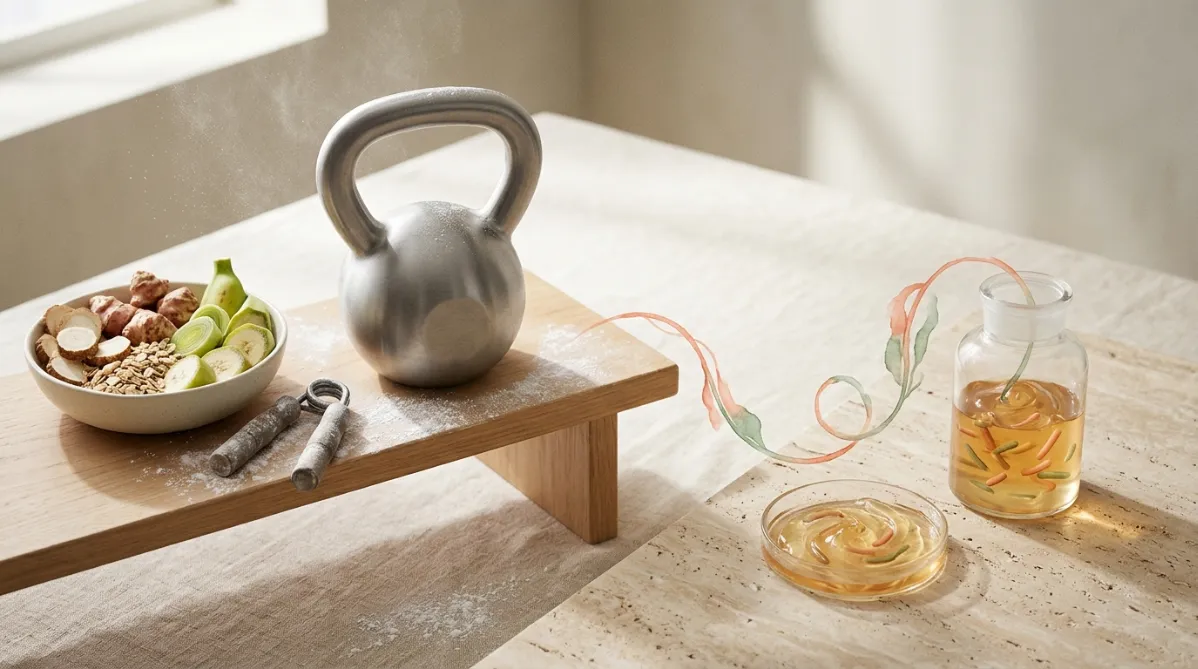
The species name hints at an appetite for inulin, a fermentable fibre. The abstract doesn't test whether eating inulin raises R. inulinivorans or improves strength, so this is speculation rather than a finding. Still, a fibre-rich diet is already recommended for general health, so trying it carries little downside for most people.
Foods that contain inulin or similar fermentable fibres include:
- Chicory root
- Jerusalem artichoke
- Garlic and onions
- Leeks
- Asparagus
- Underripe bananas
- Oats and other whole grains
If you go this route, increase fibre gradually to limit gas and bloating, and keep up your protein intake and resistance training. Those are the proven drivers of strength. The bacterium is a possible add-on at best, not a replacement.
Who this is relevant to
- Lifters and athletes curious about the microbiome: this is an early signal worth watching, not a protocol.
- Older adults and anyone concerned about age-related muscle loss: the lower abundance in older people makes this a promising research direction. The proven actions are still resistance exercise and adequate protein.
- Researchers and clinicians: the species-specific effect makes this a clear target for follow-up human trials.
Who should skip the hype
Anyone hoping to buy a quick fix. No validated R. inulinivorans product is on the market. People with digestive disorders, a weakened immune system or other medical conditions should talk to a clinician before making big diet changes or trying probiotics. And if a high-fibre diet upsets your stomach, you don't need to force it based on a mouse study.
The bottom line
This study offers a rare species-level link between a gut bacterium and muscle strength, backed by a causal test in mice and consistent with the lower levels seen in older adults. It does not show that eating fibre or taking a probiotic will raise your bench press. The next step is human intervention trials, and until they arrive, this is a promising lead rather than a training tool.